How I Make Money Writing a Blog: From Starting at Zero to Actually Getting Paid
Alright, so I’ve never been about gatekeeping, so buckle up while I tell you about my journey blogging and how I’ve finally made it to where I’m making some sort of revenue.
I started seriously writing my blog on August 4, 2024, which means I’ve now spent a little over two years throwing articles onto the internet and hoping Google eventually decides I’m interesting. Apparently, sometimes it does, which is very nice of it (Google overlords if you’re listening, please love me more!!!).
I make actual money from my blog now, which is still a slightly bizarre sentence to type because for a very long time I was making approximately $0 while spending an absolutely unreasonable number of hours writing about wine, plants, space, weird historical things, science, travel, food, and whatever else had managed to hijack my brain that particular week.
At the moment, it’s still small money and I’m not ready to retire from my day to day. A pretty normal day might make around $2 in advertising revenue. Sometimes it’s more, sometimes less, and there are individual articles that have surprised me by earning considerably more than the rest of the site.
I know $2 doesn’t exactly sound like anything to write about, but that’s also kind of missing the point.
The interesting part is that I can write something once, publish it, go make dinner, go to work, sleep, fly to another country, forget the article exists entirely, and six months later somebody can Google some strange question at 2:13 in the morning, land on my website, read what I wrote, and somehow I make a tiny amount of money from it.
I enjoy the writing part, and I’m making money doing it, so it’s a win-win for me. So, since people ask me how blogging actually makes money, here’s exactly what I’ve done from the beginning, including the parts where I had essentially no idea what I was doing (most of the time).

First I Wrote. A Lot.
My website is michelegargiulo.com, and I have never been particularly good at the advice that says you should choose one tiny niche and stay there forever. I’m a sommelier, so obviously I write a ton about wine. I’ve worked in restaurants for years, written books about wine, studied it professionally and accumulated enough wine certifications that I occasionally question what happened to me.
Wine makes sense to write about here…but, then there’s everything else.
I like gardening just ask my husband about it. He calls our house the jungle. I like weird science because it’s cool and it makes me feel like there’s still some magic left in the world. I like history and things nobody can completely explain. I like traveling somewhere and then reading 45 tabs about the city after I get home because apparently seeing something in person wasn’t enough for me.
This is how I ended up with articles about everything from grape varieties to immortal jellyfish to figs to people disappearing under bizarre circumstances. For a while, I worried that having so many subjects on one website was going to destroy it, but instead, I eventually realized the common theme was basically me and my strange little brain.
That sounds incredibly self-important, but I mean it in the least glamorous way possible. The site is just the collection of things I’m genuinely curious about, written in the way I would explain them to another person. Apparently there are other people who want to know the same strange things, which is majorly convenient for me.
I Somehow Ended Up With Around 900 Articles
This happened considerably less dramatically than the number makes it sound. I didn’t wake up one morning and write 900 articles. I wrote one then another one, then I did that for a very long time.
By 2026, my archive had grown to roughly 900 posts, and the horrifying realization eventually arrived that some of my oldest articles were…not great. I mean, they weren’t catastrophic (some of them). They were mine and I loved them in the way you love an ugly little craft you made in elementary school, but I had become a much better writer and had learned considerably more about websites, search engines, formatting and what people were actually looking for.
So I started rewriting them…one by one.
For about a year, I was going back through an old article basically every day, and by the end of August 2026 I had rewritten more than 700 of them. Seven hundred articles of mine. I would like some kind of medal from Squarespace at this point in time because no one else is giving me one.
Some older articles out there needed better information while others needed new titles. Some were missing internal links and had terrible formatting. Literally me out there cringing to images that made sense to 2024 Michele and absolutely nobody else.
The funny thing is in the blogging world that old content can become valuable again once you actually take care of it. I think people get obsessed with publishing new things because new things feel productive, while fixing a five-year-old page feels like cleaning out a junk drawer. Unfortunately, sometimes the junk drawer is ranking on Google.
Google Takes Its Sweet Time
This has probably been one of the strangest lessons of the entire process, and the most ANNOYING. You can completely restructure your website, rewrite hundreds of articles, publish constantly, fix your SEO, stare lovingly at Google Search Console and then…nothing.
Google is apparently immune to intimidation and will not be swayed by bribery (I don’t know who to bribe anyway) or sheer willpower. Then some random Tuesday an article you barely thought about starts climbing. I’ve had huge stretches where I felt like I was screaming into the void, followed by periods where traffic suddenly moved very quickly, only to fall back down again.
In April 2026, my blog had about 2,079 visits. May jumped to 14,403, then June hit 26,525. That was considerably more exciting than what’s been going on the last few months. At one point my search data had reached millions of impressions over a three-month period, which is still an insane concept to me because an “impression” means Google showed something I wrote to someone. Millions of times my words touched someone’s screen.
Of course an impression doesn’t mean someone actually clicked it, which Google politely reminds you by placing the considerably smaller click number directly beside it. Thanks for that Google.
Still, once those numbers started moving, the website finally began feeling less like a giant personal encyclopedia I happened to keep publicly accessible and more like an actual publishing business.
Mediavine Finally Said Yes
For a long time, advertising was one of those future blogging things I kept thinking about. First I needed traffic, then more traffic, then analytics. Apparently I also needed a small degree in understanding sessions, users, pageviews, RPMs and why three different dashboards can show three completely different numbers for what appears to be the same people (tons of bots out there in 2026).
Eventually I applied to Journey by Mediavine. This was only made possible because in early 2026 Mediavine lowered the threshold number needed to apply. It used to be 50,000 visits per month but they lowered it to 1,000. On July 6, 2026, I got accepted after waiting three months.
I was extremely excited, then I immediately had to figure out how to install it on Squarespace, because naturally the glamorous moment of finally monetizing years of writing was followed by me staring at Code Injection and an ads.txt redirect. Very on brand for how things tend to turn out in life.
Once Journey was running, ads started appearing on the site and I started earning money when people visited my articles. That’s the simplest part of how I currently make money blogging. People come from all over the world and read, advertisements load somewhere on the pages, and I get a portion of the advertising revenue.
There are approximately 9,000 variables that determine how much those visits are worth, including where readers live, advertiser demand, time of year, what pages they visit and how long they stick around. So 1,000 readers today might make a different amount than 1,000 readers next month. Nothing on the internet is allowed to be simple or clear cut or easy to explain to someone who found their way to my blog.
The Weirdest Article Can Be the One That Makes Money
I think this might be my favorite part of blogging. You think that you know what article is going to hit, but you really have no idea at all what will work.
I could spend hours writing an incredibly detailed article about wine, drawing on years of professional experience and credentials, and Google may respond with the technological equivalent of “aww, that’s cute”. Then some bizarre thing I did like make clay out of coffee grinds gets thousands of views.
My articles about things like the Man from Taured, clay, strange science, gardening and historical mysteries have all taught me that my personal prediction system is approximately useless and I’m typically dead wrong about what is actually going to work. That’s also why having hundreds of articles becomes so powerful because every article is another little doorway into the website. I get over 8,000 impressions per day on Google (at my peak it was over 80,000 per day, but Google is a fickle friend). Most of those impressions only have a few people wander through them every month, but there are weird spikes and rises where I have no idea why everyone has congregated there, but welcome.
Pinterest Is Way More Important Than I Originally Thought
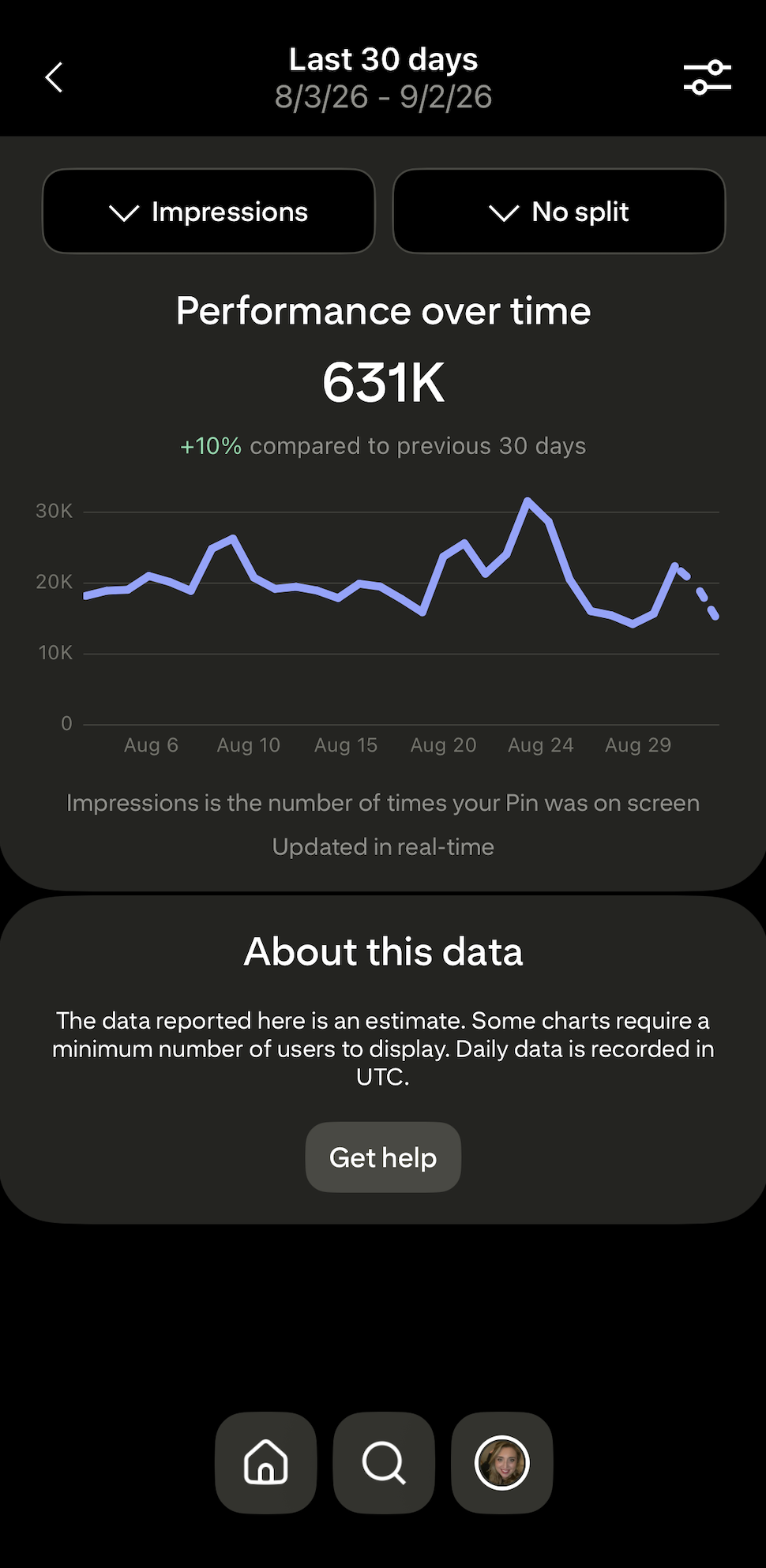
I’ll probably write a whole post about this at some point, but I just want to throw out there the importance of Pinterest. Google gets most of the attention when people talk about blogging, but I’ve spent years building Pinterest too.
When I say years, I mean I have made an absolutely absurd number of pins. More than 5,000 for some sort of idea if you’re truly curious. Pinterest works very differently from most social media because something you post today can continue circulating and sending traffic months later. If you tried that on Facebook you’d post and get a few views then that would be the end of that. Because Pinterest operates this way it makes it unusually useful for blogging.
A Pinterest pin about an old article can suddenly start sending people to something I wrote ages ago, and because Journey ads are running on that article, those Pinterest visitors can generate advertising revenue too.
This is when you start realizing that the article itself is only the center of a much larger little ecosystem. I write the article then maybe I make several Pinterest images for it and those images link back to the post. When people click them they read another article (hopefully), or maybe they join my newsletter or they find one of my books.
It’s also possible they come back six months from now because apparently they also wanted to know whether the Sun can interfere with a tractor. The traffic source almost becomes less important than getting people into the universe of the website somehow.
I Also Have a Newsletter
My newsletter is called Grape Bunch, and it has around 120 subscribers right now, which is absolutely tiny compared with some giant newsletter lists, but I actually really value those people because they made a deliberate decision to hear from me again.
That’s considerably different from somebody Googling a question, reading three paragraphs and vanishing back into the internet forever. Email gives me somewhere to send new articles and share the things I’m building, and there are a lot of things.
I write books and start wine projects like Cruising With Wine or Snail Mail Sommelier. I apply for grants for Blockchain Botany, or I work on websites with my husband like EnergyDrinkRatings.com or helping him apply for acting gigs. Whatever bizarre project I have started this month I like to share with people on my newsletter. I also hate getting tons of emails from people, so I try not to send it out too often (every other month is normally where I land). The blog basically sits in the middle of everything I’m doing though, and I like to document it all.
Affiliate Links Are Another Tiny Stream
You may have noticed the disclosure at the bottom of my site saying some links are affiliate links. Those can make money too.
If I write about something and link to a retailer or product through an affiliate program, I can sometimes earn a commission when somebody buys it. The reader pays the same price and the company basically gives me a tiny referral fee for sending them the customer.
Again, we are not discussing private-island money here. At my peak I made $200/month off this, but lately it’s been more like $10. This is where blogging starts becoming interesting because revenue can stack eventually with all the random things you’re doing.
An article might earn ad revenue or contain an affiliate link. It could also send someone onto my newsletter or introduce them to one of my books. If someone reads something they like it also might make somebody Google my name later (which Google loves).
The same article can keep doing several tiny jobs at once, which is very ambitious for a webpage.
My Blog Also Makes Money in Ways That Are Harder to Measure
This is the part that analytics dashboards aren’t particularly good at showing. My website is also my portfolio! I’m a writer and a sommelier, and when somebody wants to know who I am or what I write about, there are now hundreds and hundreds of examples sitting there, which matters more than you’d think.
My books are connected to it as well as my professional work and wine experience. I’ve had someone reach out to me and ask me to write a chapter in their book about Madeira before, which was super cool! I wrote the chapter in a book where the writer of the movie Sideways also wrote a chapter.
Other projects I create can start with an audience that already knows me instead of beginning from absolute zero which is also super helpful. Social media is so fickle and goes up and down at the algorithm’s whim. My blog is steady and stays in a range I can sort of predict.
I think this is one of the biggest reasons I’ve continued writing even during the stretches where the financial payoff has been painfully slow. Every article adds another tiny piece of credibility, another search result, and ultimately another way somebody can find me. The money directly deposited from advertising is only one way the website has value, which is why I’d encourage everyone out there who’s thinking about starting a blog to just do it! You never know what you’ll get from it.
Bot Traffic Will Briefly Make You Feel Very Successful
I learned this one recently. Sometimes your traffic suddenly explodes and for approximately seven minutes you think: THIS IS IT. I’VE MADE IT TO THE BIG LEAGUES!!!
…then you look deeper and discover that a suspicious amount of this newfound fame appears to be coming from one location in Oregon and behaving absolutely nothing like normal readers. Hello, little robots that give me approximately zerrrrroooo benefits of being here.
I had a stretch of strange Direct traffic in August that made the analytics look considerably more exciting than reality, which is why I’ve learned to check several things whenever traffic jumps.
Google Search Console is my best friend, Squarespace does a decent enough job at telling me where the traffic is coming from and at what IP address and time, while Journey also uses Google Analytics to breakdown how they’re paying me. Pinterest had a decent little creator page as well that helps.
Where people are coming from is more important than you’d think. If all of those are moving together, something interesting might genuinely be happening, but if one dashboard suddenly says 20,000 people showed up from nowhere while every other metric looks exactly the same, perhaps postpone the champagne.
The Money Is Still Small. The Machine Is the Interesting Part.
Right now, there are days when my blog makes around $1, and there have been better days where it make $5 per day! There are individual posts that have earned considerably more and it’s been fun to watch and see what happens.
I’m obviously hoping those numbers grow to something that could go to a real bill one day, but the dollar itself is almost less interesting to me than the system that produces it.
Two years ago, I could write something and that was essentially the end of the transaction. I wrote it because I wanted to write it. Now I can write something, publish it, have Google index it, create several Pinterest pins, send it to subscribers, have strangers find it months later, display advertising alongside it, occasionally include affiliate links and connect that article to hundreds of other things I’ve written.
That’s an actual machine that no one on the outside has thought much about, but exists nonetheless. And yes, it’s a very strange, slightly temperamental machine operated partly by Google robots, but still a machine.
I wish I had something cooler to tell you. There was no single SEO trick that suddenly did everything and no one article changed my entire life. I didn’t start a blog in January and retire in June (all those articles out there that claim they did are LYING to you). I’ve written for years, made thousands of Pinterest graphics, rewritten more than 700 old posts, and reorganized the website more times than I’d care to admit to you.
I’ve gone out of my way to change titles, fixe links, watch Google rankings move up and down, and checked analytics far too often and published things that five people read.
Occasionally I publish something that thousands of people read. You never really know which one it will be, which is probably the part I love the most. I can write about solar storms one day, Japanese wine the next, and some bizarre historical mystery after that, and every one of those articles becomes another little piece of the giant library I’m building.
Around 900 articles sounds ridiculous when I say it out loud and at this point I’m curious what happens at 1,000…then 1,500. Apparently I’m going to find out. I’ll keep you posted.
Related Reads You Might Enjoy
The Internet Is Being Sanitized and Controlled: What You’re Not Seeing
How Visionary Entrepreneurs Quietly Shaped My Wildest Dreams
Why We Romanticize Burnout: The Toxic Myth of Glorious Exhaustion
Hot Dogs to Millions: The Wild Entrepreneurial Journey of Sam Parr
How to Self-Publish Your Book with Kindle Direct Publishing and IngramSpark