What is Web3 and Why Should I Care to Learn About It?
If you follow me on any social media at all then you’ve already seen I post about Web3 a lot. I mean, I created Blockchain Botany to help people learn Web3, so I clearly care about it (and post about it) probably too much. Well, the other day after I had been prattling on about it for a little while someone asked me what Web3 even was and why they should bother learning it as AI is growing and taking over everything (to my fellow bloggers out there, I see you, and I’m sorry).
The thing is though, it was such a fair question that I decided to go back and explain it all from the beginning.
I know how Web3 sounds from the outside. It sounds like one more exhausting internet thing we are all apparently supposed to understand now, right when most of us are still trying to emotionally process the fact that AI can write an article, create an image, answer a search question, summarize a book, help code a game, generate a recipe, imitate a writing style, and casually make every creative person wonder if the ground under their feet is turning into quicksand. Well…that’s what AI is supposed to be doing anyway, from where I’m sitting it’s sort of doing a bad job at all of those things and then getting in the way of the people who actually are doing those things, but that’s neither here nor there. Then, just as we are trying to adapt to all of that, someone comes along and says, “actually, you should also learn about blockchain, wallets, NFTs, smart contracts, decentralized finance, tokenization, and digital ownership.”
I get why people want to throw the whole laptop into a pond.
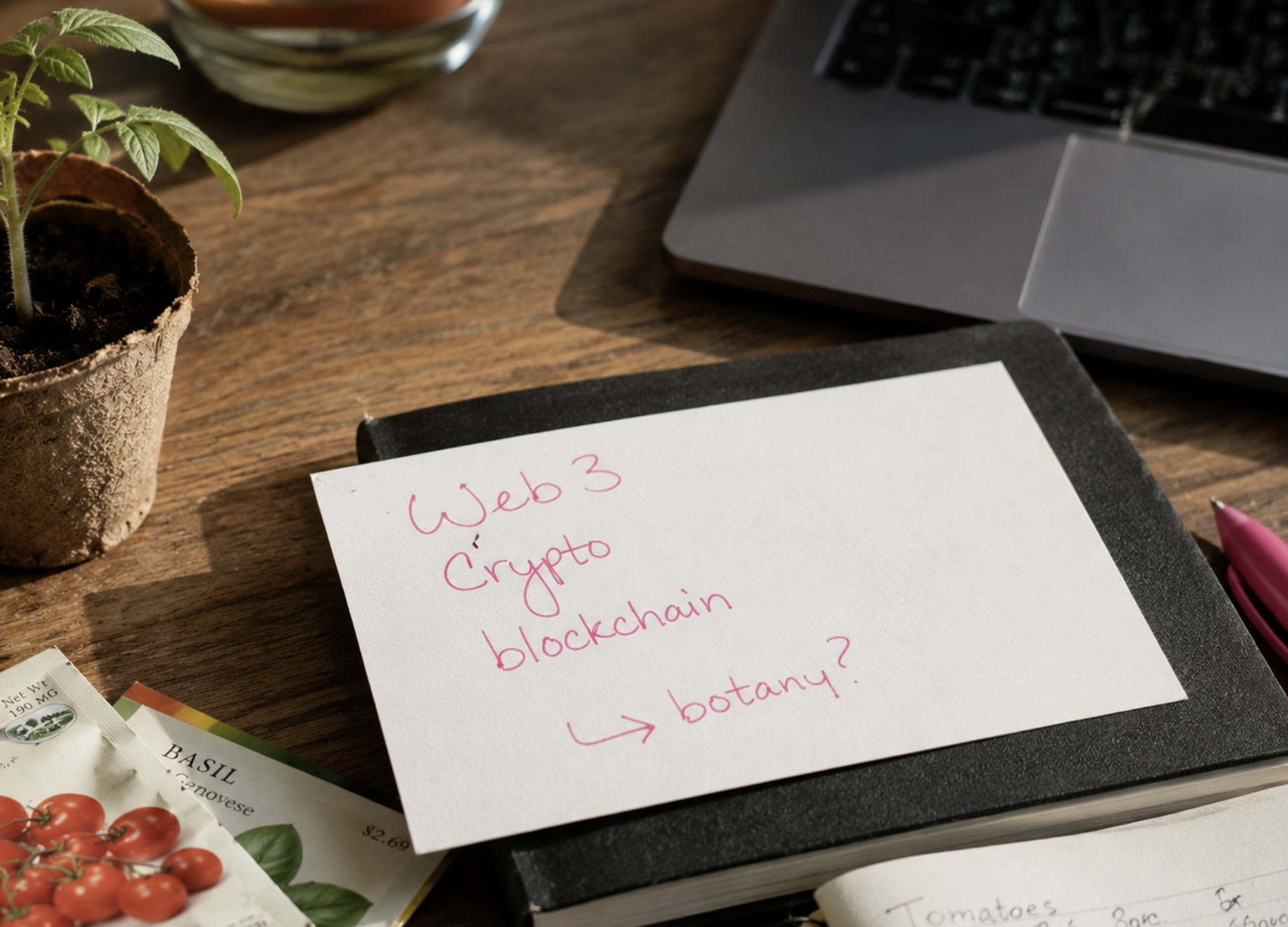
Why Web3 is So Hard to Learn
The language around Web3 doesn’t help either. It’s one of those spaces where every beginner-friendly explanation somehow still manages to contain twenty words that need their own beginner-friendly explanation. A little circle within a circle within a circle…like one of those Russian Doll Sets. You start by looking up what a blockchain is and ten minutes later you’re reading about gas fees, private keys, proof-of-stake, decentralized autonomous organizations, and some coin with a name that sounds like it was invented by a rabid raccoon with a gambling problem. Half of the time it’s beyond strange, and vaguely suspicious, like a world built by people who forgot that normal people who work 9-5s might one day want to understand what they were talking about.
Also honestly, Web3 didn’t introduce itself to the public in the most graceful way. For a lot of people, their first impression of it was crypto hype bros, scams, celebrity NFT projects, weirdly aggressive online communities, cartoon animals selling for absurd amounts of money, and someone on YouTube promising that a coin named after a dog was going to change the entire global economy. So if your first instinct is skepticism…I think that’s healthy and completely fair. I don’t think anyone should approach this world with blind trust, because blind trust is exactly how people get talked into things they don’t understand by people who benefit from their confusion. Hence, the scammers of crypto were born.
I also think dismissing Web3 entirely because the nonsense that went around would be a mistake though.
Underneath all the garbage, there’s a much more serious and much more interesting idea, and that idea becomes especially important in a world where AI is changing what it means to create, publish, own, prove, and be found online. Web3, at its core, is really about ownership. It’s about whether the internet has to keep functioning like a world where regular people create the value while giant platforms own the land, the road, the map, the marketplace, the rules, and sometimes even the relationship between creator and audience. To me, it’s more about whether digital life can be built in a way that gives more power back to the people actually making, building, learning, teaching, collecting, playing, writing, and participating than the super giants who own it all.
That is the part that made me care.
I’m not interested in Web3 because I want to become some unbearable crypto person at parties. When I was single if I had a dollar every time someone tried to man-splain to me what bitcoin was, I’d never have to worry about paying my mortgage ever again. I’m interested in it because I’m a writer, a sommelier, a gardener, a blogger, a person building strange little projects on the internet, and someone who has spent years creating things on platforms that I do not own. I’ve posted into algorithms I cannot see and in the process, built audiences I can’t fully take with me. I’ve watched search change and even had a front row seat to it as my Google impressions were slashed in half, social media change their algorithms until I didn’t even know what it wanted anymore, attention spans get shorter and shorter, AI change everything again, and through all of it the same question keeps getting louder in my head: who actually owns the value of what we make?
That question is why Web3 matters.
What Actually is Web3
To understand what it is, it helps to think about the internet in phases.
The earliest version of the web, what people now call Web1, was mostly read-only. You could visit websites, read information, click through pages, and maybe print something out if you were feeling particularly committed, but most people were not really participating in the way we do now. The best analogy I can think of is like walking through a giant digital library where the shelves were uneven, the lighting was strange, and half the books had been written by someone’s uncle at two in the morning, but there was a kind of wild charm to it. The internet felt smaller then, rougher around the edges, less polished, and in some ways more human because you could still feel the hands that had built the pages.
Then Web2 arrived, which is the internet most of us live inside now. Web2 gave us the read-and-write internet. It gave us social media, blogs, comments, YouTube, online shops, apps, newsletters, platforms, and all the little places where regular people could suddenly publish, share, connect, and build. It gave creators a way to reach people without waiting for a magazine editor, a record label, a publisher, a television producer, or some other gatekeeper to decide they were worth hearing from. That was enormous. I don’t want to pretend Web2 gave us nothing, because it changed the entire creative landscape for the better.
My own life is proof of that too. My writing exists online because of Web2. My wine thoughts, my garden experiments, my books, my weird science rabbit holes, my Pinterest images, my long blog posts about forgotten inventions, my unique theories about quantum physics, and strange corners of the universe, all of that has been able to find people because the internet made publishing accessible. There’s still something magical about being able to sit on your couch with a laptop and send an idea into the world, knowing someone in another state or another country might stumble upon it later because they were searching for the exact strange thing you happened to write about. I can’t tell you how many times that’s happened to me.
However…over time, Web2 started to reveal the cost of building everything on someone else’s land.
Web2 lets you plant a garden, but the platform owns the soil. You bring the seeds, you water every day, you prune, tend, harvest, photograph, explain, sell, and share. You build the little paths and invite people in, and in doing so, you make the place beautiful. Then one day the landlord (or the bank) changes the gate code, moves the road, alters the weather, raises the rent, or decides the garden doesn’t deserve sunlight this month.
That’s literally what it can feel like to create online right now.
A platform changes its algorithm and your reach disappears literally overnight. There have been days now where a search engine changes how results are displayed and your traffic shifts so dramatically you’re left scrambling trying to save your traffic. Sometimes social media companies decides what kind of content it wants to reward and suddenly the work that used to connect with people is buried, never to see the sunlight again. A creator spends years building an audience, but the relationship is mediated by a company that owns the feed, the data, the rules, and the connection. Even when we technically own our content, we often don’t own the infrastructure that lets people find it, value it, or stay connected to it.
This is where Web3 enters the conversation.
Web3 is often described as the read-write-own internet. Web1 let us read, Web2 let us read and write, and Web3 asks whether we can read, write, and own. That doesn’t mean every version of Web3 is good, or useful, or ethical, or even ready for normal people to be on. Let me be clear when I say that not every blockchain project deserves attention. Every token doesn’t have value because it just exists or every NFT was a good idea. It just means that the underlying goal is different from the internet we have now.
The goal is digital ownership, plain and simple.
That can mean a lot of things to a lot of different people and creators. It can mean owning a digital item, or access to a community, owning proof that you created something, owning a portable identity, or owning a direct relationship with the people who support your work. It can also mean building communities where decisions are made by the participants instead of an overarching central company, or creating systems where transactions and records can be verified without depending entirely on a middleman to come in.
What is Blockchain?
The technology that makes much of this possible is blockchain.
I know blockchain sounds like a word that should be filed somewhere between taxes and electrical wiring, but the basic idea is more understandable than people make it seem (everyone likes to gatekeep these days). A blockchain is a shared digital record. Instead of one company keeping the master copy of information on a private server, the record is spread across a network. When something happens, the network verifies it and adds it to the record. Once it’s recorded, it becomes very difficult to quietly change without everyone noticing.
That means that no single person can sneak in at midnight, tear out a page, rewrite the history of whatever they want to change, and pretend they did everything themselves the whole time. The trust comes from the shared record instead of from one central authority asking you to simply believe them because “they said so”.
That shared record is why blockchain can matter in areas where trust, ownership, provenance, and authenticity are important.
Think about wine for a second, because obviously I am going to. Wine already depends on provenance, especially once you get into rare bottles, collectibles, auctions, and cellars where the history of a bottle matters almost as much as the wine inside it. Where was it made, who owned it, how was it stored? Is it authentic or has it been tampered with? If you’ve been the movie Sour Grapes then you know sometimes people can swindle others out of billions of dollars with counterfeit wines. A transparent digital record could, at least in theory, help trace a bottle’s journey from vineyard to cellar to collector in a way that is much harder to fake.
The same idea can apply to pretty much everything from our food systems, art, music, tickets, education, gaming, memberships, and charitable donations. In todays day and age where it feels like someone is always stealing our tax dollars (hello, I’m talking about all the fraud happening in the United States led by politicians and others who know the systems) and then they just “lose the paper trail” whenever anyone tries to investigate it, this seems more important than ever. Blockchain is a tool for keeping track of value in a digital world that’s becoming harder and harder to trust at face value.
What About AI?
Well, I’m glad you asked, because this is where AI makes the conversation even more urgent than it already is.
AI is already changing the way content moves through the world. It can do tons of stuff like generate images, summarize articles, rewrite ideas, mimic styles, answer questions, draft emails, code websites, and produce more material in a few minutes than a real person could make in days. Some of that is totally useful (don’t come at me environmentalists!), and some of it is fascinating. A big part of that is deeply unsettling to me, but either way, we’re moving into an age where generating something quickly is not the rare part, but proving where something came from, who made it, whether it can be trusted actually is.
That’s why Web3 becomes more important because of AI.
AI makes copying, remixing, summarizing, and generating easier. Web3 asks how ownership, proof, authenticity, identity, and value might work in a world where digital things can be infinitely reproduced. Those are different questions, but they’re starting to collide from where I’m sitting. If the internet is filling with AI-generated content, then proof of origin matters more than ever. If creators’ work is being scraped, summarized, or repackaged, then ownership matters. If a reader can get an AI answer without clicking through to the original article, then the relationship between creators, platforms, and audiences matters even more than it did before.
When someone asked me why they should care about Web3 when AI is growing so quickly, my honest answer was that AI is exactly one of the reasons to care.
Web3 doesn’t magically solve the problems AI is creating (it’s creating more than I could even go on to list at this point). I do not trust any technology that arrives wearing a cape and promising to fix every problem caused by the last technology, and neither should you. The truth messier than that, and AI and Web3 will probably get tangled together in strange, useful, annoying, exploitative, beautiful, and unpredictable ways, the same way tomato vines get tangled around anything they can grab onto and make you question whether you’re gardening or negotiating with a green octopus.
Web3 gives us a way to talk about digital ownership, verified identity, creative provenance, direct payment, community participation, and records that don’t live entirely inside one corporate black box. Those things matter now, and mark my words, they’re going to matter even more as AI reshapes more about search, writing, art, education, and online work.
For bloggers, this feels especially personal. We spent years learning how to write for people and search engines at the same time. We learned keywords, internal links, Pinterest graphics, email lists, affiliate strategy, metadata, formatting, image optimization, and all the tiny tricks of trying to make useful work discoverable. Then AI came along and started changing the search experience itself. Suddenly a question that might have brought someone to a blog can be answered directly by a machine that has absorbed information from across the internet…including your blog post. That answer may be helpful, or sometimes it may be dead ass wrong. That response could also be built on the work of people who will never receive the visit, the credit, the email subscriber, the ad impression, the affiliate click, or the relationship that they deserved for their effort.
So yes, I see my fellow bloggers right now. I see the anxiety, and I feel it too.
Web3 is For Creators
That’s why I don’t think creators can afford to ignore the ownership conversation. We don’t need to become experts overnight, and we definitely don’t have to fling ourselves into every new technology just because someone online says it’s the future. We do need to understand the basic ideas shaping the next version of the internet however, because if creators don’t understand them, then the future will be built by the same kinds of people and companies who already figured out how to profit from everyone else’s creativity.
That’s the pattern I don’t want the bloody world to keep repeating.
Web3, in its better form, asks whether creators can have more direct relationships with their audiences. Artists should be able to earn royalties when their work is resold. Musicians should be able to build communities without giving most of the value to streaming platforms. I believe that writers should be able to create digital editions, memberships, or archives that readers can actually own a piece of. I want to live in a world where educators can issue proof of learning that belongs to the learner instead of being trapped inside one platform.
This conversation isn’t relevant to everything in life. I don’t think every idea is good that we have, and not everything needs to be recorded so diligently. In places where ownership and trust genuinely matter though, Web3 deserves attention.
Learning Web3 doesn’t mean trusting everything in Web3 either, it just helps people being able to tell the difference between the parts that are useful and the parts that are nonsense. All I want is for people to understand enough to ask better questions. I absolutely despise that so many people out there are told what to do or believe and they just go along with it. I want everyone to learn to think for themselves.
Technology has a way of becoming part of our lives whether or not we felt ready for it. Most of us did not sit down and vote on whether social media should restructure attention, journalism, marketing, friendship, politics, small business, and childhood all across the planet. It just happened, platform by platform, app by app, until suddenly we were all living inside the consequences. AI is moving even faster.
How Can You Learn About Web3
This is exactly why I created Blockchain Botany.
I wanted to build something that made Web3 feel less confusing and more alive. I feel like regular finance seminars are boring, and better graphics and gameplay could make it more fun. I took these intimidating concepts and planted them in a world that felt warmer, softer, and waaay easier to approach. A greenhouse on Mars because I’ve always been obsessed with the stars and space travel. One of my best childhood memories involve looking at stars with my dad late at night. The sense that even strange new systems can become understandable when you start with one seed also spoke to my green thumb that I just love plants.
In Blockchain Botany, you grow plants. You take your time and plant seeds, wait for them to grow, harvest them, stake them, and learn through the process. The game uses gardening as a way to explain Web3 concepts without making people feel like they need to understand every technical detail before they’re allowed to participate. A seed can teach scarcity while a harvest can teach rewards. Greenhouses teach ecosystems and staking a plant can make staking feel less abstract.
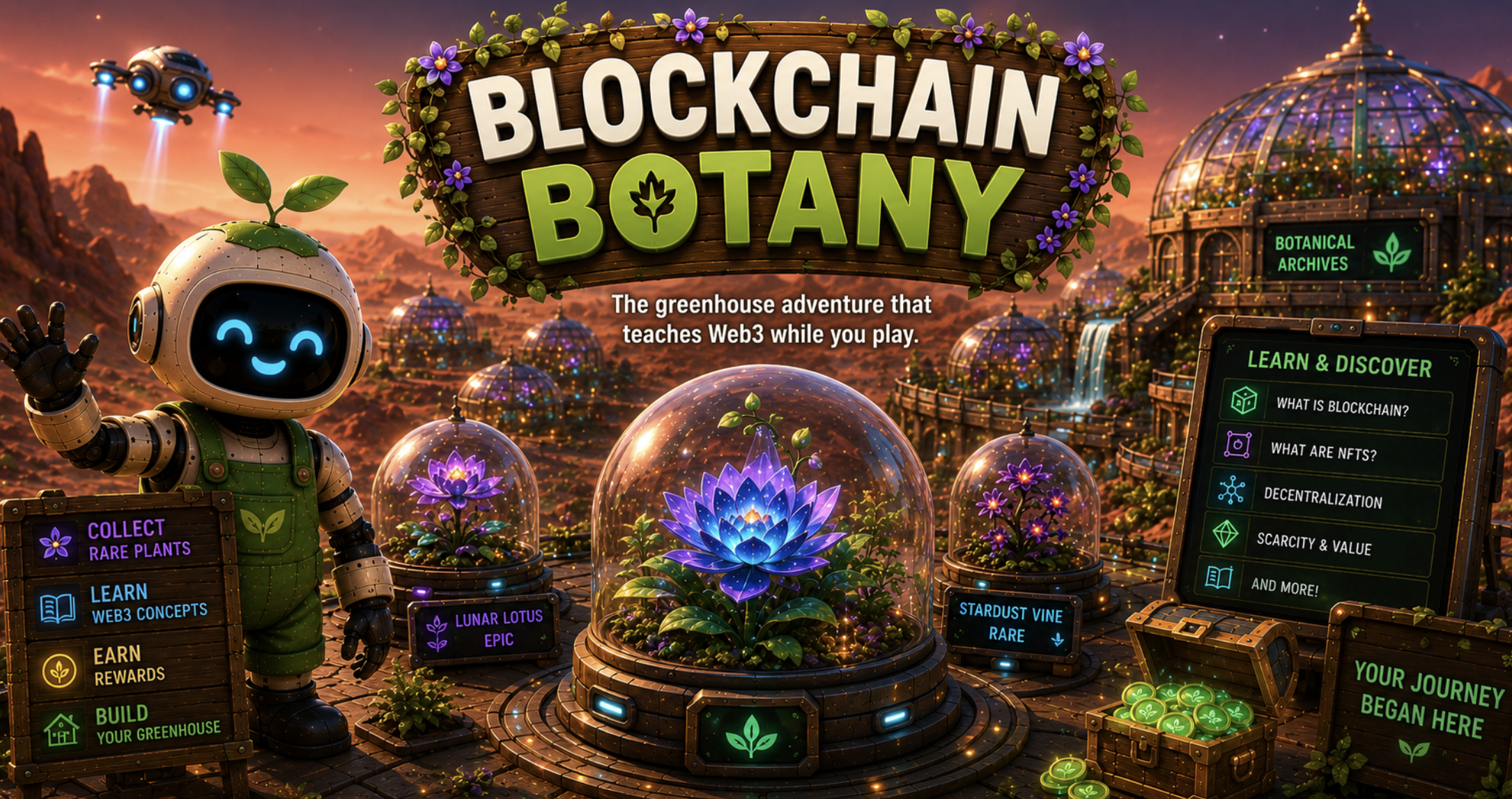
I think more technology education should work this way.
A lot of people out there have been told they’re stupid or not smart enough for not being able to sit in a room and memorize things. I’m tired of the old way of teaching. People need entry points and metaphors to learn better and actually understand things at a deeper level. They need someone to say that this isn’t as scary as it sounds and you can start with something you already understand. That is how we learn almost everything meaningful in life. Nobody starts wine by understanding all the subregions in Burgundy. I haven’t met a person who starts gardening by knowing exactly how to prune tomatoes, prevent fungus, balance soil, save seeds, and recognize nutrient deficiencies. You begin somewhere, usually awkwardly, and the map appears as you go.
Web3 needs that kind of doorway.
Right now, too many people assume the room is not for them. Women, artists, writers, teachers, gardeners, parents, small business owners, and curious beginners hear the language and decide it belongs to someone else. Not if I have anything to say about it though. That bothers me so much because technology shapes everyone’s world, not only the lives of the people who got there early enough to make the vocabulary unbearable.
I don’t want regular people to be locked out of understanding the next version of the internet just because the first public wave of it was messy, speculative, and badly explained.
I’m also not saying that if you’re brand new to Web3 your first step should be investing money, buying tokens, minting NFTs, or connecting your wallet to random websites because someone with a futuristic profile picture told you to. Please don’t do that. The first step to anything in life is literacy. Learn what a blockchain is, a wallet is, learn what a token is. Learn what an NFT actually means beyond the headlines, and figure out decentralization promises and where it falls short.
The words are annoying at first, but some of the ideas underneath them are worth knowing.
Web3 has scams in it, just like everything else in life. It has bad actors, confusing tools, and hype cycles that make normal people feel like they’re watching a slot machine dressed up as a revolution. It’s got projects that talk about community while treating people like exit liquidity, and plenty of security risks, tax questions, regulatory uncertainty, and user experiences that sometimes feel like they were designed as a punishment for curiosity. Some blockchains have fees that make small transactions impractical, some wallets are intimidating, losing a seed phrase can be disastrous, and clicking the wrong link can be expensive.
So no, I’m not here to tell you Web3 is perfect, because it absolutely isn’t, but I am here to tell you it is worth understanding. That’s a very different thing.
Why Should I Care To Learn Web3?
People should care because the internet is changing, and the questions Web3 asks are going to become harder to avoid in an AI-shaped world. Who owns what we make and who controls access to our communities? How do we prove authenticity in this confusing world? Do creators get paid the full of their worth, or should companies take a cut of it? How do small businesses build direct relationships without renting attention forever?
Those questions are too important to leave only to the most annoying people in the room (sorry crypto-bros).
So yes, I think Web3 is worth learning. Carefully, skeptically, and curiously, but don’t rush into it. Sort of like the stock market. Cool idea, but ultimately, don’t do anything too rash.
If AI is changing what can be created, Web3 is part of the conversation about what can be owned, proven, shared, and valued. That’s why I keep talking about it and why I built a game around it. It’s why, even though I know I sound like I have become the neighborhood lady trying to explain blockchain through tomatoes, I’m going to keep learning out loud and invite others to do it with me.
The future doesn’t have to be super confusing, it might just show up as a strange little seed in your hand.
Other Reads You Might Enjoy:
Blisters of Passion: What “Follow Your Blisters” Really Means
The Secret Life of Pollinators: What Bees and Butterflies are Saying to my Garden
The Secret Life of Soil: Why Healthy Dirt Might Be Smarter Than You Think
Why Your Houseplants Might Be Gossiping (and Other Strange Plant Behaviors)
Wild Ramps: How to Forage, Grow, and Cook Spring’s Most Fleeting Ingredient