The Weird Things Solar Storms Can Mess With That You’d Never Think About
I’m sure you already knew that the Sun could throw tantrums big enough to paint auroras across the sky. I’ve written about the Carrington Event, telegraph machines catching fire, solar flares, our magnetic field, and the fact that our lovely little star occasionally hurls enormous clouds of plasma in our general direction.
Apparently I still gave the Sun way too little credit.
I guess activity happening around 93 million miles away can help decide where a tractor drives through a cornfield, whether an airplane takes a different route over the Arctic, how accurately a bank timestamps a transaction, how quickly a steel pipeline corrodes, and whether a satellite quietly stays in orbit or gets dragged back toward Earth. Who knew?
I mean, it feels like an absurd amount of influence for something I mostly interact with by complaining that it’s too hot outside whenever there aren’t any clouds.
For the fun of it, here are some of the things that happen far away from the glowing ribbons of an aurora, in places where you’d probably never think to blame the Sun. Somehow, solar storms get into everything.
Solar Flares Are Only Part of the Story
We tend to call everything dramatic coming from the Sun a solar flare, which is understandable because “solar flare” sounds considerably more exciting than a discussion about charged particles and magnetized plasma for some of us out there. Not me, but I’m not the norm I’ve been told lovingly by my mother.
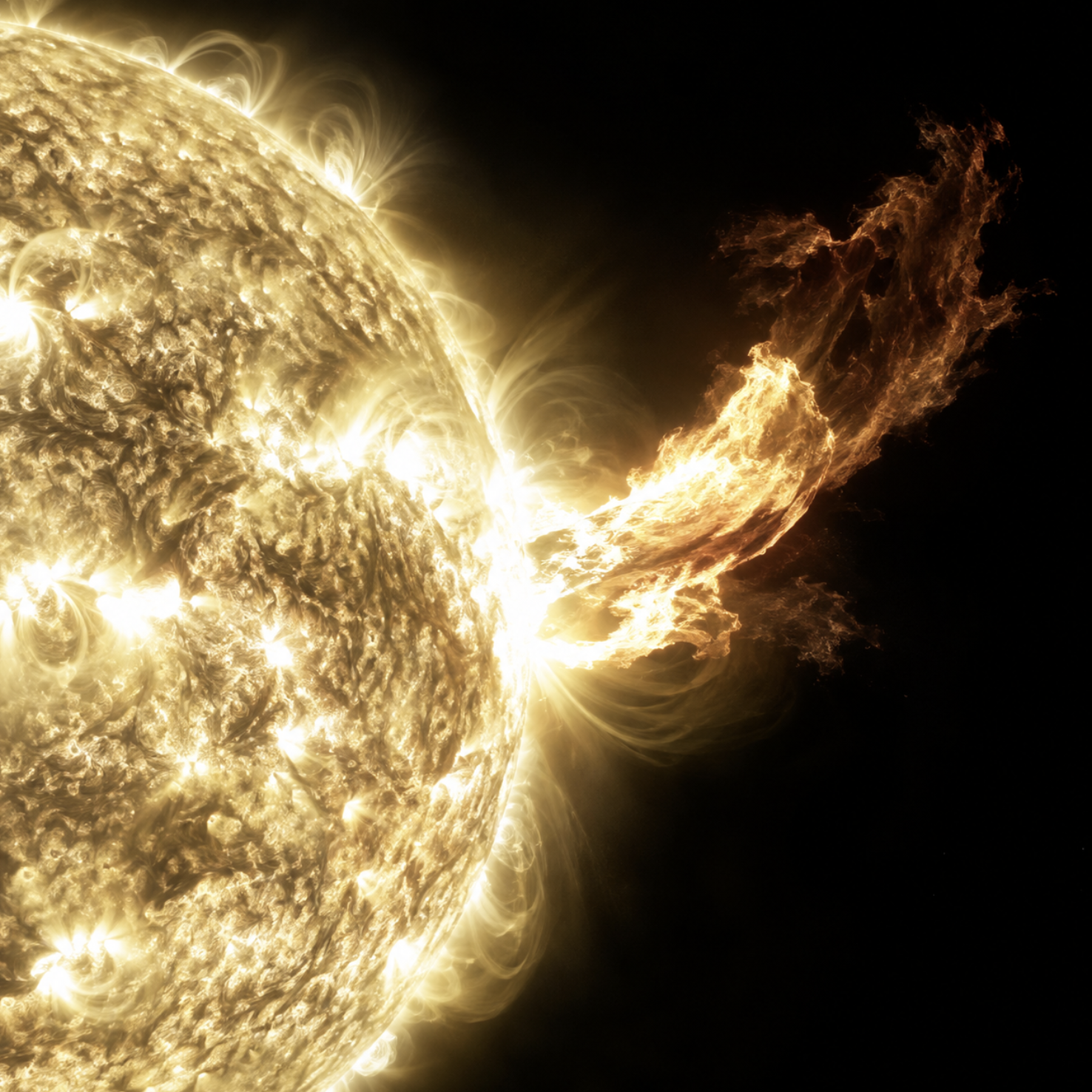
The Sun actually has several different ways of reaching us. A solar flare is a powerful burst of electromagnetic radiation. Its energy travels at the speed of light, which means the effects can reach Earth roughly eight minutes after the eruption happens.
Solar eruptions can also launch solar energetic particles, incredibly fast charged particles that may arrive within tens of minutes or several hours.
Then there are coronal mass ejections, or CMEs, enormous clouds of magnetized plasma launched into space. When one is aimed our way, it generally takes somewhere around 30 to 72 hours to reach Earth. When that plasma interacts with our magnetic field, we can get a pretty geomagnetic storm.
So when I say “solar storm” throughout this post, I’m really talking about this whole strange family of solar activity working together, because each one has its own particular way of messing with our stuff.
A Farmer’s Tractor Can Suddenly Forget Exactly Where It Is
This one immediately got me because I always think about GPS as the little blue dot on my phone telling me where I made the wrong turn and not recalculating fast enough for my liking. Turns out though, modern GPS is doing considerably more serious work than getting me to Target and back.
Precision agriculture uses high-accuracy GPS to guide tractors and farm equipment along extremely precise paths on farms. Some systems work at centimeter-level accuracy, helping farmers plant straight rows, apply fertilizer and pesticides exactly where they’re needed, harvest efficiently, and return to the same place in a field over and over again. Pretty insane when you think about that for a moment, just how amazing our farming equipment has gotten.
Sometimes though, the Sun gets involved.
GPS signals travel from satellites through the ionosphere before reaching receivers here on Earth. Space weather can disturb that electrically charged layer of atmosphere and change the path of those signals. During severe disturbances, GPS errors can grow dramatically, and receivers can even lose their satellite lock altogether. NOAA specifically lists farming among the industries vulnerable to these effects.
So picture a farmer sitting inside a tractor somewhere in Iowa, Nebraska, France, Australia, wherever, while hundreds of millions of miles of empty space sit between him and the surface of the Sun. Then the Sun erupts and suddenly the tractor’s navigation system is having a weird day. I love space.
Your Bank Is Using Satellites as a Clock
This one might be even stranger. GPS gives us location, but it also gives us time. Each GPS satellite carries atomic clocks, and the signals they broadcast allow receivers around Earth to synchronize themselves with incredible precision. That timing has become woven into communication systems, electrical grids, financial networks, and countless automated systems. Think of how your iPhone is somehow the same time as your coworkers.
Financial institutions use GPS-derived time to timestamp transactions so records happening across huge networks can be placed in the correct order. Wireless networks use it to synchronize base stations. Power utilities use precision timing to monitor electrical disturbances, and even seismic monitoring networks can use GPS timing to help locate earthquake epicenters.
So apparently when you tap your card at Target, somewhere in the giant invisible infrastructure behind modern life is a timing system connected to satellites orbiting Earth. Those satellite signals are traveling through an atmosphere the Sun can disturb whenever it feels like burping.
Obviously financial institutions and critical infrastructure build layers of redundancy into these systems, so a solar flare isn’t going to make your checking account spontaneously disappear while you’re buying shampoo thankfully. The fascinating part is just how deeply space-based timing has been woven into things that feel completely Earth-bound.
Banks have clocks in space. Coolest thing I’ve written today.
Solar Storms Can Change Your Flight Route
Airlines actually pay attention to space weather forecasts. This becomes especially important on routes near the poles, where Earth’s magnetic field funnels charged particles deeper into the atmosphere. High-frequency radio communication plays an important role over polar and oceanic areas, and solar activity can disrupt those signals. Severe solar events can also increase radiation exposure at high altitudes, particularly at high latitudes.
Airlines can respond by changing altitude or rerouting flights away from the most affected areas. Imagine sitting on a plane, eating six pretzels out of a bag designed for a toddler, while the pilots are taking space weather into account.
Weather usually feels very Earthly to me. There’s rain, snow, wind, thunderstorms, all the normal earthly-things. Space weather is such an underappreciated phrase.
The Atmosphere Can Puff Up and Pull Satellites Out of Orbit
This might be my favorite one because it sounds like the atmosphere is an angry little chihuahua, huffing and puffing. When a geomagnetic storm dumps energy into Earth’s upper atmosphere, the atmosphere heats and expands. That means atmospheric density increases higher above Earth than usual.
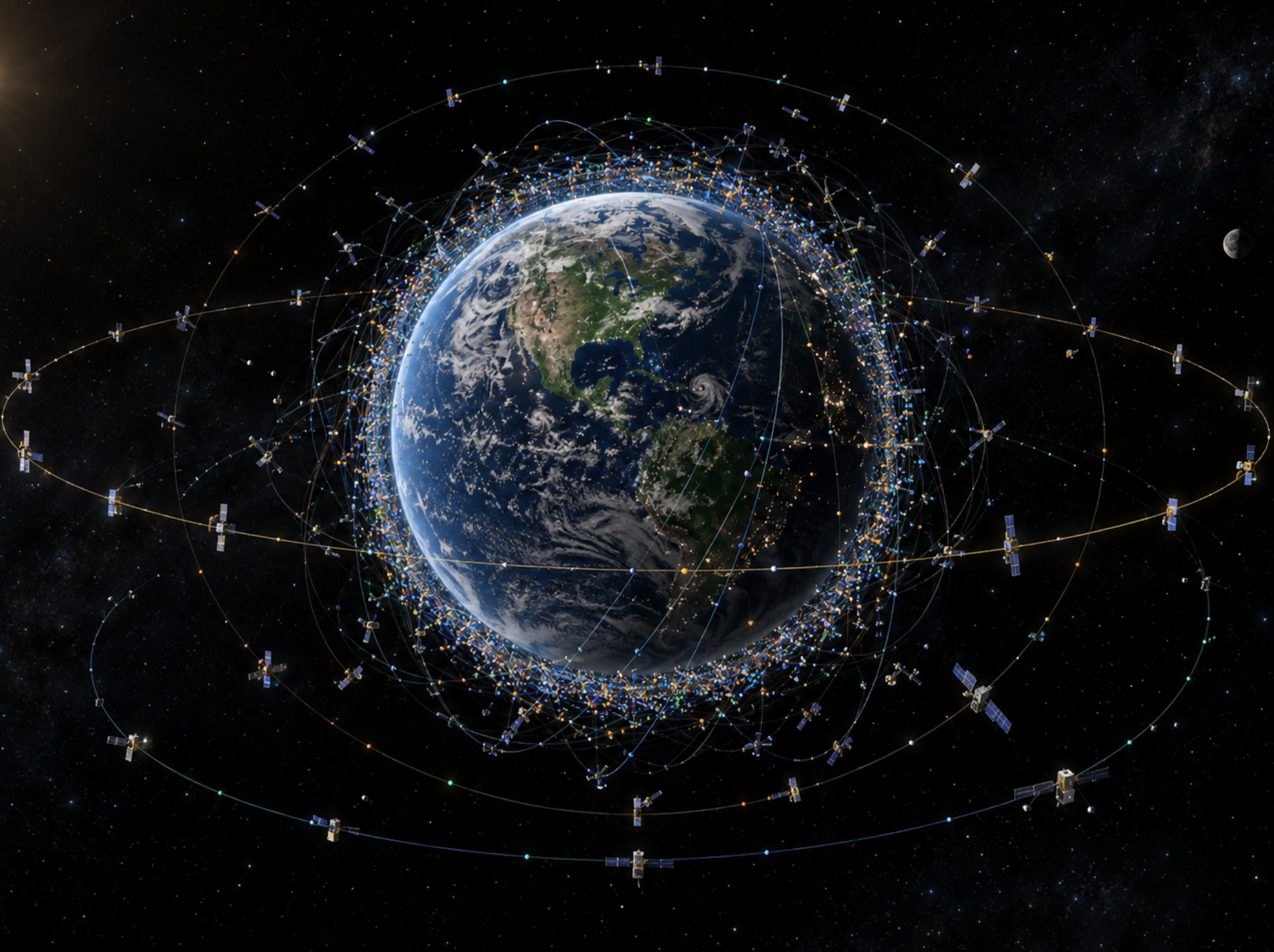
For satellites in low Earth orbit, more atmosphere means more drag, and in February 2022, we got a spectacular real-world example. SpaceX launched 49 Starlink satellites into low Earth orbit just as a geomagnetic storm was affecting the planet. The storm heated and expanded the upper atmosphere enough to dramatically increase drag around the satellites’ low deployment altitude.
Thirty-eight of the 49 satellites eventually reentered Earth’s atmosphere. That’s…the majority of them in case you were wondering. All because space weather made the atmosphere thicker where they were flying. I think this is absolutely wild because we think of satellites floating peacefully in the vacuum of space, safely above all the mess happening down here…except low Earth orbit still brushes against the very outer reaches of our atmosphere, and that atmosphere breathes.
The Sun heats it, it expands, drag increases, and suddenly an object orbiting hundreds of miles above our heads starts losing altitude. The Sun basically reached down and knocked satellites out of the sky like I would a gnat.
Solar Storms Can Send Electricity Through Oil Pipelines
Here’s one I genuinely never thought about.
Geomagnetic storms can generate electrical currents in the ground. Those currents love long conductors, which makes things like power lines and pipelines particularly interesting. Oil and gas pipelines can stretch for hundreds or thousands of miles underground, essentially creating enormous conductive structures running across the Earth. Geomagnetically induced currents can flow through them and interfere with the electrical systems companies use to protect steel pipelines from corrosion.
Over time, those effects can contribute to corrosion and complicate pipeline monitoring. NOAA and the U.S. Geological Survey have both studied this connection. So somewhere underground, a steel pipe carrying oil across a continent can literally pick up electrical currents because the Sun disturbed Earth’s magnetic field.
This sounds like one of those facts somebody would say at a bar and I’d immediately Google under the table because I’d assume they were lying.
The Ground Itself Can Feed Electricity Into the Power Grid
Pipelines are only one example. Long electrical transmission lines can also act as pathways for geomagnetically induced currents. During strong geomagnetic storms, those extra currents can enter power grids and stress transformers.
In March 1989, a geomagnetic storm caused the Hydro-Québec power grid to collapse, leaving millions of people without electricity. Transformer damage also occurred elsewhere, including New Jersey. I wasn’t alive yet (I was born soon after, but don’t want to give away my age tehe), but it sounds pretty crazy.
The part I find so fascinating is where the electricity is coming from. The Sun interacts with Earth’s magnetic environment, Earth’s magnetic field changes, electrical currents are induced across the ground, and our infrastructure becomes part of the circuit. We built power lines across the surface of a giant magnet floating through space and then acted surprised when space occasionally joins the electrical system.
Fair enough, space, fair enough.
Radio Can Basically Hit an Invisible Wall in the Sky
Solar flares can pour X-rays and extreme ultraviolet radiation into the upper atmosphere, changing the ionization of the ionosphere. High-frequency radio signals rely heavily on that region of the atmosphere because they can bounce off it and travel huge distances around Earth.
Change the ionosphere dramatically enough and suddenly those signals behave very differently. Strong flares can produce radio blackouts across the sunlit side of Earth, affecting aviation, ships, military communications, emergency services, search-and-rescue operations, and amateur radio all over the globe.
I keep picturing the signal sailing happily toward the upper atmosphere expecting its usual bounce home and instead finding the atmospheric equivalent of someone rearranging all the furniture while it was gone. Feng Shui anyone? (Is that how it’s spelled?).
A Solar Storm Once Almost Looked Like an Act of War
This one deserves its own tiny moment because it sounds like a Cold War movie.
On May 23, 1967, a powerful solar flare interfered with U.S. early-warning radar systems that were watching for Soviet missiles. At the height of the Cold War, simultaneous radar failures immediately looked suspicious. Fortunately, space-weather forecasters recognized what was happening and were able to explain that solar activity was disrupting the radar systems. NOAA includes the event among the most remarkable examples of solar activity affecting Earth.
Activity on the Sun briefly created conditions that people could’ve interpreted as hostile military interference. An event 93 million miles away entered geopolitics somehow. That is the kind of thing that makes me want to put my phone down and stare at a wall for a minute.
All of these strange effects come from the same basic relationship that gives us one of the prettiest things in the sky. Charged particles interact with Earth’s magnetic environment and atmosphere, oxygen and nitrogen glow, and suddenly the sky becomes green, red, violet, or blue.
I’ve written an entire post about auroras because I’m still desperate to see a really spectacular one while Zak, who grew up in Minnesota, continues treating my lifelong dream like I’m asking to see a particularly impressive parking lot. The aurora is basically the beautiful part of space weather that we can actually see.
Meanwhile beneath those glowing ribbons, power companies are watching transformers, airlines are checking polar routes, satellite operators are calculating drag, farmers are depending on GPS, and somewhere a pipeline engineer may be thinking about electricity flowing through steel buried underground. The sky is putting on a show while half our technological civilization quietly checks its equipment.
We Built a Civilization Connected to the Sky
We’ve spent thousands of years living beneath the Sun while its storms came and went above us. The atmosphere and magnetic field did most of the protecting, and people carried on farming, sailing, fighting wars, falling in love, making wine, building cities, and occasionally looking up at strange lights in the sky.
Then we built satellites and GPS, global aviation networks, power grids stretching across continents, pipelines thousands of miles long, and financial systems synchronized by atomic clocks flying above Earth. Suddenly space weather became our weather too.
Our technology has stretched civilization upward into regions where the Sun has always been active, and every new satellite, navigation system, automated tractor, communication network, and piece of infrastructure ties us a little more tightly to whatever our star happens to be doing.
People live their small little lives everyday and forget that we’re a part of something much bigger, but apparently even our most advanced technology still exists inside an environment controlled by a giant ball of plasma.
The Sun rises every morning looking completely ordinary, meanwhile it has its hands in everything.
Related Reads From the Archive
How Do Auroras Form? A Dance of Solar Fire and Magnetic Veils
The Carrington Event: The Solar Storm That Set Telegraphs on Fire
Are Black Holes Actually Tunnels? The Mind-Bending Theory That’s Changing Space Science
The Sun Isn’t Yellow: A Mind-Bending Dive into Light, Space, and the Lies Our Atmosphere Tells
The Invisible Symphony: How the Universe Flickers Through Our Lives Without Us Knowing
Sprites, Blue Jets, and Elves: The Ghostly Lightshows Above the Storm