Zombie Sea Urchins Are Real, and We’re Turning Them Into Sushi
I learned about zombie sea urchins today, and obviously whatever I was supposed to be doing went out the window for a little while. If you know me at all, I have a weird fascination/fear of zombies (they heavily star in my nightmares), so I had to look into this strange phenomenon.
Zombie sea urchins are apparently a thing, and like a big problem too that I had never heard of. These guys can survive for literal YEARS in an almost starved-out state after eating basically everything around them. Now of course, people being people have figured out that we can collect these weird little zombie creatures, feed them back to health, restore the kelp forests they helped destroy, and then turn the fattened urchins into expensive uni.
God I love the entrepreneurs out there inspiring me every day.
These sea urchins have earned the nickname “zombies” because of the incredibly weird way they survive. They spend years in a starved state across areas called urchin barrens, stretching their resources while they wait for food to return. The more I learned about how these barrens happen, the more intrigued I became.
These little spiky guys basically eat themselves out of house and home, settle in for the long haul, and then wait around for the buffet to reopen. What a life.
How Do You Get a Zombie Sea Urchin?
Kelp forests is where this whole mess begins.
Kelp forests are basically underwater jungles. They create food, shelter and nursery habitat for everything from fish to marine mammals, while absorbing carbon and building these enormous underwater ecosystems that we rarely think about because we can't see them from land. I've written about kelp before because I think it's one of the coolest plants (technically algae, don't come for me!!) on Earth, and it can grow insanely quickly under the right conditions. We here in the Edington household love kelp.
Sea urchins eat kelp, which normally isn't a problem. That's their job in the ecosystem, and predators eat the urchins, kelp keeps growing, everybody carries on in their happy little wet world.
However…if you start removing pieces of that system, it all goes to shit pretty quickly.
Along parts of the Pacific Coast, sea star wasting disease devastated sunflower sea stars, which was one of the major predators of purple sea urchins. At around the same time, marine heatwaves made life increasingly difficult for kelp. Suddenly you had fewer predators eating the urchins, weaker kelp forests, and a LOT of hungry purple sea urchins.
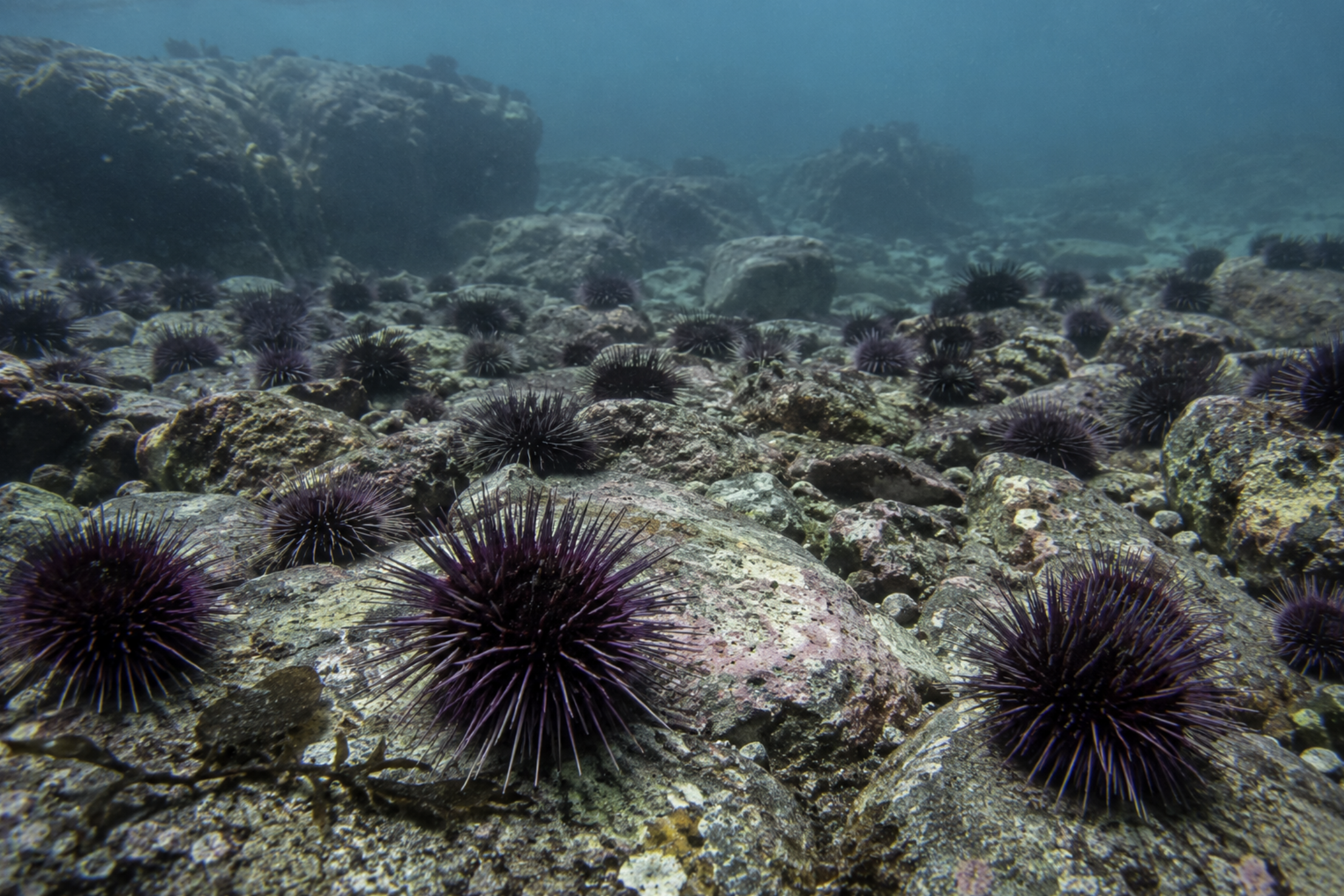
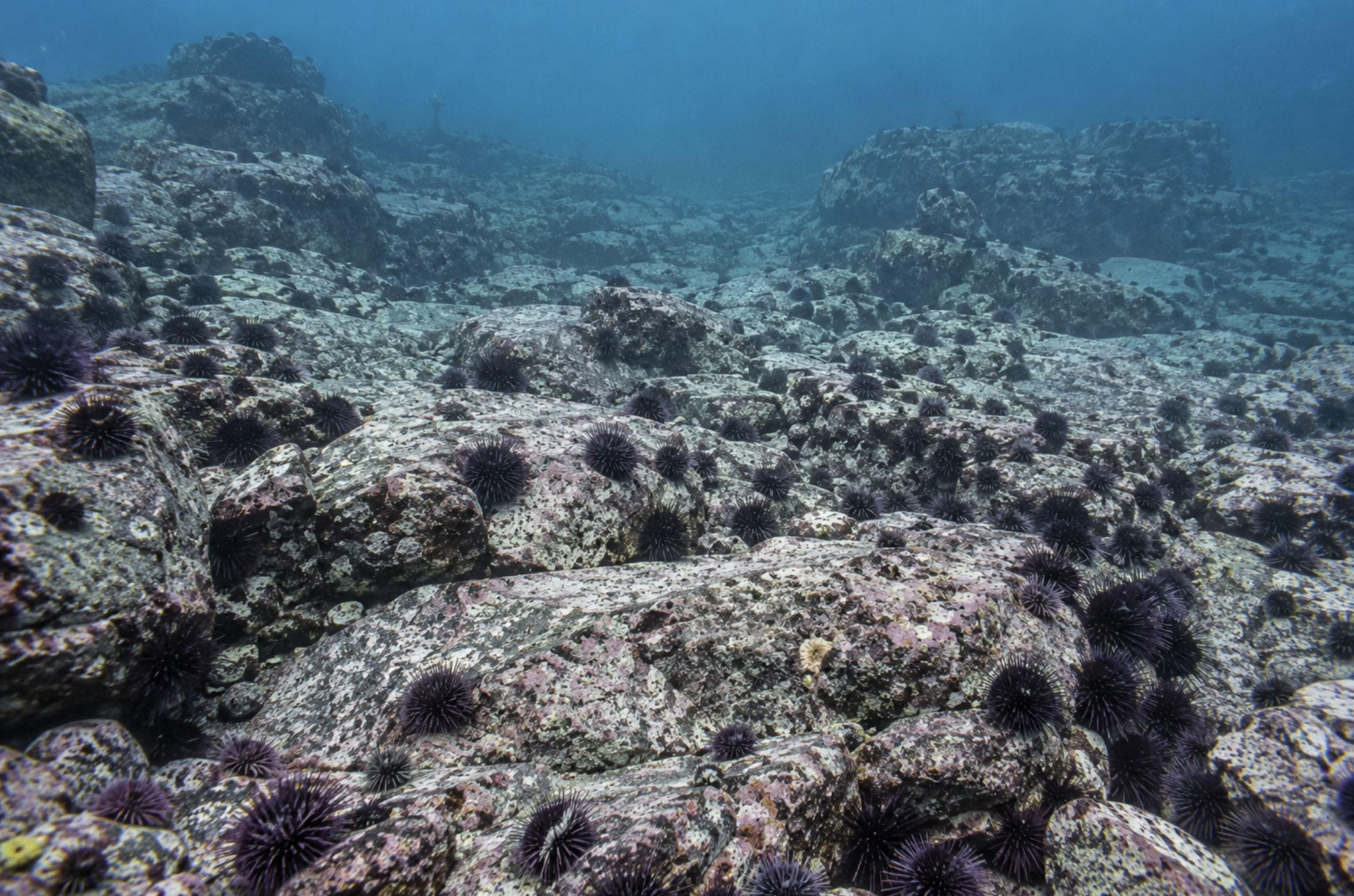
You can probably figure out what happened next. They ate…and ate…and kept eating until forests of kelp became bare stretches of rock covered in sea urchins. We have an actual name for these places, urchin barrens, which sounds like somewhere a witch would send you in one of those romantic fantasy books I read, but it’s actually a very real ecological state.
In some parts of the world these barrens can survive for decades, even when the lush kelp forests that used to grow there are long gone. Which brings us to the obvious question I had when I learned this: if the urchins ate all their food, why didn't they starve?
Well…they sort of did. They just didn't die.
The Zombies Arrive
This is where sea urchins become fascinating little survival machines/straight out of a horror film.
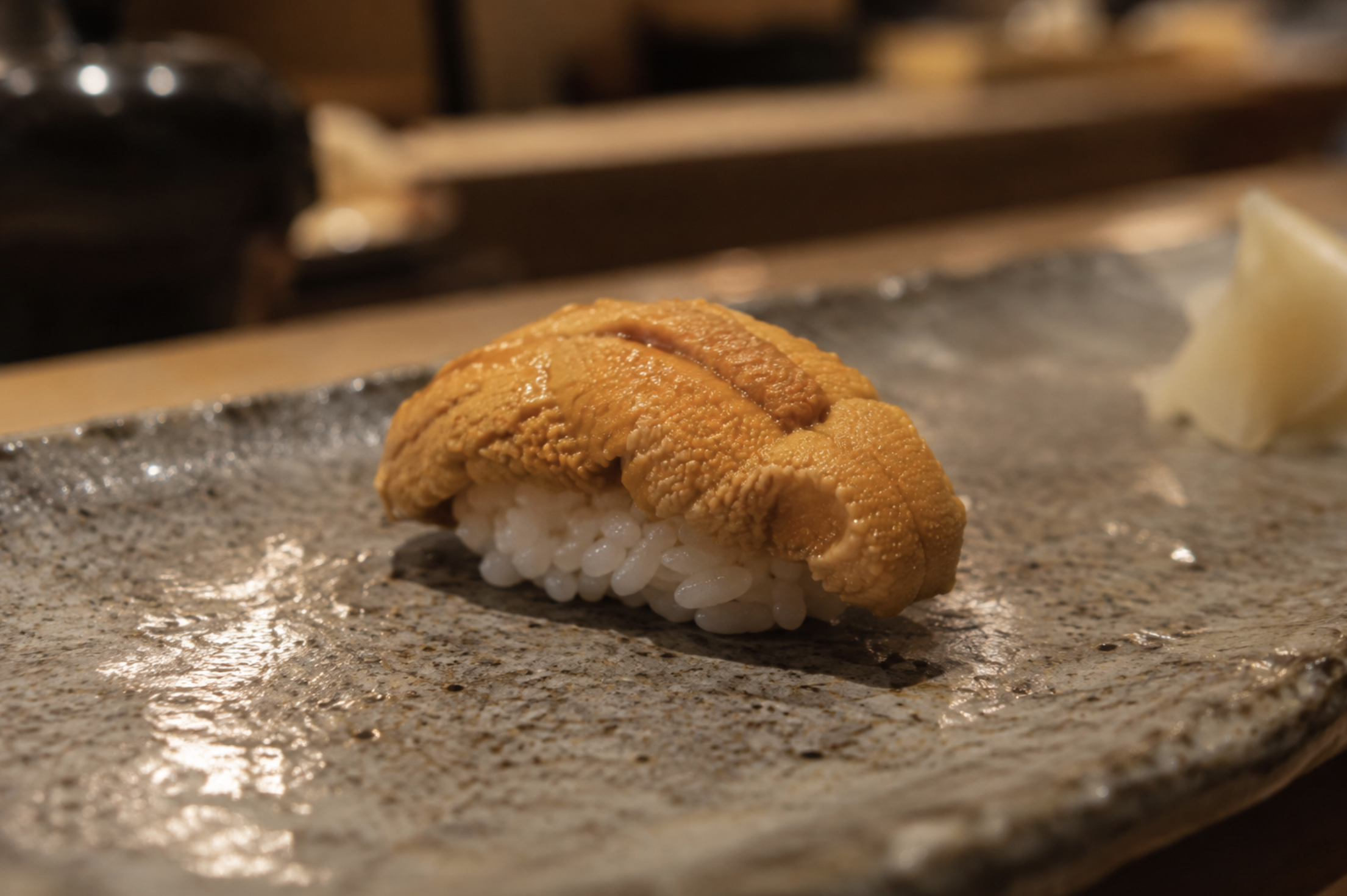
When food disappears, urchins living in barrens can survive with almost nothing to eat. Their gonads, which are the part we actually eat as uni (sorry if you didn’t know that little fact and I threw it in so casually), become tiny and depleted, leaving very little valuable food inside the shell.
Basically, you crack open one of these urchins expecting those beautiful buttery orange lobes of uni and there's almost nothing there. They're alive though. Some of these nearly empty urchins can chill in these barren environments for years, waiting for conditions to improve. Their metabolism slows, reproduction declines, and they somehow continue existing on a seafloor that looks like it should no longer support them.
That's where the nickname zombie urchins comes from because they're alive, but barely. Unfortunately, they're also part of the reason the forest has such a hard time coming back. You'd think once the kelp was gone and the urchins were starving, nature would eventually reset itself. The urchin population would collapse, baby kelp would start growing again, and slowly the underwater forest would return.
Except the urchins are still there. Think about a tiny new piece of kelp trying to establish yourself on this barren stretch of rock while thousands of starving sea urchins have been sitting around waiting years for something edible to show up. Yeah, good luck little kelp. Because of this an urchin barren can essentially become stuck in this state, with enough hungry urchins remaining to prevent the very kelp forest they depend on from recovering.
It's such a bizarre ecological loop. The urchins destroy their food source, survive the destruction of their food source, and then their survival helps prevent the food source from returning. Nature usually has these beautifully complicated checks and balances built into it, but once enough pieces get knocked out of place, sometimes the system settles into an entirely different version of itself.
Instead of a kelp forest, you get an underwater desert filled with zombies.
Okay, So What Do We Do With All These Urchins?
Here's where this story gets considerably less depressing, because somebody looked at millions of starving, commercially worthless sea urchins and apparently thought something along the lines of…why don't we feed them? That's exactly what people are doing now too.
Urchin ranching goes out and grabs those depleted little sleepy urchins out of barren areas and moves them into controlled systems where they're fed again. Give them enough good food and those sad, nearly empty interiors start filling back up with the creamy orange gonads we know as uni. One California Sea Grant project collected purple urchins from barrens near San Diego and tested different diets. After only nine weeks, urchins fed prepared diets developed substantially more roe, enough for researchers to show that previously low-value barren urchins could potentially become marketable seafood.
So now we have this strange situation where removing the urchins can give kelp a chance to grow back, while the animal that was essentially worthless on the barren seafloor can be fattened into one of the more expensive things you can order at a sushi restaurant.
This might be one of my favorite forms of environmental restoration I've come across, mostly because I like sushi so much. Save the kelp by feeding the zombie, then eating the zombie.
I mean…come on.
From Zombie to Uni
There's actually a company doing this at commercial scale called Urchinomics, and their entire model is built around turning the problem into part of the solution.
Divers and local partners identify urchin barrens and collect the starving urchins. The nearly empty zombie urchin slowly becomes a plump little uni factory. Urchinomics then sells the regenerated uni as seafood, while removing enough grazing pressure from the original barren to give kelp a fighting chance at returning. The company currently has live operations in Japan and additional projects in development elsewhere around the world.
Obviously I immediately started wondering what zombie-urchin-turned-uni tastes like. I'm a sommelier, this was inevitable, but unfortunately for me, the last time I ate some uni I ended up in the hospital with anaphylaxis. No, I did not realize I was allergic until about 15 minutes after popping one of those salty suckers in my mouth, and I must say I’m vastly disappointed that I am. Uni is creamy and tastes almost caviar-like with a rich fresh salinity that really is very pleasant.
Apparently diet matters tremendously here too for what the uni tastes like. Makes sense if you think about it, it’s just like every other food out there. Urchinomics uses kelp-based feed that includes Japanese kombu because what an urchin eats can influence the flavor, color and quality of its roe. My wine brain immediately goes to livestock finishing diets, or even how vineyard conditions influence the final grape. Feed becomes flavor, environment becomes texture, and suddenly ecological restoration has a sensory component too.
Give me the rehabilitated zombie uni with a cold glass of Champagne, Chablis, Assyrtiko or maybe a really mineral-driven sake and tell me I'm helping restore a kelp forest while eating it after a dose of Benadryl and I’m so down. (If my mom is reading this, I’m kidding mom, I’d never risk it and I know Benadryl doesn’t prevent my throat from closing, love you!!)
The Zombies Aren't the Villains
The funny thing is that after reading all of this, I don't really think of the urchins as the bad guys. They're actually incredible survivors who are sort of miraculous in their ability to chill and wait for food to come back around.
We changed the conditions around them, predators disappeared, oceans warmed, kelp struggled, and the urchins did exactly what living things have been trying to do since life began, they survived. Almost too well though.
There's something strangely impressive about an animal that can sit on an underwater desert for years with barely anything inside it and simply wait for the world around it to change. Ecosystems depend on balance, and once enough pieces disappear, even an animal doing exactly what evolution taught it to do can push everything further out of place.
If we're lucky, somewhere underneath all of this, the kelp starts growing again. Little green-brown blades pushing up through rock that was barren for years, fish slowly moving back into places they'd abandoned, an underwater forest rebuilding itself one piece at a time. Meanwhile, the zombies get dinner. I think that's a pretty good ending for all parties involved, no?
If you want to see what this looks like outside of my rambling about zombie seafood, check out Urchinomics! They remove overgrazing urchins from damaged reefs, bring them into land-based ranching systems, feed them for roughly eight to twelve weeks, and produce uni while reducing grazing pressure on kelp forests. See how Urchinomics turns barren urchins into uni.
Environmental solutions sometimes mean you can restore an ecosystem, create a useful product, support the people living around it and end up with something delicious at the end.
Especially when the starting ingredient was basically a zombie.