The Best Places to Visit in Greece: Thessaloniki, Parga and Meteora
I had been to Greece before and, this feels almost sacrilegious to admit, I wasn’t particularly impressed.
I had done the big ones: Athens, Santorini and Mykonos. I honestly couldn’t understood why people liked them. Don’t get me wrong, there were absolutely beautiful parts of each trip, but I never left Greece feeling the way some people talk about it. It was so expensive and overrun with tourists I can’t even explain. I didn’t get it.
This time, we were already in Bulgaria and had a car, so instead of going back to the islands, we drove south through mainland Greece. We left Sofia at 3am, crossed into Greece, spent the morning walking through Roman ruins in Thessaloniki, then kept going until we reached Parga on the Ionian coast. Somewhere between swimming out to a tiny island covered in old ruins, eating grilled sardines and giant beans at tables near the water, drinking Greek grapes I rarely get to play with at home, and staring down at the sea from a Venetian castle, Greece finally got me.
Actually, Parga got me so aggressively that it is now, by far, my favorite place I’ve been in Greece.
Big shout out to my husband’s bestie Yavor and his wife Vesselina who planned this whole thing. Without the two of them, we wouldn’t have had such an incredible experience.
The Little Greece Plan
The plan was pretty simple, which is probably why it worked as well as it did. We would leave Sofia obscenely early (thank you Yavor for driving the whole time), stop in Thessaloniki, drive to Parga and stay there for a few days, then go through Kalabaka and Meteora on the way back to Bulgaria.
Parga was really the point, and most of the trip was built around waking up, choosing a beach, eating whatever looked good, walking through town and seeing where we ended up. After doing Santorini and Mykonos before, where tourism can feel like the machine running underneath the entire experience, this felt completely different.
It also meant leaving Sofia at 3am, which is the sort of idea that seems responsible when you’re planning a road trip and significantly less responsible when the alarm actually goes off. Still, we got in the car (thank you jet-lag?) Thessaloniki was first.
Roman Ruins in Thessaloniki
By the time we reached Thessaloniki, I was ready for coffee in a way that had become less of a preference and more of a medical necessity.
We stopped at Estia and had cappuccinos and pastries, which were amazing and exactly the sort of breakfast I wanted after driving through the dark for hours. Greece is very good at making you remember that coffee and pastry can be a complete emotional reset. Give me a proper cappuccino, something buttery and flaky, a table outside and ten minutes where nobody asks me to navigate, and suddenly I can participate in society again. Zak is different, of course, his 250lb body is screaming for protein, so we found him a little chicken pastry that he proceeded to eat three of, and the lady who sold them to us was astonished.

After that, we walked around the city and made our way toward the Galerius ruins.
This is one of those things Europe does to Americans that I will probably never completely get used to. You’re walking through a modern city with people getting coffee, traffic moving around you and shops open for the day, and then suddenly there are the remains of an enormous Roman imperial complex just sitting there as part of the neighborhood.
The Galerian Complex dates to the late third and early fourth centuries, when the Roman emperor Galerius made Thessaloniki one of his imperial centers. It was enormous, with a palace, ceremonial spaces, a hippodrome, the Rotunda and the Arch of Galerius all forming part of the same monumental district. The arch, which Thessaloniki now casually has sitting beside one of its main streets, was probably built between 298 and 305 AD to commemorate Galerius’ victory over the Persians. Only three of the original eight piers survive, and two of them still have carved reliefs showing Roman victories and imperial propaganda.

The Rotunda nearby comes from roughly the same period and has had one of those wonderfully complicated European lives where one building gets repurposed over and over again for more than a thousand years. It began in the early fourth century, later became a Christian church, served as Thessaloniki’s cathedral for a period, became a mosque under Ottoman rule and survived with walls more than six meters thick.
We definitely could have spent more time in Thessaloniki, and I’d actually like to go back and give the city a real trip instead of treating it as the world's most historically significant coffee stop, but Parga was still several hours away.
So, back to the car.
Parga Was the Greece I Had Been Missing
I had seen photos of Parga before we went because Google is my friend, but I still wasn’t prepared for how much I was going to love it.
The town sits along the Ionian Sea with colorful buildings climbing up the hillside, little beaches tucked against the waterfront, boats everywhere and the old castle sitting above everything. It’s beautiful without feeling like its entire existence has been arranged so you can photograph it. People actually live there and families are at the beach. Restaurants are busy late into the night and little streets turn into staircases and hills and suddenly you’re looking down at the water from somewhere you absolutely did not intend to hike to. It’s real in the way Mykonos didn’t feel real.
We also seemed to be among the only Americans there. Some of the locals were very excited to meet us, with one lady in a shop telling me she had never met an American before.
Everyone spoke English, so getting around was incredibly easy, but the tourists we met seemed overwhelmingly European. Parga has a completely different tourism feel from Santorini or Mykonos, and I loved that. Prices were reasonable, people were incredibly friendly, and I never felt like we had somehow arrived inside a conveyor belt designed to move tourists from one expensive experience to the next. This was where I finally started understanding Greece.

Racconto Boutique Design Hotel
We stayed at Racconto Boutique Design Hotel, which was a beautiful little base for the trip.
The pool area was easily my favorite part of the property, especially after long hot days climbing around Parga and swimming at the beaches. It was pretty, quiet and gave us somewhere to actually sit still for a minute before heading back into town. The staff was also incredibly friendly the entire time we were there, which ended up matching the experience we had basically everywhere in Parga.
Breakfast was decent in terms of hotel buffets. It did its job, there were enough options to get the day started, and then I could move on with my life and start thinking about Greek food again.
The hotel itself is outside the busiest part of the waterfront, which I actually liked because Parga gets very lively at night. We could go into town when we wanted all of that energy and then come back to something quieter.
The first order of business, though, was the beach.

Lichnos Beach and My Poor Feet
Our first beach was Lichnos Beach, and visually, this was an excellent introduction to the Ionian coast.
The water was clear, the hills around the beach were lush and green, and the whole thing had that ridiculous blue-green color where I inevitably start taking 300 photos because I’m convinced the next one will somehow capture what the water actually looks like. I think people must edit their photos to make it look as blue as it does in real life.
The ground, however, was trying to kill me.

I cannot emphasize this enough: bring water shoes to Lichnos Beach. Future you will thank me for reading this.
The stones were insanely painful. Not mildly uncomfortable or one of those things where a travel blogger who has apparently never experienced hardship tells you the beach is “pebbly.” My feet were legitimately bruised by the end of the day. Walking into and out of the water became this pathetic little routine where I tried to distribute my body weight across different parts of my feet and somehow outsmart rocks.
I did not outsmart the rocks. The rocks absolutely won, no contest. Rocks: 1 Michele: 0
The beach itself was absolutely beautiful, and I’d happily go back, but next time I’m arriving with serious footwear like I’m preparing for battle.
Luckily, dinner helped.

Dinner at To Dixtu
Our first dinner in Parga was at Ψαροταβέρνα Το Δίχτυ (I put it in Greek in case it’s easier to find for someone out there looking!), or To Dixtu, and this was the kind of meal I had wanted from Greece my whole life.
We ordered a ridiculous amount of food, which is my favorite way to deal with a menu full of things I want to try. There was fried zucchini with that perfect combination of crisp batter around soft zucchini, a proper Greek salad full of ripe tomatoes, cucumbers, olives and feta, and little fried sardines that were salty, crunchy around the edges and exactly the kind of thing you keep picking at long after you’ve told yourself you’re full.
The beans might have been the highlight for me, which feels unfair considering the amount of seafood on the table. I originally thought they were lupini beans, but looking back at the dish, I’m pretty sure what we had was closer to gigantes plaki, the giant Greek beans baked or braised in tomato, olive oil and herbs until they’re ridiculously soft and almost creamy. It’s such a simple dish, but when the tomatoes are good and there’s enough olive oil involved, simple becomes a very dangerous word because suddenly you’ve eaten half the bowl.

Then came this enormous grilled calamari that tasted so fresh and had that beautiful slight char from the grill without becoming chewy, plus octopus, which created an ethical crisis at the table.
I normally don’t eat octopus. I have a weird moral thing about them because they’re so intelligent, and apparently this is where my brain has chosen to draw an extremely specific line despite the fact that I eat plenty of other animals and understand the hypocrisy involved. I ate some anyway and I’m sorry, octopus.
The first wine of the trip was Boutari Lefko Gramma 2025, and this was such a good reminder of why I love drinking wine in the place where it belongs.
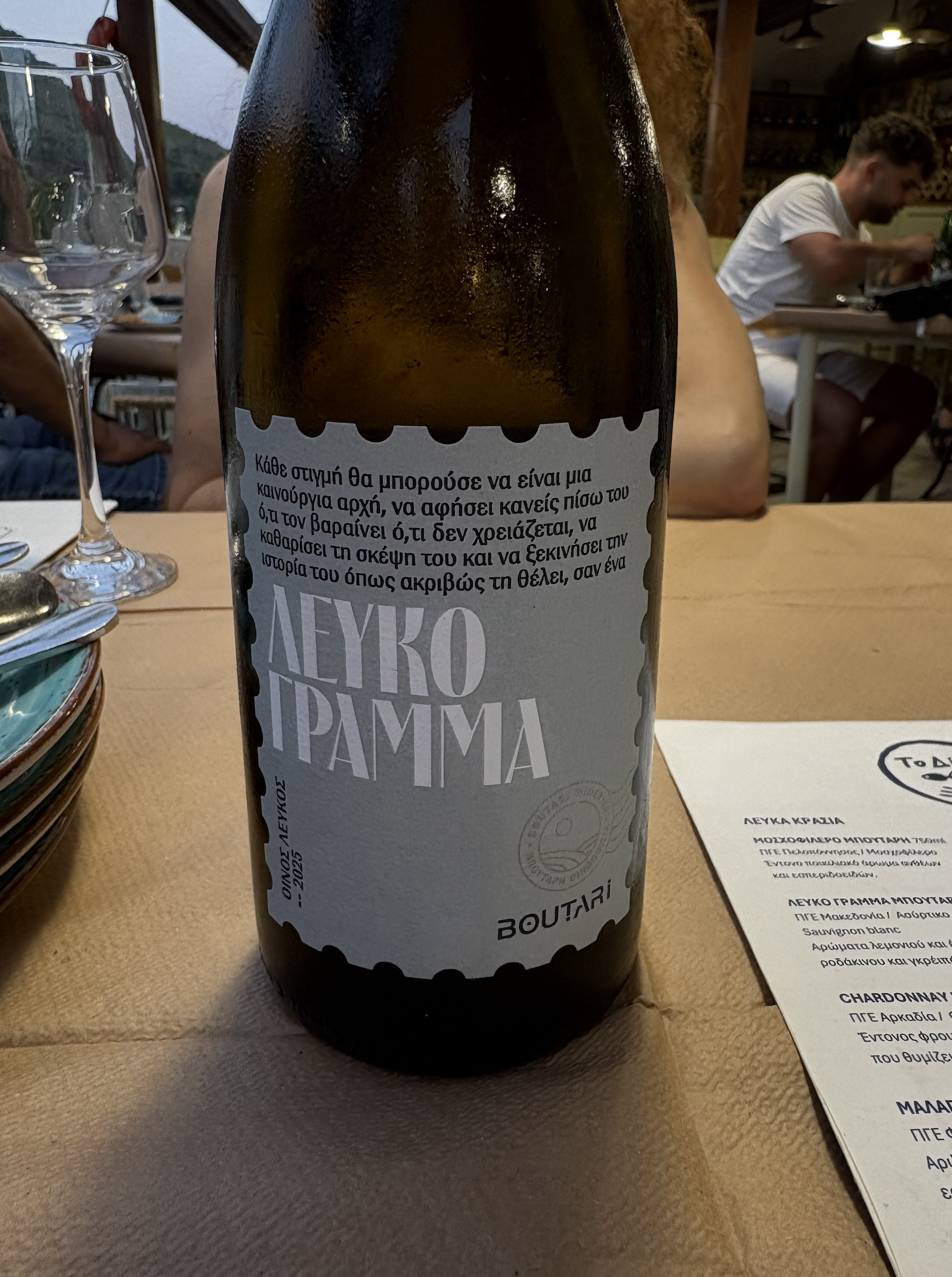
Lefko Gramma is a PGI Macedonia blend of Assyrtiko, Sauvignon Blanc and Malagouzia, which gives you a lot happening without turning the wine into some enormous aromatic monster. It’s got lemon, citrus, peach and grapefruit, with crisp acidity and minerality, and those pieces all made sense with our table because we had fried vegetables, fresh salad, oily little sardines, grilled calamari and basically enough lemon floating around to qualify as a food group.
Assyrtiko gives the blend the acidity and structure I want with seafood, Sauvignon Blanc brings some obvious lift and citrus, and Malagouzia softens the whole thing with a little more perfume and fruit. It wasn’t trying to be the intellectual event of the evening, which was perfect, I mean, we were sitting in Parga eating grilled calamari and throwing lemon on everything.
Krioneri Was My Favorite Beach of the Trip
The next day we went to Krioneri Beach, and this was easily my favorite beach of the trip.
My feet were still furious with me from Lichnos, so the softer ground already gave Krioneri an unfair advantage, but the water here was stunning. It stayed shallow enough that I could swim surprisingly far without suddenly realizing I was in deep open water, and the whole bay felt easy to actually enjoy instead of just stand there admiring.
I bought snorkeling stuff because once I can see fish in clear water, I immediately become convinced the world needs 40 minutes of poorly framed underwater footage from me. I really don’t know why I do that, but I’ve now got three hours of shaky underwater footage of fish if anyone wants to see it.
There were fish everywhere, the water was warm, and directly offshore is the little island of Panagia with its church, bell tower and old ruins sitting above the beach. You can swim out to it, so obviously, I swam out to it after Zak and Yavor bullied me into it.

The island of Panagia is exactly the sort of thing that turns an ordinary beach day into one of the parts of a trip you keep talking about afterward. There’s a little church and bell tower on the island, along with the remains of a French fortification built in 1808 when the French controlled the area. The fort helped defend part of Parga’s bay that was difficult to cover from the larger castle on the mainland.
So naturally, I climbed around the ruins. This went well until I almost fell off a cliff and had to grab onto a tree before cliff diving. I’m using “cliff” a little dramatically here, but there was absolutely a moment where I looked down at the sharp rocks far below me, reconsidered several decisions I had made during the previous thirty seconds and decided that perhaps I had absorbed enough French military history for one afternoon.
It was also incredibly hot, my feet were still bruised from Lichnos, and the water was right there looking significantly more inviting than another pile of rocks. Back to snorkeling and filming badly underwater.
That whole afternoon ended up being one of my favorite parts of Greece. I could swim, look at fish, go out to a tiny island, climb around old ruins and then swim right back to the beach. It felt like the sort of thing that would be turned into some highly organized $200 excursion elsewhere, and here it was just…across from us.
Afterward we ate at Zorbas, where our server was incredibly friendly and started teaching me a little Greek.

Everyone we encountered on this trip spoke English remarkably well, so there was never really a language issue, but I still like learning at least a few words wherever I go. Even when I’m absolutely butchering the pronunciation and the person teaching me has that very patient expression people get when they realize they’ve accidentally become your language tutor.
This was also where I kept thinking about how different Parga felt from the other places I had visited in Greece. It was busy, especially at night, but it never felt overwhelmed by American tourism. We heard different European languages everywhere, people seemed to be staying for beach vacations rather than racing around checking off attractions, and the whole town had this friendly, relaxed atmosphere that made it incredibly easy to settle into.
Then night came, and Parga became even better.
We spent that evening walking through town, which sounds very leisurely until you understand Parga’s relationship with hills. There are a lot of them.
The waterfront itself is easy, with restaurants, shops, boats and people everywhere, but start moving toward the castle and suddenly your cute little evening walk has become cardiovascular exercise. We ended up climbing an enormous hill while the sun was going down, and although I complained during at least 60% of the ascent, the views from the top completely shut me up.
Parga’s history helps explain why everything important seems to be sitting on a hill looking out toward the sea. The town became a Venetian possession in 1401 and spent centuries as a mainland outpost connected closely with Corfu, occupying an incredibly strategic position along a coastline otherwise surrounded by shifting powers. After Venice collapsed in 1797, control bounced between the French, Ottomans under Russian protection, the French again and then the British. In 1817, the British agreed to cede Parga to Ali Pasha of Ioannina, and when the handover actually happened in 1819, most of the residents chose to leave for the Ionian Islands rather than stay under his rule.
It’s a huge amount of history packed around what now feels like a very happy little seaside town. We watched the sunset, wandered through the streets and then encountered the next great problem of the evening. Everyone else wanted dinner too.
Taverna Stefanos
We were starving, and seemingly every restaurant had a wait.
This is always the point on vacation where my standards start becoming incredibly flexible. Thirty minutes earlier I’m reading menus and comparing what everyone serves, then suddenly I haven’t eaten in too long and I’m willing to sit on an overturned milk crate if somebody promises there are potatoes nearby.
Eventually we got into Taverna Stefanos, and thank goodness because this became another one of those full-table Greek dinners where there was constantly something else to try.

We had grilled sardines again because I love sardines and they’re hard to find in the US, and these had that lovely smokiness from the grill with crisp skin and enough lemon to brighten everything up. There were potatoes, mushrooms and, once again, fried zucchini because what’s better than fried zucchini?
There was this creamy dish that looked like mashed potatoes when it arrived, but is something called skordalia. Skordalia is essentially an intensely garlicky Greek purée, often built from potatoes or bread emulsified with olive oil and sharpened with vinegar or lemon. It has the visual innocence of mashed potatoes and then you taste it and realize someone has put enough garlic in there to permanently alter your evening. I loved it.
We also had chicken cooked in a deep tomato sauce with olives, which was in the family of kotopoulo kokkinisto, Greece’s classic style of chicken slowly cooked in tomato until the meat takes on the sauce and everything gets richer and softer together. “Kokkinisto” essentially refers to cooking something in that red tomato sauce, and versions can include warm spices, herbs and other additions depending on the kitchen.
Then there were the chicken skewers, which yes, were souvlaki. Tender little pieces of chicken grilled on skewers with charred edges, lemon, herbs and that very specific vacation ability to make an extremely simple plate of grilled meat taste like the greatest possible thing you could have ordered.
There was more wine…of course there was.
The first bottle was the one with the giant black F on the label, Folvos Papastratis Assyrtiko Muscat.
This was immediately more aromatic than the Boutari blend from the night before. Muscat has absolutely no interest in quietly entering a room, so even with Assyrtiko holding the structure together, you get that unmistakable floral, lifted, grapey perfume coming through first. Then Assyrtiko pulls things back toward citrus, freshness and acidity so the whole bottle can actually survive beside a table loaded with fried zucchini, sardines, garlic, mushrooms and chicken.
This is the sort of blend I like finding while traveling because it gives you two very different sides of Greek white wine in the same glass. Assyrtiko has become the international superstar, particularly through Santorini, while Muscat brings this completely different aromatic personality.

Then came Dialogos from Dio Ipsi Estate, made from Kydonitsa and Assyrtiko, and this one scratched the much nerdier part of my brain.
Kydonitsa is one of those Greek varieties I wish we saw more often in the U.S. because it gives me another excuse to get excited about Greece beyond the same handful of internationally recognized grapes. In Dialogos, it’s blended with Assyrtiko and fermented in stainless steel before spending four months on its lees. It’s got lemon blossom, quince, citrus and lime, and the quince note is particularly appropriate for Kydonitsa since even the grape’s name relates to the Greek word for quince.
Assyrtiko keeps the wine bright and structured while Kydonitsa brings more fragrance and fruit, which worked beautifully after the more overtly aromatic Muscat blend.
This was probably the wine of the trip for me from a pure sommelier-curiosity standpoint. I knew Assyrtiko but I wanted the Kydonitsa.
After dinner we got ice cream at Magic Cream. I say “we” loosely, because I was the only one that got it, but I have no regrets.
This makes no physical sense based on the amount of food I just described, but vacation stomachs operate under a completely different legal system and I don’t make the rules. Parga was still completely alive at night, which I loved. Families were out, restaurants were packed, people were walking along the water and there was no feeling that dinner ending meant the evening had to end with it. We wandered around with ice cream for a little longer before finally admitting we had successfully eaten and walked ourselves into submission.
The next morning, apparently having forgotten what hills had done to us the night before, we headed for the castle.
Parga Castle
Parga Castle sits on the rocky peninsula between the town’s harbor and Valtos Beach, and even before you get into the history, the location tells you exactly why everyone wanted it. You can see everything from up there!!
The Ionian Sea spreads out in one direction, Parga curls around the harbor on another side, and Valtos Beach opens below the castle. If you wanted to defend this piece of coastline, you’d be hard-pressed to choose a better position.
Parga came under Venetian control in 1401, but the castle went through destruction, rebuilding and political chaos for centuries. Most of what you see today comes from the Venetian fortification after 1571, with walls following the natural shape of the hill rather than trying to force some neat geometric pattern onto it. There’s still a winged Lion of Saint Mark, Venice’s symbol, built into the site, and after Ali Pasha took control in 1819, he added another fortified citadel at the highest point.
There are also remains of old houses, barracks, churches and defensive structures scattered through the complex, which makes it much more fun to walk around than a castle that has been polished into one neat visitor route.

Yes, there was more climbing…Parga really makes you work for the pretty parts.
From the castle, you can look directly down over Valtos Beach, and this is another area I’d consider staying if I went back.
It’s broader than Krioneri and sits on the opposite side of the castle from Parga’s main harbor, so you get this completely different beach scene while still being close enough to town that you aren’t isolated from everything. Looking at it from above, with the Ionian Sea stretching out behind it and the castle walls framing part of the view, made me immediately start mentally planning a trip I had not yet left.
That’s usually how I know I really like somewhere, when I start planning the return before the current trip is finished. Eventually, though, we did have to leave.
One Last Greek Meal
We headed toward Kalabaka on the way back to Bulgaria and stopped at Platanos Tavern for food before Meteora.
By this point, the landscape had completely changed. Parga had been all water, beaches, boats and steep coastal hills; heading toward Kalabaka brought us inland into this much broader mountain scenery, and then these enormous rock formations started appearing in the distance. This is the problem with putting Meteora near the end of a trip, it makes a very aggressive attempt to steal the ending.
Meteora Is Completely Insane
I had seen Meteora in photos before, and let me tell you, the photos do a terrible job.
There’s something about the scale of the place that just doesn’t translate when you’re looking at it on a screen. These enormous columns of rock rise hundreds of meters out of the landscape, with sheer sides and strange shapes created over millions of years through tectonic movement, erosion and weathering. Some reach around 300 meters, while the wider formations rise more than 400 meters above the surrounding ground.

Then somebody put monasteries on top of them.
Hermits had already begun settling around Meteora by roughly the 11th century, drawn to how isolated and inaccessible the rocks were. During the political instability of the 14th century, monastic communities started building on top of the formations themselves, and by the end of the 15th century there were 24 monasteries scattered throughout the area. The difficulty involved in constructing anything up there is hard to understand even while you’re looking at it. People and supplies once had to be hauled vertically using ropes, nets and ladders. Some of them still are brought over this way.
Today Meteora is a UNESCO World Heritage Site. The monasteries contain significant post-Byzantine artwork, including 16th-century frescoes, and the site is one of those rare places where the additions some of our ancestors added somehow make an already ridiculous natural landscape even stranger.

I kept staring up and trying to understand how anyone looked at one of these enormous rock pillars centuries ago and thought, yes, that’s where I’m going to build…on top.
I tried looking up how many people died while building these things, and came up empty. It really made me wonder though.
Meteora was such a good final stop because it was completely different from everything else we had done. We started the trip with Roman ruins buried inside a modern city, spent several days swimming along the Ionian coast, and ended underneath monasteries that look like someone placed them into the landscape using Photoshop.

Then we got back in the car and headed for Bulgaria.
Would I Do This Greece Trip Again?
Absolutely, although next time I would stay in Parga longer.
That was the biggest surprise of the whole trip. I had already been to Athens, Santorini and Mykonos and came away thinking Greece was beautiful but maybe just wasn’t one of my places. Parga changed that almost immediately. I liked that there weren’t many Americans around us, I liked how inexpensive everything felt compared with the famous islands, I loved the people, and I especially loved that we could spend the day doing something as simple as swimming off a beach and somehow end up snorkeling around fish and climbing through the ruins of a French fort on a tiny island.
I would go back to Krioneri in a second. I would spend a proper day at Valtos instead of admiring it from above, and I would even return to Lichnos now that I understand it requires the same footwear preparation as a minor geological expedition.
I’d stay at Racconto again, although I’d also be tempted to try somewhere near Valtos just to experience another side of Parga. I’d eat at To Dixtu again for those giant beans, grilled calamari and fried sardines, and I would happily make another lap through Taverna Stefanos with enough people at the table that I could order half the menu without pretending I have any restraint.
And obviously, I’d keep drinking Greek wine.
Assyrtiko gets so much attention internationally that it can be easy to let it become the entire conversation, especially if your first Greek wine experience revolves around Santorini. This trip gave me Malagouzia, Muscat and Kydonitsa alongside it, and that’s always the part of wine travel I find the most exciting. Give me a grape I don’t see every day, pour it beside the food people actually eat there, and let me understand why the wine exists in the first place.
That was really the whole trip. A 3am departure from Sofia, cappuccino and Roman emperors in Thessaloniki, one beach that beat the hell out of my feet, another beach I wanted to live on, a swim to a tiny island, an almost-cliff incident, a lot of sardines, enough fried zucchini to become part of my personality, three completely different Greek white wines, a Venetian castle, and finally Meteora sitting there looking like geology and religion had conspired to show off.
I had been to Greece before, but this was the trip that finally made me understand why everybody wants to go back.
Other Reads You Might Enjoy:
The Art of the Hangover Cure: What Science, Culture, and This Sommelier Say to Do
A Sommelier’s Perfect Finger Lakes Trip: Wineries, Waterfalls, and Unforgettable Bites
Why Airplane Wine Tastes Different (And What to Order Instead)
Fermented Futures: The Rise of Alt-Alcohols (Kvass, Tepache, Makgeolli)
An Ode to Yeast: The Microscopic Magician Behind Every Glass of Wine
How to Buy Great Wine at a Regular Grocery Store (Without Getting Scammed)