A Guide to Bulgarian Wine
Before I went to Bulgaria, I knew Bulgarian wine in the way I think a lot of sommeliers do. I knew Mavrud and Melnik, I knew the country had an extremely old winemaking history, and I knew Bulgaria had once been a surprisingly large player in the international wine industry. I had tasted Bulgarian wines once before about ten years ago, but they weren't something I regularly encountered on restaurant wine lists or saw taking up much space in American wine shops. Actually, I don’t think I’ve ever seen one in a store here now that I think about it.
Then I actually went to Bulgaria, drank the wine there, started paying much closer attention to what was being grown, and realized just how much of the story we miss in the United States.
Bulgaria has indigenous grapes that are difficult to find anywhere else, very different growing conditions depending on which part of the country you're in, a wine industry that has gone through enormous political and economic changes, and plenty of international varieties that have been planted there long enough to have developed their own identity. There are serious structured reds, aromatic whites, lighter reds, sparkling wines, orange wines and plenty of producers experimenting with what modern Bulgarian wine should look like.
There are also some wonderfully strange facts hidden in Bulgarian wine. Rubin, for example, is a Bulgarian crossing of Nebbiolo and Syrah, which sounds like something I would have invented while studying for a wine exam just to see if anyone was still paying attention.
So if Bulgarian wine is mostly a blank space for you, this is everything I think is worth knowing about it, from the regions and grapes to the history, styles and what I would actually look for in a bottle.
Bulgaria Has Been Making Wine for Thousands of Years
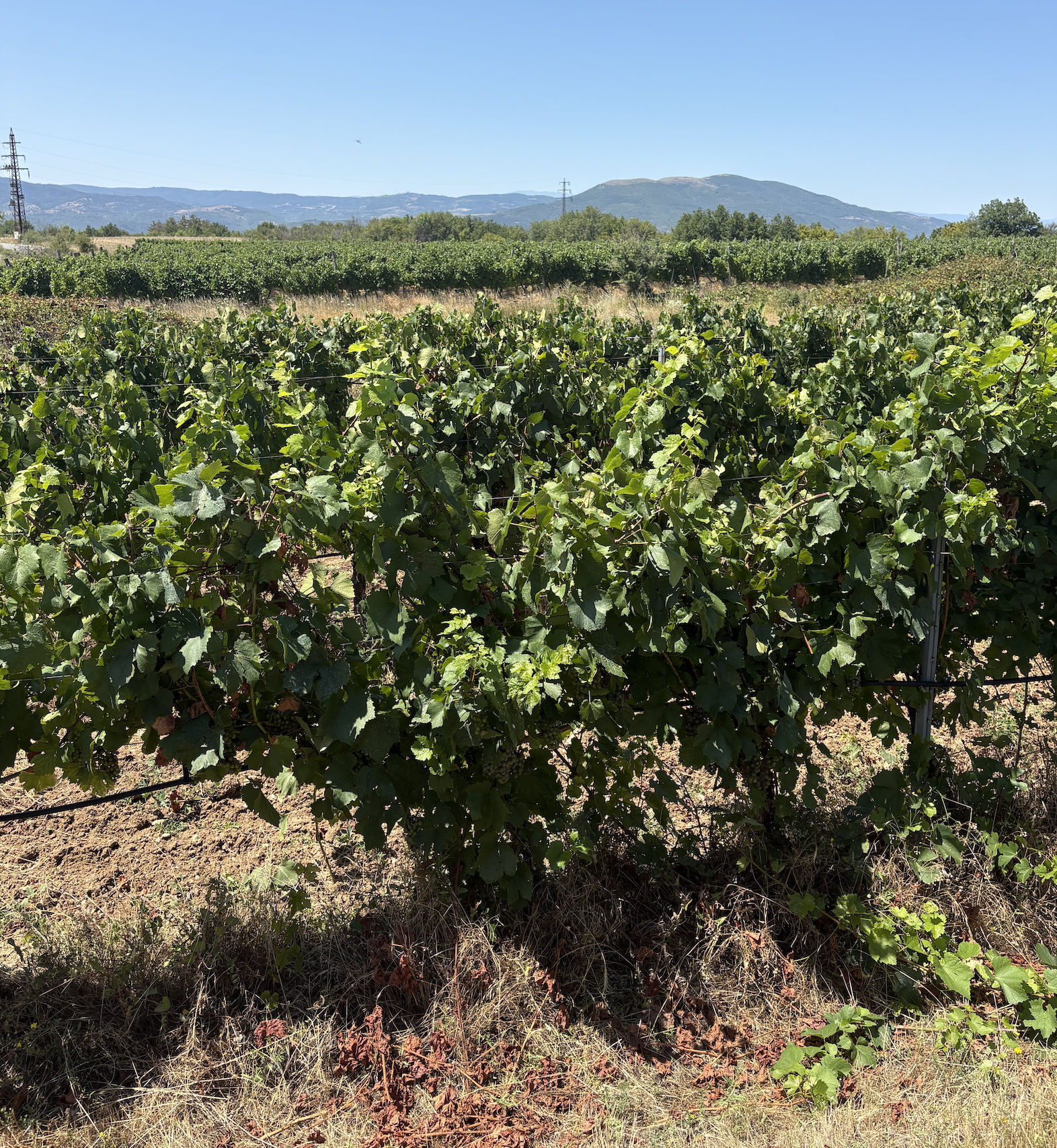
Calling Bulgaria an emerging wine country would be a little ridiculous because people have been making wine in this part of southeastern Europe for literally thousands of years.
The Thracians, who inhabited much of what is now Bulgaria, cultivated vines and placed enormous cultural and religious importance on wine long before Bulgaria existed as the country we know today. Greeks and Romans later influenced the region, then Christianity further entrenched wine into everyday and religious life, and viticulture continued through centuries of political change.
The more recent history is also just as important because it explains a lot about how the rest of the world came to view Bulgarian wine.
During the communist era, vineyards and wineries were consolidated and production became heavily centralized. I’m not a stranger to hearing this story, when I was in Portugal and Hungary I heard similar things. Bulgaria developed an enormous wine industry, with most of its production intended for export throughout the Soviet bloc and beyond. Cabernet Sauvignon and Merlot became particularly important because they were recognizable international grapes that could be produced in large quantities and sold easily in foreign markets.
For a period during the second half of the twentieth century, Bulgaria was one of the world's significant wine exporters.
When communism ended, the entire system changed. Now, if you read about this online, it tells a nice little neat story about how communism changed to socialism and everything was much better. If I hadn’t visited Bulgaria with people who lived through the regime change, I might’ve believed this too. However, I was with my husband’s friends who actually lived through this. They tell a story of socialists who behaved exactly like communists, seizing the properties and land that they wanted or caught their eye. Some of their children and grandchildren still have these holdings today, the legal owners of what was taken from others. Land was returned to private ownership and sometimes taken by force, vineyards were divided, some plantings were abandoned and the industry had to restructure itself. What has developed since then is much more fragmented and, in my opinion, much more interesting. Alongside larger commercial producers, there are now smaller wineries focusing on specific vineyards, local varieties, lower yields, better viticulture and more distinctive styles.
This history is worth understanding because Bulgarian wine still sometimes carries an outdated reputation for being inexpensive bulk Cabernet and Merlot. Those wines certainly existed, and inexpensive Bulgarian wine still exists today, but that's only a small fraction of what the country is producing.
Where Bulgaria Is Matters
Bulgaria sits in southeastern Europe, with Romania and the Danube River to the north, Serbia and North Macedonia to the west, Greece and Turkey to the south and the Black Sea along the eastern edge of the country.
That geography gives Bulgaria much more climatic variation than you might expect from looking at its size on a map.
The Balkan Mountains run across the center of the country and create a natural divide between northern and southern growing areas. Northern Bulgaria generally has stronger continental influences, with cold winters and warm summers, while southern parts of the country can feel considerably warmer and receive Mediterranean influence coming north from Greece and Turkey. Along the eastern edge, the Black Sea helps moderate temperatures, which is especially useful for white grapes and aromatic varieties that I enjoyed so much.
Elevation changes things yet again, as do river valleys, mountain protection, soils and local mesoclimates, so describing Bulgarian wine as one particular style doesn't really work well. The country can grow everything from fresh aromatic whites to deeply colored, powerful reds without either feeling particularly out of place.
So, How Many Wine Regions Does Bulgaria Actually Have?
This is one of the first confusing things you run into when you start reading about Bulgarian wine because almost every general guide tells you there are five wine regions, while other sources will tell you there are two.
Both can make sense depending on what they're describing.
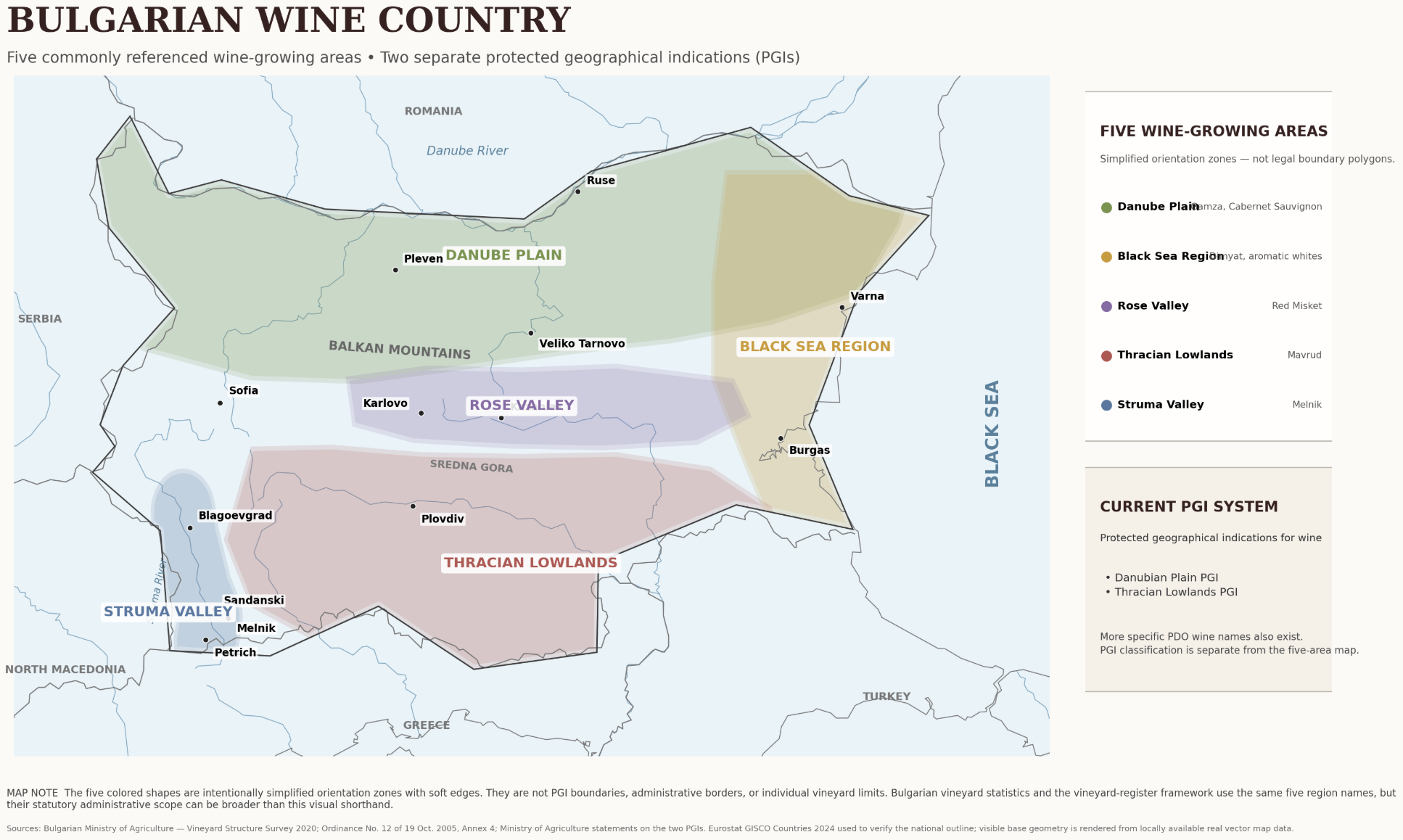
The traditional geographical breakdown divides Bulgaria into five broad wine-growing regions: the Danube Plain, the Black Sea region, the Rose Valley, the Thracian Lowlands and the Struma Valley. Those divisions are useful when you're trying to understand where grapes grow and why wines from different areas taste different, so you'll still see them used constantly in wine education and by people talking about Bulgarian wine.
In the current geographical-indication system, however, Bulgaria has two very broad PGIs, Danubian Plain and Thracian Lowlands, while more specific protected designations can sit within the larger framework. Under EU wine law, PGI and PDO are geographical protections rather than simply a map dividing a country into wine regions.
For drinking wine, you really don't need to make this more complicated than it is. If someone tells you Bulgaria has five wine regions, they're probably referring to the traditional viticultural map. If someone tells you there are two broad official PGIs, they're talking about the modern classification system.
Now that we've gotten that out of the way, the traditional five regions are still worth knowing because they tell you much more about the actual wine being produced.
The Danube Plain
Northern Bulgaria stretches from the Balkan Mountains toward the Danube, which forms a lot of the country's border with Romania.
The climate here is primarily continental, with warm summers and genuinely cold winters, and the region supports a mixture of red and white varieties. International grapes like Cabernet Sauvignon, Merlot, Chardonnay, Riesling and Muscat are grown alongside local grapes, but the Bulgarian variety I'd particularly associate with the north is Gamza.
Gamza can make fresh, relatively light red wines with red fruit, spice and noticeably less weight than something like Mavrud. If the only Bulgarian wines you've encountered have been big, dark, oak-aged reds, Gamza is a useful little reminder that the country isn't limited to that style.
The Danube Plain can also produce white and sparkling wines, so I wouldn't automatically head straight for the red section if I were visiting a winery in northern Bulgaria.
The Black Sea Region
The eastern side of Bulgaria runs along the Black Sea, and the maritime influence helps moderate some of the temperature extremes found farther inland. This is particularly useful for white wine production, and a substantial amount of Bulgaria's white grapes have historically been grown in this part of the country.
You'll see familiar names such as Chardonnay, Sauvignon Blanc, Riesling, Traminer and Muscat, but this is also where Dimyat becomes particularly interesting.
Dimyat is an old white grape grown in Bulgaria and elsewhere in the Balkans, producing wines that are generally fresh rather than massively structured, with fruit and floral characteristics that can range through citrus, apple, peach and gentle aromatic notes depending on the site and winemaking. This was probably my favorite grape I tried while in Bulgaria.
If I were shopping for Bulgarian wine while actually in the country, Dimyat is exactly the sort of thing I would look for because I can find Chardonnay almost anywhere in the world. Finding a good bottle of Dimyat once I'm back in Philadelphia is considerably harder…aka impossible.
The Rose Valley
Central Bulgaria is famous internationally for something other than wine: roses.
The valleys around places such as Karlovo and Kazanlak are associated with Bulgaria's enormous rose-oil industry, but grapes are grown here too, particularly around the valleys lying between mountain ranges.
One of the grapes to know here is Red Misket, or Cherven Misket. Despite the name and the reddish color of the grape skins, it’s primarily used to make white wine. Just to make it niiiice and confusing for you.
Red Misket can produce aromatic wines with floral, herbal and fruit characteristics, and it's one of those grapes that makes considerably more sense once you realize Bulgarian white wine isn't just an assortment of international varieties planted around the Black Sea.
You'll also see international whites and other local grapes throughout the broader central part of the country.
The Thracian Lowlands
Southern Bulgaria is where things become especially interesting for red wine drinkers.
The Thracian Lowlands are warmer than most of northern Bulgaria and benefit from protection provided by the Balkan Mountains along with Mediterranean influence from farther south. The combination creates conditions particularly well suited to red grapes, which is why this is such an important area for Mavrud, Cabernet Sauvignon, Merlot and Syrah.
Plovdiv sits within this broader part of Bulgaria, and the surrounding area has become one of the country's most recognizable centers for modern wine production.
Mavrud is the grape I would remember here.
It can produce deeply colored, structured reds with plenty of tannin and acidity, and flavors that often move through blackberry, dark plum, black cherry, herbs and spice. Oak can add the tobacco, vanilla and baking-spice characteristics you'd expect, although producers are working with Mavrud in enough different ways now that it would be a mistake to assume every bottle is going to be a massive oak bomb.
If you normally drink Cabernet Sauvignon, Syrah, Aglianico, Sagrantino or other reds with real structure, Mavrud is probably the easiest introduction to indigenous Bulgarian wine you’ll find.
The Struma Valley
The Struma Valley in southwestern Bulgaria runs toward Greece and North Macedonia and is one of the warmest wine-growing areas in the country.
This is Melnik country.
The town of Melnik itself is tiny, strange and beautiful, surrounded by dramatic sandstone formations, but for wine purposes the important thing to remember is that this part of Bulgaria has the warmth and long growing season necessary for varieties that struggle to ripen elsewhere in the country.
The historic local grape is Shiroka Melnishka Loza, usually translated as Broadleaf Melnik or shortened simply to Melnik when people are discussing Bulgarian wine.
It’s a late-ripening grape and has traditionally been associated with the area around Melnik, Sandanski and Petrich. The wines can have cherry and darker fruit, spice, herbs and noticeable tannin, developing more tobacco, leather and earthy characteristics with age and oak.
You'll also encounter related crossings that were developed partly because traditional Melnik ripens so late, which brings us to the much more entertaining part of Bulgarian wine: the grapes themselves.
Grapes:
Mavrud
If you're only going to learn one indigenous Bulgarian red grape, I'd start with Mavrud.
Mavrud is most strongly associated with southern Bulgaria, particularly areas around Plovdiv, Asenovgrad and the Thracian Lowlands. It's a late-ripening variety capable of producing deeply colored wines with substantial tannin and acidity, which also gives good examples the ability to age.
The flavor profile can include blackberry, mulberry, plum, dark cherry, herbs and spice, and it generally responds well to oak. Styles vary considerably depending on how ripe the fruit gets and how aggressively the producer uses barrels, so you can encounter everything from relatively fresh, fruit-driven versions to dense, polished reds built for aging.
This is one of the Bulgarian wines I'd be most likely to bring home because it's both distinctly Bulgarian and capable of being genuinely serious wine.
Shiroka Melnishka Loza and Melnik 55
Melnik gets confusing quickly because the name can refer broadly to wine from the area while several related grape varieties also contain Melnik in their names.
Shiroka Melnishka Loza is the old local variety. It thrives in southwestern Bulgaria because it needs a long, warm growing season, and traditionally it has been difficult to grow successfully outside this small area because of its late ripening and sensitivity to cold.
Then there is Melnik 55, also known as Early Melnik, which was developed to ripen earlier while retaining some of the character associated with the local Melnik grapes.
For a normal wine drinker, the important part here is just understanding that when you see Melnik on a Bulgarian wine label, particularly in southwestern Bulgaria, you're looking at one of the country's most geographically distinctive wine traditions.
Rubin
Rubin is one of my favorite Bulgarian grape facts because I mean, it was created in Bulgaria in the twentieth century by crossing Nebbiolo and Syrah.
I would like to have been in the room for that decision.
Nebbiolo brings acidity and tannic structure while Syrah brings color, fruit and spice, and Rubin can make deeply colored, concentrated reds with blackberry, dark fruit, spice and plenty of structure. Good examples can handle oak and aging particularly well.
It's not an ancient indigenous variety like Mavrud, but it’s absolutely part of modern Bulgarian wine identity, and it's a grape I would seek out because there's almost nowhere else in the world where you're going to casually encounter a Nebbiolo-Syrah crossing on a wine list.
Gamza
Gamza is particularly associated with northwestern Bulgaria and is the same grape known as Kadarka in other parts of Central and Eastern Europe.
Stylistically, it's almost the opposite direction from Mavrud.
Gamza tends to produce lighter-colored reds with fresh acidity, red fruit and relatively gentle structure. Raspberry is a classic descriptor, and the wines are often best appreciated for their freshness rather than buried under a huge amount of oak.
If you like lighter reds such as Schiava, Frappato or some styles of Pinot Noir, Gamza is worth looking for. I would also happily put some examples in the refrigerator for a little while before serving them, particularly during the summer, which it happened to be while we were there. Nothing like a little cool Gamza on a 100 degree day.
Pamid
Pamid is one of the oldest grape varieties grown in the Balkans and was historically an important part of Bulgarian viticulture.
It generally produces lighter-colored, relatively low-tannin reds intended more for drinking young than for decades of cellar aging. It's not the grape I'd use to convince someone that Bulgaria makes enormous, profound red wines, but that's also not really the point.
Wine regions need everyday wines too, and varieties like Pamid are an important part of understanding what people historically grew and drank rather than only looking at the grapes currently easiest to market internationally. While this wouldn’t be the wine I’d bring home to cellar for a decade, it really hits at the end of a long day walking around Bulgaria.
Dimyat
Dimyat is one of the Bulgarian white grapes I wish we saw more often in the United States. I mentioned it was my favorite, right?
It's particularly associated with eastern Bulgaria and the Black Sea area and can produce fresh, relatively light white wines with orchard fruit, citrus and floral characteristics. Historically, the grape has also been used for distillation as well as table wine.
It isn't necessarily trying to compete with a grand white Burgundy in terms of weight or complexity. A good Dimyat can simply be fresh, regional and interesting, which is exactly what I want when I'm somewhere drinking a grape I can't easily find at home. It reminds me a little of Furmint from Hungary, and the nostalgia was off the charts while I was drinking it.
Red Misket
Red Misket is another grape whose name makes the situation sound more complicated than it is.
The skins have a reddish or pinkish tone, but as I mentioned earlier, the grape is generally used to make aromatic white wines. It's especially associated with central Bulgaria and the Sub-Balkan valleys, and the resulting wines can show floral, herbal, citrus and orchard-fruit characteristics.
If you like aromatic varieties but don't necessarily want something as aggressively perfumed as Gewürztraminer or Muscat can sometimes become, Red Misket is a fun Bulgarian grape to look for.
Yes, Bulgaria Grows Plenty of International Grapes
For all the attention I give indigenous grapes, international varieties are an enormous part of Bulgarian wine and have been for decades.
Cabernet Sauvignon and Merlot became particularly important during the country's export boom, and both remain widely planted. Syrah is well suited to warmer parts of southern Bulgaria, while Pinot Noir can work in cooler sites. On the white side you'll find Chardonnay, Sauvignon Blanc, Riesling, Muscat, Traminer and plenty of other familiar names.
There's absolutely nothing wrong with drinking Bulgarian Cabernet Sauvignon. In fact, comparing Cabernet from Bulgaria with Cabernet from Bordeaux, California, Chile or elsewhere can be one of the easiest ways to understand the country's climate because you're starting with a grape you already know.
If I'm physically standing in Bulgaria with six spaces left in my suitcase, though, I'm probably not filling them all with Cabernet. I can buy Cabernet when I get home.
What Does Bulgarian Wine Actually Taste Like?
Southern Bulgaria can give you ripe, deeply colored, structured reds, particularly from Mavrud, Rubin, Syrah, Cabernet and Merlot, while Gamza from the north can be considerably lighter and fresher. The Black Sea area and other cooler sites can produce aromatic whites and fresher international varieties, while differences in elevation, soils and winemaking create even more variation worth seeking out and trying.
Modern Bulgarian winemakers also aren't trying to make the same thing as each other. You'll find polished, internationally styled wines alongside producers working with indigenous grapes, amphorae, skin-contact whites, sparkling wine, low-intervention winemaking and older traditions.
That’s why Bulgaria is much more interesting to me than if it were simply a source of inexpensive Cabernet.

Understanding a Bulgarian Wine Label
Bulgarian labels may be partly or entirely in Cyrillic if you're buying wine locally, although bottles intended for export usually provide enough information in English to figure out what you're drinking. Luckily for me, I was with friends who speak so many different languages, it was never a problem for us.
Bulgaria follows the broader EU geographical-indication framework, so PDO and PGI terminology can appear on labels. For a PDO wine, the grapes and production requirements are tied more strictly to a defined geographic area, while PGI allows a broader geographical connection; for wine specifically, EU rules require at least 85 percent of the grapes in a PGI wine to come from the named geographical area.
Unless you're studying for an exam, I wouldn't spend too much energy memorizing Bulgarian labeling law before buying a bottle though, it’s unnecessary and cumbersome. Look for the producer, grape and place first.
If it says Mavrud from the Thracian Lowlands, you already know quite a lot about what you're buying thanks to this little article of mine. If you're in southwestern Bulgaria and see Shiroka Melnishka Loza, try it. If you see a grape name you don't recognize at all, look it up or ask someone. That’s generally how you end up drinking the most interesting things anyway.
What I Would Drink First
If you've never had Bulgarian wine and want some sort of order rather than wandering blindly through a wine shop, I'd begin with Mavrud because it gives you a very clear introduction to one of the country's most important native red grapes.
After that, I'd try Melnik, preferably something based on Shiroka Melnishka Loza or one of the local Melnik crossings, and then Rubin because a Nebbiolo-Syrah crossing deserves at least one evening of your life. For something lighter on a nice hot sweaty summer day, find Gamza.
For whites, look for Dimyat and Red Misket before moving into international grapes.
Once you've tasted a few of those, Bulgarian versions of Cabernet Sauvignon, Merlot, Syrah, Chardonnay and Sauvignon Blanc become more interesting because now you have some context for the country rather than judging Bulgaria entirely through grapes you've tasted a thousand times somewhere else.
Bulgarian Wine and Food
Bulgarian food makes wine pairing fairly easy because there are grilled meats, sausages, vegetables, peppers, herbs, yogurt, brined cheeses, stews and a seemingly endless number of things that I would happily eat with a glass of wine.
Mavrud works with lamb, grilled meats, slow-cooked meat dishes and richer preparations where its tannin has something to work against. Melnik is also excellent with grilled or roasted meats, mushrooms and dishes with earthy or smoky flavors, while the lighter structure of Gamza makes it easier with poultry, pork, charcuterie or anything that doesn't need a huge red wine.
Fresh Bulgarian whites work beautifully with seafood, salads, grilled vegetables and Bulgaria's salty white cheeses.
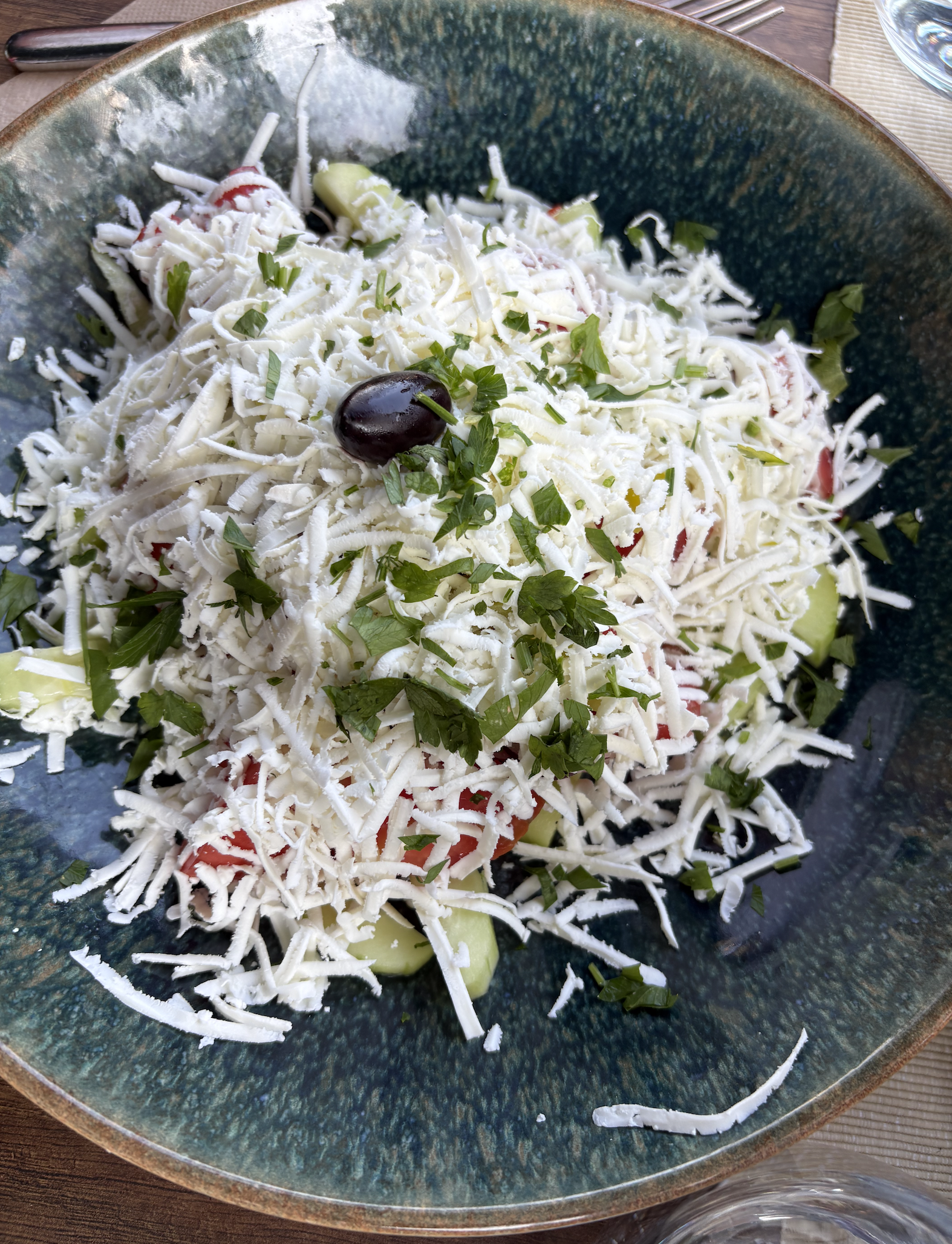
And then there's shopska salad, which combines tomatoes, cucumbers, peppers and onions under a mountain of grated Bulgarian white cheese. Sometimes they throw in some olives, and I’ve got to be honest with you, this is the best salad of all time.
It turns out that my preferred salad-to-cheese ratio may actually have been Bulgarian this entire time.
Why We Don't See More Bulgarian Wine in the United States
I think the biggest obstacle for Bulgarian wine in the United States is familiarity.
Most wine drinkers know Cabernet Sauvignon, Pinot Noir, Chardonnay and Sauvignon Blanc. More and more, people recognize grapes like as Albariño, Grüner Veltliner and Assyrtiko because restaurants, sommeliers and importers spent years teaching consumers what those names meant.
Mavrud hasn't had that moment yet. Neither has Shiroka Melnishka Loza, and I think we can all agree that one may require a little more marketing than a good old Albariño.
For importers and retailers, unfamiliar grapes are harder to sell because every single bottle requires an explanation. Bulgaria is also competing for attention with dozens of established European wine regions that already have stronger recognition among American consumers.
The upside is that Bulgarian wine still offers something I find increasingly difficult to find in the wine world: genuinely unfamiliar grapes and regions that aren't unfamiliar because someone invented them last Tuesday.
These wines have some serious history behind them, we just haven't been paying much attention to them.
If You're Going to Bulgaria
Drink Bulgarian wine while you're there. Yes, yes, I’m working on my Bulgarian travel guide and I’ll get it out as soon as I can, but in the meantime, don’t drink Cabernet because you recognize the word Cabernet.
Ask what the local grape is wherever you are in Bulgaria, particularly if you're traveling through different parts of the country. Drink Mavrud around Plovdiv and the Thracian Lowlands and look for Melnik wines in the southwest. Try Gamza from the north and Dimyat or other whites closer to the Black Sea.
Wine is always easier to understand when you're drinking it in the place that produced it because the geography stops being theoretical. You can actually feel the heat, see the mountains, eat the local food and understand why certain grapes ended up where they did.
Bulgaria is also a good place to buy bottles to bring home because some of the wines you're going to find locally simply aren't easy to replace in the United States. If suitcase space is limited, I'd prioritize indigenous varieties, small producers and wines tied specifically to where you're visiting. Again, the Bulgarian Cabernet may be excellent, but Cabernet will survive without one of my six suitcase spaces.
If You Only Remember One Thing About Bulgarian Wine
If you finish this entire article and retain only a few facts, these are the ones I'd keep.
Bulgaria is an ancient wine-producing country with substantially more regional and stylistic diversity than its old reputation for inexpensive export wine suggests. You'll commonly hear Bulgaria described as having five traditional wine regions (the Danube Plain, Black Sea region, Rose Valley, Thracian Lowlands and Struma Valley) while the modern geographical-indication system uses the two broad PGIs Danubian Plain and Thracian Lowlands alongside more specific protected areas.
For grapes, remember Mavrud first, particularly for structured red wine from southern Bulgaria, and Melnik for southwestern Bulgaria. Gamza is an important lighter red from the north, while Rubin is the Bulgarian crossing of Nebbiolo and Syrah. For native or traditional whites, Dimyat and Red Misket are two of the names worth knowing.
If you see Mavrud, Melnik, Gamza, Rubin, Dimyat or Red Misket on a Bulgarian wine list, that's where I'd start.
Other Reads You Might Love:
The Secret Story of Grape Bricks: How Americans ‘Accidentally’ Made Wine During Prohibition
The Most Dangerous Cheese in the World: Casu Marzu, the Rotting Rebel of Sardinia
Fermented Futures: The Rise of Alt-Alcohols (Kvass, Tepache, Makgeolli)
An Ode to Yeast: The Microscopic Magician Behind Every Glass of Wine
How to Buy Great Wine at a Regular Grocery Store (Without Getting Scammed)
Wine Closures: Screw Cap vs. Cork vs. Glass (and Why It Actually Matters)