The Weird Things Tree Rings Can Tell Us
I knew tree rings told you how old a tree was. You cut down a tree, count the little circles and tadaaaa…tree age. My sisters and I used to count tree rings on every stump we could find when we were little, marveling at the ages of them all.
Apparently though, everyone left out about 97% of what makes tree rings interesting.
Trees can also record droughts, wildfires, unusually cold summers, insect attacks, landslides and major volcanic eruptions. They’ve even preserved evidence of extremely strange things happening on the Sun. One of those solar events eventually helped scientists figure out the exact year Vikings were chopping down trees in North America. I mean, the EXACT year. It wasn’t an estimate, it was the year 1021.
The reason we know involves a burst of radiation from space that left a chemical timestamp inside trees all over the planet. That was about where my elementary-school understanding of tree rings completely fell apart.
Trees actually blow my mind.
So What Actually Makes a Tree Ring?
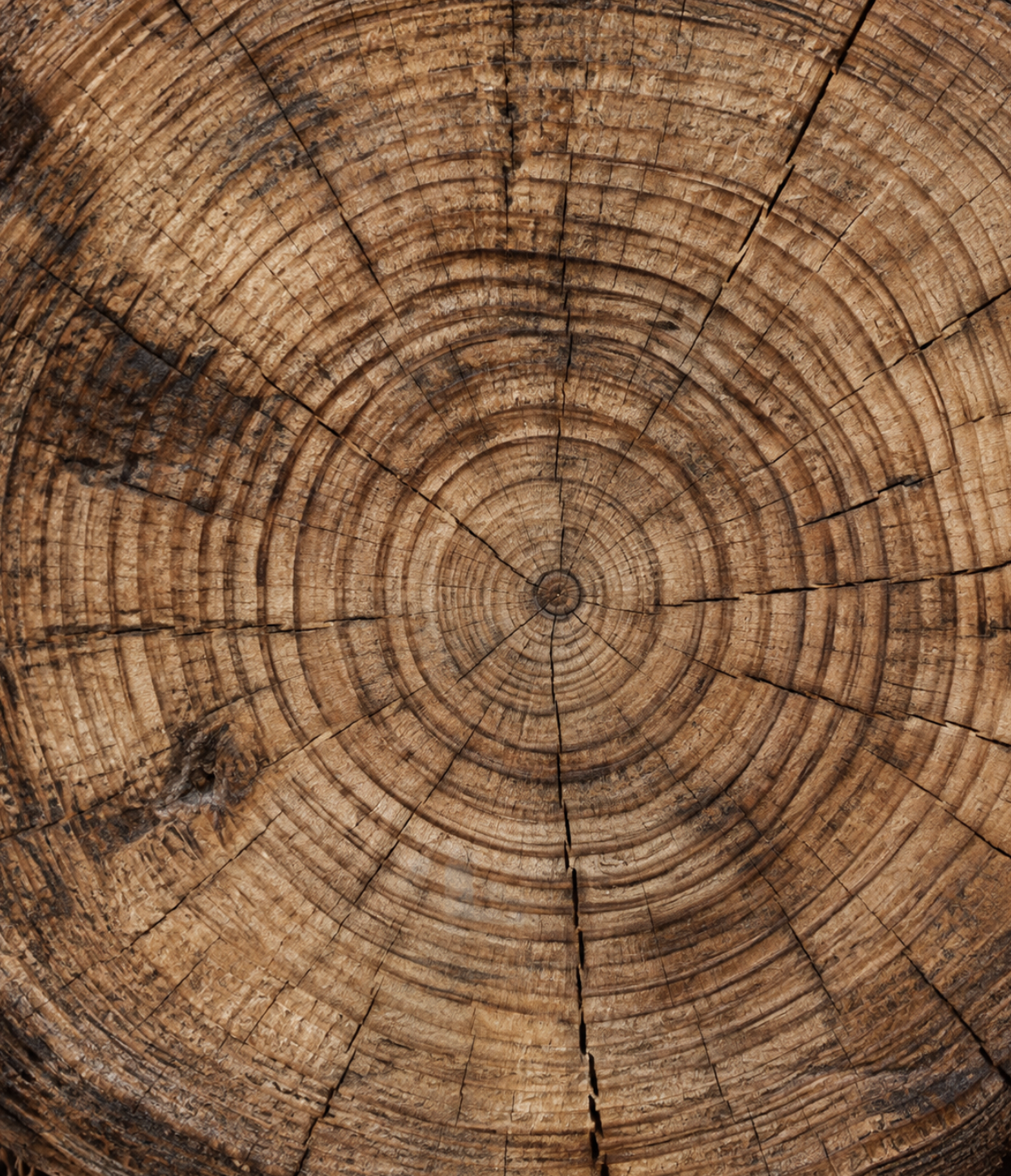
Trees don’t grow at exactly the same rate all year. In places with distinct seasons, the wood produced near the beginning of the growing season generally looks different from what grows later.
During spring and early summer, many trees produce what’s called earlywood, which tends to contain larger cells with thinner walls. Later in the season though, growth slows and the tree produces denser latewood made from smaller, thicker-walled cells. Together, those changes produce the light and dark bands we recognize as an annual tree ring.
One year of growth usually equals one ring.
Simple enough, except because this is nature we’re talking about, and it obviously isn’t always that simple. Trees can sometimes produce what look like extra rings after unusual weather, and really stressful years can leave rings so small that they’re difficult to identify. Different species also respond differently to temperature, rainfall, altitude and basically everything else happening around them.
That’s why scientists aren’t usually staring at one stump, counting circles and announcing what happened in the year 1347. In fact, they compare trees…and like A LOT of them.
Scientists can take a pencil-thin core from a living tree without cutting it down, measure its rings under a microscope and compare that pattern with other trees from the same area. If a whole group of trees has the same sequence of wide ring, narrow ring, narrow ring, giant ring, tiny miserable ring, then that pattern can be lined up across samples.
This process is called cross-dating, and it’s how researchers can connect living trees with dead trees, old logs and even wooden beams from archaeological sites. NOAA’s International Tree-Ring Data Bank now contains records from thousands of sites across six continents. If you didn’t know that was a government agency, don’t feel bad, neither did I.
Basically, they’ve built an enormous wooden calendar that stretches backward through history.
Trees Can Tell Us When It Barely Rained
This one makes sense when you think about it. Trees need water, and some years Mother Nature apparently decides everybody needs to build character and struggle a bit more. I feel for those trees, because I too, am tired of building character.
For trees growing somewhere that water strongly limits growth, wetter years often create wider rings while very dry years produce narrower ones. In other environments, temperature might be the bigger limitation, so unusually warm or cold seasons can affect growth instead.
Scientists figure out what controls a particular species by comparing modern tree growth with weather records from the same years. If narrow rings consistently match recorded drought years, then the older rings suddenly become extremely useful because our instrumental weather records don’t go back very far, but our trees do.
That means tree rings can extend records of drought, temperature and rainfall hundreds or even thousands of years beyond the period when somebody was standing nearby with a thermometer and rain gauge.
So when researchers say a modern drought is unusual, they’re not necessarily comparing it only with the last century. There might be a 1,000-year-old tree sitting there like, actually, you should’ve seen 1142.
Trees Remember Being on Fire
A wildfire can burn into part of a tree without killing it, andif the tree survives, it keeps growing and gradually produces new wood around the damaged area. The burn scar gets sealed inside the trunk and then maybe another fire comes through 20 years later. Another scar forms on the tree and then say…fifty years after that, another one.
Suddenly you have a tree that has spent several centuries collecting receipts from every time the forest tried to kill it. Also, bad luck for that tree and it makes me sad they can’t just get up and move if they’re living in a place with fires that frequently.
The thing is though, if scientists can accurately date the rings around those scars, they can determine the actual calendar years when fires occurred. They can sometimes even tell roughly where in the growing season a fire happened based on where the damage appears inside that year’s growth.
Giant sequoias are especially useful for this because some of them live for thousands of years and survive repeated fires. Fire-scar records from the Sierra Nevada show that many of these forests burned regularly long before modern fire suppression began. That information matters now because forest managers are trying to understand what these ecosystems looked like before we dramatically altered their natural fire cycles with our cigarettes and clumsiness.
An ancient tree can help modern humans figure out how often a forest is supposed to burn. No pressure, tree.
Volcanoes Can Show Up in Trees Nowhere Near the Volcano
This is where it starts getting stranger, but I absolutely loveeee it.
A giant volcano can erupt hundreds or thousands of miles from a particular forest and the lava never gets anywhere near those trees. They might not even get much ash, but the eruption can still leave a mark.
Large explosive eruptions can inject sulfur-containing gases high into the atmosphere. Those gases can eventually form aerosols that reflect sunlight and temporarily cool parts of the planet. If temperatures drop enough during a tree’s growing season, the cold can damage the cells that are forming inside the wood. Those injuries can produce what researchers call frost rings.
Scientists have studied unusual frost damage in tree rings alongside the timing of major volcanic eruptions to help reconstruct past climate events. So a volcano erupts somewhere far away, changes the atmosphere, cools the weather and a tree quietly writes down that something strange happened. I genuinely don’t think trees get enough credit for how nosy they are. They’re just standing there absorbing neighborhood gossip for 2,000 years. It really puts some of those gossiping ladies in the south to shame.
Trees Can Tell Us When the Ground Moved
Trees would generally prefer to grow upward, which I think is a given. Fair enough, you guys have a thing for the sun, I get it.
If the ground beneath one starts creeping downhill because of a landslide, the tree can tilt. It then tries to correct itself by changing how it grows, producing more or structurally different wood on one side of the trunk. That can create asymmetrical rings and something known as reaction wood.
Scientists who study these patterns are working in a field called dendrogeomorphology (had to triple check this was spelled correctly because it’s such an uncommon word autocorrect thinks I’m saying something else), which is basically the use of trees to reconstruct what landscapes have been doing over time. Tree-growth disturbances have been used to date past landslides, including movements that happened before anyone was monitoring the slope with modern instruments.
Trees can even sort of record earthquakes. Earthquakes can trigger landslides, tilt trees, damage roots, change groundwater conditions and disturb the landscape around them. Those secondary effects can absolutely affect how a tree grows.
Researchers can then compare those growth disturbances with geological evidence and known earthquake histories to work out what most likely happened. It’s more like it’s saying, something violently messed with me around 1873.
Bugs and the Sun Can End Up in the Record Too
A serious insect outbreak can strip leaves or needles from a tree, which reduces how much photosynthesis it can do and therefore how much energy it has available for growth. The result can be dramatically narrower rings. Of course, drought also causes narrow rings or cold can cause narrow rings. Disease can affect growth and competition from neighboring trees can affect growth. Scientists don’t just look at one sad tree and blame bugs.
If lots of trees in the same area suddenly show the same suppressed-growth pattern however, and researchers have other evidence for an insect outbreak, tree rings can help reconstruct infestations from before anyone was keeping written records. Trees are apparently excellent gossips, but you do still have to fact-check them. Check your sources, people!!!
THIS is where I really went down the rabbit hole, because the Sun can leave something inside a tree.
Trees absorb carbon dioxide from the atmosphere while they grow and incorporate that carbon into their wood. A tiny percentage of atmospheric carbon exists as radioactive carbon-14, which is produced when energetic particles interact with atoms in Earth’s atmosphere. Usually carbon-14 levels change relatively gradually…but then researchers studied Japanese cedar trees and found something very weird.
Between 774 and 775 CE, the amount of carbon-14 preserved in the wood suddenly jumped. The increase happened within essentially one annual step, and it was far larger than the normal changes researchers expected to see.
The phenomenon became known as a Miyake event after physicist Fusa Miyake, whose team identified the 774–775 radiocarbon spike. Researchers later found another dramatic event in 993–994 CE, and several more candidates have since been identified deeper in the tree-ring record.
The evidence points toward extremely energetic solar particle events as the cause of at least some of these spikes. Energetic particles hit Earth’s atmosphere, atmospheric chemistry changed, carbon-14 increased and trees absorbed that carbon while they were growing.
And That Helped Us Date the Vikings in North America
Okay, this is my favorite part, so thanks for reading this long.
We already knew that Norse explorers reached North America long before Columbus. The archaeological site at L’Anse aux Meadows in Newfoundland contains clear evidence of a Norse presence.
What researchers didn’t have was a completely secure calendar year telling them exactly when those people were working there. Enter our weird little solar event. Remember the giant carbon-14 spike in 993 CE? Well, because the spike occurred globally, it functions like a timestamp hidden inside wood from that period.
Researchers examined pieces of wood from L’Anse aux Meadows that had clearly been cut with metal tools. Once they found the 993 radiocarbon signal inside the wood, they could count the annual rings outward toward the bark. All three pieces pointed to the same year: 1021 CE.
That means we have direct evidence that Norse people were cutting wood in North America in 1021. COME ON, tell me that’s not the most absurd thing you’ve ever read? We figured out what year Vikings were chopping down trees in Newfoundland because something happened on the Sun decades earlier and left a radioactive timestamp inside Earth’s atmosphere.
That is one of those facts I desperately want to tell random people at work who absolutely did not ask.
Tree Rings Can Date Ancient Buildings Too
Thankfully, we don’t need a freak solar event every time we want to date a piece of wood.
Normal ring patterns can do a huge amount of archaeological work. At Mesa Verde, for example, many structures there still contain preserved wooden beams. Trees growing in the region developed distinctive sequences of narrow and wide rings depending on yearly growing conditions, and researchers can match those sequences against established chronologies.
In some cases, this lets archaeologists determine the exact year a tree was cut and therefore narrow down when a structure was built or remodeled. Tree-ring dating has played a major role in understanding the chronology of Mesa Verde for more than a century.
There’s an Actual Global Library of Tree Rings
NOAA manages the International Tree-Ring Data Bank, which contains tree-ring records from thousands of sites around the world. Depending on the study, researchers may analyze wood density, isotopes and other chemical or physical information preserved inside the samples.
Somewhere there are thousands upon thousands of tree cores being used collectively to reconstruct little pieces of Earth’s history.
This is probably worth mentioning that tree rings aren’t magical before I start looking at every stump I pass and deciding I’m a dendrochronologist now. One narrow ring does not automatically mean drought and one scar does not automatically mean wildfire. If you find a leaning tree it does’t prove there was an earthquake.
Trees are living things, and their growth can be affected by approximately one billion variables: water, temperature, sunlight, age, disease, elevation, competition, insects, fire, soil and physical damage. Probably also that one squirrel that seems to have a personal vendetta against the tree, although I don’t think that one makes it into many scientific papers. (If that one squirrel keeps ripping all my figs off my fig tree I’m gonna start growing them indoors next year!!).
That’s why researchers study lots and lots of trees, carefully choose species suited to the question they’re asking, cross-date the samples and compare what they find with completely different kinds of evidence. A strange ring is interesting, but a hundred trees showing the same strange year while an ice core, archaeological site or historical record tells you something happened at exactly the same time is a lot more interesting.
Trees Have Been Keeping Tabs This Whole Time
I don’t think I’ll ever look at tree rings as just an age thing again.
Somewhere inside an old trunk might be the year the rain stopped coming, the summer a wildfire burned through, a period when a volcano helped cool the atmosphere, the moment the hillside under the roots started moving, an insect outbreak or a massive blast of energetic particles from the Sun.
The tree doesn’t understand any of this, obviously. It just reacts to whatever happens around it. Bad year, well it just grows less. If there’s a fire eventually they will heal around it. If the ground moves the tree will do it’s best ot correct the angle. If the atmosphere changes they just take in whatever carbon happens to be there.
Eventually, another year comes along and the tree covers everything with another layer. Hundreds or thousands of years later, we figured out how to read what was left behind.
There are so many things that happened before we had satellites, weather stations, cameras or somebody standing nearby thinking they should probably write this down. Turns out we weren’t completely without witnesses on this blue planet, the trees were there.
Buy your own trees for life to seem a little brighter! I love this Fiddle Leaf Fig or this Money Tree (it hasn’t grown me money yet, but I’m still waiting!!). Not to brag or anything, but my lucky bamboo plant is now over three feet tall! Any day now, my luck will change.
Other Reads You Might Enjoy:
The Weird Things Solar Storms Can Mess With That You’d Never Think About
The Carrington Event: The Solar Storm That Set Telegraphs on Fire
The Plants That Predict Earthquakes: Is Nature Trying to Warn Us?
The Mountains That Breathe Fire: Volcanoes Most Likely to Erupt in Our Lifetime
The Deepest Hole on Earth: What Scientists Found Inside Kola Superdeep Borehole
When the Moon Rang Like a Bell: NASA’s Apollo Mystery That Still Echoes
The Quiet Giants: Why Trees Are More Valuable Than Diamonds (and Always Have Been)
The Sound of Extinction: How Disappearing Animals Take Silence With Them
Plants Can Sense the Dead? What Science Says About Flora and Human Remains
How to Talk to Your Houseplants (And Why They Might Be Talking Back)
Waking the Ancient: How 41,000-Year-Old Worms Came Back to Life in Siberia
The Skull That Held a Spark: What a Primate Fossil Tells Us About Becoming Human
The Quiet Terror of the Cosmos: Unseen Forces and Forgotten Corners
Works Cited
Kuitems, Margot, et al. “Evidence for European Presence in the Americas in AD 1021.” Nature, vol. 601, 2022, pp. 388–391.
LaMarche, Valmore C. Jr., and Katherine K. Hirschboeck. “Frost Rings in Trees as Records of Major Volcanic Eruptions.” Nature, vol. 307, 1984, pp. 121–126.
Miyake, Fusa, et al. “A Signature of Cosmic-Ray Increase in AD 774–775 from Tree Rings in Japan.” Nature, vol. 486, 2012, pp. 240–242.
Miyake, Fusa, Kimiaki Masuda, and Toshio Nakamura. “Another Rapid Event in the Carbon-14 Content of Tree Rings.” Nature Communications, vol. 4, 2013.
National Centers for Environmental Information. “How Can Tree Rings Teach Us About Climate?” National Oceanic and Atmospheric Administration.
National Centers for Environmental Information. “International Tree-Ring Data Bank.” National Oceanic and Atmospheric Administration.
National Park Service. “Dendrochronology — The Study of Tree Rings.” U.S. Department of the Interior.
National Park Service. “Giant Sequoias and Fire.” Sequoia & Kings Canyon National Parks.
National Park Service. “Tree-Ring Dating.” Mesa Verde National Park.
Sigl, Michael, et al. “Timing and Climate Forcing of Volcanic Eruptions for the Past 2,500 Years.” Nature, vol. 523, 2015, pp. 543–549.
Šilhán, Karel. “Dendrogeomorphology of Different Landslide Types: A Review.” Forests, vol. 12, 2021.