What the Last Day of the Dinosaurs Actually Looked Like
I’m one of those people who believe the dinosaurs had feathers. Call me crazy, but I really do. Now, take that with a grain of salt, because I did a lot of research on this one and I promise not to mention another conspiracy theory throughout this post.
I obviously knew an asteroid killed the dinosaurs since I was like five years old. I feel like that's one of those facts you learn approximately five minutes after learning dinosaurs existed in the first place. There were dinosaurs, there was a giant asteroid, boom, no more dinosaurs.
Except that version leaves out basically all of the really cool parts (not for them, I get it). Scientists figured out that an asteroid hit Earth about 66 million years ago, yes, but they've managed to reconstruct pieces of what was happening that actual day.
We know where it hit, and we have a pretty good idea how big it was. Rocks melted and flew through the atmosphere, huge waves moved through bodies of water thousands of miles away, forests were damaged, and tiny bits of melted Earth literally rained back out of the sky. They even know what season it was when it happened, which is absolutely ridiculous when you think about it.
I barely remember what I was doing last Tuesday without looking at my Google calendar, but apparently we can look at the bones of a fish that died 66 million years ago and figure out that spring had just started.
Naturally I needed to know how. The answer somehow involves fish bones, flower pollen, ferns, tiny glass balls, weird quartz crystals, a rare metal from space, and scientists drilling directly into the crater. Yeah, this is about how the dinosaurs died, but it’s mostly about how we actually know all of this.
It Was Probably Spring
I think this might be my favorite fact in the entire thing because it feels like something we absolutely should not be able to know. The Chicxulub asteroid hit Earth approximately 66 million years ago during spring in the Northern Hemisphere.
Researchers figured this out using fossilized sturgeon and paddlefish found at a site called Tanis in North Dakota. These fish appear to have died during the immediate aftermath of the Chicxulub impact, and their bones preserved some seasonal growth patterns somewhat like the rings inside trees.
Fish don't grow at exactly the same rate all year in case you didn’t know (I didn’t). Their bones record periods of faster and slower growth depending on things like temperature and availability of food. The researchers looked at microscopic growth patterns inside the bones, along with carbon isotope changes related to feeding.
The fish had already started their new season of growth, but hadn't reached their summer growth peak yet. Basically, their skeletons stopped recording time in spring, and six different fish told essentially the same story. Thank you little fishes for your sacrifice.
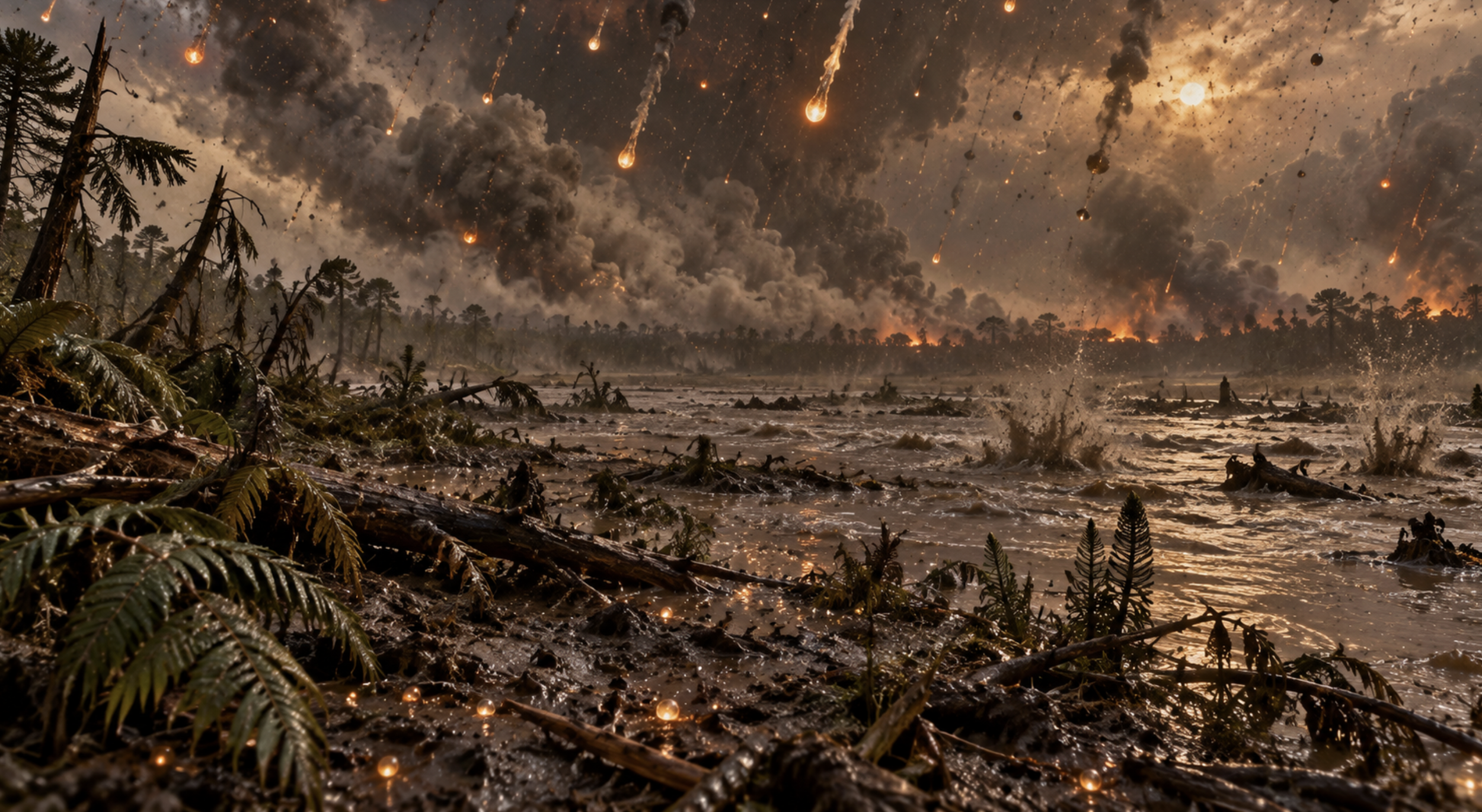
Somewhere, a Dinosaur Was Having a Completely Normal Spring Day
Obviously none of us knows what one particular dinosaur was doing that morning. There wasn't a Triceratops journaling its plans for the day and unfortunately leaving the notebook somewhere for us to find.
But it was spring across parts of the Northern Hemisphere which means out there plants were growing and animals were feeding. The seasons were moving along exactly as they had for millions and millions of years.
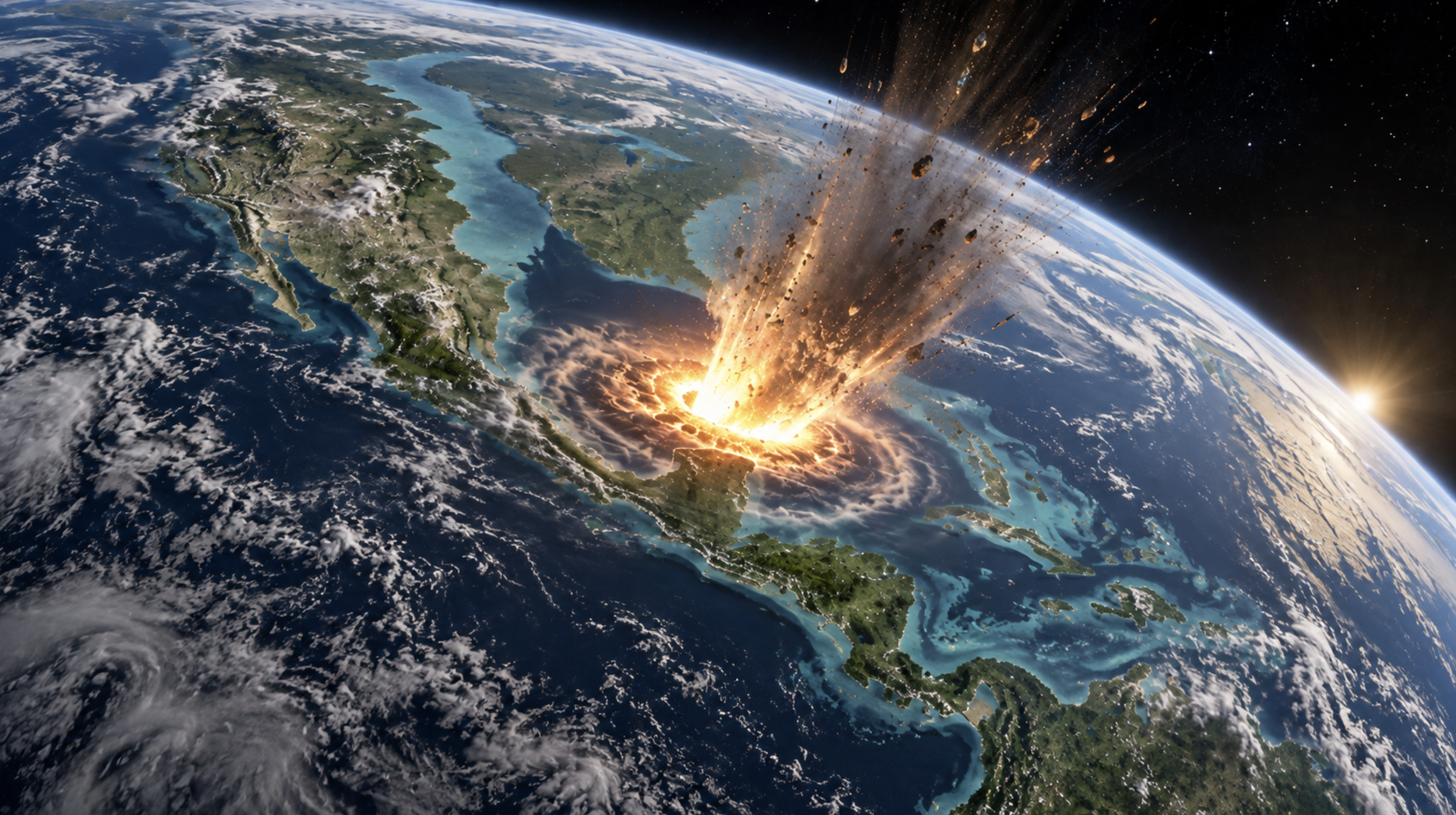
Then a roughly 10 to 15 kilometer-wide asteroid came screaming toward what is now Mexico's Yucatán Peninsula. The impact created the Chicxulub crater, an enormous buried structure roughly 200 kilometers across. For a little perspective, Philadelphia to New York is only around 130 kilometers in a straight line.
Something from space punched a hole in Earth considerably wider than that. Whenever I try to think about that my anxiety feels like it got a new hobby.
The asteroid splattering to Earth wasn't exactly like dropping a gigantic rock onto the ground. The speeds and pressures involved in a hypervelocity impact are so insanely enormous that rock doesn't behave the way we're used to seeing rock behave. Rock gets crushed then melts, some of it getting so hot it actually vaporizes. The momentum behind the impact made it so that some of the rock got launched upward fast enough to leave Earth entirely.
Scientists estimate the most violently ejected material from Chicxulub exceeded Earth's escape velocity, more than 11 kilometers per second. The crust underneath the impact was compressed and displaced. Deep rock from way down in the planet temporarily rose upward near the middle of the crater and then collapsed outward, producing a ring of uplifted material called a peak ring.
Scientists have drilled into this peak ring to get more information.
In 2016, an international drilling project pulled cores directly from Chicxulub's buried peak ring. Those cores contained around 130 meters of impact melt rock and smashed-up material that accumulated during essentially the first day after the asteroid hit. The lowest layers tell us what happened within minutes, then above that are materials deposited within tens of minutes. Then come deposits from ocean water rushing back into the crater, followed by material carried back by waves later that same day.
Some of the timeline of that day is sitting inside actual rock cores.
Then the Ocean Came Rushing Back In
Chicxulub hit near a shallow sea, so after excavating this absolutely enormous hole in the crust, seawater started pouring back toward it. The drill cores show material that was moved and sorted by this incoming water. Within roughly an hour, ocean water had surged over parts of the crater's newly formed peak ring. More material continued settling through the water over the following hours.
Later that day, waves returning toward the crater deposited another layer containing material from farther away…including charcoal. Meaning that while the crater was flooding, things elsewhere were already burning. This whole sequence is stacked physically inside the crater.
Earth accidentally made us a scrapbook of its worst day ever.
Fish Were Having an Absolutely Terrible Day
Now we have to go back to those fish in North Dakota because their story gets even stranger. Tanis is more than 3,000 kilometers from Chicxulub, yet the fossil bed there contains fish, plants and other organisms that were buried during an enormous surge of water very close to the time of the impact.
Researchers think seismic waves generated by Chicxulub triggered huge seiche waves in the river and estuary system there. A seiche is basically what happens when water in an enclosed or partly enclosed area starts violently sloshing back and forth after a major disturbance. Think about shaking a bathtub…same sort of idea, except the bathtub is an ancient river system and the thing shaking it is one of the largest impacts Earth has experienced during the age of complex life.
Fish were swept up and buried in the mess, and then naturally, scientists looked inside their gills.
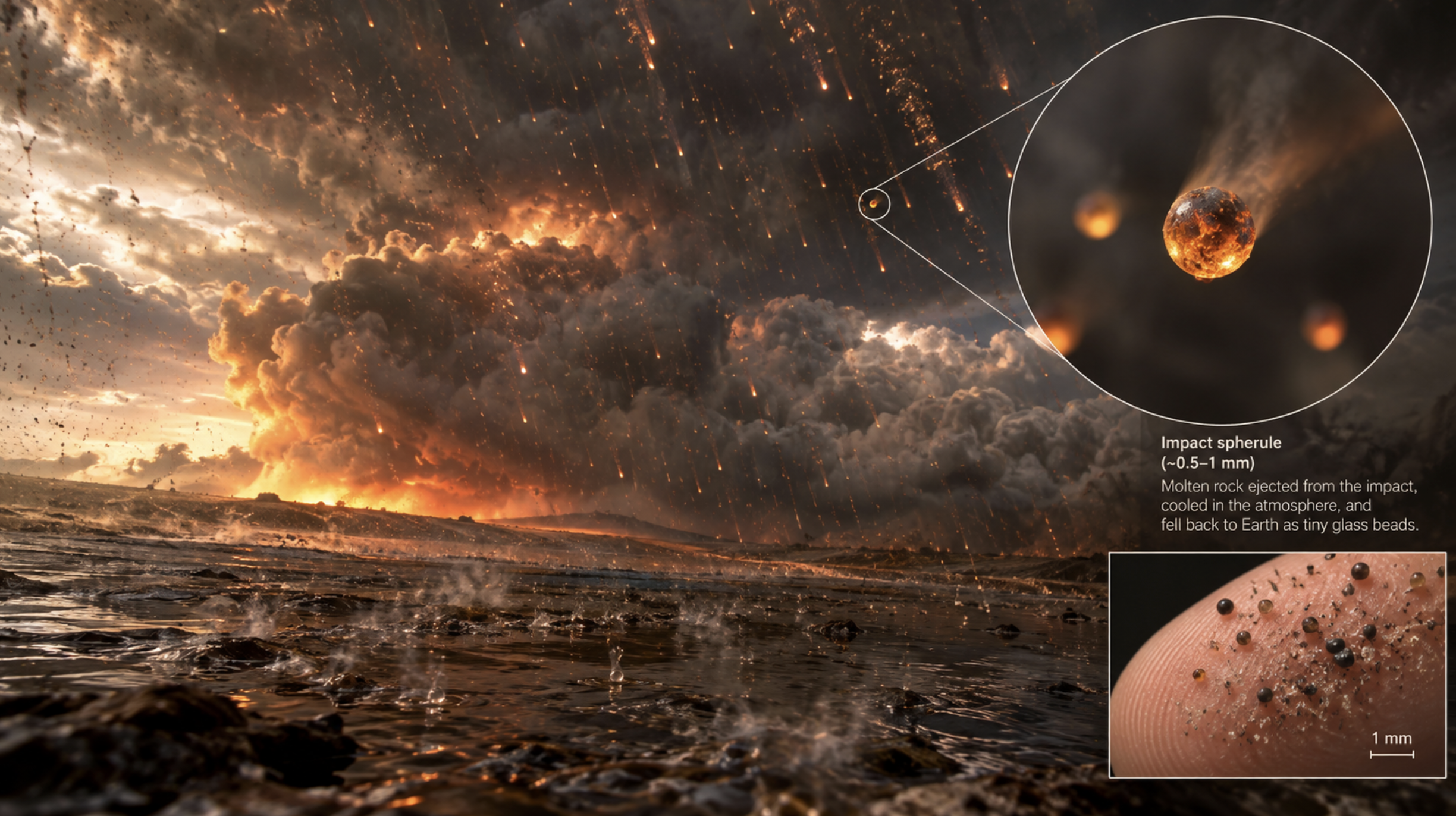
Tiny glassy balls called impact spherules were lodged in the gills of some of the fish. Turns out that when Chicxulub hit, some of the rock at the impact site melted and was blasted high into the atmosphere. Tiny droplets cooled while airborne and solidified into little glassy spheres before falling back toward Earth. It basically started raining pieces of melted planet which sounds a little like my worst nightmares.
The Tanis fish were apparently still alive and breathing while these particles were coming down because the spherules became trapped inside their gill structures. Ugh, what a way to go. Then the fish died and were buried, then 66 million years passed.
That’s about as close as we're ever going to get to somebody handing us a timestamp from the end of the Cretaceous.
If all we had was one strange fossil deposit in North Dakota, you'd obviously want to be careful about building an entire global story around it. Thankfully, we have way more than that though.
It’s neat to me how many different branches of science eventually arrive at the same place. Geologists have the crater then the Paleontologists have the fossils while Botanists have pollen and Chemists have iridium. Mineralogists even get involved with their shocked quartz and climate scientists have sediment and atmospheric models.
Quartz Apparently Remembers Being Hit
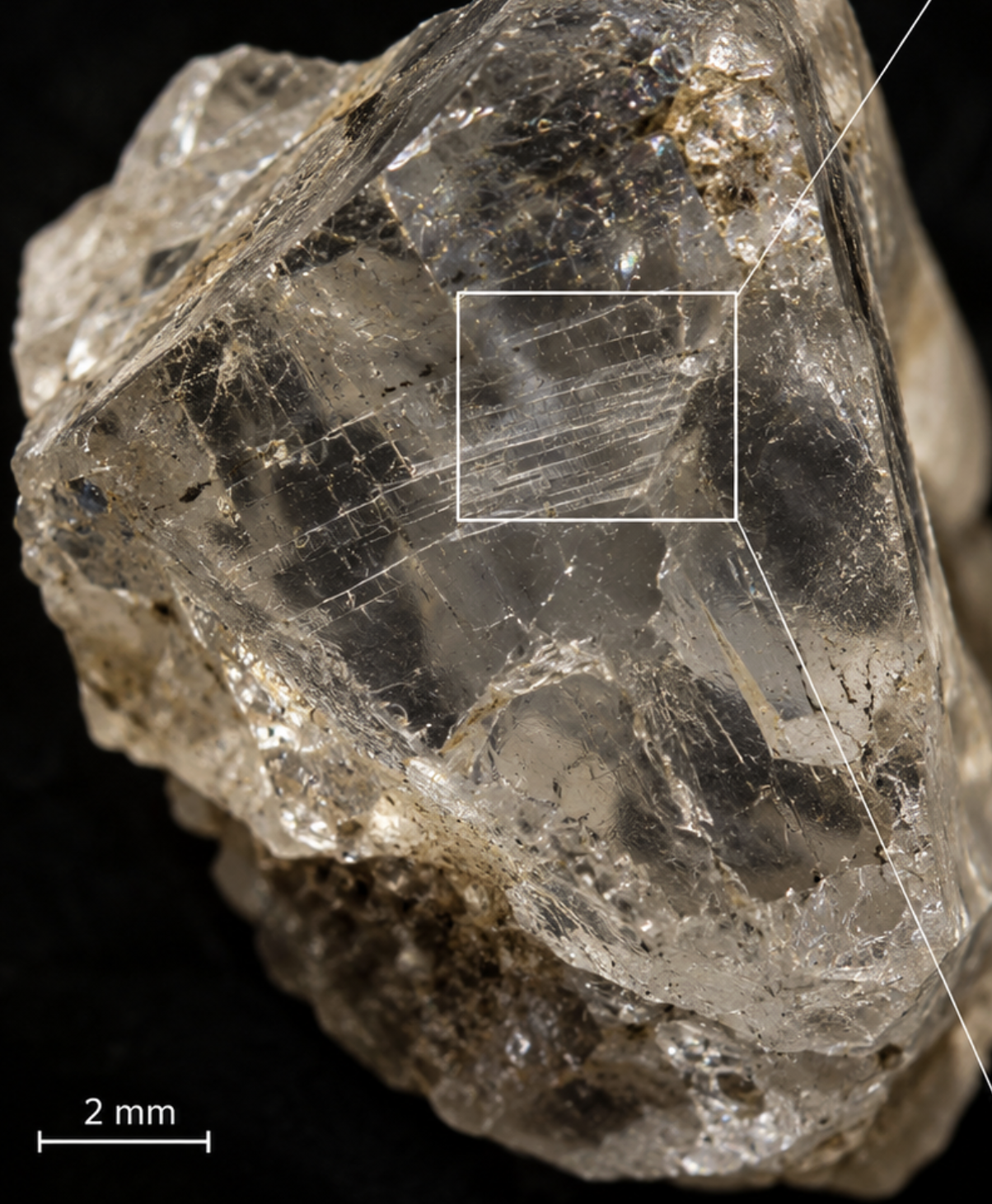
Regular quartz is extremely common and you can find it a wholeeee lot of places on Earth. Shocked quartz is another story, however. When quartz experiences enormous pressure very suddenly, its crystal structure develops microscopic features called planar deformation structures. Normal geological conditions don't just casually do this, but meteorite impacts do or nuclear explosions can.
The kind of pressures we're talking about are so extreme that the mineral itself preserves microscopic scars from what happened to it. Shocked quartz has been found in K-Pg boundary deposits far from Mexico, along with other pieces of impact ejecta.
A tiny crystal got absolutely blasted 66 million years ago and kept the damage inside its structure until somebody put it under a microscope. Rocks are incredible little snitches, and seeing as I don’t think dinosaurs were messing around with nuclear weapons, the meteor is probably a better culprit.
Then There's the Iridium Layer
This was one of the discoveries that really pushed scientists toward the asteroid explanation in the first place. Back in 1980, physicist Luis Alvarez, geologist Walter Alvarez and their colleagues published research on a strange layer sitting right at the boundary between the Cretaceous and Paleogene.
That boundary is basically Earth's line between “before the mass extinction” and “after the mass extinction.” Inside it, they found way too much iridium.
Iridium exists here on Earth, but most of the planet's original supply sank toward the core when Earth was young, so there's relatively little of it in the crust. Meteorites and asteroids tend to contain considerably more than just the top of our planet has. The researchers found huge iridium spikes in K-Pg boundary rocks from several different places around the world and proposed something pretty wild for the time.
A giant asteroid had hit Earth and that asteroid dusted the planet with a chemical fingerprint.
Decades after the original iridium discovery, scientists analyzed the drill cores from Chicxulub itself and they found an iridium anomaly there too. So now you have this unusual element showing up in boundary layers around the planet and inside the giant impact crater in Mexico. Four independent laboratories worked on the crater samples, and the results tied the Chicxulub impact even more tightly to the iridium layer marking the global K-Pg boundary.
And Then We Have the Plants
This might be the evidence I love the most after the fish because pollen seems so ridiculously delicate compared with an asteroid impact, yet pollen survives beautifully in the fossil record.
Different plants make differently shaped pollen grains, and those microscopic grains accumulate in sediment over time. Scientists can take samples from rock layers before and after the K-Pg boundary and see what kinds of plants were living there. Before the impact, western North America had diverse plant communities represented by all kinds of pollen.
Then you hit the boundary and a significant number of those pollen types abruptly disappear.
At studied sites in southwestern North Dakota, researchers have estimated an extinction of roughly 30 percent of pollen taxa right around the boundary, while studies of fossil leaves indicate even heavier losses in some areas. Then something really weird happens and the ferns show up. A LOT of ferns.
Directly above the K-Pg boundary at many sites, scientists find a sudden explosion of fern spores. It's literally called the fern spike. This sounds random until you remember what ferns are really good at doing. They move into disaster zones. After volcanic eruptions, fires and other events that clear out established vegetation, ferns can be some of the first plants to recolonize the landscape. Their spores travel easily and they don't need a healthy mature forest sitting there waiting for them.
Scientists finding rich flowering-plant pollen communities below the boundary, then the impact layer, then suddenly…FERNS. At a North Dakota site called John's Nose, one fern-spore genus accounted for around 59 percent of the pollen-and-spore assemblage immediately above the boundary.
The fossil record is basically saying: forest…forest…forest…something absolutely terrible happened…FERNS EVERYWHERE. Gradually, other plants returned eventually, but the ferns came in hard.
The Dinosaurs Didn't All Just Get Blasted Off the Planet
Obviously anything reasonably close to Chicxulub was having an extremely terrible time and most likely didn’t have the best of days, but a dinosaur living on the opposite side of the planet didn't get vaporized because an asteroid landed in Mexico.
The truly deadly part was what happened next when Chicxulub threw huge amounts of dust, pulverized rock, soot and gases into the atmosphere. A fast-moving cloud of impact material appears to have spread around the planet within only about four or five hours.
So something happened in Mexico at breakfast and material from it already wrapping around the PLANET by lunch. The atmosphere filled with things capable of blocking sunlight and Earth began getting dark…and then it got cold.
Different models have looked at the effects of sulfur, soot and pulverized rock, and scientists are still debating exactly how much each contributed. A 2023 Nature Geoscience study looked closely at very fine silicate dust preserved in K-Pg sediments and modeled what that dust could've done in the atmosphere. Their simulations suggested some of the finest dust particles could have stayed aloft for around 15 years. More importantly, the model produced conditions where photosynthesis could've been almost completely shut down for nearly two years.
Two years of plants trying to live without normal sunlight. Good luck with that, my houseplants kick the bucket if I look at them a little funny.
The same study modeled a global average surface temperature decline of as much as around 15°C under its dust scenario.
More recent work has suggested the amount of sulfur released could’ve been lower than some previous estimates, so exactly how much of the cooling came from sulfur versus dust and soot is still being worked out. The broad picture stays pretty horrifying even while the exact ingredients are adjusted.
No Sunlight Means Everything Starts Falling Apart
This is where the asteroid becomes a mass extinction instead of simply an enormous natural disaster. Plants need sunlight to do their thing. Phytoplankton need sunlight to create oxygen. Herbivores need plants andddd predators need herbivores.
Ocean food webs depend heavily on microscopic organisms doing their little photosynthesis jobs at the bottom of the chain. You don't have to kill every Tyrannosaurus rex with a flaming rock, you just have to remove enough of the food system underneath it.
Once photosynthesis crashed, ecosystems began unraveling from the bottom up.
A really interesting study published in Nature in 2026 modeled marine ecosystems after the Chicxulub impact and found that the dramatic reduction in sunlight could reproduce many of the strange extinction patterns scientists actually see in marine fossils. Smaller organisms and those better adapted to low-light conditions tended to have advantages, while many larger and more energy-hungry forms struggled.
Which is kind of the whole mass extinction problem in a nutshell. When the planet suddenly stops supplying energy the way it always has, being enormous becomes considerably less fun.
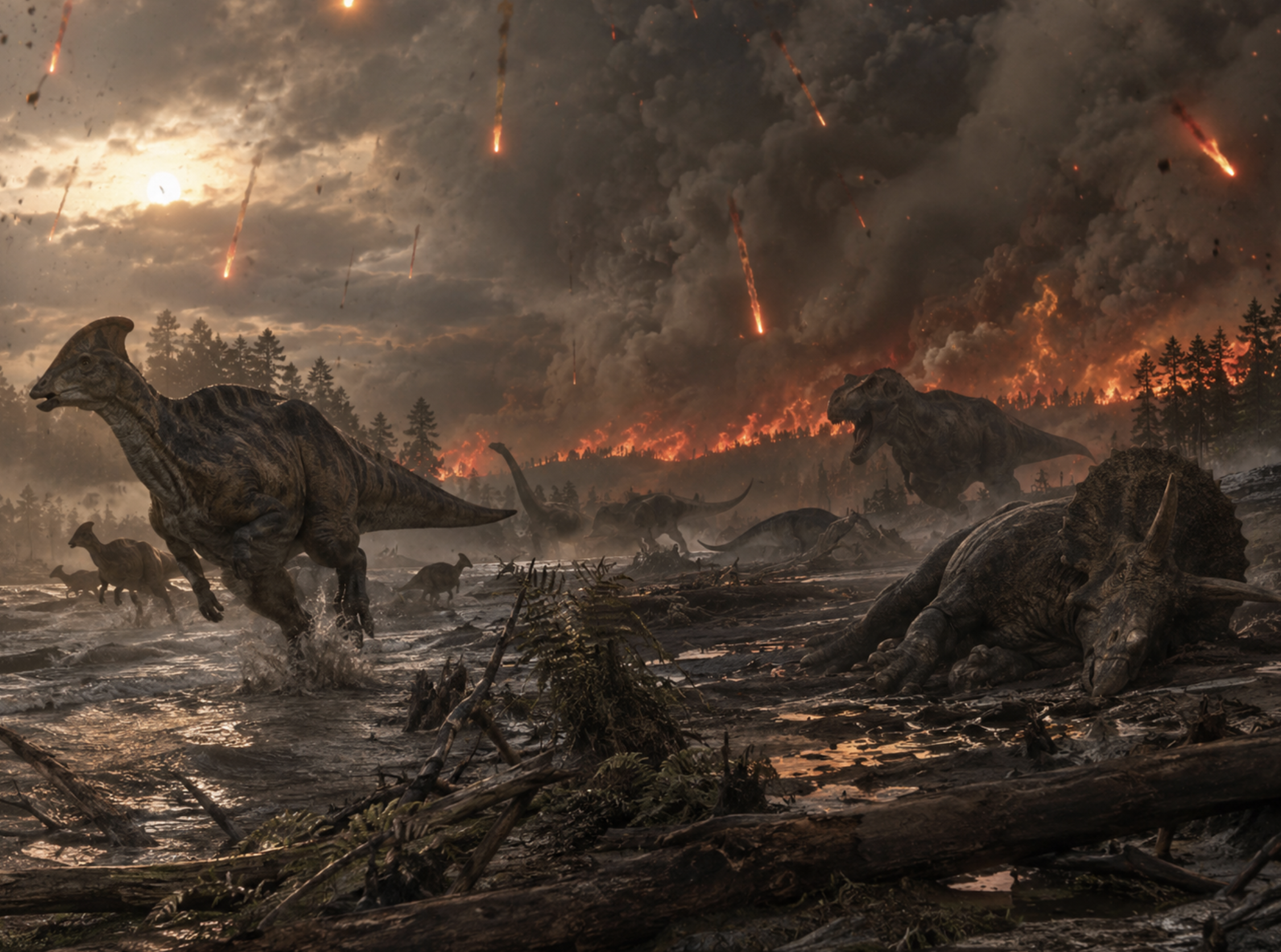
There Were Fires Too, but Probably Not One Giant Global Fireball
The movie version gets a little ahead of the science in this case. There absolutely is evidence of major fires associated with the impact. Scientists have found charcoal in K-Pg deposits, and the Chicxulub drill cores contain charcoal that appears to have washed into the crater on the first day.
Researchers have also found charred tree material in Mexico that reached incredibly high temperatures shortly after impact. What scientists have debated is whether essentially the entire planet burst into flames from the heat of ejecta falling back through the atmosphere. Evidence supports enormous and widespread fires, but the old image of every forest on Earth simultaneously becoming one giant bonfire is probably too simple.
Which is fine, really. We already have an asteroid, earthquakes, giant waves, raining glass, burning forests, darkness and a multi-year environmental catastrophe, I don't think the story needs embellishment.
Did Every Dinosaur Die That Day?
No, they did not.
I think that somehow makes the story sadder. Plenty of animals would've survived the impact itself then life got a lot harder. Especially those that were far away from Mexico. They probably felt the ground shake, then sky started acting very strange. I’d imagine that some fires appeared around them before the plant’s temperature changed. Days got darker then the plants around them start dying.
Food became harder to find and the ecosystem they spent their entire life depending on simply stops working the way it always did.
The Chicxulub impact happened in a moment, but the extinction unfolded afterward.
Around three quarters of Earth's species ultimately disappeared during the K-Pg mass extinction, including every non-avian dinosaur. Birds survived, meaning technically dinosaurs are still yelling outside my bedroom window every morning, but the giant terrestrial dinosaurs were gone.
The asteroid changed Earth so much that surviving the first day wasn't necessarily the hard part.
Isn’t it cool though that people out there could reconstruct a random day 66 million years ago? We don't know it because of one magical fossil, but because thousands of completely different clues agree with one another. The crater tells us something enormous hit Mexico, and the physics of the crater tells us the pressures and energies involved.
Shocked quartz tells us rocks experienced insane pressure all over the globe, and glass spherules tell us Earth material melted and flew through the atmosphere. Fish with those spherules stuck in their gills tell us living animals were breathing while the debris fell (worst nightmare), and growth bands and isotopes inside those fish bones tell us what season it was.
Iridium tells us that extraterrestrial material spread around the planet while the pollen we found tells us which plants disappeared. Fern spores show us devastated landscapes starting to recover over time and charcoal tells us fires happened. Ocean sediments show huge biological changes and climate models take the actual dust and chemistry preserved in those sediments and test whether they can recreate the darkness and cooling the fossil record seems to require.
Earth Keeps Receipts
Sixty-six million years is an amount of time my brain cannot even remotely comprehend without starting to itch a little bit. In that time mountains can rise and erode and entire species can evolve and disappear. Continents crawl across the planet while oceans open and close based on where the landmasses have migrated along to.
Somehow after all that time, a fish can still have tiny pieces of the worst day in Earth's recent geological history sitting inside its gills.
The dinosaurs never wrote down what happened to them, and apparently they didn't have to. The planet did it for them.
Related Reads You Might Enjoy:
Asteroid 2003 MH4: The Colossal Stranger Slipping Past Earth
The Shattered Planet That Lives On: What Vesta Tells Us About Cosmic Ruins
The Deepest Hole on Earth: What Scientists Found Inside Kola Superdeep Borehole
When the Moon Rang Like a Bell: NASA’s Apollo Mystery That Still Echoes
The Sound of Extinction: How Disappearing Animals Take Silence With Them
The Quiet Giants: Why Trees Are More Valuable Than Diamonds (and Always Have Been)
The Plants That Predict Earthquakes: Is Nature Trying to Warn Us?
Will Earth Really Become Uninhabitable? A Supercomputer’s Warning, and What We Can Still Save
The Immortal Jellyfish: A Creature That Rewinds Its Own Life
Comb Jellies and the Ghost Code of Life: What These Ancient Creatures Teach Us About Evolution
The Skull That Held a Spark: What a Primate Fossil Tells Us About Becoming Human
Weird Science for Beach Scrolling: Strange Discoveries to Melt Your Brain While You Tan
Works Cited
Alvarez, Luis W., Walter Alvarez, Frank Asaro, and Helen V. Michel. “Extraterrestrial Cause for the Cretaceous-Tertiary Extinction.” Science, vol. 208, no. 4448, 1980, pp. 1095–1108. Science/PubMed record
DePalma, Robert A., et al. “A Seismically Induced Onshore Surge Deposit at the KPg Boundary, North Dakota.” Proceedings of the National Academy of Sciences, vol. 116, 2019, pp. 8190–8199. Research paper
During, Melanie A. D., et al. “The Mesozoic Terminated in Boreal Spring.” Nature, vol. 603, 2022, pp. 91–94. Nature study
Goderis, Steven, et al. “Globally Distributed Iridium Layer Preserved Within the Chicxulub Impact Structure.” Science Advances, vol. 7, no. 9, 2021. Science Advances/PubMed record
Gulick, Sean P. S., et al. “The First Day of the Cenozoic.” Proceedings of the National Academy of Sciences, vol. 116, no. 39, 2019, pp. 19342–19351. PNAS study
Morgan, Joanna V., et al. “The Chicxulub Impact and Its Environmental Consequences.” Nature Reviews Earth & Environment, vol. 3, 2022, pp. 338–354. Nature Reviews article
Nichols, Douglas J. “Selected Plant Microfossil Records of the Terminal Cretaceous Event in Terrestrial Rocks, Western North America.” Palaeogeography, Palaeoclimatology, Palaeoecology, vol. 255, 2007, pp. 22–34. USGS record
Vajda, Vivi, et al. “Palynostratigraphy of John's Nose, a New Cretaceous-Paleogene Boundary Section in Southwestern North Dakota, USA.” Palynology, vol. 36, 2012. Journal article
Senel, Cem Berk, et al. “Chicxulub Impact Winter Sustained by Fine Silicate Dust.” Nature Geoscience, vol. 16, 2023, pp. 1033–1040. Nature Geoscience study
Vellekoop, Johan, et al. “Reduced Contribution of Sulfur to the Mass Extinction Associated With the Chicxulub Impact Event.” Nature Communications, vol. 16, 2025. Nature Communications study
Ying, Rui, et al. “Darkness and Body Size Shaped End-Cretaceous Marine Extinction Patterns.” Nature, vol. 655, 2026, pp. 957–962. Nature study