Inside Sơn Đoòng, Earth’s Hidden Weather System
I’m an adventurer at heart. I say “at heart” because I truly want to go around and explore the world. There are many issues with me actually acting on that including that spiders make me scream, I have a deep fear of being in water, my bank account is getting sadder the older I get, and there’s also the fact that dirty things make me cringe. Other than all of those things though, I’d be an excellent adventurer.
Even though it feels like the world is already mapped and explored everywhere, there are still places on Earth that feel less like locations and more like secrets. This particular place I’m talking about might be waiting patiently beneath the surface, holding its breath for thousands, maybe even millions, of years. These places weren’t designed for us, and honestly the world would be better off if we never went into them, yet, when they’re finally revealed, they rearrange our sense of scale, time, and humility.
Deep in central Vietnam, beneath dense jungle and limestone ridges that look truly unremarkable from above, such a place exists. Its name is Sơn Đoòng Cave, and it’s the largest known cave on Earth.
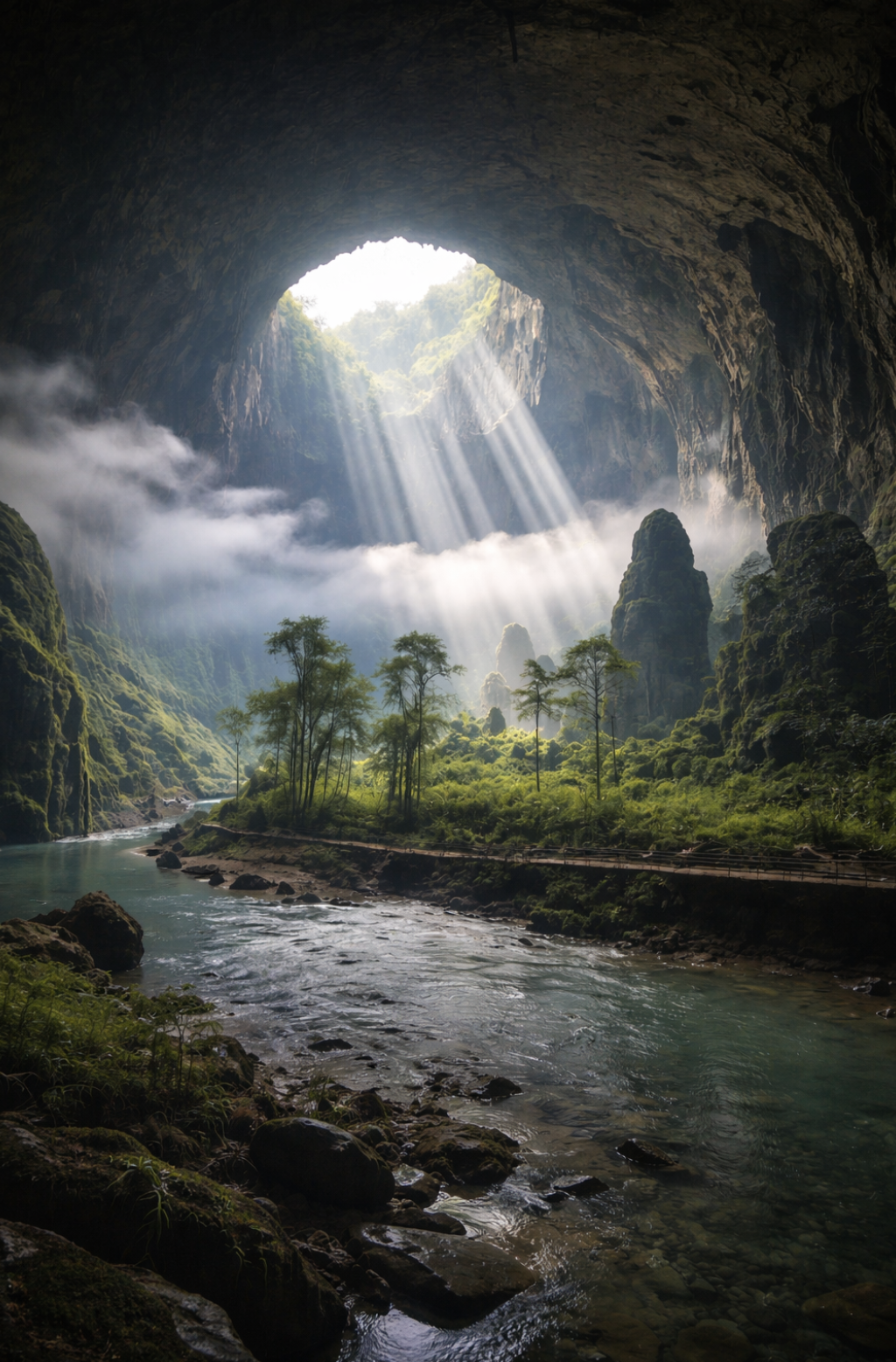
I say the largest cave on Earth and I don’t mean by length alone or a technical footnote buried in geological records, I mean by volume, the sheer amount of space it carves out of the planet. Inside Sơn Đoòng, clouds drift as rivers flow, and trees grow toward sunlight that filters through collapsed ceilings hundreds of meters above. Temperatures shift as mist forms and air circulates. This truly magical cave contains weather, yes, but it also creates it.
I’m talking about geology doing what it has always done best: reshaping the impossible until it becomes inevitable.
A World That Was Never Meant to Be Found
Sơn Đoòng lies within Phong Nha–Kẻ Bàng National Park, a UNESCO World Heritage site known for its dense forests and super extensive cave systems. Oddly enough though, for most of human history, Sơn Đoòng itself went unnoticed. Local villagers knew of a strong wind and rushing water emerging from the forest floor, but it was a place they avoided. The name “Sơn Đoòng” loosely translates to “mountain river cave,” but the scale of what lay beneath was almost unimaginable.
It wasn’t until 1990 that a Vietnamese man named Hồ Khanh stumbled on the entrance while seeking shelter from a storm. Even after that, the cave remained unexplored for nearly two decades. The opening was intimidating and the roar of water was relentless, so I can’t really blame them. The wind also seemed to breathe outward, as if the mountain itself were exhaling, which is intimidating on a good day.
In 2009, British cave explorers finally returned with proper equipment and mapping tools. What they found made them to revise cave records, but also expectations of what Earth is capable of hiding in plain sight. Some chambers were so large that a Boeing 747 could fly through them if it wanted to (not advised). Other areas inside were more than 200 meters high, which is tall enough to swallow skyscrapers whole.
I’d love to imagine the explorers walking through Sơn Đoòng the way I stroll through Fairmount Park in Philadelphia, but I feel like it might have been a touch different. These guys entered it more similar to how one enters a cathedral, or a massive storm, more like something that doesn’t care whether you’re impressed by it or not.
Sơn Đoòng has its own weather, which is pretty remarkable if you think about it. To fully wrap my head around that idea I had to understand time in a more geological sort of way, the kind that moves at the pace of dissolving stone.
Roughly two to five million years ago (give or take), water began flowing through fractures in Vietnam’s limestone bedrock. Limestone is especially vulnerable to erosion by slightly acidic water, which slowly dissolves calcium carbonate. Over a literal millennia, small cracks widen and streams deepen as voids form. We all know what the Grand Canyon looks like and how the determination of water can eventually break stone.
Over enough time, those voids connect. Sơn Đoòng grew through collapse as well as patient excavation with water carrying stone away grain by grain, molecule by molecule, until space itself emerged.
At some point, sections of the cave ceiling became too thin to support their own weight and collapsed. These collapses created massive openings that the interwebs (and geologists I guess) call “dolines”, which are natural skylights that let in sunlight, rain, and a bunch of other organic matter that blows in to pour into the cave’s interior.
This is where the weather begins. Warm air enters through openings and meets cooler air trapped deep inside. If you’ve ever looked into how a distillery makes alcohol this might sound familiar to you. Moisture condenses and fog forms. Clouds drift across chambers large enough to host them as temperature gradients create airflow strong enough to feel like wind.
Sơn Đoòng doesn’t borrow weather from the outside world like the rest of us lowly peasants, it generates it through physics alone.
Forests Beneath the Earth
Where sunlight reaches stone that has never seen it before, life inevitably follows.
Inside Sơn Đoòng are entire underground forests now, and I mean real ones, not poetic exaggerations (although if you’ve been here before you know I love to exaggerate). Trees actually stretch upward from nutrient-rich soil formed by centuries of fallen debris and moss carpets rock walls. These ecosystems are young by geological standards, but already deeply complex. Insects adapted to low light thrive alongside plants that have learned to survive without direct sun for most of the day. Microbes process minerals leached from stone and nutrient cycles form in isolation.
This isn’t a relic ecosystem preserved from ancient times, it’s a new one, a magical environment that came into existence only because the cave partially collapsed, letting the surface world bleed inward.
Unlike some of us, terrified to take a risk, nature never wastes an opening. It used it.
Photographs of Sơn Đoòng often look unreal and like something churned out of ChatGPT. Sunbeams cascade dramatically through mist as rivers glow a hue of almost emerald beneath cavernous ceilings. Trees look impossibly small, as if pasted into a fantasy landscape, both cute and impressive at the same time. I actually thought some of the images I saw online were fake because of that. Most of the photos out there are often enhanced for contrast, exposure, and clarity. Cameras struggle to capture spaces this large and our eyes do too. Not that it matters much, when was the last time you saw an untouched photo in a magazine?
Standing inside Sơn Đoòng is surreal because your brain expects walls to close in or ceilings to appear. Mine at least expects caves to be small, damp, and dramatically enclosing. Here though, you find space. So much space that sound behaves differently, light behaves differently, and even time feels different.
The cave doesn’t feel subterranean, it feels separate and almost alien. Caves like this are what inspired wild stories like Journey to the Center of the Earth.
Why We Protect What We Barely Understand
Despite its grandeur, Sơn Đoòng is one of the most tightly controlled natural sites on Earth. Thankfully.
Only a small number of visitors are allowed inside each year. I’m honestly hoping one day someone from there will see this post and invite me (I’m totally ready to go, I’ll brave the spiders and everything!). Expeditions require days of trekking, trained guides, safety teams, and super strict conservation protocols. Human waste is carried out and not left behind, campsites are carefully managed, and paths are limited.
While it might sound a little like gatekeeping, it’s actually preservation being carried out as best as they can.
Cave ecosystems are extraordinarily fragile. A single footprint can destroy formations that took tens of thousands of years to grow. Introducing bacteria, light pollution, or unchecked tourism could permanently alter the cave’s internal climate, which could have devastating results. Sơn Đoòng survived unseen for millions of years, but now that we know it exists, our responsibility is to leave it as intact as possible.
There’s something quietly revolutionary about that idea because we live in an era obsessed with visibility.
If something cannot be photographed, monetized, shared, optimized, and repeated, it’s treated as if it doesn’t matter. Depth is traded for social reach as mystery is flattened into content. The thing is though, the most extraordinary systems on Earth still operate beyond our gaze. Sơn Đoòng is a nice little reminder that beauty doesn’t always require an audience. It can exist fully formed, perfectly functional, and utterly indifferent to whether anyone ever sees it.
For millions of years, clouds drifted through that cave without witnesses as forests grew underground without names. Nothing about the cave changed when we finally entered it.
The planet is still capable of surprise, and not just small surprises either, but ones that rewrite our assumptions. Nature builds systems layered atop systems, hidden beneath systems, and quietly running long after we stop paying attention.
The world we see is only a surface layer, which is actually thin, temporary, and wholly incomplete. There are entire climates beneath our feet. To me, there’s a strange comfort in knowing that places like Sơn Đoòng exist. They prove that not everything has been discovered, explained, or claimed by someone that came before us. Some things out there still remain vast and indifferent and unoptimized.