The Gold We Still Don’t Fully Understand
I’m a gold-girlie. I’ve always been partial to golden rings, necklaces, bracelets, you name it. If my budget wasn’t strictly pay-bills-and-try-not-to-starve, I’d have a much larger collection than I currently boast. Alas, my taxes are busy going to a bunch of people who steal them, so I’ll be here dreaming about it instead.
Etruscan gold is something fancy that caught my eye a while back, but I didn’t think anything of it. To me, gold is gold is gold. Today, however, I was using my 5 minute doom-scrolling treat (yeah, I know it’s not a treat for my brain), and stumbled upon just how strange this gold actually is. Color me pink and slap me with an orange, I was instantly intrigued.
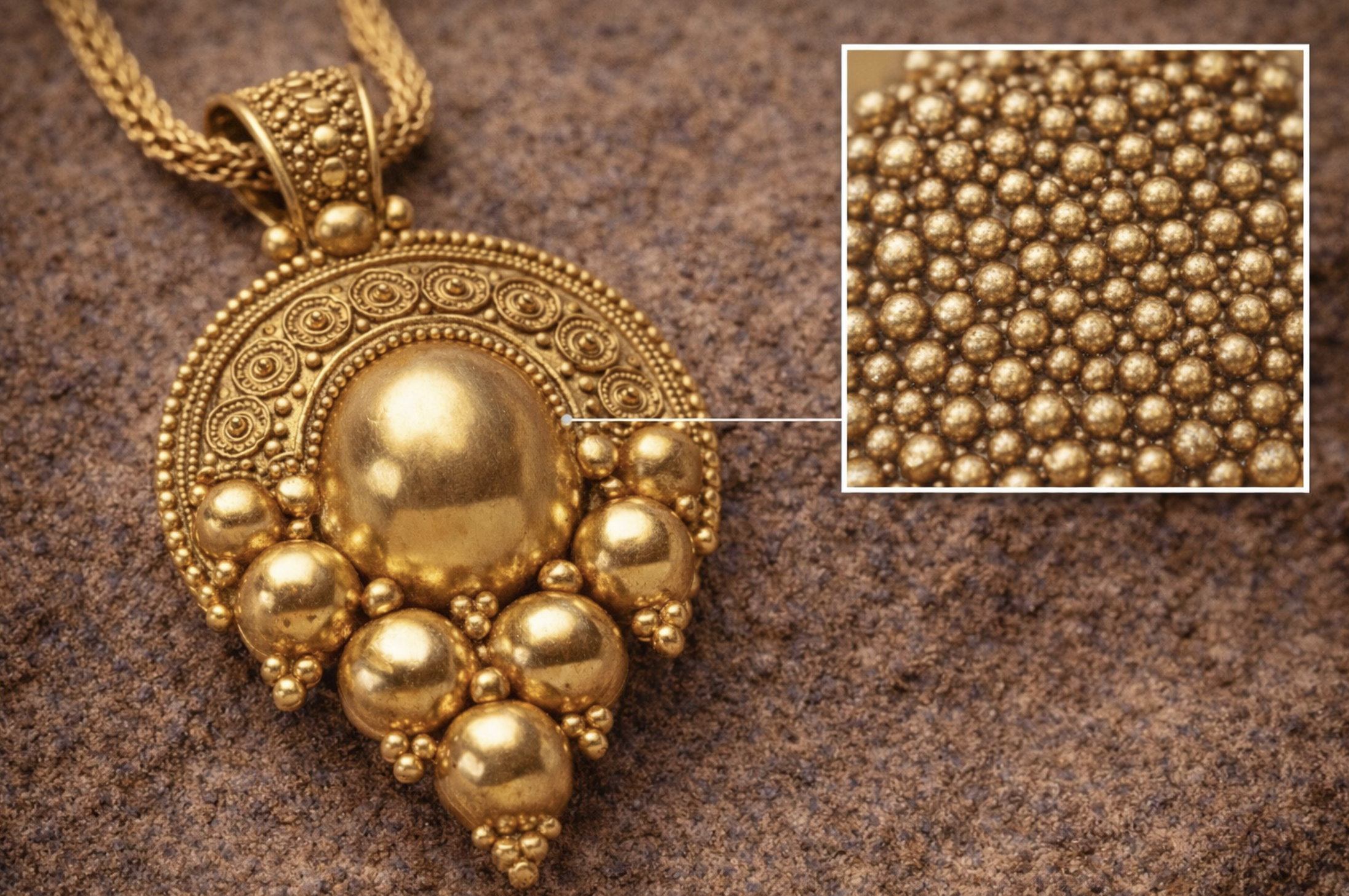
If you were to peer at some Etruscan gold piece today you’d be expecting to find the seam to it eventually, some sort of trick how to stays together. My fellow gold-girlies know what I’m talking about, that sign of how it was fused to make the piece. The thing is though, the longer you look, the stranger it becomes. Hundreds, sometimes thousands, of microscopic gold spheres, arranged into precise geometric patterns, fused to a surface with no visible solder, no pooled metal, and abslutely no distortion.
Nothing looks melted or forced on these pieces, which gives it that mysterious feeling like it just popped into existence instead of being made.
Once you see it, after you get past the shock of how did they do this, it turns more into why did we ever decide this kind of knowledge shouldn’t exist anymore?
The Separation of Making From Knowing
The Etruscans lived in central Italy centuries before Rome decided it would inherit their land, their art, and eventually their silence. They were traders, ritualists, metalworkers, and storytellers, a people who understood the world as layered and symbolic, where materials weren’t just objects but expressive.
Gold was not a commodity to them in the modern sense that it is today. It wasn’t future wealth or stored value to be traded in case of the apocalypse for some chicken or beef. No, gold was something alive with meaning and used in funerary rites, religious symbolism, and personal adornment meant to travel with the dead.
They treated craftsmanship as a literal art-form, and the more beautiful a piece was, the better for bringing with you to the afterlife.
Etruscan gold granulation is basically a technique where tiny spheres of gold that are sometimes smaller than a grain of sand, are arranged onto a gold surface and fused in place without visible solder. That means no seams or weird drips or even excess metal betraying the join.
For centuries, modern jewelers stood in front of these pieces baffled. Attempts to replicate them usually failed when either the spheres melted and lost their shape, visible solder lines appeared, or the surface warped or pooled.
Don’t get me wrong, modern metalworking could produce similar designs, but not this. The same cleanliness, restraint, and invisibility of method seemed almost impossible to recreate. That gap between imitation and understanding is where the myth began.
The Myth of “Lost” Knowledge
For a long long time, Etruscan granulation was labeled a “lost art.” Museums used the word freely as scholars whispered it with fascination and popular culture ran with it. Now, lost of course doesn’t mean someone put down the recipe and then forgot where they put it. It also implies some sort of mystery or tragedy, like something essential had slipped through history’s fingers.
But “lost” really isn’t the right word.
What eventually emerged through decades of careful experimentation by the way, was a more mundane and far more uncomfortable truth.
We abandoned the conditions that made it possible. The process itself is no longer a complete mystery, even though it remains extraordinarily difficult to execute cleanly, so don’t expect to find any at your local jewelry store. Etruscan granulation relied on several different factors working together in near-perfect balance, something my Libra brain can appreciate.
First, the gold itself. Ancient Etruscan gold was exceptionally pure, often exceeding 99% gold. Modern gold alloys normally include higher percentages of copper or silver for durability, which changes how the metal behaves under heat. Also, the granules weren’t poured or cast, they were often formed by cutting fine gold wire into teeny tiny fragments and gently heating them, sometimes on charcoal, until surface tension coaxed them into perfect little spheres. Then came the binder. Research suggests the Etruscans used copper salts, organic compounds, or plant-based glues to temporarily hold the granules in place. Now, when heated, these substances created a localized chemical environment that encouraged bonding at the surface level.
The final step was heat…but not too much.
Gold melts at 1064°C in case you were wondering. Granulation occurs just below that threshold. At this precise temperature, atoms on the surface of the gold become mobile enough to migrate across boundaries, bonding granule to base through a process known as surface diffusion.
So nothing really liquefies or collapses in this process, the bond forms invisibly. Miss the temperature by a few degrees and the entire piece is ruined. There was no brute force metallurgy happening here, it was control at the atomic edge.
Why Modern Craftspeople Keep Failing
Early recent attempts to recreate granulation approached it like a puzzle, which was why we couldn’t recreate this. They wanted to first identify the missing ingredient, apply the method, then reproduce the result.
The thing is though, granulation resists shortcuts. You need patience (which none of us seem to have these days), tactile awareness, a tolerance for failure, and a willingness to ruin hours of work in seconds. The thing is, I really honestly don’t know anyone who’s okay with failure these days. I might be one of the most comfortable people I know with it, but I’m still annoyed by it.
Modern workshops are not designed for this at all, they’re designed for efficiency, repeatability, and high yield. That’s why microscopes helped, but didn’t solve the real mystery.
The Etruscans didn’t leave behind blueprints for granulation. The knowledge lived in hands and was passed down via their craft. Long apprenticeships that couldn’t be rushed had plenty of time to train muscle memory how heat behaved before metal ever betrayed it. Failure that happened quietly, without cameras, and without an audience waiting for results is how these pieces were created.
Today, we document everything but actually understand very little. We go about our lives and produce endless content about making things, while fewer people actually know how to make them. Craft has been replaced by visibility and skill by speed.
What the Etruscans practiced couldn’t survive in a world obsessed with content, because it required slowness, patience, and repetition without reward. Performance is the opposite of these pieces. When the hands that made them disappeared, the knowledge went with them.
Today we love to label ancient techniques “impossible” when they don’t fit neatly into our systems of productivity. If something can’t be scaled, automated, monetized efficiently, or taught quickly, we assume it was mysterious or a little magical. It’s easier to say the knowledge vanished than to admit we reorganized society in a way that no longer makes room for it.
Brute Force vs Understanding
Modern metallurgy celebrates dominance over materials with higher temperatures, stronger alloys, and faster throughput. There’s pride in pushing matter past its limits, but granulation did the opposite.
It worked just shy of melting and respected thresholds. It was mastery through restraint. Which is funny, because restraint isn’t something we reward much anymore. Etruscan granulated jewelry wasn’t some wild hidden knowledge either, I mean, these pieces were worn, buried with the dead, or passed through generations. The makers didn’t feel compelled to explain their work to the future either, they trusted that someone, someday, would recognize what they were seeing, even if they couldn’t immediately reproduce it.
That confidence feels foreign now as we document everything because we fear being forgotten. They made things that assumed they wouldn’t be.
Maybe I’m feeling down at the state of the world today, but this gold makes me long for simpler times. I feel as though I missed my chance to be born into a world that produces people who have time to learn these skills and arts.
Some knowledge doesn’t disappear, it just waits for hands that aren’t rushing.
Other Reads You Might Enjoy About Gold:
The Earth’s Core Is Leaking Gold: A Hidden Alchemy Beneath Our Feet
10 Outrageously Absurd Things the Super Rich Have Actually Bought
The Rise of the “Average” Millionaire, And Why It’s Not What It Used to Be
Why We’re Bankrolling Luxury Brands: The Spending Habits No One Talks About
When Luxury Starts to Burn: Moët Hennessy’s Crisis and the Future of Fine Wine
How the Middle Class Spends on Luxury, and Why It’s Not What You Think
The Richest Generation in History? Millennials and the Mirage of Wealth
The French Farmer Who Found $4 Billion of Gold Under His Field
The Death of the Penny: Why America’s Smallest Coin Is Finally Getting the Axe
Cosmic Alchemy: How Magnetar Flares Scatter Gold Across the Universe
If you’re looking for golden earrings, these are some of my favorites.