I've recently developed a rather enthusiastic interest in loose gemstones, which is apparently what happens when my brain decides the existing collection of hobbies needs an expansion pack. There are yellow sapphires, emeralds, an alexandrite that shifts toward purple and red, and those wonderfully strange salt-and-pepper diamonds.
I started with the colors. Naturally, I ended up reading about whether any of them were supposed to change my life, because…duh.
According to the world of crystal meanings, there's practically an entire emotional support department hiding in a jewelry box. Rose quartz gets assigned love, citrine gets prosperity, and amethyst gets the job of helping everybody settle down. Thinking about how long people have been attaching meaning to beautiful stones, I wanted to understand where those ideas came from, and what people actually mean when they say a gemstone has a frequency.
There's real physics here, fascinating history, and a considerable amount of interpretation that I of course ran with. The metaphysical properties below are beliefs and symbolic associations, rather than established effects of wearing a stone.
The chemistry is already pretty spectacular, even before we start giving the rocks responsibilities.
We Were Giving Stones Jobs Thousands of Years Ago
Long before crystal shops, people wore objects they believed could offer protection, good fortune, or a connection to something larger than themselves. The Metropolitan Museum of Art's account of Egyptian amulets explains that their supposed power could depend on material, color, shape, inscriptions, and the actions performed with them.
Green and blue could represent life and regeneration, while red could carry both dangerous and protective associations. A stone's appearance was part of its meaning, alongside a whole religious and cultural system.
Those meanings also changed between places and centuries. According to GIA's history of sapphire, blue sapphires became associated with royalty, faithfulness, heavenly blessings, and protection from harm. Of course, older gemstone names weren't always referring to the exact mineral we identify by that name today, so tracing a modern crystal claim directly back to antiquity can get messy pretty quickly.
Then there's amethyst, which has a particularly entertaining history for somebody who works in wine. Greek and Roman traditions connected its wine-like color with the god of wine, and people believed wearing it could prevent drunkenness.
That's an awfully convenient power to assign a purple rock. Alcohol still does what alcohol does, of course, but the belief tells us how easily color, storytelling, and the things people wanted protection from became tangled together.
What Different Gemstones Are Supposed to Help With
Guides such as Crystal Vaults document what their authors believe; I’m using those pages as examples of those beliefs, rather than scientific evidence for the health claims they sometimes contain.
Think of this as a guide to the stories people give the stones, with a little gemology mixed in because I can't leave well enough alone.
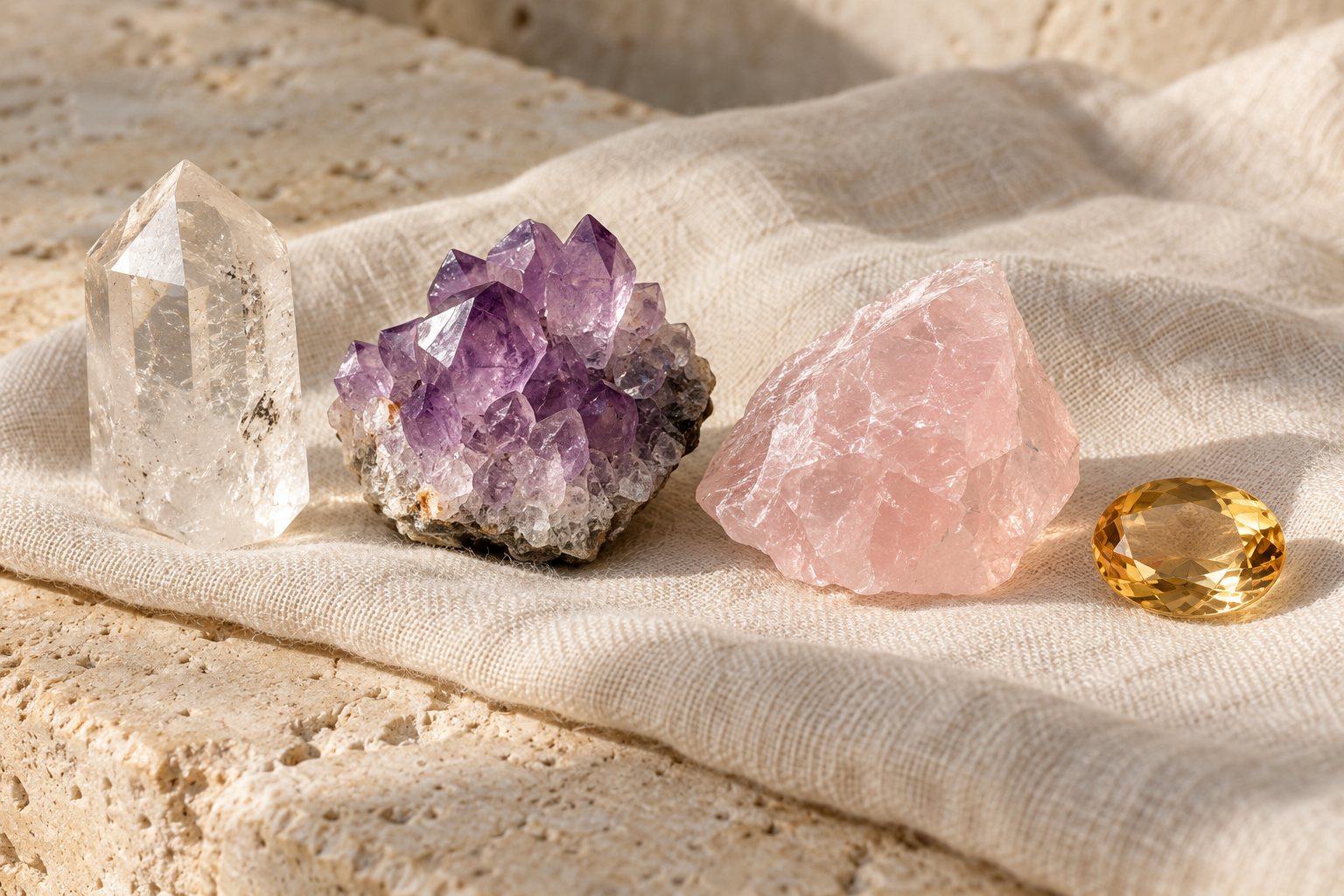
Left to right, clear quartz, amethyst, rose quartz, and citrine.
Clear Quartz and Having a Little More Clarity
Clear quartz is commonly described as an amplifier of intentions, associated with clarity, concentration, and spiritual awareness. The transparent appearance makes the clarity metaphor feel almost inevitable. I like the idea of choosing a specific intention when putting on a piece of jewelry, then letting the jewelry remind you of it during the day.
That's a practical use for a meaningful object, while the claim that quartz broadcasts thoughts into the universe remains a slightly more spiritual belief.
Amethyst and Giving Your Brain a Minute
In modern crystal writing, amethyst is associated with calm, reflection, meditation, and spiritual insight.
That sits rather nicely beside its older associations with clear-headedness, although the modern meanings have their own history too. I understand why somebody might choose a violet stone as a reminder to pause before reacting. Whether that pause helps is a different question from whether the mineral itself treats anxiety or changes sleep.
Rose Quartz and Being Kinder to Yourself
Rose quartz gets the love assignment, including affection, compassion, forgiveness, and self-love. Its pale pink color certainly makes it look qualified for the job.
I find the self-compassion association more useful than treating it as a way to make another person fall in love with you. A little reminder to speak to yourself with the same patience you'd offer somebody you care about seems like a pretty reasonable thing to carry.
One of my favorite rose quartz stories came from a woman named Liis in Estonia. Before meeting with somebody she had a hard time seeing eye to eye with, she’d put on a rose quartz necklace. She told the researcher it helped her keep her heart open and see the good in the person across from her.
Citrine and the Appeal of a Prosperity Stone
Citrine is associated with abundance, confidence, creativity, and success, which gives one yellow stone a rather ambitious workload. I'd happily borrow the symbolism for sitting down and actually working on a project.
Also, a useful gem fact from GIA, most commercial citrine is heat-treated amethyst. That's a disclosed treatment question when you're buying it, and a good reminder that the stories attached to color can be quite different even within the quartz family.
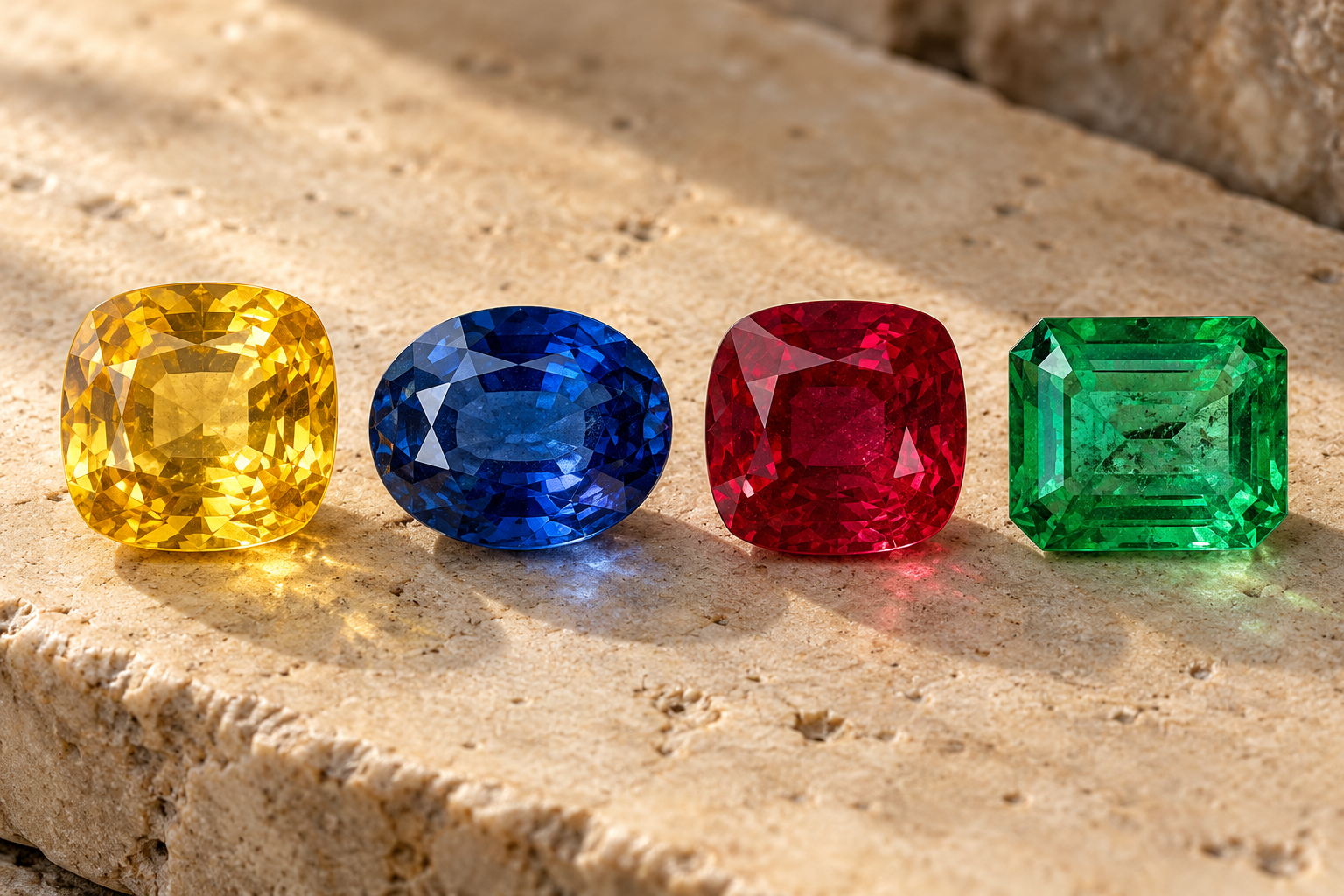
Left to right, yellow sapphire, blue sapphire, ruby, and emerald.
Yellow Sapphire and Turning an Idea Into Something
Yellow sapphire is given associations with prosperity, wisdom, and bringing ideas into form.
This is one of the meanings that interested me because I have about a million projects working at the same time normally. I purposefully sought out yellow sapphires to wear because turning an idea into something useful is practically a recurring theme in my life. I like the emphasis on action in that interpretation.
A gemstone can be a beautiful reminder of a goal, while the work, decisions, and circumstances still determine how the goal develops.
Blue Sapphire and a Bit of Good Judgment
Wisdom, truth, focus, and faithfulness are among the familiar meanings attached to blue sapphire.
Its longstanding connection with royalty probably helped give those associations some staying power. Personally, I think good judgment is a lovely thing to commemorate in a ring. It would certainly be useful to have a tiny blue reminder before agreeing to yet another project because it sounds interesting.
Ruby and Actually Having the Courage to Do It
Ruby's modern symbolism centers on passion, courage, motivation, and vitality. Its older lore also connected that intense red color with life and protection, as GIA describes. The color does a lot of the storytelling here.
There's something very understandable about looking at a vivid red gem and deciding it should represent being fully invested in your own life, rather than merely being very good at maintaining a to-do list.
Emerald and the Things We Want to Keep Growing
Emerald is associated with love, patience, renewal, and loyalty. Its old school meanings included truth and foresight, and GIA documents its long connection with Egyptian adornment.
My gardening brain rather likes assigning growth to a green gemstone, but I don’t like that they’re a lot softer of a gemstone. I can appreciate the symbolism of tending a relationship the same way you keep tending something you want to grow, preferably with fewer squirrels involved.
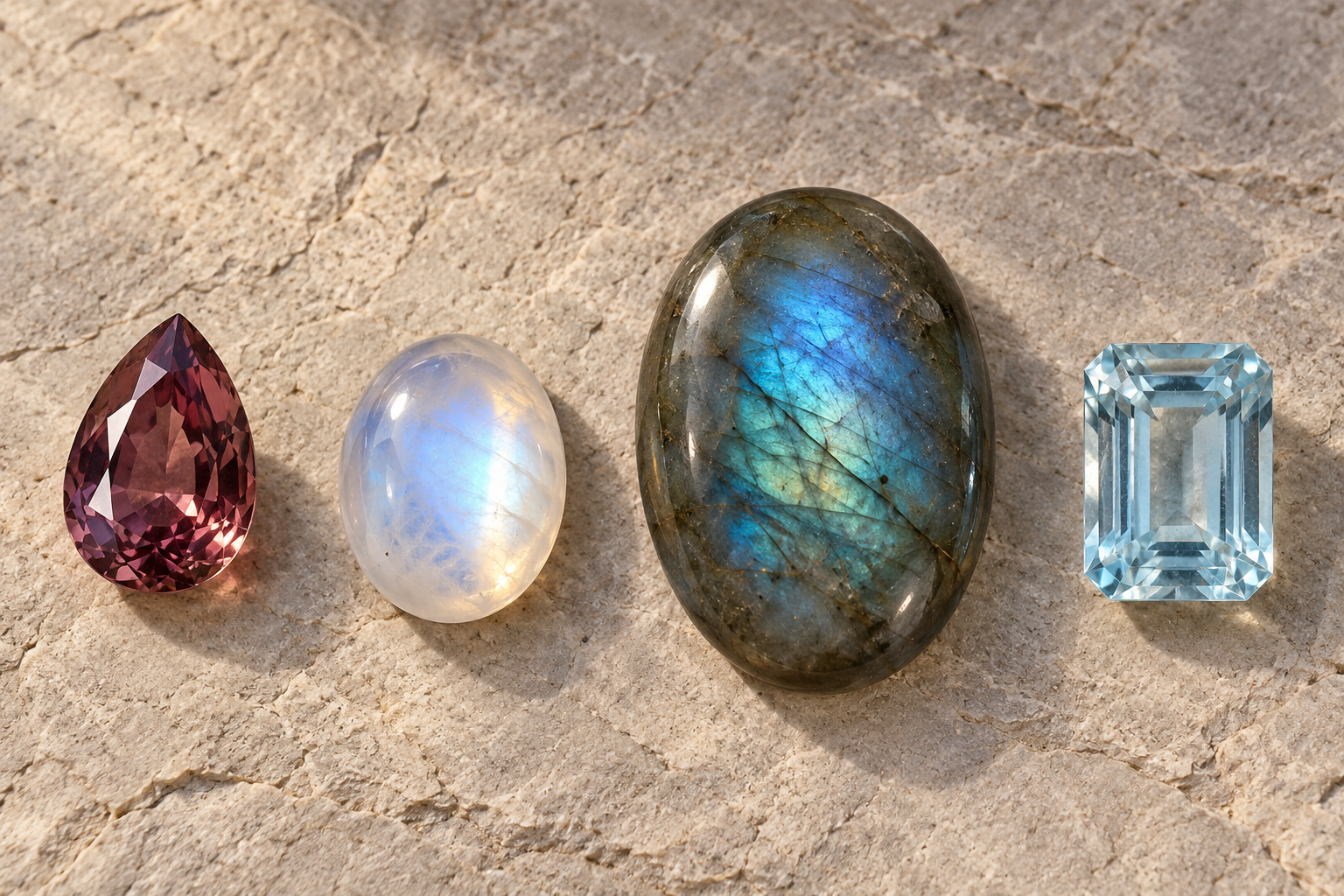
Left to right, alexandrite, moonstone, labradorite, and aquamarine.
Alexandrite and the Possibility of Change
Alexandrite makes me think about adaptability, perspective, and the possibility of being more than one thing at once. That's my interpretation of its color change, rather than an ancient theory though.
The gem was identified in Russia's Ural Mountains in the nineteenth century, which gives its named history a much more recent starting point than emerald's. Its color shift has an optical explanation involving the light source and the stone's absorption of light. My purple-to-red stone makes that idea especially appealing to me.
Moonstone and Beginning Again
In contemporary crystal lore, moonstone is associated with intuition, emotional balance, and transitions. Older Hindu mythology connected it with solidified moonbeams, according to GIA, which is a wonderful description of how it looks.
That floating sheen has a physical explanation too, light scattering within its layered structure. The symbolism of a new phase is lovely, while claims about hormones or fertility would need their own clinical evidence, which is lacking.
Labradorite and Finding Another Side of Something
Labradorite is associated with intuition, protection, and spiritual awareness.
I can see why its shifting flashes of blue and green inspire that sort of language. Turn the stone and an apparently ordinary surface suddenly does something spectacular. I'd personally borrow that as a reminder to look at a problem from another angle, which is admittedly a fairly practical job for a stone often given considerably more mystical responsibilities.
Aquamarine and Saying What You Mean
Aquamarine's modern associations include calm, courage, and clear communication. Its name comes from Latin words referring to seawater, which GIA explains in its history, and the watery color makes that easy to understand.
I like the idea of choosing it as a reminder to slow down enough to say what you actually mean. Especially if you're the kind of person whose thoughts occasionally arrive considerably faster than the sentence they're supposed to fit inside.
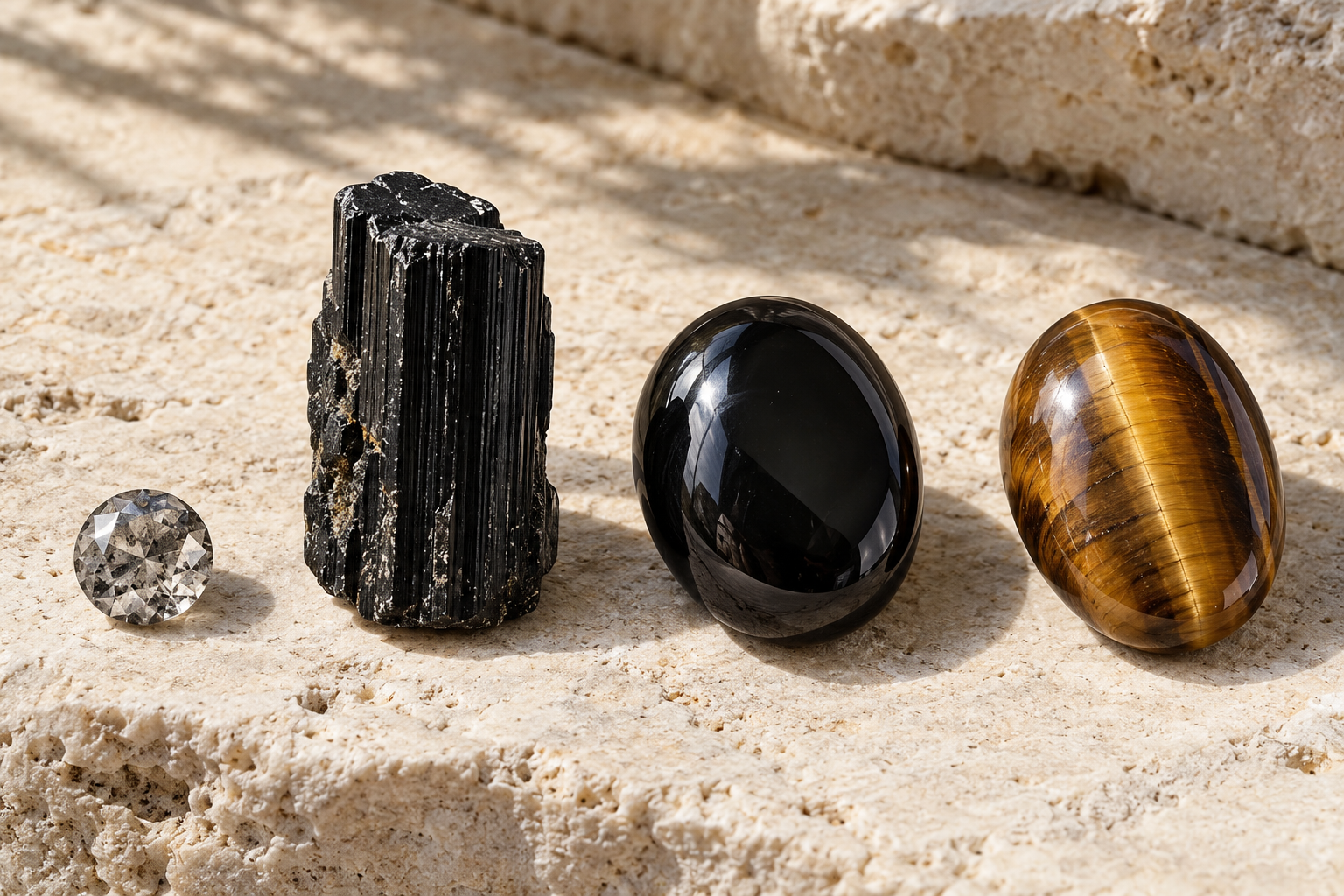
Left to right, salt-and-pepper diamond, black tourmaline, obsidian, and tiger’s eye.
Diamonds, Including the Salt-and-Pepper Ones
Diamond symbolism includes strength, commitment, courage, and clarity.
The salt-and-pepper diamonds I've been interested in have a very different look from the perfectly clear image people often associate with that symbolism. Their visible inclusions give them character, and I personally like the idea of letting one represent individuality.
That particular meaning is mine to choose, rather than a scientifically distinct energy produced by the speckles.
Black Tourmaline and Keeping Your Boundaries
Black tourmaline is commonly associated with grounding and protection. In everyday language, I’d translate the symbolism into remembering your boundaries and having something tactile to focus on when your thoughts are scattered.
Tourmaline also has real electrical properties under particular physical conditions, which we'll come back to. Those properties alone don't establish that a stone beside a laptop shields somebody from electromagnetic fields.
Obsidian and Being Honest With Yourself
Obsidian's modern meanings include protection, self-reflection, and facing difficult truths. It's volcanic glass, which gives us an interesting complication when people talk about every spiritual stone having an orderly crystal lattice.
Glass lacks that same long-range crystalline order. I still understand why a dark, reflective surface might become a symbol for looking inward, and I think choosing what you're ready to reflect on is rather more useful than expecting a stone to decide for you.
Tiger's Eye and Following Through
Tiger's eye is associated with courage, focus, confidence, and practical judgment. Its golden bands and moving silky reflection make it visually quite different from a transparent faceted gem.
I like the grounded side of that symbolism, the idea of taking what you know and doing something with it. There are plenty of days when following through on one manageable thing would be more useful than having another fourteen inspirational ideas.
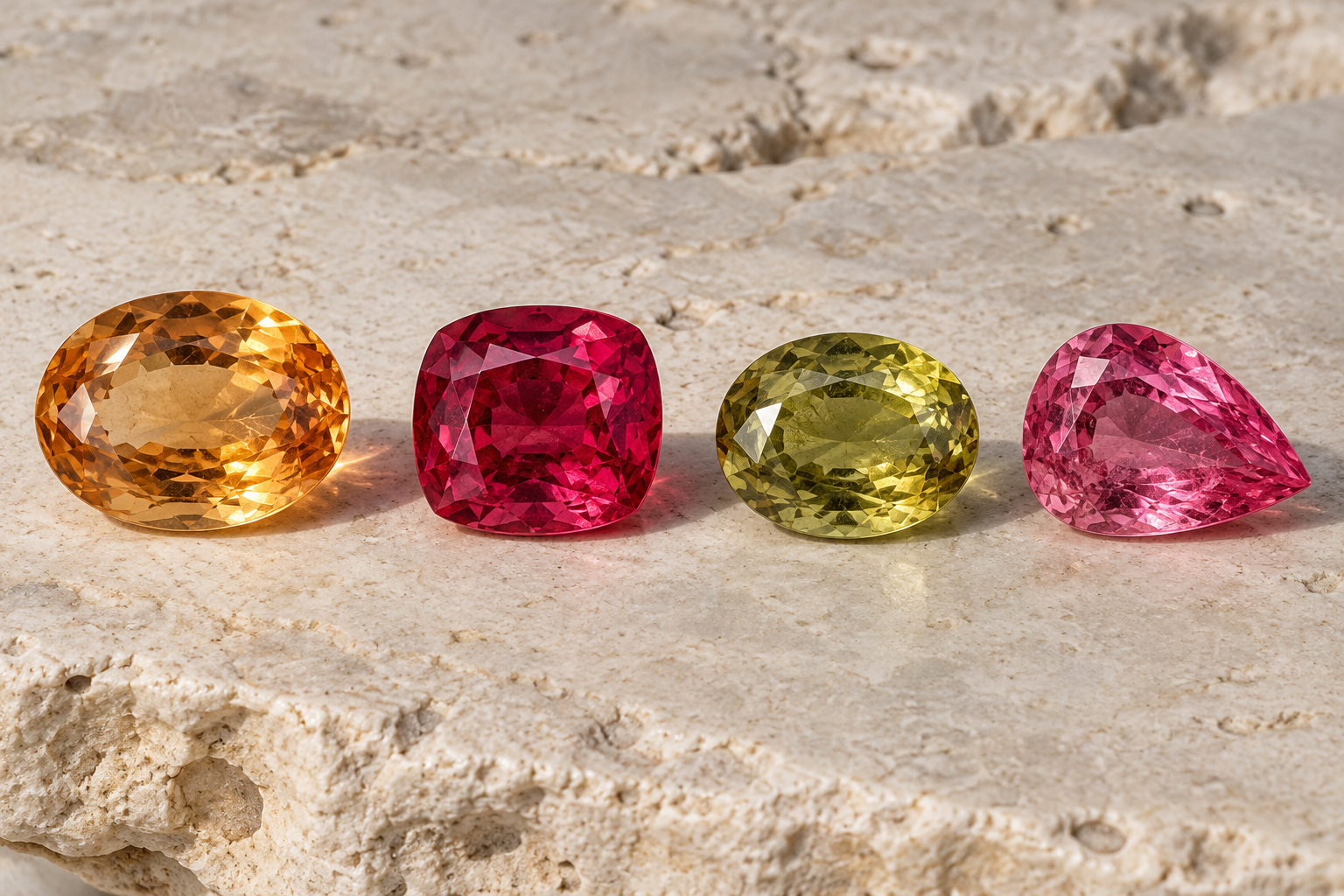
Left to right, topaz, spinel, chrysoberyl, and pink sapphire.
Topaz and a Little More Confidence
Topaz is associated with generosity, confidence, joy, and clear intention, with different meanings assigned to different colors.
Golden varieties get the warm, abundant symbolism, while blue topaz is often linked with expression and communication. There’s a practical distinction worth remembering too.
Topaz and citrine can both be yellow, but they’re different minerals, with different physical properties, even when somebody gives them very similar spiritual jobs.
Spinel and Giving Yourself a Fresh Start
I'd choose renewal as my personal meaning for spinel, partly because its history includes finally being recognized for itself.
As GIA explains, famous red gems long thought to be rubies turned out to be spinels. That strikes me as a pretty good metaphor for getting to be appreciated on your own terms. It's a symbolic reading I'm bringing to the stone, rather than a claim that its crystal structure produces a fresh start.
Chrysoberyl and Having Some Discipline
Chrysoberyl appears in contemporary crystal writing about discipline and planning, although its meanings are much less familiar than rose quartz's love association. For me, its appeal would be a reminder to stay with the work after the exciting beginning.
Alexandrite belongs to the chrysoberyl family too, despite looking so different from the yellow-green gem shown here. Gem names, colors, and mineral families overlap in ways that make shopping for stones a surprisingly efficient way to acquire another research project.
Pink Sapphire and Being Open Again
Pink sapphire is associated with compassion, forgiveness, resilience, and openness to love.
I like that combination because gentleness and strength can belong in the same description. Pink, yellow, and blue sapphire are color varieties of the same mineral, corundum, and ruby is its red gem variety. The different spiritual meanings assigned to them show just how much color and cultural interpretation contribute to these stories.
What About the Harder Stones for Jewelry?
Since I've also been interested in making jewelry (I watch these videos constantly online), there's another kind of property I want to know about. Mohs hardness describes resistance to scratching, and the scale runs from 1 to 10. The steps are unequal, so a 10 isn't simply twice as hard as a 5. Here's how the stones in this article compare, grouping color varieties that share the same basic hardness.
| Stone or mineral family | Approximate Mohs hardness |
|---|---|
| Diamond, including salt-and-pepper diamond | 10 |
| Ruby and blue, yellow, and pink sapphire | 9 |
| Chrysoberyl, including alexandrite | 8.5 |
| Topaz | 8 |
| Spinel | 8 |
| Emerald and aquamarine, members of the beryl family | 7.5–8 |
| Tourmaline | 7–7.5 |
| Clear quartz, amethyst, rose quartz, citrine, and tiger's eye | 7 |
| Moonstone and labradorite, members of the feldspar family | 6–6.5 |
| Obsidian | About 5–5.5 |
Hardness is only one part of durability. GIA gives topaz a hardness of 8 but explains that a hard blow can split it along its cleavage. Ouch.
Emeralds can have fractures and treatments that affect care, while sapphire generally combines high scratch resistance with excellent toughness. A jeweler needs to consider the individual stone, its treatments, its setting, and how you'll wear it. The spiritual meaning won't tell you whether it will enjoy being knocked against a countertop.
So Do Crystals Actually Have Frequencies?
They have measurable physical behavior, absolutely.
In physics, frequency means how often something repeats per second, and a crystal can have different vibrational modes rather than one single number that describes everything about it. Composition, shape, size, temperature, and the particular phenomenon being measured all matter. Calling something a high-frequency stone leaves quite a few questions unanswered, starting with the frequency of what, measured how, and interacting with which part of the body.
Quartz is useful in electronics because of its piezoelectric behavior, which links mechanical deformation and electrical polarization. An engineered quartz resonator can work with an electrical circuit to produce a stable timing signal. Epson's explanation of crystal oscillators describes the crystal units, drive circuits, and carefully controlled cuts involved. The circuit supplies energy and keeps the oscillation going; a quartz point on a bedside table doesn't have that same arrangement.
Tourmaline also has piezoelectric and pyroelectric properties, meaning it can develop electrical polarization in response to mechanical stress or a temperature change. That is fascinating all by itself. To establish a therapeutic effect, we'd still need to measure what a particular stone produces during ordinary use, how it reaches the relevant tissue, and whether it changes a meaningful outcome. A real electrical property is the beginning of a mechanism question, rather than the answer to a medical one.
Resonance is real too, as the OpenStax physics text explains, but it involves a system responding to a driving force under particular conditions. For a claim that a gemstone tunes an organ or emotion, there’s no evidence of that specific interaction, including a source of energy and a way for the two systems to couple. The familiar claim that everything vibrates doesn't supply those missing measurements. Anger and affection also aren't each assigned one established frequency that a colored stone can simply match.
The thing is though…just because we haven’t proven something YET, doesn’t mean one day we might not.
The Part Where Meaning Could Actually Affect How You Feel
I find the psychology at least as interesting as the proposed mineral energy. NCCIH explains that expectations can influence experienced outcomes. A familiar object might also serve as a reminder to pause, notice your surroundings, or act on an intention. Those are plausible ways a meaningful stone could fit into somebody's day, although that suggestion is a bit different from demonstrating that a particular gemstone treats a condition.
A 2025 randomized study in CNS Spectrums compared rose quartz with a visually similar glass placebo over 14 days in 138 adults from a nonclinical sample. The researchers reported anxiety reductions among believers regardless of which material they received, with no specific advantage for rose quartz. The study was short and didn't test every stone or every outcome, and changes over time can also include ordinary symptom fluctuations.
That's why I can take somebody's experience of comfort seriously while staying curious about its cause. If a ring reminds you of somebody you love, that association matters to you, even though a laboratory wouldn't find a love frequency stored in the setting. Likewise, choosing rose quartz as a reminder of self-compassion could affect what you pay attention to and how you behave. Of course, for health concerns, I'd keep stones in the role of meaningful personal objects alongside appropriate care, rather than making treatment decisions from a gemstone guide.
And What About Lab-Grown Stones?
This interested me immediately because several stones I've been looking at are lab-grown. GIA explains that synthetic gemstones have essentially the same chemical composition, crystal structure, and physical and optical properties as their natural counterparts, although growth features and impurities can differ. A lab-grown sapphire is therefore a different proposition from a piece of glass sold to resemble sapphire. Origin, identity, and treatment are separate questions worth asking.
Ice from a glacier is ice just like what comes out of your freezer. One is just a little more far traveling.
Personally, I can choose a stone for its color, the way it behaves in light, its suitability for a piece of jewelry, and the meaning I want to attach to it.
I Think the Stories Are Part of the Appeal
The more I read about this, the more I think gemstones sit at a particularly interesting intersection of nature and storytelling. We see a deep red stone and think of courage, a green one and think of growth, or a color-changing one and start thinking about possibility. Then we turn those ideas into objects we can actually carry around. It's a wonderfully tangible way of remembering something that would otherwise remain a thought.
Like, I thought my salt-and-pepper diamonds had character, and then I found out what the Hope Diamond does after dark! Shine ultraviolet light on that deep-blue stone, switch off the lamp, and it keeps glowing red like an ember.
Researchers compared it with 66 other natural blue diamonds and found that the colors in the afterglow and how fast they faded gave each stone something like its own fingerprint. And of course this is the diamond people already told curse stories about. If I’d been in that museum vault, I probably would’ve stayed a little longer to see what else it did when it thought nobody was looking.
I'd choose my yellow sapphire as a reminder to keep building things, my alexandrite for the possibility of changing perspective, and a salt-and-pepper diamond because I like the character in it. Those are meanings I can give them without pretending I've measured a prosperity wave.
Related Reads You Might Enjoy
Why Does Fall Smell So Good? The Weird Science of Autumn Air
Before Pumpkins, People Carved Terrifying Faces Into Turnips
Sources and Further Reading
Isabel Stünkel, The Metropolitan Museum of Art. Ancient Egyptian Amulets, 2019.
GIA. Gem histories and care guides linked above, plus June birthstones and alexandrite durability, sapphire care, and emerald care.
Epson Crystal Device. Technical glossary. OpenStax. Forced Oscillations.
National Center for Complementary and Integrative Health. Placebo Effect.
Escolà-Gascón and colleagues. Placebo effects in alternative medical treatments for anxiety, CNS Spectrums, 2025.
Crystal Vaults. Individual gemstone entries linked above document that publisher's contemporary metaphysical interpretations. They are belief sources, rather than clinical evidence.