Halley's Comet Is Raining Down on Earth This October (Sort Of)
I have a slightly ridiculous obsession with space. I love learning about things happening millions or billions of miles away that have absolutely nothing to do with my everyday life, yet occasionally remind me that we're living on a giant rock flying around a star while I struggle to find creative ways to pay my bills.
In case you didn’t know, this month we're flying through the leftovers of one of the most famous comets in human history.
If you've heard of Halley's Comet, you probably know that it only visits our part of the solar system roughly once every 76 years. The last time anybody could see it from Earth was 1986, before I was even born, and it won't return until 2061.
Except that's not entirely the whole story.
Every October, Earth passes through a trail of debris left behind by Halley's Comet, and tiny pieces of that material come crashing into our atmosphere at speeds reaching approximately 148,000 miles per hour. That wasn’t a typo or anything, that’s actually how fast it hits.
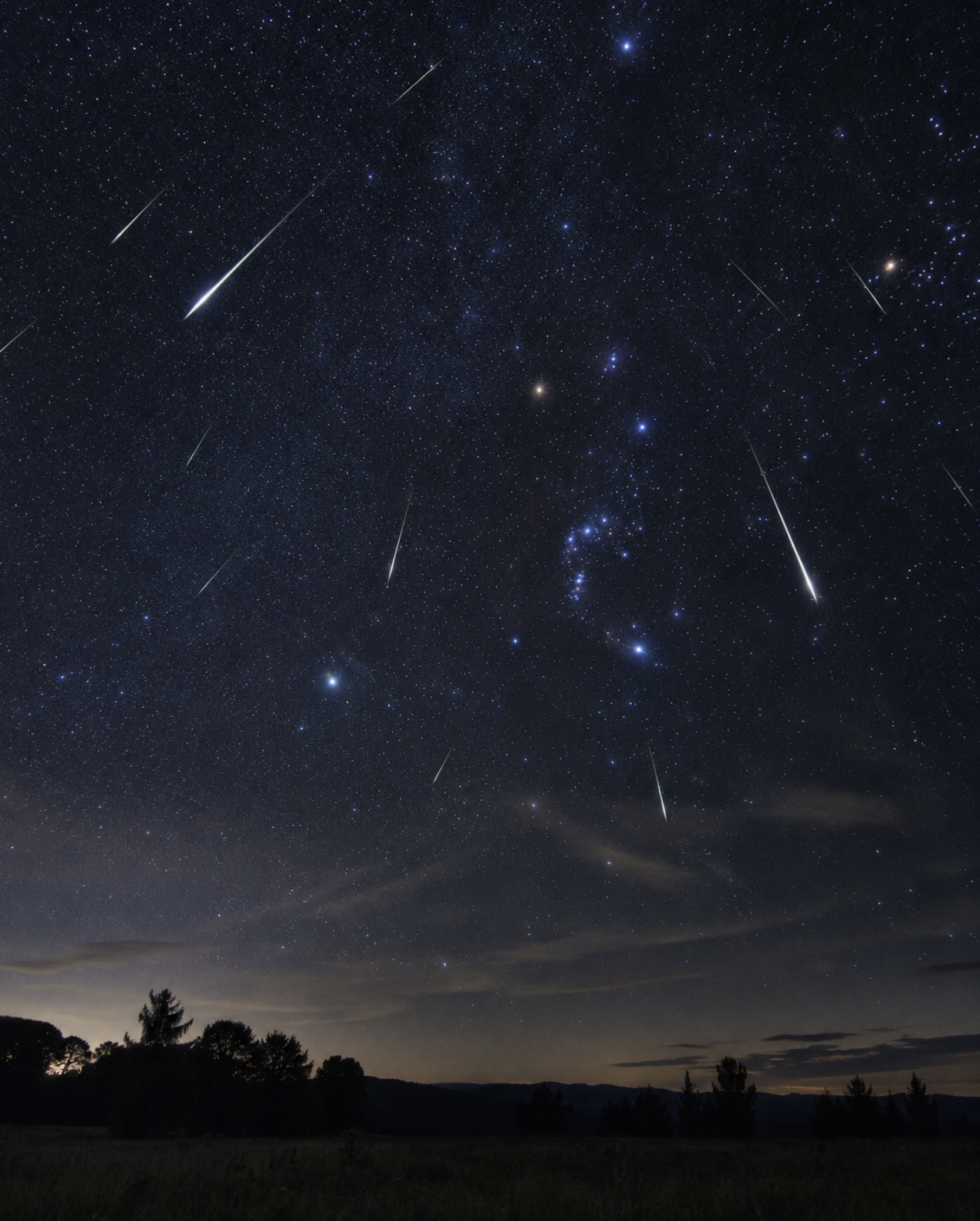
These collisions produce the Orionid meteor shower, which reaches its peak this year on the night of October 21 into the early morning of October 22, 2026. Technically, Halley's Comet isn't returning this month…but pieces of it are arriving, and they've been doing so every year whether we're paying attention or not.
I thought that was pretty interesting on its own, but then I started reading about how the comet became famous, why its debris keeps finding us, and how people hundreds of years ago interpreted its appearance as a warning that terrible things were about to happen. Naturally, I now have a whole collection of strange facts that I feel compelled to share.
Halley's Comet Isn't Actually Coming Back Yet
Comets are made from a mixture of frozen gases, dust, rock and other materials they collect in space. They're often described as dirty snowballs, although the actual composition and structure are considerably more complicated than that charming little nickname suggests.
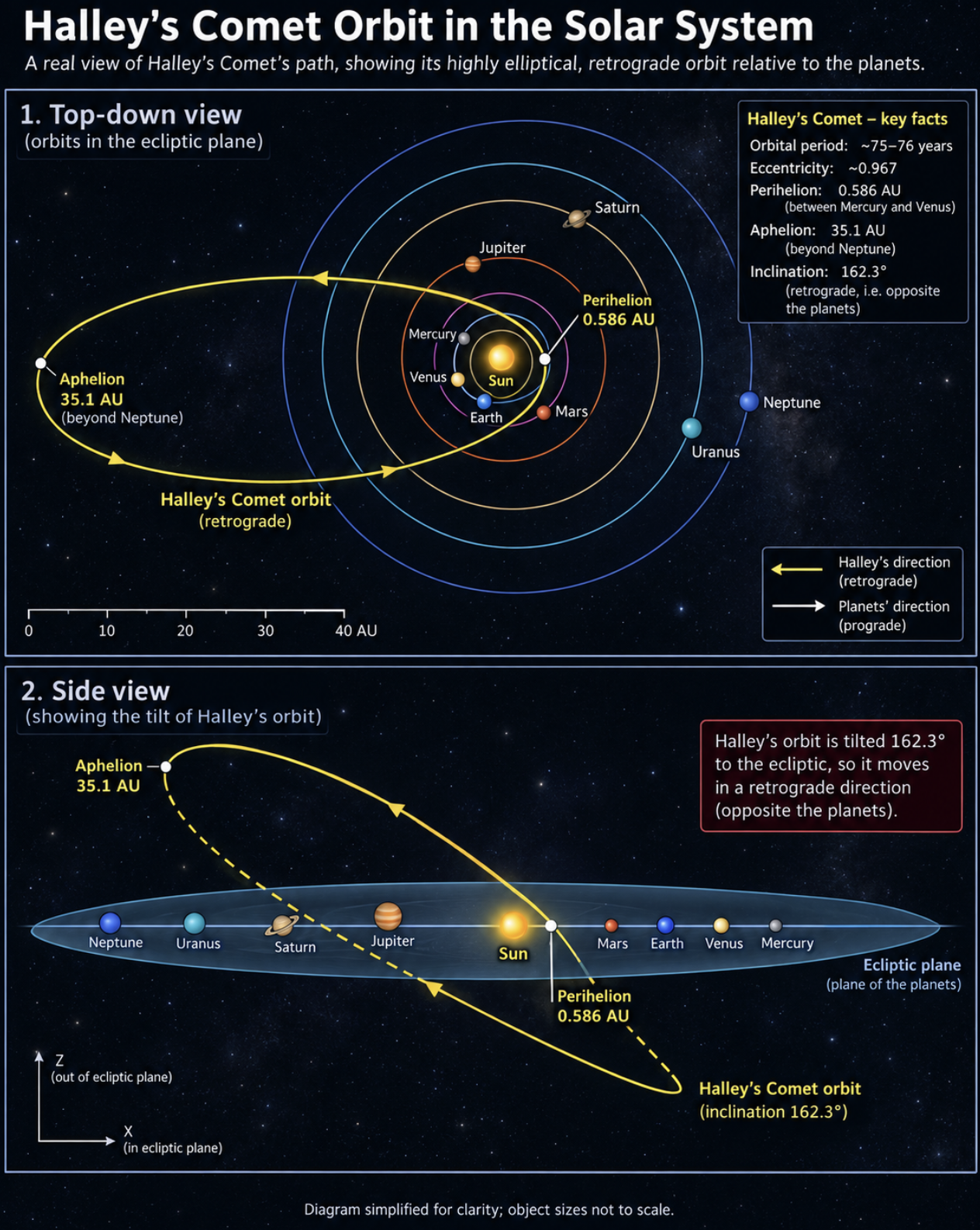
Unlike Earth, which follows a relatively circular orbit around the Sun, Halley's Comet travels along a highly elongated path that takes it from the inner solar system all the way beyond Neptune. It spends decades traveling through the cold outer reaches of our solar system before eventually returning toward the Sun. Then, when it gets close enough, things start getting interesting.
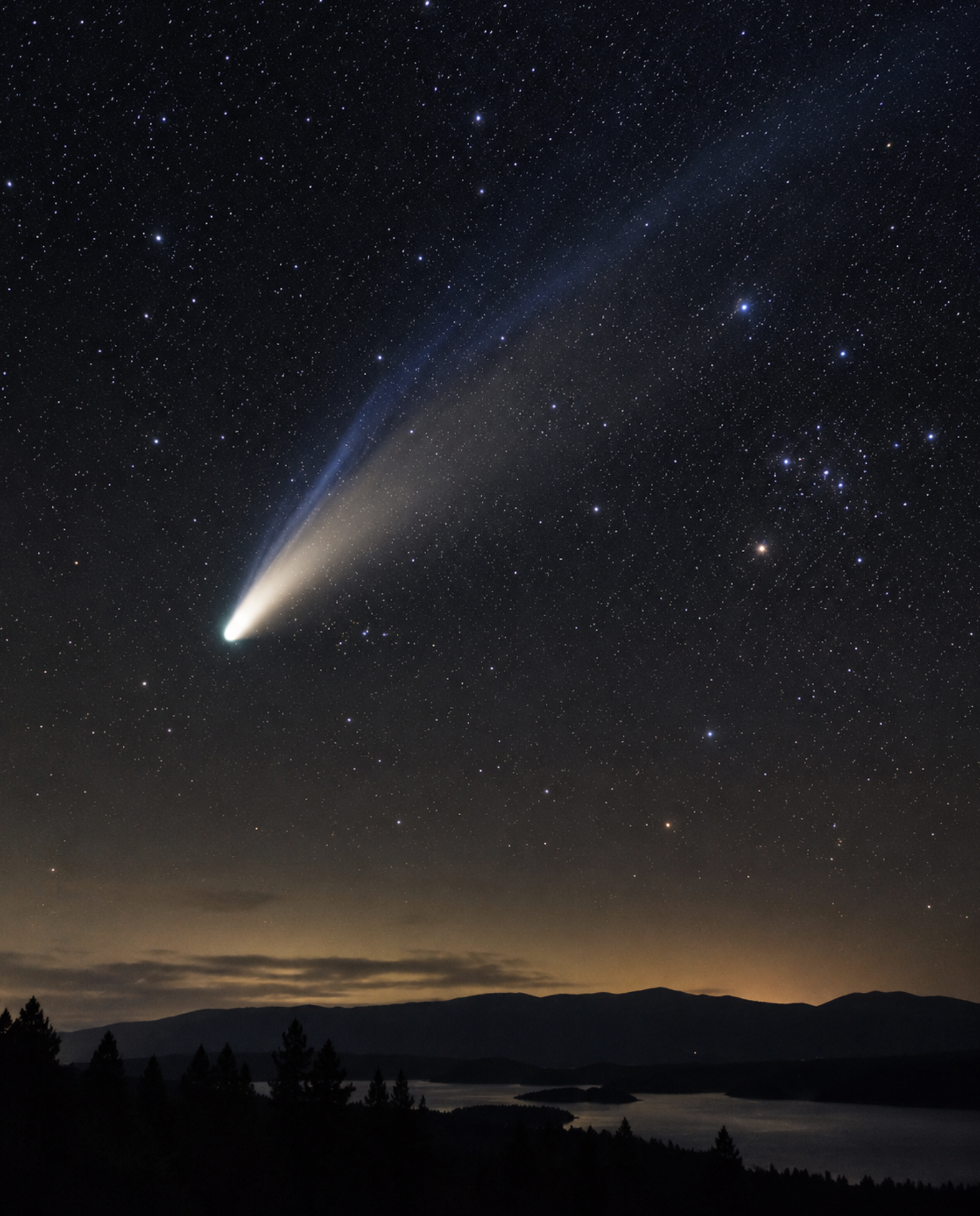
The Sun heats the comet's surface, causing frozen stuff to turn directly into gas through a process called sublimation. That gas escapes from the comet and carries dust and rocky particles into space, creating an enormous cloud around its nucleus called a coma. Solar radiation and the solar wind help push material away from the comet, producing the tails we associate with these spectacular objects.
The thing is, not all that dust just disappears when the comet moves away. A great deal of it continues traveling around the Sun in its own orbit, gradually spreading along the comet's path. Every time Halley's Comet returns, it can contribute additional material to this debris stream. It's basically leaving a trail of cosmic litter behind every time it visits, and Earth has the unfortunate habit of driving directly through it.
Earth Is Basically Driving Through a Cloud of Space Dust
As Earth travels around the Sun, it regularly encounters streams of debris left behind by comets. When our planet crosses one of those streams, individual particles enter the atmosphere at tremendous speeds.
The Orionids come from Halley's Comet, and they're particularly fast because of the way the comet's debris orbits the Sun relative to Earth. According to NASA, Orionid meteors enter our atmosphere at approximately 66 kilometers per second. That's about 41 miles EVERY single SECOND.
For perspective, Philadelphia to New York City is approximately 80 miles in a straight line. An object traveling at that speed could cover the distance in roughly two seconds. I can't even get through a traffic light in Philadelphia in two seconds, meanwhile a tiny grain of comet dust is moving fast enough to cross an entire metropolitan area before I've finished complaining about the traffic.
The truly strange part of it though is that the particles making those beautiful streaks of light are generally incredibly small.
Those Bright Shooting Stars Can Be Smaller Than a Pea
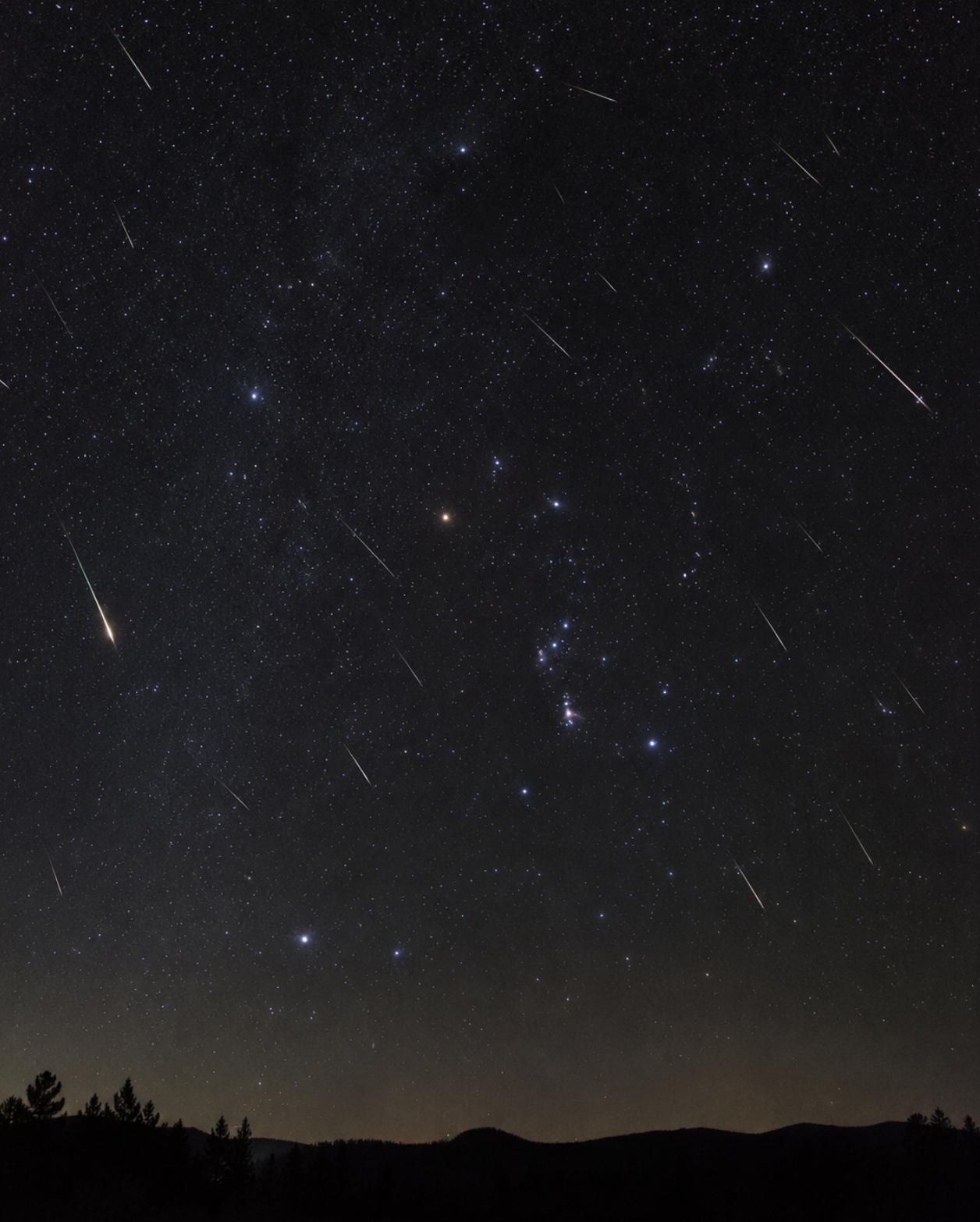
When you see a shooting star streak across the night sky, it's easy to imagine a massive piece of rock burning its way toward Earth. In reality, the debris responsible for many meteor showers is often no larger than a grain of sand or a pea. A tiny piece of material that's barely visible sitting in your hand can create a brilliant streak of light visible from the ground.
The reason is the enormous amount of energy involved when an object enters Earth's atmosphere at tens of thousands of miles per hour. At those speeds, air in front of the incoming particle becomes violently compressed and heated. The meteoroid itself also heats up, loses material and interacts with atmospheric gases, producing the light we recognize as a meteor.
It's worth pointing out that the explanation you probably learned as a kid, that meteors catch fire because of friction, doesn't describe the entire process accurately. Rapid compression of the air and the resulting high temperatures are major parts of what's happening. There's also another little distinction I think is pretty interesting: the terminology actually changes depending on where the object is.
A meteoroid is the piece of rock or dust traveling through space. A meteor is the streak of light produced as that material enters the atmosphere. If a fragment survives the journey and actually reaches the ground, it's called a meteorite.
So technically, you don't see a meteorite shooting across the sky…you see a meteor.
I feel like that's the kind of completely unnecessary distinction I'm going to start correcting people about at parties, which is probably why I don't get invited to enough parties. Fortunately, the vast majority of these tiny particles disintegrate high above us, meaning the Orionid meteor shower isn't going to leave everybody's backyard covered in little pieces of Halley's Comet.
Although I admit that finding a piece of a famous comet in my garden would be pretty damn cool.
Why Is It Called the Orionid Meteor Shower?
The name comes from the constellation Orion, one of the most recognizable collections of stars in the night sky.
If you've ever looked up during winter and noticed three bright stars lined up almost perfectly in a row, you've probably seen Orion's Belt. During the Orionid meteor shower, the streaks of light appear to originate from a point near the constellation, just north of the bright star Betelgeuse.
Astronomers call this point the radiant.
The meteors aren't actually coming from Orion. Those stars are hundreds of light-years away, while the debris producing the shower is right here in our solar system. The meteors only look like they’re radiating from one location because of perspective. The particles are traveling along related paths through space, but from our position on Earth, their streaks appear to spread outward from a single point in the sky.
Which means you don't actually need to stare directly at Orion to see the shower.
In fact, NASA recommends looking approximately 45 to 90 degrees away from the radiant because meteors can appear to make longer, more impressive streaks across that part of the sky.
Halley's Comet Gives Us TWO Meteor Showers Every Year
This is probably my favorite fact about the whole thing.
The Orionids aren't the only meteor shower associated with Halley's Comet, we actually pass through debris from the same comet twice a year.
The first encounter produces the Eta Aquariid meteor shower, which generally peaks in early May. The second produces the Orionids in October. This happens because Earth's orbit intersects the comet's debris stream in two regions. So while Halley's Comet only returns to the inner solar system about every 76 years, the dust it left behind gives us two annual opportunities to watch pieces of it enter our atmosphere.
And those particles don't necessarily have to come from its last visit in 1986 either, comet debris can remain distributed along an orbit for hundreds of years or longer, meaning the streaks of light we watch today may come from material released during much earlier visits.
You're watching Earth intersect the history of another object traveling through our solar system.
People Have Been Watching Halley's Comet for Over 2,000 Years
Halley's Comet has been recorded by human observers for thousands of years, long before anybody understood what comets actually were. The earliest reliably identified observations date back to 240 BCE, when Chinese astronomers documented its appearance.
More than two thousand years ago, people were looking up at the same celestial object that astronomers photographed with spacecraft in 1986. They obviously didn't have telescopes, computers, or modern astronomy, but they knew enough to recognize that something unusual had appeared in the sky.
And naturally, humanity did what humanity has always done when confronted with something it doesn't understand: we decided it was probably a sign that something terrible was about to happen.
Across different cultures and periods of history, comets were associated with war, death, political upheaval and other major events. A thousand years ago, people might have looked at the exact same thing we all get excited about and started worrying about whether their king was about to die. Astronomy has had a pretty serious public relations improvement in the past 100 years.
The Man Who Predicted Its Return Didn't Live to See It
You might assume Halley's Comet was named after the person who discovered it, except people had been observing the comet for centuries before Edmond Halley came along.
He was the person who figured out that several apparently different comets were actually the same object returning again and again. In 1705, Halley used Isaac Newton's work on gravity and planetary motion to calculate the paths of comets that had appeared in 1531, 1607 and 1682. He noticed that their orbits were remarkably similar and proposed that they were all appearances of one comet traveling around the Sun.
Then he made an extraordinary prediction: the comet would return in 1758.
Now, remember that this was the early 1700s. People had been watching comets for thousands of years, but predicting that a specific comet would return decades later was a major scientific achievement. Unfortunately, Halley died in 1742 and never got to see his prediction confirmed.
But in 1758, the comet returned as expected, and astronomers eventually named it in his honor.
When Can You See the Orionid Meteor Shower in 2026?
The Orionids are active from October 2 through November 7, 2026, but their expected peak falls on the night of Wednesday, October 21, into Thursday morning, October 22.
Under good viewing conditions, NASA estimates that observers can see approximately 10 to 20 meteors per hour near the peak. Before anybody gets too excited, that doesn't mean you're guaranteed to see a meteor every three to six minutes. Those numbers describe favorable conditions with dark skies, good visibility and an unobstructed view. City lights, clouds, moonlight and the position of the radiant can all reduce what you actually see.
Unfortunately, the Moon isn't doing us any favors this year. On October 21, the Moon will be in its waxing gibbous phase, with much of its visible surface illuminated. That extra brightness can wash out fainter meteors.
However, there is a viewing window worth considering.
For Philadelphia, the Moon is expected to set at approximately 3:18 a.m. EDT on October 22, leaving a darker period before dawn when Orion will be relatively high in the sky. Moonset times will differ depending on your location, of course, but the general idea is to look for a clear stretch after the Moon has disappeared below the horizon. Now, do I particularly love the idea of waking up at three in the morning to stand outside in October? Not really. Do I think watching pieces of Halley's Comet fall through the atmosphere would be worth it? Absolutely.
You Don't Actually Need a Telescope
You don't need a telescope, binoculars or expensive equipment to enjoy them. In fact, those things can make meteor watching more difficult because they restrict how much of the sky you can see at once.
Meteors can appear almost anywhere overhead, so your best option is to find a dark location with a wide, unobstructed view.
If you live in or near Philadelphia like I do, light pollution is going to be a problem. The glow from buildings, streetlights, traffic and everything else happening in a major metropolitan area makes it harder to see faint objects in the sky. Heading away from the brightest areas can make a significant difference, provided the weather cooperates.
NASA recommends giving your eyes around 30 minutes to adjust to the darkness, which means resisting the temptation to check your phone every forty-five seconds. I realize that's a fairly ambitious request in 2026.
You'll also want to dress warmly, bring a blanket or reclining chair, and give yourself enough time to watch the sky rather than expecting an immediate performance. If you're in the Northern Hemisphere, NASA suggests lying back with your feet facing southeast and taking in as much sky as possible.
You don't need to identify every constellation, although being able to recognize Orion is a nice bonus.
Remember, even if the peak night is cloudy, the shower doesn't suddenly disappear at midnight on October 22. The Orionids remain active for weeks, with activity gradually changing before and after their maximum.
You may see fewer meteors on another night, but the possibility is still there.
For updated sky positions and viewing conditions, NASA's Orionid guide and the American Meteor Society's meteor shower calendar are excellent references.
We're Watching History Burn Across the Sky
There's a lot happening in our universe that we never get to see.
Entire galaxies are colliding millions of light-years away, while stars are being born inside enormous clouds of gas. Black holes are swallowing material, planets are forming, and countless objects are traveling through space along paths we can barely begin to imagine.
Most of it is completely invisible to us without specialized equipment…but once in a while, the universe gives us a little reminder of what's happening beyond our atmosphere.
An ordinary-looking grain of dust, released by a comet during an earlier journey around the Sun, happens to cross paths with Earth. It enters our atmosphere at an absolutely ridiculous speed, produces a brief flash of light, and disappears. The entire event might last less than a second, but that tiny streak connects us to an object our ancestors have been watching for more than two thousand years.
We spend an enormous amount of our lives staring at screens, worrying about work, paying bills, arguing about things happening on the internet and forgetting that we're literally traveling through space every second of every day. Once a year in October, our planet passes through an ancient trail of comet debris and gives us a reason to look up.
I can't help wondering what the people who saw Halley's Comet in 1066 would've thought if they'd known that nearly a thousand years later, we'd be standing outside with coffee, blankets and smartphones, hoping to see tiny fragments of the same object streak across the sky.
They would've probably thought we were insane, and to be fair, they might have had a point. I'll gladly lose a little sleep for a chance to watch a piece of astronomical history disappear into the atmosphere.
After all, Halley's Comet won't be back until 2061, but its leftovers, thankfully, are considerably more punctual.
Related Reads You Might Enjoy:
The Weird Things Solar Storms Can Mess With That You'd Never Think About
How Do Auroras Form? A Dance of Solar Fire and Magnetic Veils
The Carrington Event: The Solar Storm That Set Telegraphs on Fire
The Sun Isn't Yellow: A Mind-Bending Dive into Light, Space, and the Lies Our Atmosphere Tells
The Invisible Symphony: How the Universe Flickers Through Our Lives Without Us Knowing
Are Black Holes Actually Tunnels? The Mind-Bending Theory That's Changing Space Science
Sprites, Blue Jets, and Elves: The Ghostly Lightshows Above the Storm
Works Cited
American Meteor Society. "2026/2027 Meteor Shower Calendar." American Meteor Society. Meteor Shower Calendar.
European Space Agency. "Giotto: Cometary Encounters and Archival Sources." ESA Archives Portal, March 13, 2026. ESA Archives.
NASA. "1P/Halley." NASA Science. Halley's Comet Facts and History.
NASA. "Orionids Meteor Shower." NASA Science. Orionid Meteor Shower Guide.
NASA. "Meteors and Meteorites: Facts." NASA Science. Meteor and Meteorite Facts.
NASA. "955 Years Ago: Halley's Comet and the Battle of Hastings." NASA, October 14, 2021. NASA Historical Research.
NASA Jet Propulsion Laboratory. "Meteor Showers: Shooting for Shooting Stars." JPL, 2010. NASA JPL.
Time and Date. "Moonrise, Moonset, and Moon Phase in Philadelphia, October 2026." October 2026 Lunar Calendar.