Poveglia Island: Plague, Ash, and the Stories We Keep Telling
There’s a small island sitting in the Venetian Lagoon that most people have never even heard of. Boats pass near it, water moves around it, and Venice (the city that most of us probably have heard of) sits just a short distance away.
This island is called Poveglia.
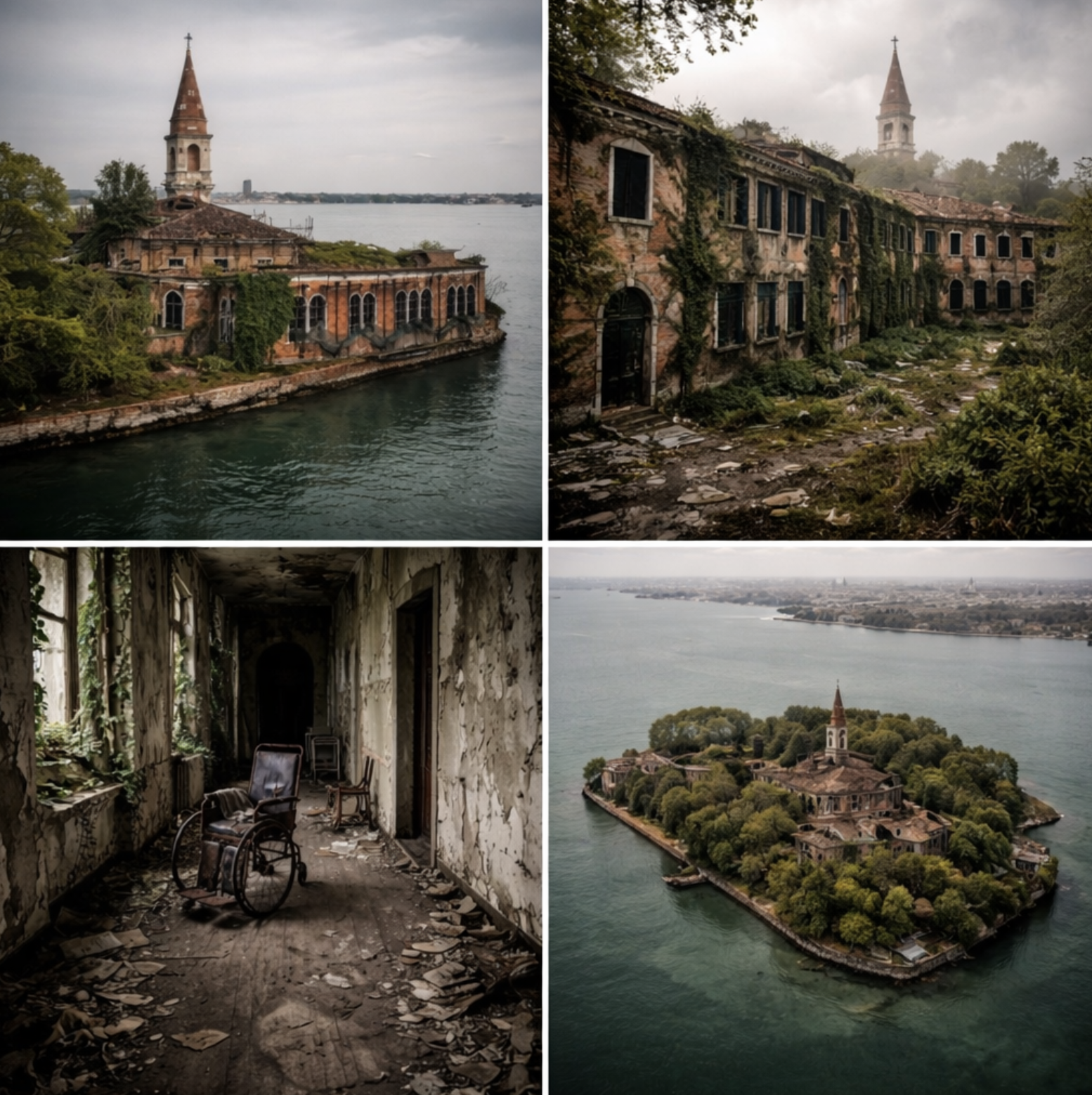
You won’t catch anyone docking there or wandering its paths. The buildings stand in place but are starting to lose the battle with time and gravity everywhere you look. It’s just sort of…left alone and ignored. An entire ghost town in a tiny island form. The reason it feels avoided has less to do with ghosts and more to do with what it was used for, repeatedly, across different centuries. It was where Venice sent people it didn’t want to take chances on.
By the time plague outbreaks became a pattern in Europe, Venice had already figured something out that other places were much slower to accept: disease travels with people. Of course, Venice had a lot of people moving through it.
Ships came in constantly bringing with the traders, some goods, crews, and passengers. It was the center of exchange, which also made it vulnerable for anything bad hitching a ride. So the Venetians built a system. Incoming ships didn’t immediately enter the city for passengers to step off and disappear into the streets. Instead, they waited. Some records even say it was for up to forty days—quaranta giorni. Fun fact: that waiting period is where the word “quarantine” comes from, and Venice was one of the first places to enforce it in any sort of organized way.
Poveglia became one of the islands used for that waiting period.
If you were sick, you went there. If someone thought you might be sick, samesies. Catching my drift? If your ship raised enough suspicion, you were sent there. Once you were there, the city kept its distance for as long as it took to prove that you were in fact, not sick. If it sounds like a witch hunt…that’s probably because it was a little bit.
People were sent to the island with whatever had been on the ship with them. I mean: clothes, small belongings, crates of goods meant for trade, whatever was there. Once they were sent to Poveglia clothing was treated like part of the problem and hung out, smoked, or left in the sun as if the illness could be pulled out of the fabric from our closest star. Cargo sat untouched, waiting to be cleared, sometimes even longer than the people who arrived with it. Even the ships carried more than anyone realized. Rats moved through them quietly, bringing the very thing the system was trying to keep out.
Post COVID-19 we all seem to have an idea in our minds about what quarantine is. Quarantine sounds strictly controlled and even clinical, when we say it now. Back then though, it really wasn’t. There were no antibiotics, no real understanding of bacteria, and honestly no reliable treatment if you in fact, were sick. Without a clear way to actually treat anything, you can forget about realistic diagnostics.
So isolation became the solution because it protected everyone else.
Poveglia was simply a place where outcomes were uncertain and often out of anyone’s control. People waited to see if they would get better. Some did while many, many didn’t. Our idea of a hospital today is sort of like this, but also…we actively treat people. Whenever outbreaks surged, the island filled quickly. The system worked for Venice (they claimed), but really only because it shifted the risk somewhere else. Mass burials happened during those periods, and that’s well documented.
It was hard for me to find an exact number or even an estimation from this time period. The thing is, when numbers rise quickly, systems simplify to be able to handle it. So their graves became larger and records became less precise. That’s where the island begins to feel heavier than it looks. Estimates suggest that over 100,000 people may have died on Poveglia across centuries of plague outbreaks, but exact numbers were never recorded. Wikipedia.
At some point, the story of Poveglia started to travel. Like most stories that last long enough, it picked up details that sound absurd and people recite them over and over again as fact…but they aren’t. One viral article said that the soil is half human ash.
There’s truth there in the fact that a lot of people died there and burial pits were used, and in extreme cases, burning of bodies did occur. The idea that the soil is “50% ash” though…well, no evidence I could find anywhere supports that wild idea.
At the end of the day, a lot of people were sent there, a lot of them didn’t come back, and we just don’t have a clean number to put on it.
The Island Didn’t Stay Empty for Long
Like every good ghost and horror story ever told, after the worst waves of plague passed, Poveglia shifted. In 1922, the buildings on the island were converted into a psychiatric hospital.
It’s well documents that there was a functioning hospital and patients lived there. It operated for decades before closing in 1968. Of course, the story that spreads online is more dramatic and includes stories of a doctor performing experiments, claims of patients being driven insane by something unseen, and even a fall from a tower that feels too perfectly cinematic.
There’s no solid historical record backing those details as things got more and more spooky, but of course they live on in the interwebs as these things tend to.
An isolated island with a history of death and a closed institution is like catnip for ghost stories, so it really doesn’t take much for imagination to fill in the rest.
When the hospital closed, Poveglia didn’t get repurposed again in any lasting way, and it was finally abandoned. The buildings were no longer maintained so the weather moved in and plants found their way through cracks and along walls. There have been attempts to do something with it more than once, plans to redevelop, reopen, or to give it a new purpose, but none have fully taken hold.
Today, it isn’t open to tourists, so don’t bother booking your plane ticket there.
It’s forbidden in some dramatic sense like Epstein’s Island, but it’s unstable. The structures aren’t safe and the island isn’t set up to receive visitors. So it remains what it became over time: a place that used to have a function, and now doesn’t.
If you take away the exaggerated stories, what’s left is harder to shake. Poveglia is what happens when faced with something dangerous and poorly understood. Venice created distance as their solution. It removed people from the center of life and placed them somewhere else out of necessity and fear.
Necessity doesn’t make it feel lighter though because if you were the one sent there, the reasoning didn’t matter much. What mattered was that you were no longer part of the city, waiting to find out if you would ever return or if you would die away from everything you had known in life.
Why the Story Grew
Places like this at some point stop being locations and start becoming ideas. We’re all a little drawn to the morbid in terms of isolation, illness, abandonment, and closed doors. It’s possible we all have a little bit of abandonment issues and these stories tickle our subconscious fears. It’s almost automatic that we turn them into haunted places.
Poveglia doesn’t need much added to it either because the real story already carries enough weight.
If you look at photos of Poveglia, nothing is happening. It’s just a small island where structures are slowly giving themselves back to time. That’s why the story keeps circulating in my opinion. It’s about how easily a place can shift from being necessary to being avoided. Poveglia is one of those places.
Other Reads You Might Enjoy
The Uncensored Library: Where Journalism Went When the Internet Closed Its Doors
The Carrington Event: The Solar Storm That Set Telegraphs on Fire (And Could Wipe Out the Internet Today)
The Prisoners, the Brides, and the Bayou: How Louisiana Was Populated by a Strange French Deal
The Ghost Ship Mary Celeste: A Crew That Vanished Without a Trace
Lost Cities and Found Feelings: Why Abandoned Places Stir the Soul
The Kyshtym Disaster: The Nuclear Catastrophe the USSR Tried to Erase
The Secret Story of Grape Bricks: How Americans ‘Accidentally’ Made Wine During Prohibition
The Man Who Dreamed in Lightning: The Life and Mind of Nikola Tesla