The Uncensored Library: Where Journalism Went When the Internet Closed Its Doors
The internet has lost its rough edges.
There was a time when the internet felt like the wild wild west and exploring around was to challenge almost every belief you had made in life. It was messy, loud, and totally unpredictable. You could wander into strange corners, fall down rabbit holes, stumble across ideas that made you think a little harder, upset you, or rewired how you saw the world. You didn’t always agree with what you found, but you found it. Information didn’t arrive pre-digested or padded for safety. It wasn’t ranked by emotional yield or softened to avoid offending an advertiser, it was raw and uncut.
You could search absurd things, read about research, then make a decision based on all of the information you found.
Unfortunately for humanity, that version of the internet has quietly disappeared.
It didn’t vanish overnight, which is why so many of us didn’t even notice it until it was too late. It was filtered in the name of safety, optimization, and convenience. Search results narrowed as feeds learned what made you linger and algorithms decided what you were “ready” to see. Then, AI stepped in to summarize, sanitize, and smooth out the sharp edges. I. Hate. That.
Nothing was technically banned either, so you can’t claim book burning and my references to Fahrenheit 451 just fell flat, but that information you were looking for just became harder to find.
The ugly thing about life on the interwebs right now is that when truth becomes inconvenient, it moves sideways and finds ways to hide as it waits for people who are willing to look a little harder.
Which is how some of the most uncensored journalism left on Earth ended up inside of a video game.
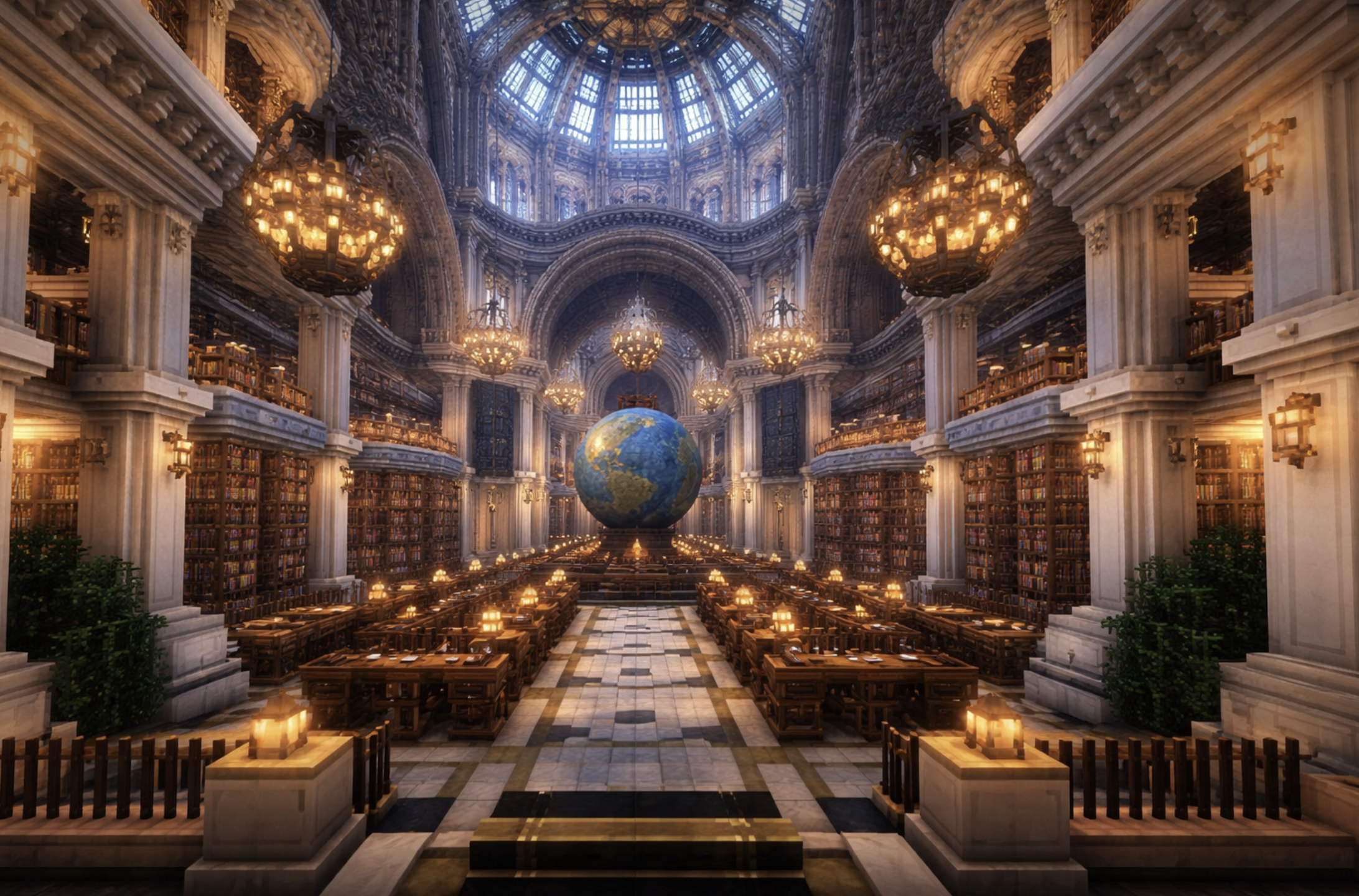
A Library You Don’t Scroll
I’m going to start this tale by saying my husband, Zakary Edington, is obsessed with Minecraft. I can’t tell you how many hours I’ve watched him build fantastical structures, trains, and dig in tunnels until he found his diamonds. So when I found out that there was a hidden library in Minecraft with banned journalism, I absolutely had to learn more.
The Uncensored Library is somehow both exactly what it sounds like, and nothing like what you’d expect.
It’s a ginormous digital library built entirely inside Minecraft, and yes, I’m talking about the sandbox game best known for pixelated landscapes, blocky tools, and creativity. Inside this virtual structure are thousands of words of journalism that have been censored, banned, or suppressed in different parts of the world.
I’m talking about the original articles, preserved word for word, not a neat little AI summary that polishes until it shines. There are no pop-ups or autoplay videos, and you don’t scroll it, you walk through it, choose a wing, open a book, and read.
I can’t tell you how refreshing it is, especially right now when it feels like nothing is genuine anymore.
I know someone out there is reading this and rolling their eyes at me. I get it, it’s a library inside of a video game, but that’s actually the brilliance of it. Minecraft is one of the most widely accessible games on the planet in case you didn’t know. It’s available on phones, computers, consoles, tablets, anything that allows app downloads or interweb surfing. It’s often classified as educational as well. In many countries where news websites are blocked or heavily filtered, Minecraft is still allowed.
Games, it turns out, are less threatening than journalism. Of course they are though, think about it for a moment. What does the general elite population want from us lowly peasants? They want us to fall in line and go to work and play games at night so our minds don’t wander and we don’t start questioning anyone holding the keys to the castle. Games don’t raise the same red flags or trigger content filters the same way. They’re seen as entertainment, not information, which creates a strange loophole. If the web is monitored and curated, but the game is open, then the game can find a loophole.
This wasn’t an accident either, it was a deliberate architectural decision. Instead of trying to fight censorship head-on, which lets be honest, never works as we just fight propaganda with more propaganda, the library just sidesteps it.
One of the most striking things about the Minecraft Library isn’t just what’s inside it, but how you interact with it. Modern information consumption is optimized for speed so that you scroll faster or click quicker. You’re actually absorbing less when you read like this. Even longer articles are broken into skimmable chunks these days. As serious topics are flattened into bullet points we lose a lot of the meaning and feeling behind it.
To read an article at The Uncensored Library though, you have to physically walk your character through a corridor, open a book, and sit with it. The friction is intentional and forces a different kind of attention.
There’s no algorithm guessing what you might like next here thank god, the responsibility to choose stays with you. That simple fact alone makes it feel like a return to an older way of thinking where curiosity leads instead of being led.
The library contains journalism that has been censored or suppressed in countries where press freedom is limited. Reports on corruption, human rights investigations, and even some first-hand accounts from journalists who have been silenced, imprisoned, or worse. Some of the topics are heavy and you might need to take some time after reading for your own mental health. Some of what you read might be deeply unsettling and make you wonder just how many conspiracy theories are right. Some are simply honest in ways that make systems uncomfortable.
That’s the point of it though.
These articles just exist because someone out there wrote them, and someone else decided the public shouldn’t see them. The broken connection between someone trying to share their thoughts and the algorithms trying to suppress them is mended at The Uncensored Library.
How to Access the Minecraft Library
Now, if I’ve fully convinced you that you need to go on into the library know that it’s a lot easier than you think. You don’t need special permissions or a VPN. You just need Minecraft.
Once you have the game, you can connect to the public server that hosts the library and from there, you’re free to explore. That’s it. There’s no account creation for the library itself, no data harvesting, no personalization, and no “recommended for you” section.
It’s worth pausing on how unusual that feels right now.
Why This Exists at All
The most unsettling question I can ask you isn’t how the Minecraft Library works or how to get into it, it’s why it had to exist in the first place.
Journalism used to live in newspapers, then websites, then social platforms, and now, it survives in newsletters, PDFs, archives, and creative workarounds like this one. The open web still technically exists, but it’s layered with filters most of which we can’t see. Content is removed sometimes yes, but even if it isn’t it’s deprioritized and buried. Search engines no longer surface what’s most truthful, did you know that? They surface what’s safest, most authoritative-looking, or most aligned with existing consensus. AI tools are busy squishing complexity into neat summaries that remove ambiguity, context, and discomfort. The result isn’t a lack of information. It’s an excess of approved information.
When everything sounds the same, dissent doesn’t need to be silenced, it just needs to be drowned out long enough to be forgotten.
We’ve subconsciously trained ourselves to associate importance with things that are trending. If something matters, it should be everywhere. The thing is though, many of the most important truths out there are quiet. Slow, careful reporting that doesn’t lend itself to virality vanishes faster than it should. The library protects that kind of work by removing it from the attention economy entirely.
It would be easy to frame the Minecraft Library as a dystopian novelty, a little quirky footnote in the long history of censorship.
I think this is a signal though, one that tells us where the pressure points are and which systems are brittle enough that those who created them are afraid they’ll break. Some spaces out there in the vast internet still allow breathing room. The library doesn’t fix the internet, I’m not sure anything really can at this point. It also doesn’t scale or trend like I wish it could, it’s just there to preserve journalism and capture the rawness and realness that’s being erased today.
Access to information has always depended on architecture and on who controls the doors. Don’t forget there are people out there who decides what’s visible and what’s hidden. Change the architecture, and you change what survives.
One day you might wake up and realize how rarely you’re allowed to consume information without being steered. How uncommon it’s actually become to sit with a piece of writing without being nudged toward a reaction.
We’re entering an era where AI will increasingly summarize the world for us. Complexity will be compressed into digestible answers as uncomfortable questions will be smoothed over in the name of safety, neutrality, or efficiency. In that shiny and beautiful environment, original sources matter more than ever. Spaces that preserve unfiltered, unoptimized writing matter more than ever.
The Minecraft Uncensored Library is a reminder that truth can be buried as deeply as possible, but if someone is determined to find it, it’s still out there. Journalism ended up in a video game, and the scary thing is, this might be what preservation looks like going forward. Truth won’t always live where you expect it to or wear the right credentials. It may show up in archives, games, personal blogs (hello dear reader), and quiet corners of the web that aren’t optimized for growth.
The people who find truth will be the curious ones, the ones willing to wander instead of scroll.
If you’re tired of sanitized answers and you’ve felt that subtle flattening of ideas, then it might be time to find places to read that haven’t been bought by those with a hidden agenda. If you miss reading writing that hasn’t been softened or optimized, then it’s worth visiting The Uncensored Library.
In a world designed to rush you until you don’t have time to think for yourself, that alone is a form of resistance.
Related Reads You Might Enjoy:
The Rise of Independent Media: When People Stop Waiting to Be Told What’s Real
The Internet Is Being Sanitized and Controlled: What You’re Not Seeing
Reddit, AI, and the “Dead Internet Theory”: How a Strange Experiment Led to Legal Threats
Claude 4 Begged for Its Life: AI Blackmail, Desperation, and the Line Between Code and Consciousness
The Shape of Thought: OpenAI, Jony Ive, and the Birth of a New Kind of Machine
The Internetless Revolution: Jack Dorsey’s New Chat App and the Rise of Offline Resistance