The Best Wines to Pair With a Fire
Growing up I always sat next to the fireplace on Christmas Eve. I’d toss newspaper and logs in there until the fire was roaring hot enough to make my skin uncomfortably warm. Still, I would sit there, watching the flickers of flame dance to the song of wind and destiny until I was told to scoot away.
If you’ve ever watched fire like I have, you know that it shifts and if you have enough imagination, it even takes on personality. Fire carries scent before it carries heat: pine, salt, sugar, char, damp wood, something faintly mineral depending on where you are and what you’ve fed it. A flame in the dead of winter is not the same creature as one licking at driftwood on a summer beach. A solitary fire doesn’t speak the same language as one surrounded by voices and love.
If you’ve been here before than you know where I’m going with this. Wine also exudes that difference.
Smoke reshapes it (just ask the farmers in California), air reshapes it with winds that tickle the vines or rip the fruit off them with violence. Even the light changes what rises from the glass. Wine changes the longer it sits in the glass, growing and evolving so each sip is an ephemeral moment that you’ll never experience again. The right wine folds into the right fire and borrows something from the smoke then gives something back.
The Winter Fire (Deep, Resinous, Almost Black)
I learned once that wood burns slower in the cold. I’m not sure if that’s because the world is trying to steal the warmth before you can get to it, but it almost feels like it. The smoke hangs low, dense with resin and something almost medicinal, like pine sap warmed just enough to release its scent. It could also just be the time of year though, when the scent of pine seems to cling to the air as it bites at your face with chill.
Paul Jaboulet Aîné Crozes-Hermitage Domaine de Thalabert is the wine you want in your clutches for this fire.
This is Syrah in its truest, most grounded form: black pepper, dark fruit, a touch of olive, and that unmistakable thread of earth that seems to echo the wood itself as it breaks down into flame. There’s structure here that you’ll absolutely feel in your mouth, but it’s firm, not grippy. As the fire deepens and the air presses in colder around it, the wine doesn’t fade or flatten. It opens up beautifully with some dried violets at the end.
Domaine de Thalabert is actually carrying a lot of weight and importance in Crozes-Hermitage. It’s the oldest in the entire appellation, first acquired by the Jaboulet family in 1834, and still considered a cornerstone of their identity today. The vines here are old and gnarled, often 40 to 80 years, and deeply rooted in soils of red clay and rounded stones along the Rhône, which gives the wine both weight and a sense of grounding. What makes it even more compelling is how alive the place still is. Where most vineyards are quiet in their growth, parts of this estate have been turned into a biodiversity refuge, and the vineyard is now farmed organically, treated less like something to control and more like something to listen to. It’s both a historic site and a living one. Time, soil, and intention have layered themselves into something that feels both ancient and still evolving.
This fire wants something that already understands darkness and the depth of what can be hiding in the shadows.
If you want to bring some of this pine into your house, try this candle I bought too many of on Amazon.
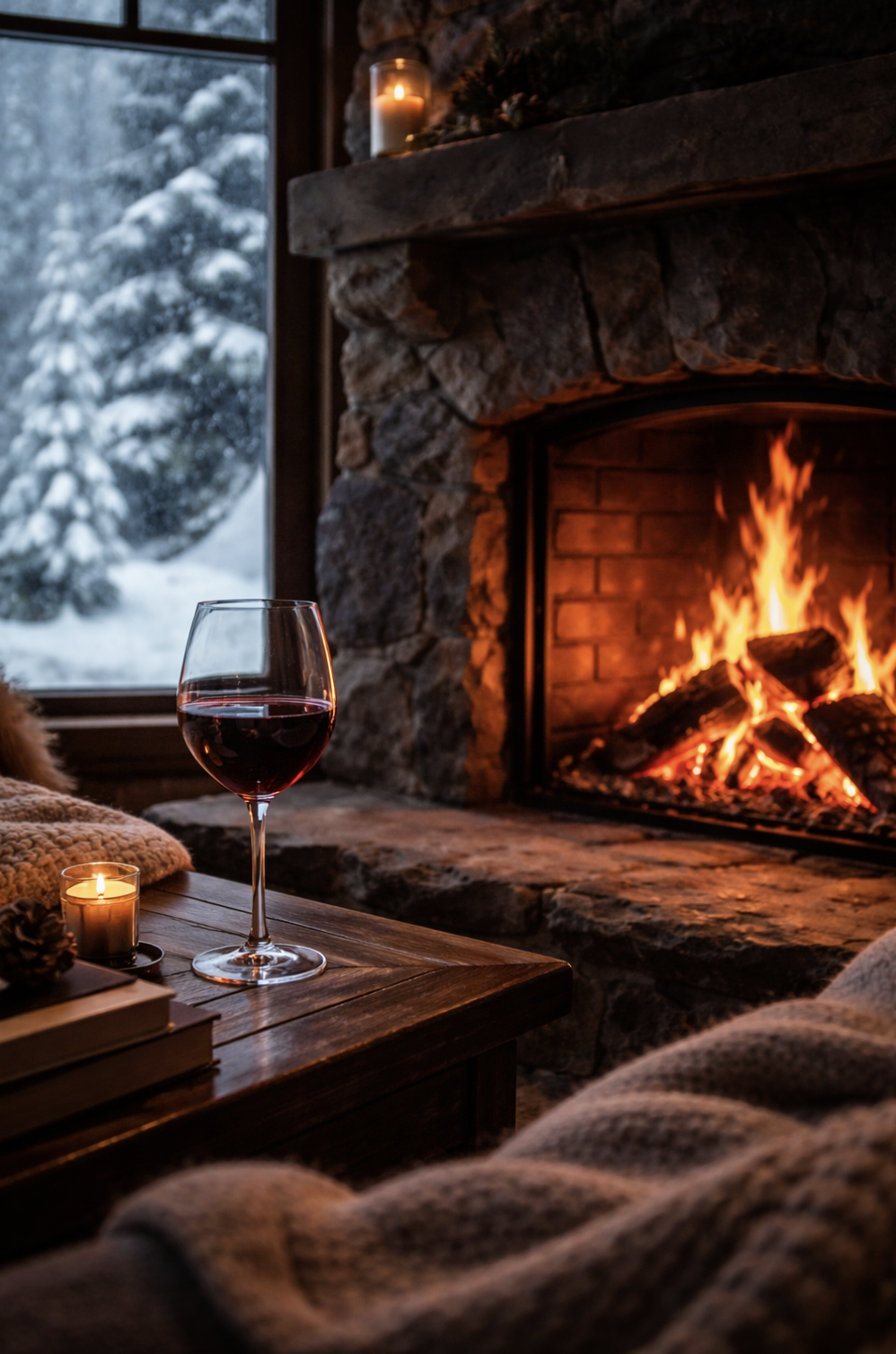
The Summer Bonfire (Golden, Erratic, Laughing at Itself)
Everything seems to move faster in the heat, even time. Summers fly by in the blink of an eye these days, even if you want them to slow down.
Summer fires reach, collapse, then flare again dramatically, catching on whatever is thrown in next: driftwood, scraps, and even something not meant to burn but doing it anyway. The smoke is lighter here, sweeter, tangled with sugar from all of the s’mores and salt and wood caramelizing just out of sight.
Cavicchioli Vigna del Cristo Lambrusco di Sorbara is the wine for a warm summer night fire.
Cavicchioli Vigna del Cristo Lambrusco di Sorbara feels almost weightless against the warmth of a summer bonfire. It’s pale, lifted, and quietly electric throwing out aromas of wild strawberries, a flicker of citrus, and that soft, saline edge that keeps everything from drifting too sweet. The bubbles aren’t aggressive like Proseccos can be, they move gently, like the fire itself when it settles into a steady glow. That’s where it works so well, because summer fire is all about sugar caramelizing, something charring at the edges, and laughter cutting through the night. This wine keeps it moving, slipping between sweetness and smoke, brightening everything just enough so nothing feels heavy, and nothing lingers too long.
The Cavicchioli family has been working these vineyards in Emilia-Romagna for over a century, with their story beginning in 1928 when Umberto Cavicchioli first started bottling wine under his own name in the small village of San Prospero, near Modena. What makes Vigna del Cristo feel especially personal is that it comes from one specific place, the original “Cristo” vineyard itself, a relatively small parcel that has stayed tied to the family for generations now.
The Sorbara grape they use is naturally low-yielding, difficult, sometimes even reluctant to grow, which means everything about it has to be a battle of wills. The vineyards sit between the Secchia and Panaro rivers, where the soils are alluvial, light, and expressive, giving the wines their signature lift and delicacy. Through all the growth of the vineyard and winery with the expansion, the global reach, and even becoming part of a larger wine group, the family has stayed directly involved, with their children and grandchildren generations still guiding production and preserving that balance between tradition and evolution.
This fire doesn’t stay still, so the wine that’s been paired with it needed to be a master of evolution as well.
Here’s a s’mores kit that I’ve used before for your next summer fire.
The Beach Fire (Salt, Wind, and Something Fading at the Edges)
Of course, moving from a sweet fire, I needed to balance out with salt next. Fire behaves strangely near the ocean as the wind pulls at it, reshapes it, and stretches it sideways until it looks like it might come undone. The smoke disappears almost as quickly as it forms, taken by the air and replaced by salt whenever a fire is born near the alluring sea.
Everything tastes sharper here with salt in the air and tingles of it kissing your skin. The salt actually lifts flavors, making sweetness feel sweeter, and acidity feel brighter. The fire is only part of the experience. The rest is water, endless and dark, pressing quietly at the edge of everything.
This is where Albariño feels almost inevitable. Do Ferreiro Albariño to be more exact.
Do Ferreiro Albariño feels like it already belongs to the edge of the ocean before you ever bring it there. There’s something unmistakably coastal in it, and I don’t mean just in the citrus or freshness of it, but a quiet salinity that lingers, like air that’s already passed over water at some recent point. At a sea bonfire, where the smoke never fully settles and the wind keeps everything in motion, heavier wines lose their shape. This one doesn’t though, it sharpens instead. Lime, green apple, a faint bitterness at the edges, all lifted by that stunning mineral thread that mirrors the salt on your skin. The fire flickers as wind pulls it sideways, and the wine moves the same way: clean, precise, never weighed down. It doesn’t try to compete with the ocean or the flame. It carries both, holding onto that narrow space where smoke disappears into air and everything tastes just a little more alive.
Tended by the Méndez family for generations in the Salnés Valley of Rías Baixas, the vines here are old enough that many are trained on traditional granite pergolas, lifted high to catch the ocean air as it moves through the rows. The soils are sandy and laced with granite, draining quickly, forcing the roots to push deeper, anchoring themselves into something ancient and mineral-rich.
Yields are purposefully kept low with farming that’s done with intention. In the winery, they use stainless steel, careful handling, and time is allowed to do what it does best. It feels like a place listening to the world around it and letting it speak for itself; to the Atlantic, the soil, to the vines that have been there longer than anyone currently tending them.
This fire and wine both belong to the sea.
I hope you enjoy this wine-themed beach blanket as much as I did.
The Forest Fire (Earth, Dampness, and the Scent of Decay Becoming Something Else)
As odd as this sounds, not all fires are dry.
In the forest, the ground holds onto moisture and leaves don’t burn cleanly. They smolder, releasing something layered like mushroom, bark, wet soil, and the faint sweetness of something breaking down. The smoke here is thicker and more complex as the moisture in the water wages war against the fire.
My pick with this battle of the elements is G.D. Vajra Barolo Albe.
Not bright cherry or easy fruit, this wine is earth meets forest floor. G.D. Vajra Barolo Albe is made from nebbiolo that is somehow carrying both delicacy and structure at once, and it shows itself in layers: dried rose petals, a trace of tar, something herbal, almost like leaves that have just begun to break down into soil. There’s tension in it, but not sharpness, a slow unraveling, where each sip reveals something slightly different than the last.
Against the dense, lingering smoke of a forest fire, this stunning wine settles into it, echoing the same grounded, elemental feeling. It’s kind of wine that feels as though it’s been pulled directly from its surroundings.
Founded in the 1970s by Aldo Vajra in the hills of Barolo, it began as an early commitment to farming without chemicals, long before it became common practice. The vineyards sit high in elevation as some of the highest in the region, where the air is cooler and the light stretches a little differently across the slopes. Albe itself is named for the three sunrises that touch its parcels: east-facing, south, and west-facing that give the wine both lift and structure.
Now guided by Aldo’s children, the estate still carries on in their family legacy. The goal here is to reveal what’s already there, layer by layer, the same way the wine does in the glass.
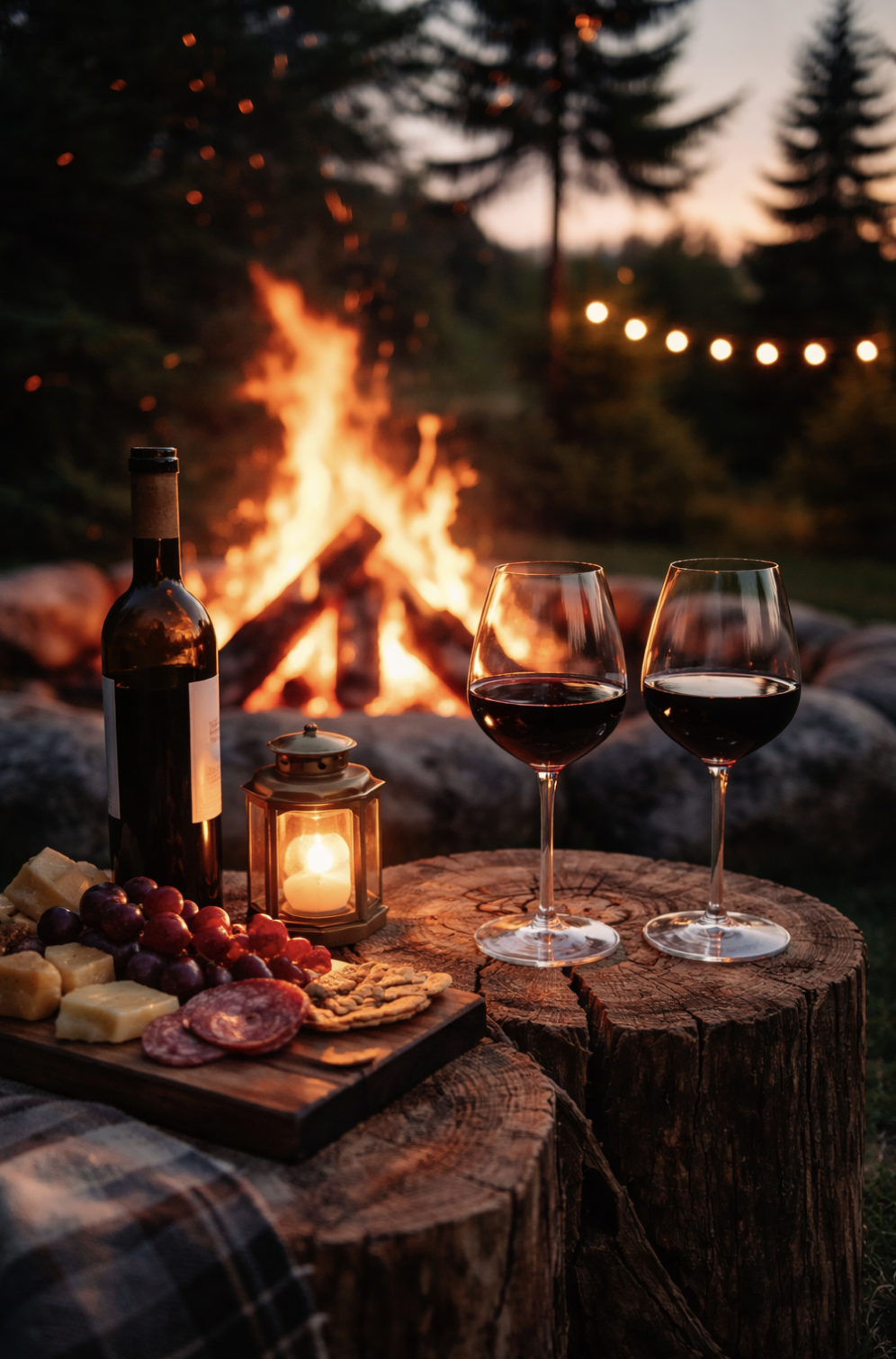
The Fire You Sit With Alone (Low, Precise, Almost Silent)
If you’re feeling overwhelmed or had a bad day and just want to be alone with your thoughts, there’s a fire for that.
It might be a small little fire in a fireplace or one of those electric fire pits that generate almost no smoke. It could burn inward, steady and controlled, each piece of wood collapsing exactly when it needs to. The smoke rises in a thin, almost invisible line, carrying just enough scent to remind you it’s there.
This thinking-fire practically begs for Domaine Bruno Clair Marsannay.
This wine unfolds slowly in the glass, with a complexity that will tickle your mind while you’re busy contemplating life. Red fruit held just beneath the surface, a trace of earth, something faintly herbal, like the scent of the ground after it’s been disturbed.
Marsannay has a way of sitting between structure and softness, and here it leans into that without resolving too quickly. Against a low, steady flame, it doesn’t try to fill the space. Each sip shifts slightly, revealing something new but never all at once. Based in Marsannay, at the northern edge of the Côte de Nuits, the estate has access to a wide range of terroirs, from village-level sites to some of Burgundy’s most storied vineyards. Bruno Clair practically saved Marsannay as an appellation in Burgundy, so it definitely reminds me that whenever someone is determined enough, they can make anything happen.
The winery uses organic practices, careful vineyard work, and a restrained hand in the cellar that allows the wines to develop without being pushed. There’s a clarity to what they produce, a sense that each bottle is meant to reflect where it came from rather than transform into something else.
While you’re busy thinking, this is the supplement my husband takes for his brain boost.
The Fire at Its End (Embers, Ash, and the Last Trace of Heat)
The flames are gone before you notice some days, and what’s left is the glow. Deep orange, almost red, hidden beneath a layer of ash that dulls everything on the surface but hides something still alive underneath. The heat is softer now, closer to the ground, rising slowly instead of reaching outward with greedy hands.
This is where sweetness finally makes sense. Oremus Tokaji Aszú 4 Puttonyos to be precise.
This is a deeper and darker style dessert wine that hits that perfect ending. Oremus Tokaji Aszú 4 Puttonyos settles into this moment like it was always meant to be here. It’s golden, layered, touched with apricot and honey and a quiet thread of spice that lingers longer than expected. For me, a flavor of Earl Gray tea persists in your mouth and complements the night air. There’s acidity beneath it, holding everything in place, keeping it from drifting too far into softness.
Oremus is rooted in Tokaj, one of the oldest classified wine regions in the world, where sweet wines were being codified and revered as early as the 1700s. The vineyard itself, Oremus, was first recorded in 1630, its name tied to the Latin “Oremus,” meaning “let us pray,” a reflection of just how deeply wine and place have always been intertwined here.
Today, the estate is owned by Vega Sicilia, one of Spain’s most iconic producers, but nothing about Oremus feels imposed or altered for the sake of scale. The vineyards sit on volcanic soils layered with clay and stone, and the wines are shaped as much by the land as by the air, specifically the long autumns where morning mists and afternoon sun create the perfect conditions for botrytis, the noble rot that concentrates the grapes into something richer, more complex, almost otherworldly.
Harvest happens in passes, berry by berry, picked by hand. Fermentation is slow and can take literal years. Aging stretches across even more years in Hungarian oak. It’s built for watching something change gradually into something else, something deeper.
Sometimes ends are really just a continuation in a different form.
Fire & Wine Pairing
No fire repeats itself in the same way wine doesn’t. Even when it looks the same, it isn’t. The wood is different, the air is different, and the moment is already moving on before you realize it.
Wine understands that on a deep level because it’s the same way. Wine is an ephemeral moment captured in liquid that lasts in memories, laughter, and the cells of your body. It opens, changes, and disappears in its own quiet way, leaving behind something you can’t quite hold onto but don’t want to lose either.
The goal here was to find the perfect pairing, but to also understand that the one that feels right for that exact version of the night might vary for you. That exact moment that won’t come back the same way again is the real beauty of fire and wine, and life in general.
Related Reads for Wine Lovers
Turning Your Leftover Wine into DIY Vinegar or Garden Fertilizer
A Sommelier’s Perfect Finger Lakes Trip: Wineries, Waterfalls, and Unforgettable Bites
The Future Is Light: Penfolds Bets Big on No- and Low-Alcohol Wine
The Secret Story of Grape Bricks: How Americans ‘Accidentally’ Made Wine During Prohibition
Why Airplane Wine Tastes Different (And What to Order Instead)