The Best Wines to Pair With a Rainy Day
Today was one of those days where the storm clouds rolled in and I caught my breath waiting for the rain that never came. The birds chirped with their eagerness that often proceeds a storm, but then the wind blew it elsewhere and I found myself almost yearning for a little rain day. Rain isn’t just one thing or one style.
I understand that it’s just water falling from the sky, but anyone who’s ever sat by a window long enough when the storm is here knows better. Rain has moods and textures, voices that scream to be heard or whisper secrets in your ear. Some days it taps gently, like it’s asking permission to be let in (don’t do it, it’s going to ruin the wooden windowsill). Sometimes it arrives uninvited, loud and electric, shaking the world outside your walls with its extreme anger. My favorite rain doesn’t feel like it’s falling at all, it feels like it’s hovering.
I know some of you out there might think I’m a little crazy (I am, can confirm), but the wine in your glass begins to matter differently depending on the storm and the weather outside.
When the air fills with moisture and humidity, aromas don’t rise as sharply from the glass. They sort of soften, or blur slightly at the edges, like everything else on a rainy day. Cooler temperatures quiet the volatility of the wine, holding it closer to itself, making it feel more contained and introspective. That’s why the cheaper your wine the colder you should serve it (you can taste less of it). Even the pressure in the sky shifts during a storm, subtly altering the way a wine opens, as if the atmosphere itself is pressing gently down on it, asking it to reveal itself more slowly.
See? There’s actually some science behind my madness.
Rain dims the light, slows the world down, and wraps everything in a kind of quiet that makes you more aware of what’s in front of you. In that stillness, wine becomes something you feel as the edges soften and the experience deepens.
A good wine on a rainy day sometimes can create a moment that lingers longer than mist on a cloudy day.
Thunderstorm Rain
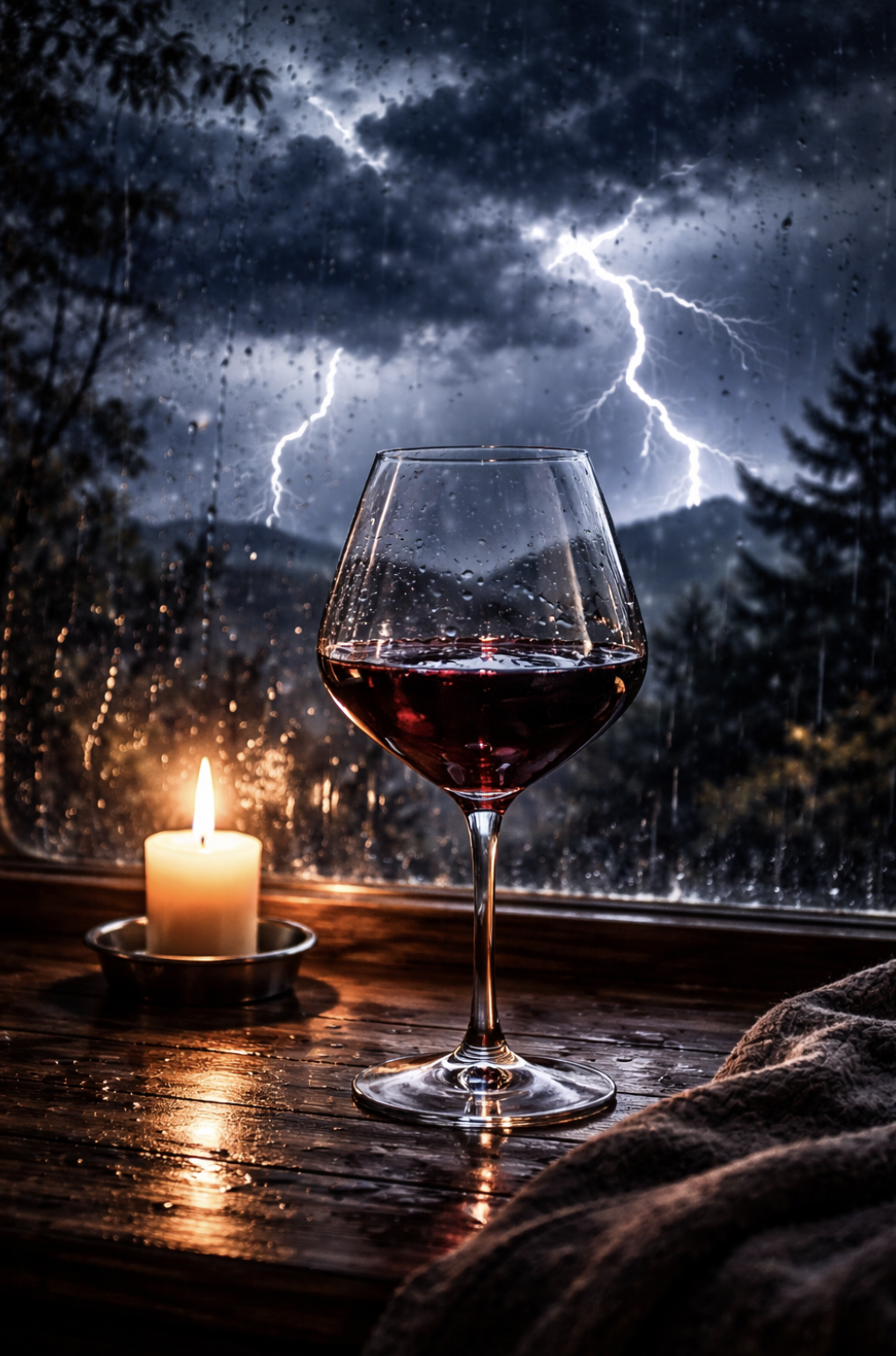
Boy do I love a good demanding thunderstorm. The sky darkens in a way that feels imminent as the air thickens then thins. Without warning that first crack of thunder splits everything open as light flashes across the room, illuminating corners you weren’t even looking at, and for a moment, the world feels exposed. Life is alive in a sharper way, which isn’t a moment for something delicate.
I don’t want subtlety or restraint with my thunderstorm, but Syrah. Auguste Clape Cornas is wild, feral, and unapologetically intense. If thunder had a taste, it would lean this direction.
Clape’s Cornas comes from steep granite slopes that don’t give easily, shaped by heat, stone, and time, it carries all of that with it into the glass. There’s something completely untamed in it with smoke, black fruit, iron, and a hint of something almost animalistic. When the sky turns heavy and the air feels charged, this wine doesn’t retreat from that energy…it meets it head-on.
As the thunder rolls and the light fractures across the room faster than you can blink, the structure of the wine begins to feel intentional with its firm tannins and density holding everything in place while the world outside shifts. This Cornas won’t make the storm any gentler. It just sits with you inside it, steady and unapologetic, like it understands something about intensity that other wines try to avoid. If thunder had a taste, it would be dark, gripping, and alive with tension.
A wine that doesn’t flinch when the sky cracks open is like a friend who sits with you through the storms of life.
Wind-Driven Rain
Not all storms are loud in the same way, because some feel restless. You know the kind of rain that doesn’t fall straight down, but moves sideways, pushed by wind that seems to have its own agenda? Trees bend, windows rattle, and everything outside feels a bit unsettled…like the world is shifting, just a little, out of place. My garbage cans are always blown all over the lawn with this sort of rain. You can hear it more than you can see it.
This is where a nice Barolo finds its footing. Azelia Barolo is structured, restless, and quietly powerful, unfolding with layers of rose, earth, and dried cherry that never sit still for long. If wind had a taste, it would feel like this wine, always shifting, persistent, and impossible to ignore.
Barolo is not an easy-going wine to sip on patios when the sun is beating you to death with its rays. It’s structured, tannic, and often misunderstood at first. This wine needs you to sit with it and let it evolve as you notice the way it changes as it opens, as it breathes. Azelia is one of those producers that makes a stunning Barolo. The Scavino family has been rooted in Castiglione Falletto since the early 1900s, working with some of the most balanced and quietly powerful vineyard sites in the region. There’s a sense of continuity in what they do without dramatic stylistic swings, or trend chasing some others do, but just a firm commitment to letting Nebbiolo speak in its own voice. Their wines feel grounded in place, shaped by limestone and clay, by altitude, and the slow patience that Barolo demands.
What makes Azelia’s Barolo so compelling is the way it holds both structure and grace at the same time. You get the expected backbone with firm tannins, that signature grip that reminds you this wine was built to last, but it really never feels harsh or overbearing. Instead, it unfolds like a flower seeking the sun. Rose petals, dried cherry, a hint of tar, and something earthy that feels almost like walking through fallen leaves after rain. There’s a quiet precision to it, like every element knows exactly where it belongs, even if it takes time to fully reveal itself.
Time is really the point with Azelia. These wines open slowly, evolve in the glass, and even more so over years in the bottle. What starts as something structured and a little reserved gradually softens into something more layered, more expressive, and more beautiful. The longer you give it, the more it gives back.
It mirrors the wind of those stormy nights. Unpredictable yet layered and slightly resistant to immediate understanding. Let both the storm and the wine unfold at their own pace.
Slow, Steady Rain
Then there’s the rain that softens everything and makes the world grow green and lush around it.
I actually really like the kind of rain that arrives without drama and stays without urgency. It coats the world in a quiet rhythm that’s steady and almost meditative. Although, that might be because I like to meditate to the sound of rain. Time stretches in these moments as your thoughts wander a little further than usual as long as you aren’t doom-scrolling.
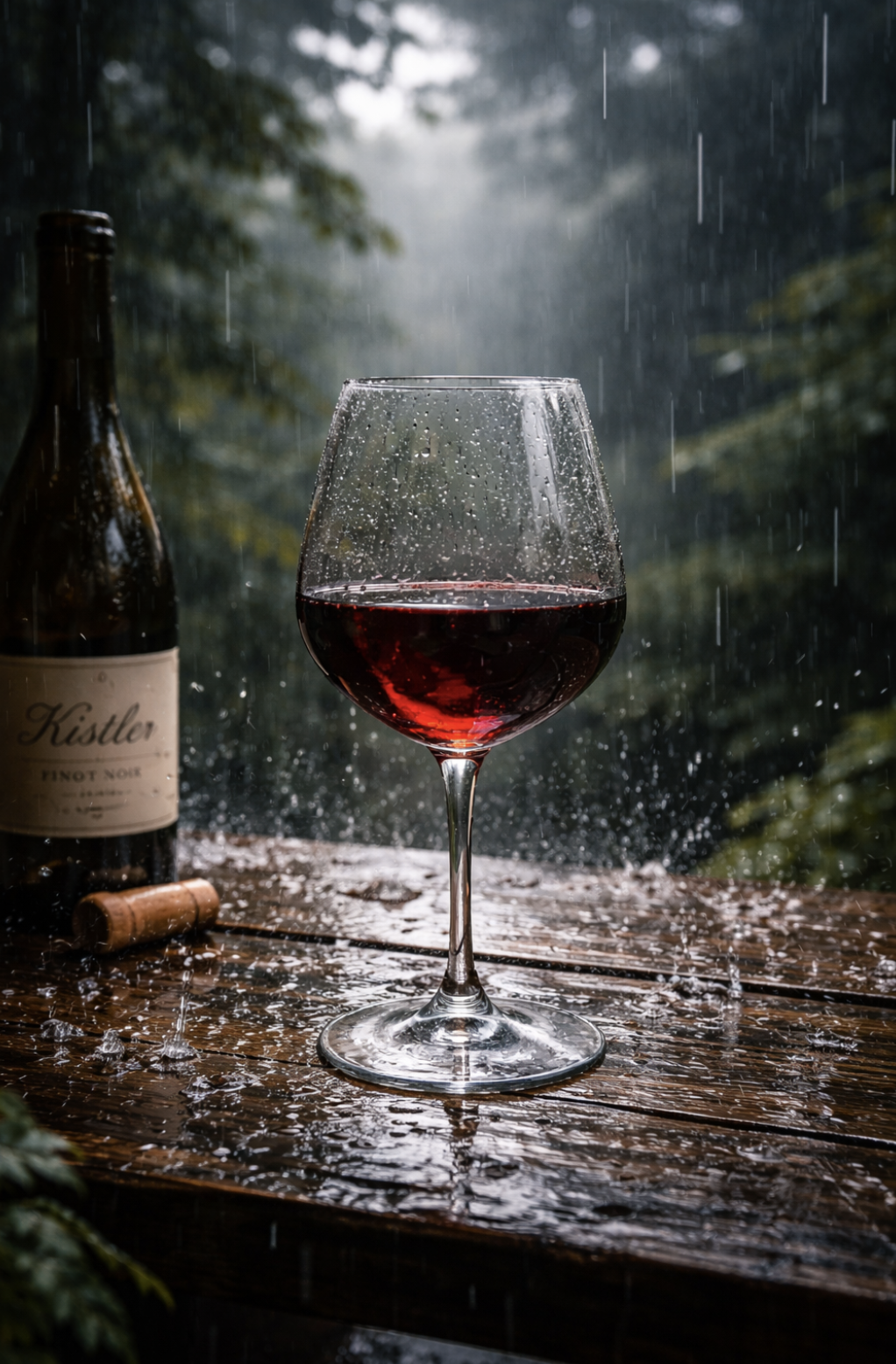
Pinot Noir belongs here. I don’t want power or intensity with this sort of rain, I want something that understands restraint. Kistler Pinot Noir carries a softness that feels purposeful, like it knows exactly how much to say and when to stop. There’s ripe red fruit, a gentle warmth, and just enough structure to hold everything together without ever feeling heavy. If this kind of rain had a taste, it would feel like this, quiet, steady, and deeply comforting.
Kistler doesn’t interrupt the moment, it settles into it. It moves at the same pace as the rain, slow and unforced, wrapping around you rather than asking for your attention. Each sip feels like an extension of the stillness, in a world that’s constantly pushing forward, this is a wine that allows you to stay exactly where you are. Founded in 1978 by Steve Kistler and Mark Bixler in Sonoma, the whole idea from the beginning was that California could produce wines with the same site-driven identity and precision as Burgundy. Even though Kistler became famous for Chardonnay, their Pinot Noir has always been deeply tied to the cool, coastal edges of Sonoma, where fog, ocean air, and slower ripening create wines with both richness and tension.
The perfect wine to enjoy in the rain.
Misty Rain
While maybe one of my favorite types of rain, there are days when the rain barely feels like rain at all.
It sort of hangs in the air more than it falls. A soft mist, almost imperceptible, turning the world slightly blurred around the edges where buildings look distant even when they’re close, and light diffuses in a way that feels gentle. It’s a quieter kind of surreal.
This is where bubbles make sense for me. Vilmart & Cie “Grand Cellier” is a bit rounder and richer than a lot of Champagnes, but still graceful. There’s plenty of orchard fruit in the glass, a gentle creaminess, and a quiet depth that unfolds slowly. If mist had a taste, it would feel like this: soft, suspended, and just slightly out of reach.
Vilmart doesn’t rise aggressively from the glass, it sort of lingers. It moves in layers, like fog drifting across a landscape, revealing and concealing at the same time. The texture is what holds you with a silkiness, and is almost weightless despite its depth. Vilmart & Cie is one of those rare Champagne houses that is both deeply traditional and quietly independent. It’s a small, family-run grower-producer based in Rilly-la-Montagne, in the Montagne de Reims, and has been in the same family for generations. Unlike the big houses, they grow their own grapes and focus on expressing their specific vineyard sites, which gives their wines a more personal touch.
What really sets Vilmart apart is their approach in the cellar. They ferment and age their wines in oak barrels, which is something not many Champagne producers do, which gives “Grand Cellier” that subtle richness and texture without overwhelming the wine. It’s a balance they’ve mastered over time, depth without heaviness, and structure without losing that lifted graceful feeling that makes their Champagne so memorable.
In this kind of rain, the world feels blurred at the edges, and this Champagne understands that. It mirrors this atmosphere in a way that feels almost too perfect. The lift of the bubbles, the lightness on the palate, the way it dances without ever becoming heavy makes it feel suspended, like the mist itself.
Rain that doesn’t fall so much as float deserves a wine that does the same.
Freezing Rain
There’s also the most deceptive rain of all to think about. The kind that looks beautiful at first as everything glistens and branches catch the light as the world feels frozen in a kind of fragile stillness. Beneath that stunning beauty though, there’s tightness. Ice forms where you don’t expect it, the ground becomes uncertain as each step requires attention so you don’t find yourself flat on your butt.
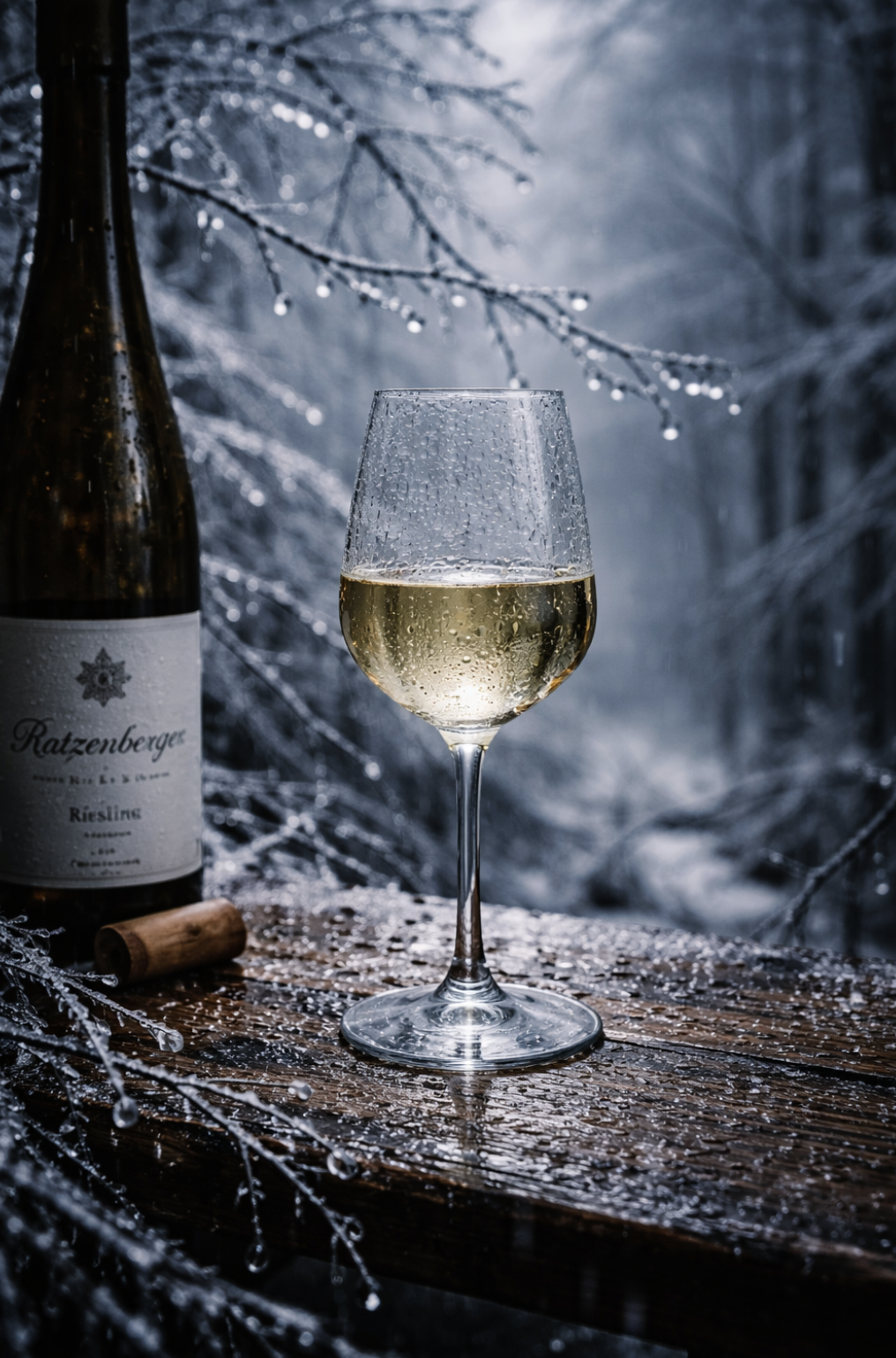
It’s not a gentle experience, but Riesling fits this moment in a way that feels almost exact. Rätzenberger’s Bacharacher Trocken Riesling captures this moment perfectly. There’s nothing rounded or forgiving about it at all, just lime, stone, and something almost metallic that cuts through the palate with surgical precision. High acidity moves like cold air, sharp and unwavering, leaving no room for distraction. If freezing rain had a taste, it would feel clean, focused, and quietly unforgiving.
This is a wine built on tension. Rätzenberger was shaped by the landscape it comes from, and the Mittelrhein is not an easy place to make wine. Their vineyards sit on impossibly steep, slate-covered slopes along a narrow stretch of the Rhine, where everything has to be done by hand. It’s one of Germany’s smallest and most overlooked regions, but also one of its most dramatic. The slate soils hold heat just enough to ripen the grapes, but the overall climate stays cool, which is why their Rieslings carry that signature edge with high acidity and a kind of mineral intensity that feels carved out of stone.
Just like the rain outside, you sip it, and it feels clear, focused, almost crystalline.
Passing Rain
And finally, there’s the rain that doesn’t stay for very long, but is just passing through.
It’s the kind that arrives in fragments with sunlight breaking through even as droplets fall. The sky can’t seem to decide what it wants to be and everything feels temporary, shifting, and caught between two states. You might even catch a rainbow or two peeking through.
You notice it because it won’t last, and Ameztoi Txakolina Rosé belongs in this moment. Slightly spritzy, but ultra-fresh this is perfect for passing rain. It’s one of those wines that feels like it was shaped by wind, salt air, and movement. Hailing from the Basque Coast in northern Spain, where the vineyards literally overlook the Atlantic Ocean, the climate is cool, rainy, and constantly influenced by ocean breezes, which is why the wine carries that high acidity, freshness, and almost electric energy. It’s alive and every sip reminds you of that.
What makes this rosé so unique is how it’s made. Instead of treating red and white grapes separately, Ameztoi blends the indigenous varieties Hondarrabi Zuri and Hondarrabi Beltza together from the start, fermenting them as one. Toward the end of fermentation, they trap a bit of natural CO₂ in the wine, which gives it that signature light spritz, just enough to make it feel like it’s still in motion. While most producers in the region abandoned the red Hondarrabi Beltza grape, the Ameztoi family kept their old vines, some dating back generations, which is part of why their rosé has so much personality and depth.
Sun and rain paired with warmth and coolness belongs with this rosé made with both red and white grapes.
Rain & Wine Pairing
Rain was never meant to be rushed through or avoided entirely or all our plants would die, and neither was wine. Both ask you to slow down just enough to notice what’s actually happening. Feel the way the air changes, watch the way the light shifts, and notice the way a wine opens if you give it the time it quietly asks for.
Some days the storm will pass before you’re ready, and other days it will stay longer than you expected, but either way, there’s always a moment hidden inside it worth holding onto (hint: this isn’t just about wine and rain now). A good bottle doesn’t compete with the rain outside your window, it meets it there, reminding you that even something as simple as a rainy day can feel a little more alive if you let it.
Not all rain is the same…and neither is the way we experience it.
Related Reads for Wine Lovers
Turning Your Leftover Wine into DIY Vinegar or Garden Fertilizer
A Sommelier’s Perfect Finger Lakes Trip: Wineries, Waterfalls, and Unforgettable Bites
The Future Is Light: Penfolds Bets Big on No- and Low-Alcohol Wine
The Secret Story of Grape Bricks: How Americans ‘Accidentally’ Made Wine During Prohibition
Why Airplane Wine Tastes Different (And What to Order Instead)