The Vault Beneath the Ice: Where Humanity Hid Its Future
I’ve been mostly writing about wine pairings the past few weeks and even though I have a few more fun pairings up my sleeve, I thought today I’d explore something else I love dearly. Mystery and plants collide in a place on this planet where the future has already been packed away.
As dramatic as I can be sometimes, this isn’t one of the crazy stories that my husband likes to listen to before going to bed at night. This place was created from a quiet decision, made carefully by a few people that had begun to understand something uncomfortable about the world. Everything we depend on is actually a lot thinner than it looks. I, myself, came to this realization shortly after my trauma, so I can relate to the person who woke up one day and decided that survival isn’t guaranteed, but built, piece by piece and seed by seed.
Deep inside a mountain in Svalbard (Norwegian archipelago in case you had no concept of where it was like me), there’s a place where the cold does not come and go with the seasons, but stays permanently. It’s the kind of cold that seeps into stone and lingers there, which makes sense because it’s halfway between mainland Norway and the North Pole. This cold preserves things, not just freezes and thaws. It’s the absolute most perfect place to store something for the long haul, which is exactly what we did.
If you didn’t know it was there, you might miss it entirely just walking through the mountains on your casual stroll.
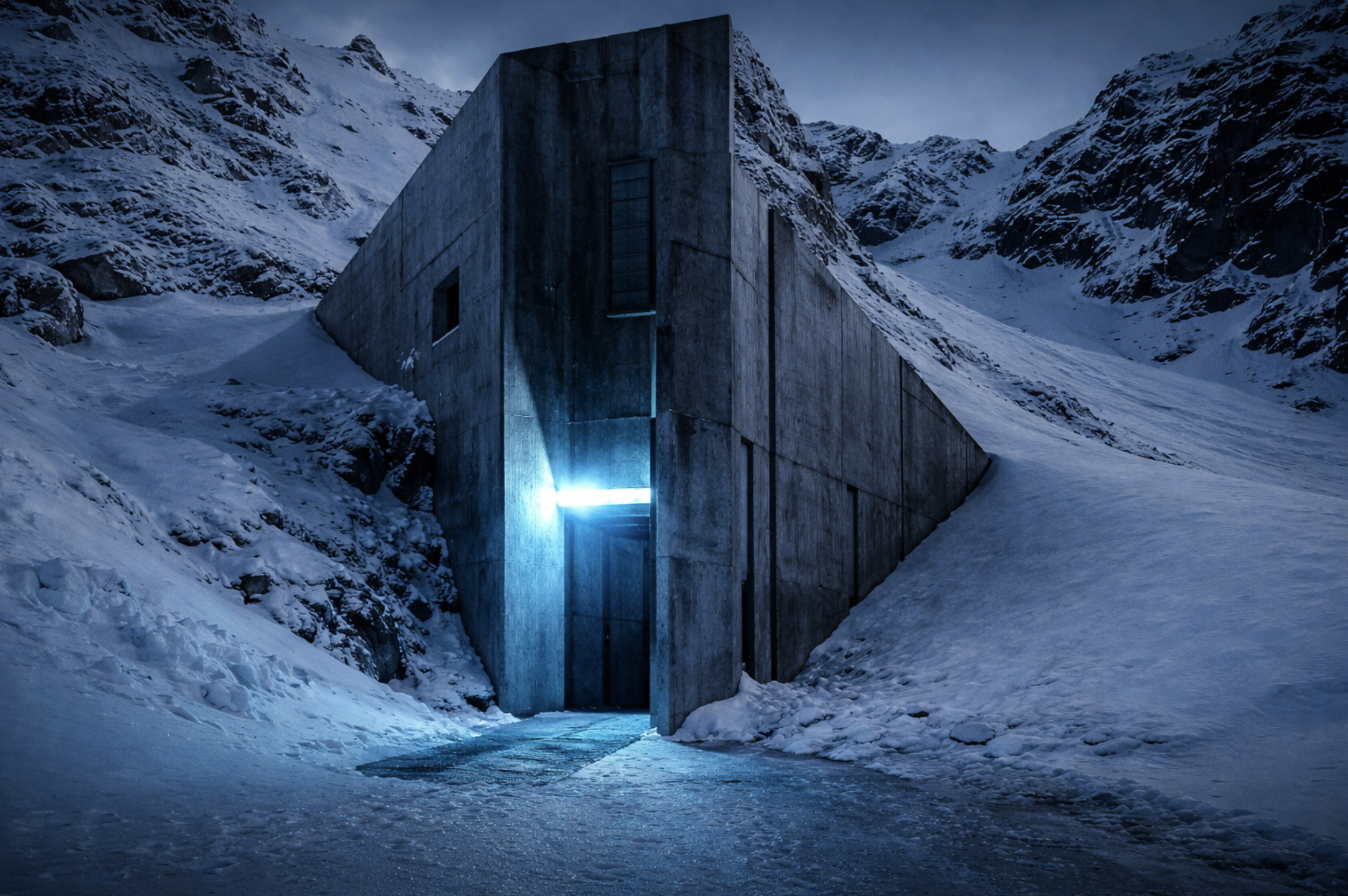
Herein lies a narrow structure cutting into the rock, a sort of wedge of concrete. It’s a quiet line against an endless white landscape and at night, the entrance glows faintly, just enough to mark its existence. While this bunker might sound like the kind that is perfect for the elites of the world or Mark Zuckerberg to build, it’s actually not here for that sort of thing.
Inside is something we decided we really can’t live without. Behind that door is the Svalbard Global Seed Vault, and inside are seeds.
A World, Folded Into Something Small
I definitely have read a bit too many fantasy books lately because I want so badly to write about the magical seeds that are hidden away from us all that could cure every disease, solve world hunger, or glow in the dark at night so we can finally get rid of all the street lamps (The Secret Light of Plants: Exploring Bioluminescence). The truth is though, most of the plants that surround us on a daily basis are nothing short of a miracle anyway.
It’s almost disorienting, when you think about it. The thing we chose to protect most carefully is also one of the smallest things we have. A seed doesn’t look like much, I mean some of them are actually things we decorate bagels with for goodness sake. You could hold one between your fingers and forget it was there more easily than you often do by looking at it and dreaming of its potential.
Inside that small, quiet shell is an entire field or an orchard. A harvest that has not happened yet lies in wait in the tiniest darkest place. Every seed is a beginning waiting for the right conditions. Is it actually so surprising that someone woke up one day and wanted to collect them all? Yes, I’m sure it was a hoarder, but also, I have a drawer in my kitchen full of seeds, so who am I to talk?
Inside this vault in the middle of nowhere are seeds from nearly every corner of the world. I mean it has rice varieties that have sustained civilizations for thousands of years and wheat adapted to specific soils, specific climates, with specific histories. There are beans that know how to survive drought and crops that have quietly evolved alongside our careful tending hands, generation after generation, adjusting, adapting, and learning without ever thinking.
They carry memory, and not the kind we recognize, but instructions on how to keep going. Everything they’ve learned about survival is tucked inside them, and there are over a million samples now.
Think about that number for just a moment because that’s a million different ways the world has learned how to grow food. It’s a million different answers to the same question of how to continue.
We like to believe that the systems we’ve built are strong. It’s a comforting lie we tell ourselves because the alternative is to worry about a bunch of stuff outside of our control. You like to think that grocery stores will always be full, supply chains will keep moving, efficiently and invisibly. Somewhere out there, someone is always planting something, harvesting something, and shipping something, so that we don’t have to think too hard about where our food comes from.
But beneath that confidence is something more fragile than you’d feel comfortable hearing about. Apocalyptic Skills You Never Thought Twice About is a fun read you might want to dabble in next.
The thing is, agriculture depends on diversity. I’m not talking about abundance or scale, I mean actual diversity. There are different seeds for different conditions for a reason. Different genetic traits allow crops to survive when something shifts because when the temperature rises, when the rain stops, or when a disease appears that wasn’t there before plants need to be able to continue on, or they die off.
When we lose that diversity, we don’t just lose variety, we lose resilience.
That loss has happened before where entire crop systems have failed and the result is famines that have reshaped countries. Diseases have come along in the past and wiped out staple foods. Sometimes the climate has shifted faster than crops could adapt. History is full of these moments. Have you ever heard of the banana trees that went down? My god, the potato famine is like textbook lesson for this.
We tend to forget these sort of things when life feel stable, but that illusion could be gone in the blink of an eye. This vault exists because someone out there remembered.
The idea behind the vault is simple, yet elegant. If something is too important to lose, you make a copy and keep it safe for the future. Every seed stored in the mountain is a duplicate of something held somewhere else from maybe a gene bank, a research facility, or a country’s agricultural archive. The vault doesn’t replace those places, it just protects them.
It’s a backup of the backups, just in case everything else fails.
The location was chosen with the kind of quiet intelligence that only becomes obvious once you hear it explained. The Arctic permafrost acts as a natural freezer, so even if the power goes out, or if the world above changes in ways we can’t predict, the cold remains.
The mountain itself is kind of a guardian with stone and ice working together to preserve something fragile. Something alive matters even if it doesn’t look alive.
According to some sources on in the interwebs (very reliable) you walk into the vault (and very few people ever do) the world changes almost immediately.
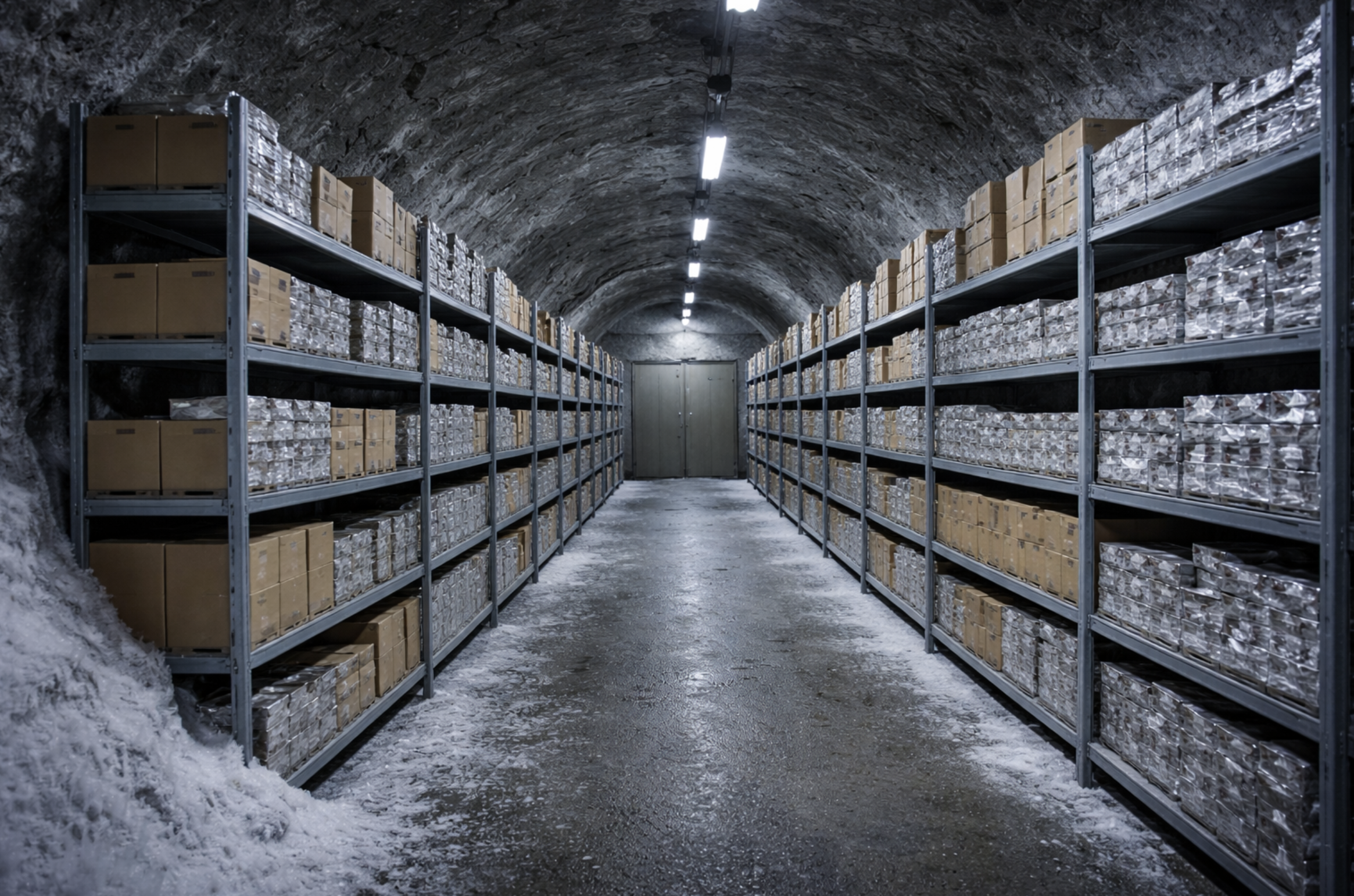
The air is still because it’s built to be undisturbed. I’d imagine it’s the kind of stillness that makes you aware of your own movement, and the quiet sound of your footsteps echoing back at you. The tunnel stretches forward, lit softly, the walls cold and unyielding, the mountain pressing in on all sides. At the end of that tunnel are the storage rooms and inside them, rows upon rows of boxes stuffed to the brim with millions of seeds.
All of them asleep, all of them waiting. Life is not happening in this cold and frozen place, it’s paused, just held in a moment before it even starts. To me, there’s something almost haunting about that. I think of life as movement, as change, as something unfolding in real time. But here, life is quiet, reduced to its bare potential.
The Day It Was Opened
It’s easy to think of the vault as something purely hypothetical, some safeguard for a distant future we hope never arrives. The truth is more immediate than that though.
The vault has already been used.
In 2015, during the war in Syria, a seed bank was destroyed. Years of agricultural research, carefully preserved genetic diversity, all at risk of being lost, and scientists turned to the vault. They requested the return of seeds that had been sent there for safekeeping. So those seeds were taken out of the mountain and planted.
From them, something began again. Fields were restored, crops regrown, and a system that had been broken started to rebuild itself.
The vault did exactly what it was meant to do, not in some imagined apocalypse, but in our present.
A seed is a strange kind of object that’s both everything and nothing at the same time. It contains a complete set of instructions, a full expression of life, and yet it does nothing on its own. It waits for the right moment, the right conditions, and the right combination of elements to wake it. I feel like there’s a lesson in there somewhere about me needing more patience in life for all my ideas to come to fruition.
If We Ever Need It
Maybe no one will ever need to walk into that mountain for the reason it was built. It’s possible the systems we’ve created will hold and agriculture will continue to adapt and respond to whatever changes come.
If that’s true, the seeds will remain there, untouched, for centuries.
But if that day does come, and something shifts too far, too fast, there will be a place where the story of how we fed ourselves has been preserved. A cold, cold place where the knowledge of growth has been kept intact.
A seed has always symbolized possibility, and for good reason.
If you ever want to start your own little seed collection, this is the heirloom kit that I bought. Let me tell you the cantaloupe was delicious and those Brussels sprouts lasted me three seasons!
Other Reads You Might Enjoy:
The Secret Life of Soil: Why Healthy Dirt Might Be Smarter Than You Think
The New Garden Revolution: Growing with Companion Microbes Instead of Chemicals
10 Plants You Can Grow Indoors Year-Round (Even If You Don’t Have a Green Thumb)
The Whispering Cure: Limewashed Trees, Natural Pesticides, and the Disappearing World of Insects
The Quiet Giants: Why Trees Are More Valuable Than Diamonds (and Always Have Been)
Airborne Seeds and Invisible Roots: The Poetry of Floating Agriculture
How the Brain Reacts to Light Pollution: What Happens When We Forget the Night