Apocalyptic Skills You Never Thought Twice About
Perhaps today I went too far down the doom-scrolling. So many things popping up on my feed about “World War III,” and I might’ve been talking about it with my husband in the car on the way to the gym. Now, for years I’ve been quietly cataloging who will be on my apocalypse team as an addition to the giant bodybuilder friends that Zak (husband) has, and also I’ve been refining my survival techniques.
The apocalypse, as we’ve been taught, looks dramatic. Hollywood has trained us all to imagine cities burning, highways empty and maybe a dash of zombies or something of the sort. The usual movie scenes, you know exactly what I’m talking about.
The thing is though, real survival probably wouldn’t look like that at all. It would look like a bunch of little facts you never thought twice about suddenly becoming the difference between comfort and catastrophe. A strange truth is that our civilization hides an enormous amount of knowledge from us, simply by making it unnecessary. Grocery stores, plumbing, electricity, refrigeration, and antibiotics quietly solved thousands of problems every single day so much so that we never notice them working.
Until they stop…and when they do, the world becomes a puzzle again.
While we were in the car today, I was talking about how in an urban farming book I read once it talked about how great rabbit meat was. I told Zak that I’d be farming rabbits after the new regime takes over, and he taught me something that genuinely stunned me: you can actually die from eating too much lean rabbit meat.
Now, rabbit meat isn’t poisonous, it’s actually too healthy. I actually lost money betting him on this today, so I feel like I’ve learned something worth sharing with the world here. The condition is called rabbit starvation, and it has killed real explorers, trappers, and Arctic travelers throughout history. When people survive on extremely lean meat with almost no fat, their bodies begin to fail even though they’re technically eating. It starts with a headache, then nausea, then fatigue so heavy it feels like gravity on Jupiter (wait gravity is heavier there, right?).
Eventually the body begins shutting down and you can truly die from this. Turns out, your metabolism needs fat and carbohydrates to process protein properly. Without them, the liver can’t keep up with the nitrogen produced from breaking down protein. The result is a slow, miserable starvation that happens while you’re still eating food every day.
This kind of fun fact (is it “fun”?…I’m not sure) made me realize just how much modern life has erased entire categories of survival knowledge. The apocalypse, if it ever comes in our lifetime, would test strength just as much as it would what you know about the world.
Fire Is Harder Than Movies Make It Look
In most movies, making fire is simple. Someone rubs two sticks together for about thirty seconds, sparks appear, and suddenly a warm campfire is crackling under the stars.
Reality is…less cinematic than that.
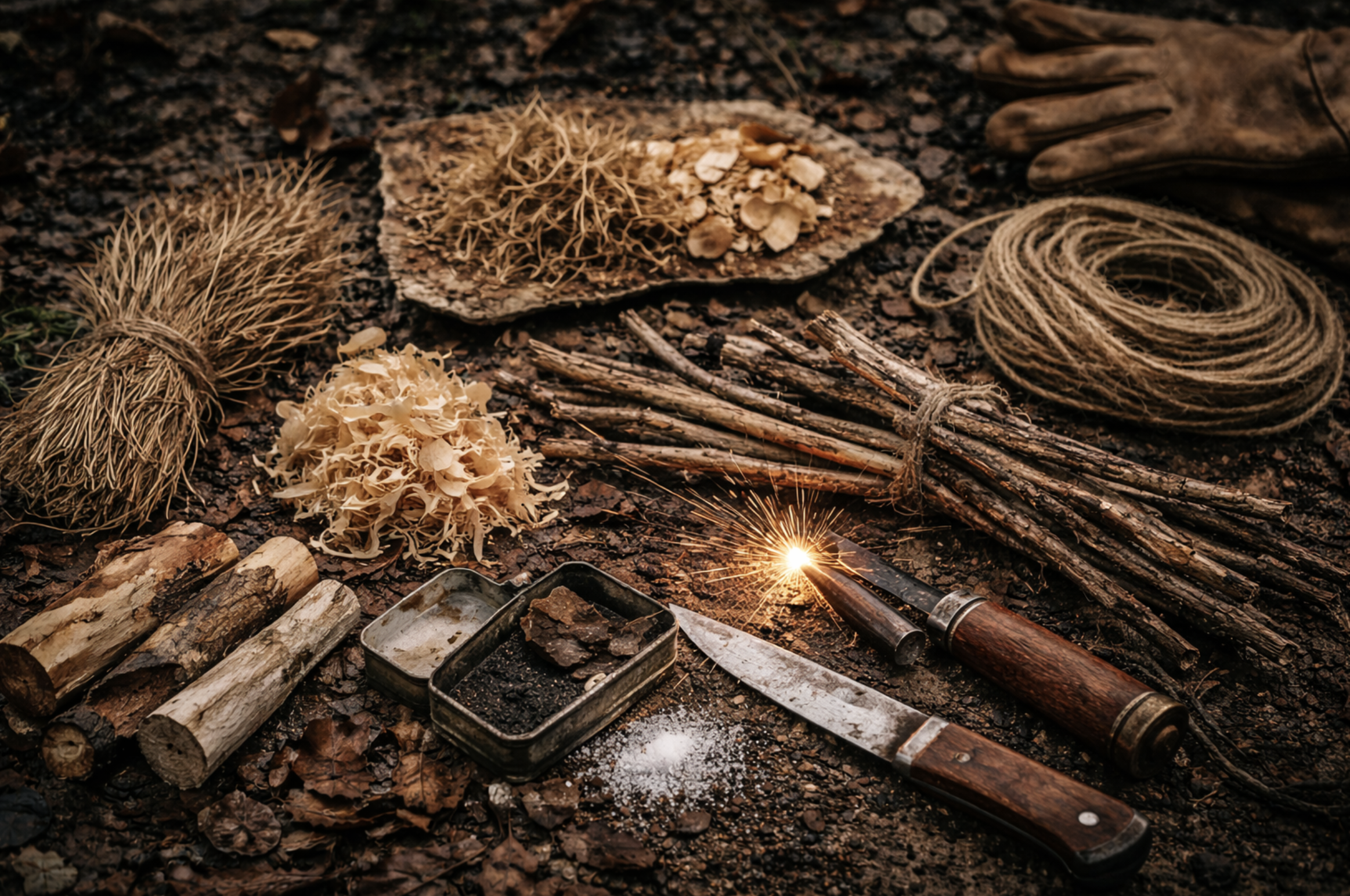
Friction fire requires dry wood, specific techniques, patience, and a surprising amount of upper body endurance that I truly believe only my husband has. Even experienced bushcrafters sometimes struggle to produce a coal. Once you do get a coal, you still need tinder that’s dry enough to catch it. One of the first survival lessons many outdoor instructors teach is that making fire is just as important as preparing for fire is.
You need tinder collected before you start, kindling arranged properly, and above all you need to protect the flame from wind. If everything around you is wet from rain or snow, the entire process becomes exponentially harder, if not impossible.
Fire is life in a survival scenario. It purifies water, cooks food, dries clothing, and prevents hypothermia. The skill of making it from scratch however, is something many modern people have never actually practiced. That means if the lights went out tomorrow, millions of people would discover something uncomfortable pretty quickly.
They don’t actually know how to make fire.
If you’re like me, and just panicked a little bit, feel free to get yourself one of these nifty fire-starter necklaces. Yes, I actually ordered one while I wrote this, it will be here tomorrow by 8pm.
Clean Water Is the First Real Challenge
When people imagine survival, they usually picture food shortages first, but dehydration kills much faster than hunger. Without water, the human body can fail in three days or less, especially in extreme temperatures.
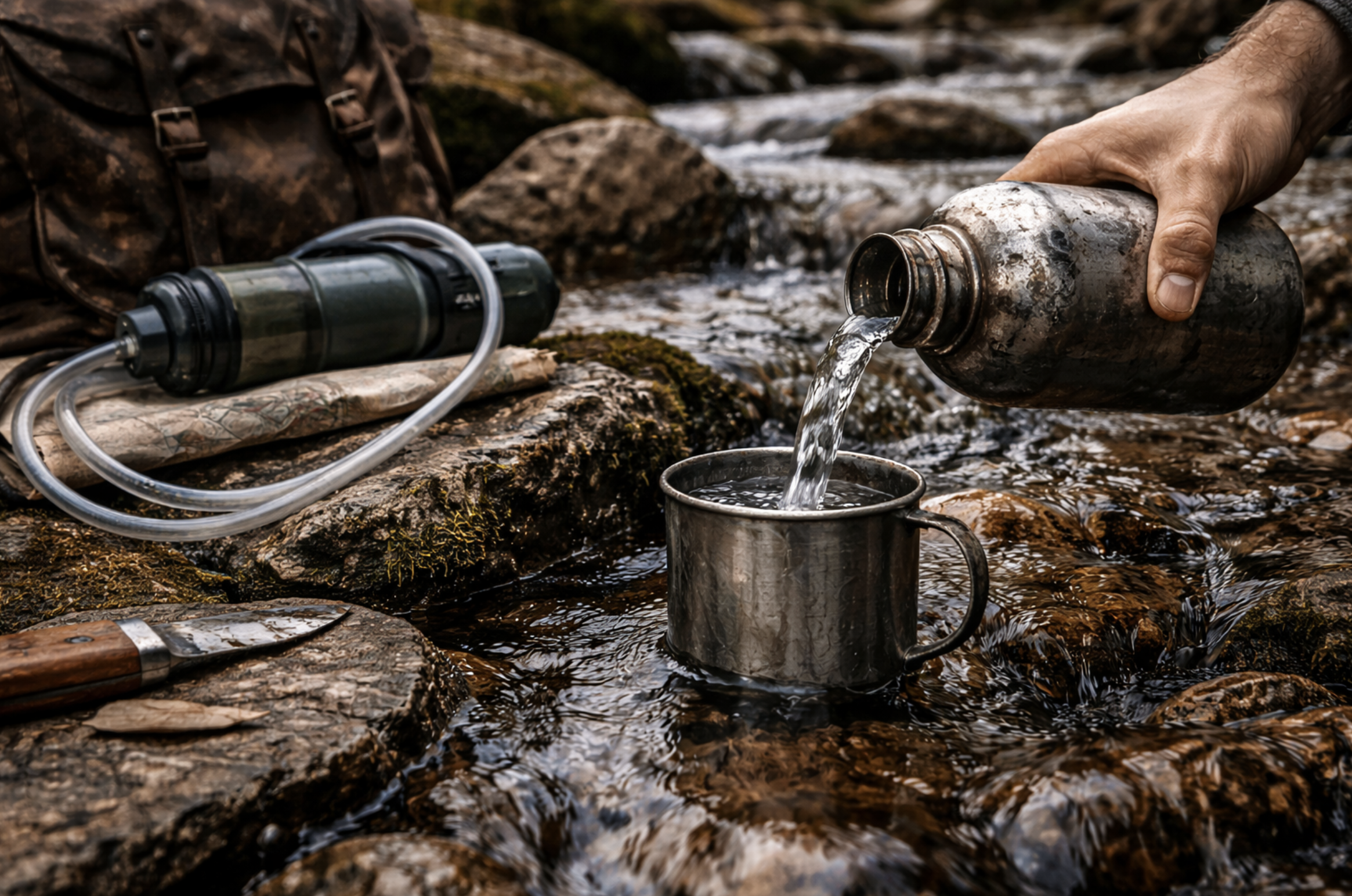
Also, the water you find out there in the wilds of nature is rarely as clean as it looks. Streams can carry parasites, and lakes can contain harmful bacteria. Even crystal-clear mountain water can harbor Giardia, which a nice little Google search taught me is a microscopic parasite that causes severe gastrointestinal illness. Fun, right?
Boiling water is the most reliable purification method, but it requires that pesky fire thing I mentioned earlier and a container. Sure, you can also use filtration, chemical purification tablets, or solar disinfection if you’ve got the stuff to make it happen. The thing is though, if municipal water systems stopped functioning, millions of people would suddenly realize they don’t know how to safely drink from the natural environment around them.
Water has always been the first question civilization solved, but remove that system, and the problem returns instantly.
Also, they have these cool little filtration straws that are good for drinking water in nature that I also might’ve ordered on Amazon (Zak’s going to kill me), but hey, better safe than sorry, no?
Salt Might Become More Valuable Than Gold
Salt seems ordinary now because you can go buy a giant container of it for a few dollars and forget it exists for months. Historically though, salt was one of the most valuable substances on Earth. I’ve written about it before here: How Salt Changed the Course of Human History, I mean, I love salt so much.
The word salary even comes from Roman soldiers being paid partly in salt. Salt preserves food and without refrigeration, meat spoils rapidly. Remember reading that survival book in high school where that guy killed the moose and more than half of the meat went bad? Salt draws moisture out of bacteria and prevents them from multiplying, allowing food to last weeks or months instead of days.
In a survival scenario, salt suddenly becomes essential for long-term food storage. Without it, every piece of meat becomes a race against time. While salt exists in nature like in the ocean and such, extracting it from seawater or mineral deposits requires time, tools, and knowledge most people have never needed to learn.
Remove supermarkets though and salt becomes a precious mineral again. Now, as much as I’d love to stick a link here for salt, I have faith you can all find your own at the grocery store, but maybe stock up on it because you can never have too much salt. I like kosher salt, personally.
Navigation is Screwed
I remember back in the day when I first started driving I used MapQuest for everything then printed out the “to” and “from” directions. If I took a wrong turn I was screwed beyond belief. Today we navigate the world with satellites on that tracker we keep in our pockets also known as a cell phone.
Your phone calculates your position using signals from orbiting spacecraft and guides you with polite voice directions. Before GPS and MapQuest and all that nonsense, navigation required reading the landscape itself.
The position of the sun and the shape of mountain ridges or the direction moss grows on trees used to tell people things about where they were. The movement of stars would help bring people home. Polaris, the North Star, has guided travelers for centuries because it remains nearly fixed in the sky while other stars rotate around it. If someone dropped you into the wilderness tonight (or the middle of the ocean) and asked you to navigate ten miles using the stars alone, most people would struggle.
The knowledge exists out there, it just isn’t commonly practiced anymore.
Of course, I needed to get myself a compass after writing this passage, but one with style. There are so many out there you can find that are “top of the line”, but not stylish, so here’s the cute one I bought myself because it looks like a necklace I’d actually wear. Also, if someone out there wants to make a line of cute compass necklaces or bracelets, please send me one to try out.
Other Random Stuff I learned
So I learned the rabbit starvation thing that taught me an important survival lesson: calories alone aren’t enough. Our bodies need a balance of macronutrients, and fat, in particular, becomes really really important in cold environments because it contains more than twice the calories per gram compared to carbohydrates or protein.
That’s why traditional Arctic diets relied heavily on fatty fish and marine mammals more so than the land ones. Explorers who tried to survive on lean meat alone often became weak and sick, even when food seemed plentiful. Survival nutrition is less about quantity and more about balance. That’s something grocery stores solve quietly through variety, so we never really noticed it. Also, scurvy is a thing, so here’s an orange tree you can grow at home.
Take away the variety of a grocery store though, and suddenly the chemistry of food matters again.
Hollywood survival stories often focus on heroic physical endurance that make me more motivated to lift heavy at the gym, but real wilderness survival often comes down to something you might’ve forgotten about.
Staying dry is essential. Wet clothing pulls heat from your body rapidly, increasing the risk of hypothermia even in mild temperatures. Shelter becomes essential because it protects against wind and moisture. A well-built debris shelter made from branches and leaves can trap body heat surprisingly effectively, so watch a few videos on YouTube how to make one for yourself in a pinch. The difference between sleeping exposed and sleeping in shelter can mean the difference between a miserable night and a life-threatening drop in body temperature.
I think one of the most fascinating parts of survival knowledge is how ordinary it once was. For most of our history, people understood seasonal food cycles, water sources, fire building, and navigation because their lives actually depended on it. These weren’t special skills, they were just part of being alive.
Modern life freed us from needing them every day, which is an extraordinary achievement and I’m not downplaying it or anything. It also means many of us now live slightly detached from the systems that actually keep us alive, and that most of you would not make it to my apocalypse team. Ask most of us to identify edible plants in the forest, and suddenly the expertise of how good we all are at eating vanishes.
The apocalypse probably isn’t coming tomorrow (pretty sure), but learning these forgotten skills never hurts, and also reconnects you to the quiet mechanics of survival that we once understood instinctively. The most valuable apocalyptic skill might not be starting fires or identifying edible plants, but keeping curiosity alive. I still have a willingness to ask questions about how the world works, and maybe you do too, because you found yourself here, didn’t you?
Lean meat alone can kill you, clean water is paramount to life, salt preserved empires, and keep your socks dry at all costs. The apocalypse might not begin with chaos, but with the moment we forget how the world actually works.
Other Reads You Might Enjoy:
Bamboo: The Plant That Refuses to Hurry, Then Rises Overnight
The First Colonizers of Mars Will Be Robots And Somehow, I Never Saw That Coming
The Carrington Event: The Solar Storm That Set Telegraphs on Fire
Why Birds Sing Before Storms: The Secret Symphony of Survival
Feeling Worthless? Here’s Why the Odds of You Existing Are the Most Beautiful Miracle