Greek Fire: The Lost Weapon That Burned on Water
It’s very possible that I’ve been watching too much Game of Thrones, yes. I also have a sinus infection, so instead of being productive the past few days I doom-scrolled too much on my phone. I love the “exploring” pages and when I saw one about Greek Fire I was a little bit too interested and had to go down an entire little spiral looking up all the things about it.
Sometimes history stumbles into something extraordinary, and then drops it like a rock in a pile of diamonds. Greek Fire is something that reads like alchemy and magic and for some reason is more interesting to me than gunpowder and bombs.
For a moment in time there was a fleeting convergence of chemistry and brilliance that produced something so insanely powerful, and so ahead of its time, that it feels almost supernatural in hindsight. Granted, I definitely know I read too many supernatural books about witches, ghosts, and magical things.
Greek Fire was absolute terror in liquid form. It burned on water, clung to skin, and couldn’t be extinguished with any ordinary means. Stop, drop, and roll had nothing on it.
For centuries, it helped hold an empire together…then it vanished. There’s no surviving manual or recipe out there for it to recreate the same exact thing today. The only thing we can find today are some scattered references in dusty chronicles and the uneasy realization that some of our most advanced technologies didn’t come from silicon chips and server farms, they came from medieval shipyards.
A Flame the Sea Couldn’t Swallow
Greek fire emerged sometime in the late 7th century, during the rise of the Byzantine Empire. Constantinople was under siege…again. Classic. The empire was surrounded by enemies on every side, and naval warfare was becoming increasingly decisive. Whoever controlled the water controlled survival. It looked like the end of the empire for a moment or two, but that’s when Byzantine engineers unveiled something no one had ever seen before.
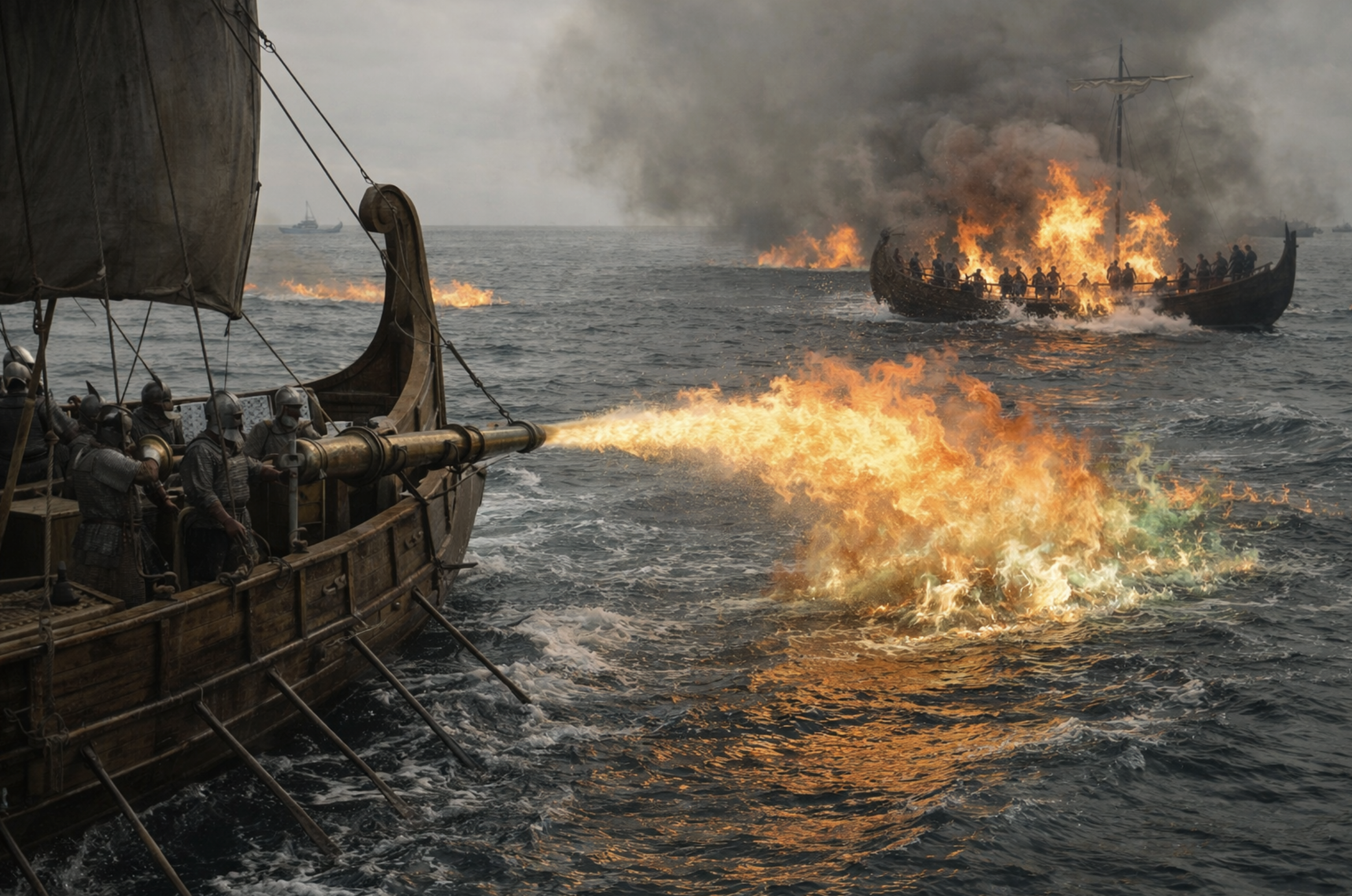
It was a pressurized liquid flame, projected from bronze siphons mounted on ships. Yeah, I’m talking about medieval flamethrowers, except worse.
This fire didn’t die when it hit the sea like most good fire does. No, this fire spread. Water didn’t extinguish it, it fed it. Enemy fleets would watch in horror as greenish flames crawled across the surface toward them, wrapping around hulls, climbing rigging, consuming sails, and turning entire armadas into floating pyres.
Accounts describe absolute panic, screams, and sailors jumping overboard only to find out the fire followed them in. If that’s not psychological warfare perfected, I don’t know what is.
What Was Greek Fire Made Of?
That’s the part that keeps historians awake at night. Besides the existential dread of just everyday life and having to pay bills of course.
No original formula survives.
The Byzantines treated Greek fire like a state secret on par with today’s nuclear codes. Knowledge was compartmentalized and ingredients were divided among specialists. Entire families were sworn to silence and some sources suggest that even emperors didn’t know the full recipe.
Of course, we have a buttload more technology these days, so modern scholars have pieced together educated guesses based on descriptions and behavior of the fire.
Most likely ingredients would be petroleum or crude oil mixed with pine resin, some sulfur, quicklime (calcium oxide), and possibly saltpeter. The most important component could have been quicklime, which reacts violently with water and generates heat. That chemical reaction could explain why the fire reignited when doused and why seawater just made it worse.
Greek fire could very well have been a self-igniting chemical chain reaction masquerading as magic. Delivered through bronze tubes using pressure pumps, it was centuries ahead of anything resembling modern incendiary weapons. Yes, I know more about weapons than I’d care to admit because my husband, Zakary Edington, watches War Hammer videos and battle tactic breakdowns on YouTube way more than the average person should.
You might be wondering why others didn’t take this Greek Fire and harness it for themselves. Fight fire with fire as the saying goes. Well, they tried and failed. Arab engineers attempted to replicate it while Crusaders desperately sought the formula. Even rival Byzantine factions failed to reproduce it once the core knowledge holders died. The secret was guarded so tightly that when Constantinople finally fell centuries later, Greek fire died with it.
There were no written instructions or standardized manufacturing happening with this war secret either, it was just plain old oral tradition and memory it lived on in. Once those people were gone, the flame went dark.
If knowledge isn’t documented, it doesn’t survive. That’s just the rule of the world. It’s why I feel such a pressure to bring all my ideas to life in my lifetime so they don’t just fade into what could’ve been.
Civilizations don’t fall all at once, they leak information first.
So Why Did Greek Fire Disappear?
Well, my husband told me that cannons replaced it and made it irrelevant. Turns out a lot of people on the interwebs also agree with this idea. It’s partially true too. Gunpowder artillery eventually reshaped everything about warfare, making walls obsolete and ships vulnerable from long distances. Cannons offered range while Greek Fire required proximity.
That’s too tidy of an explanation though. Greek fire disappeared because the Byzantine Empire weakened economically. Too many raids and more money being spent than coming in. The specialized craftsmen who knew the formula died which was probably one of the biggest blows to it, and political instability fractured continuity throughout the empire itself. Gunpowder became cheaper and easier to standardize and as trade routes shifted, access to key materials was often cut off.
Weapons evolve toward whatever is scalable, and unfortunately (fortunately?) Greek Fire just wasn’t scalable.
It was artisanal warfare with a magical flare and custom chemistry. Once centralized power collapsed, the infrastructure needed to produce it collapsed too. Industrialization replaced secrecy as the need for more, more, more became more important.
We forget that ancient societies were capable of sophisticated chemical engineering. While we really don’t know how it was invented, and yes, it could have been by mistake one day, it’s still something they were able to replicate enough to have the name live on hundreds of years later and inspire shows like Game of Thrones.
Progress is never a straight line. It just isn’t. People like to think about history as a staircase, always moving upward, but if you’ve ever tried to build something for yourself you know it doesn’t work that way. Knowledge rises then recedes and entire technologies vanish between generations.
We lost Roman concrete, lost Antikythera-level mechanical computation, and we lost Greek fire. When systems collapse there’s only so much we can do to retain the information of the past.
Greek fire disappeared because it lived inside a fragile structure as a guarded secret. Today, a whole lot of our world’s most advanced knowledge lives inside corporations, classified programs, and proprietary silos. Think about AI models or pharmaceutical processes. Even energy technologies are being more and more gatekept.
Never assume permanence because everything around us feels digital because history proves otherwise. If something isn’t openly preserved, it’s temporary. Even genius fades into the night without any sort of continuity.
Brilliance without transparency is brittle and secrets die with their keepers. Living in a world full of secrets today as our politicians steal from the people blindly and corporations are secretly running the world, this should strike a nerve into all of us. Civilizations fade as they forget quietly.
Somewhere, more than a thousand years ago, a Byzantine engineer stood on a wooden deck, opened a valve, and watched chemistry become legend. Then the knowledge slipped away into silence.
Related Reads You Might Enjoy:
The Ghost Ship Mary Celeste: A Crew That Vanished Without a Trace
The Kyshtym Disaster: The Nuclear Catastrophe the USSR Tried to Erase
The Secret Story of Grape Bricks: How Americans ‘Accidentally’ Made Wine During Prohibition
Six Shipwrecks Beneath the Streets: The Accidental Discovery That Rewrote Maritime History
The Cursed Mummy Who Sank a Ship (Or So the Newspapers Said)
The Day the Whale Exploded: How a Town Tried Dynamite and Blew Its Mind
When the Atom Breaks Twice: What Happens When Nuclear Sites Are Bombed
Lost Cities and Found Feelings: Why Abandoned Places Stir the Soul
Legendary Treasures, Forgotten Fortunes, and the Beautiful Ache of Not Knowing
The Man Who Dreamed in Lightning: The Life and Mind of Nikola Tesla
For fun, if you want to add these little things to your campfire they turn them colors! Inspired by Greek Fire, but alas…not the same.