Popcorn is my favorite snack (okay, maybe pretzels are it depends on the day), and I think it deserves considerably more respect from the wine world.
We’ll spend an entire dinner discussing what goes with a piece of fish or turkey, then act as though the enormous bowl of popcorn on the couch is somehow outside the jurisdiction of a sommelier. I mean, how can anyone overlook the smell of freshly popped popcorn? Especially once butter enters the conversation.
I’ve played around with wine and popcorn before, and what interests me is how much you can change the pairing while keeping the wine exactly the same. Plain popcorn, salted popcorn, and buttered popcorn begin with the same little puffed kernel. Put them beside one bottle and suddenly you have three different parties happening in your mouth. The kettle corn comes later, because I love that too and it deserves its own round.
If you want an easy way to feel what food does to a wine, with ingredients you can understand immediately, try this.
Also, as a little note, I did choose recommended wines with each category of popcorn, but trying the same wine with different bowls also teaches you a ton about the pairing.
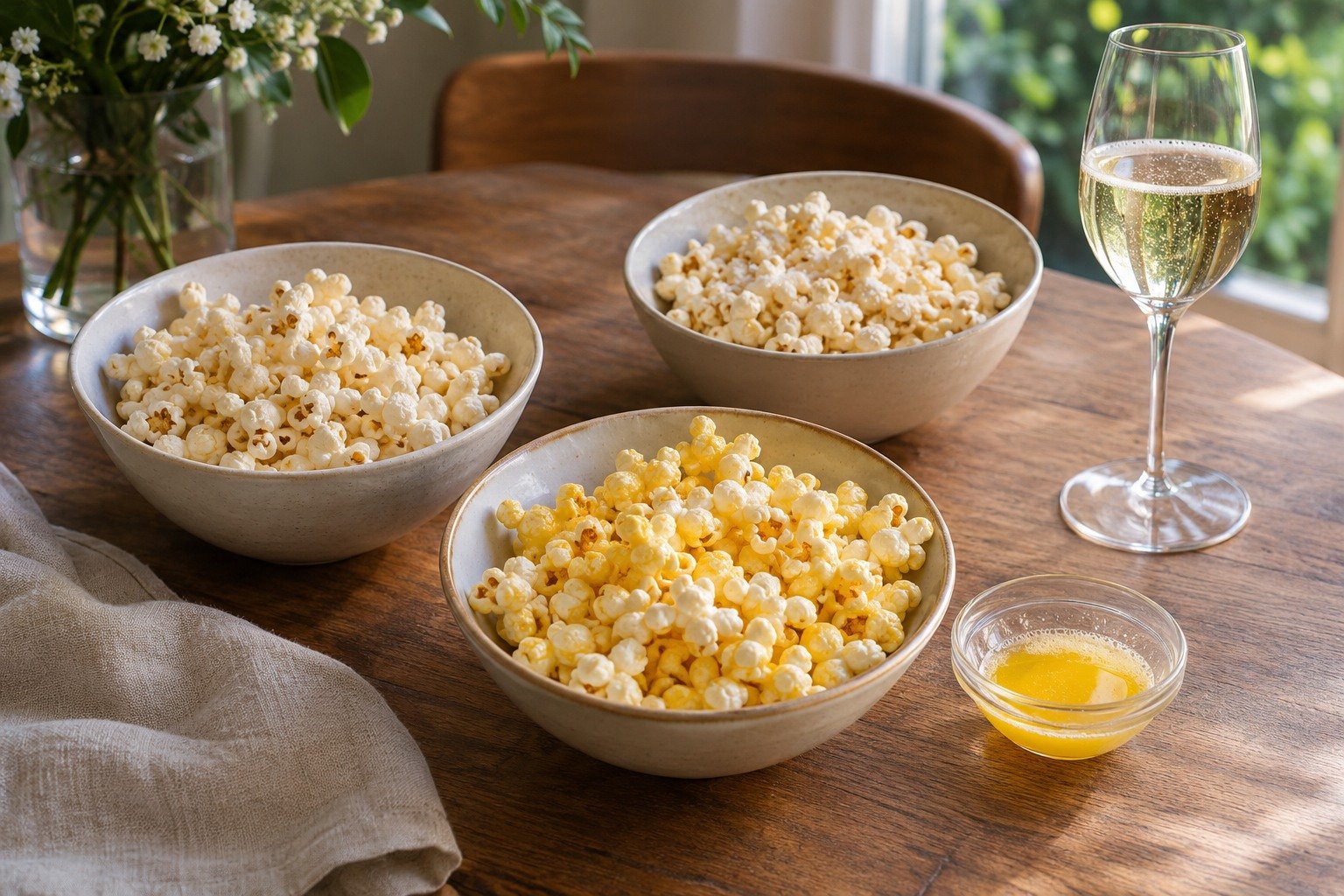
One Bottle and Three Bowls
I’d start with a dry sparkling wine, such as a Cava or Crémant, and one batch of popcorn. Divide it between three bowls while it’s fresh. Leave the first plain, season the second lightly with fine salt, and toss the third with a modest amount of unsalted melted butter. Keeping the butter unsalted gives it a chance to make its own contribution, but just know I absolutely added salt to them too because that’s how I like my popcorn.
A stovetop popcorn popper is handy if popcorn features as prominently in your life as it does in mine. A covered pot works beautifully too, so whatever works! I’d make one batch so the starting point stays similar, then set out water and a piece of paper before the snacking portion of the project becomes the entire project.
Pour a small amount of wine and taste it by itself first. Pick two or three things to notice, perhaps how tart it feels, how fruity it smells, and what happens after you swallow. You’re creating a starting point you can come back to, rather than trying to produce a page of impressive vocabulary.
A couple of bottles I’d suggest for this are Juvé & Camps Reserva de la Familia Brut Nature Cava and Lucien Albrecht Crémant d’Alsace Brut.
Plain Gives Us Somewhere to Begin
Plain popcorn lets the toasted corn flavor and airy texture do all the heavy lifting here. Take a bite, chew, then try another sip of the wine. Look for whether the wine seems brighter, broader, more aromatic, or simply much the same. There’s room for all of those answers.
This is one of the useful things about pairing with familiar food. You already know what popcorn tastes like, so you can spend your attention more on the interaction. A complicated restaurant dish can be delicious while making the cause of a change harder to follow, but with a plain kernel, the supporting cast is considerably easier to keep track of.
Salt Has a Surprisingly Large Role
Now try the lightly salted bowl. Salt can change the balance of tastes we perceive, which helps explain why seasoning a dish also changes the experience of the wine beside it. A salty bite can soften the impression of bitterness or acidity and make fruit seem more apparent.
There’s a particularly interesting little Philadelphia connection here that caught my eye because that’s also where I live. Paul Breslin and Gary Beauchamp, researchers affiliated with the Monell Chemical Senses Center, published a 1997 Nature paper called Salt Enhances Flavour by Suppressing Bitterness. It gives evidence for a taste interaction; but our popcorn comparison gives us a very approachable experience to notice what happens in a particular glass.
I’d start with a light hand and taste before adding more.
If the wine suddenly seems rounder or its fruit becomes easier to notice, write that down or just take mental notes. If the difference is small, write that down too. The amount of salt, the wine, and your own sensitivity all get a vote, which is part of why I like letting people try these things themselves.
A few of my suggestions for the salted bowl are Schloss Johannisberg Gelblack Riesling Trocken, Sohm & Kracher “Lion” Grüner Veltliner, and Famille Hugel Classic Pinot Gris. Taste whichever you choose before and after a few bites, and see what shifts for you.
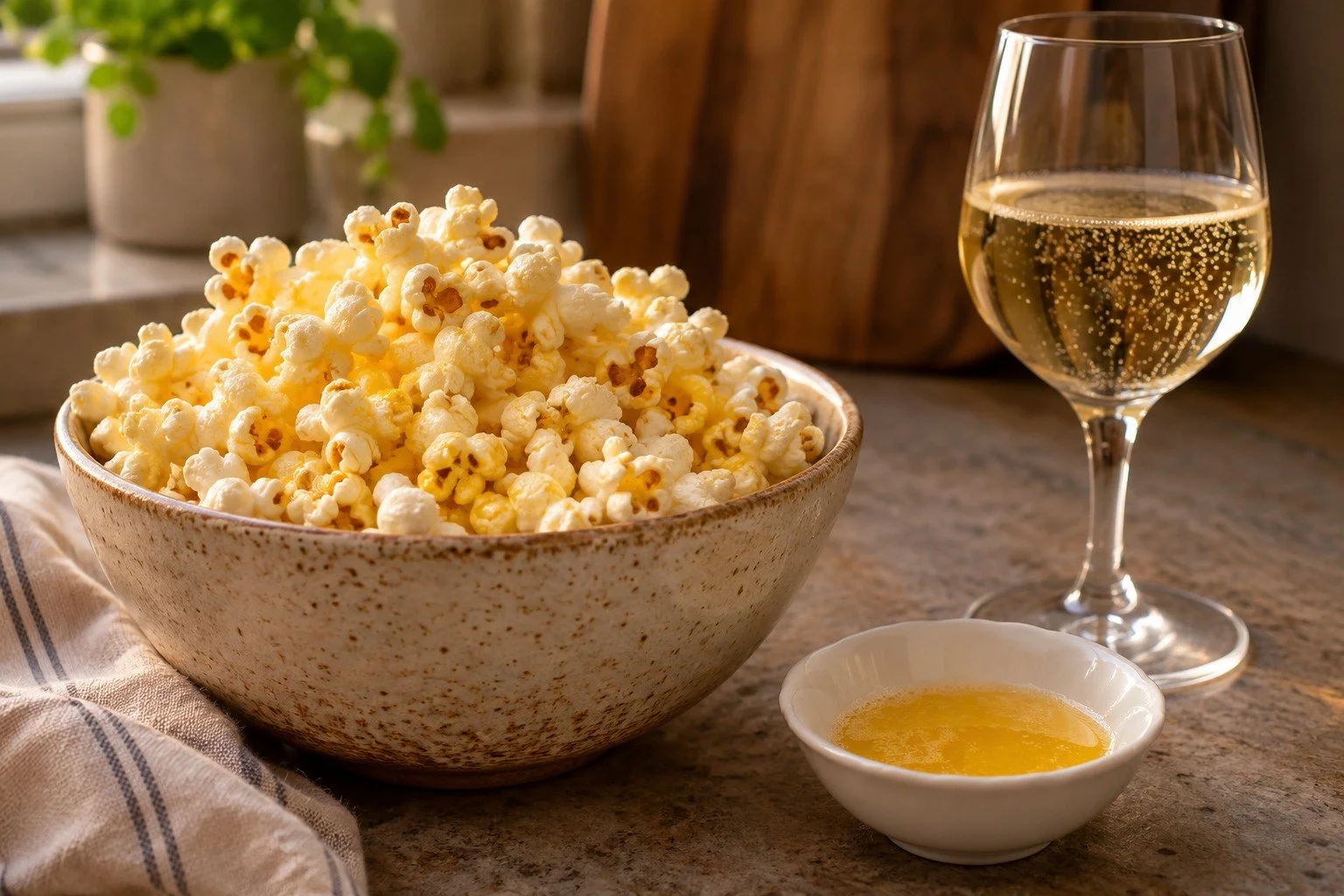
Butter Changes More Than the Flavor
Unsalted melted butter brings richness, aroma, and a different texture to the popcorn. Who doesn’t love more butter added to anything? Try a bite from that bowl and then return to the same wine you had earlier. I’d pay attention to whether the next sip feels especially fresh beside the buttery coating, and whether the toasted or creamy parts of the combination become more appealing.
This is where sparkling wine sounds particularly good to me.
The contrast between a rich bite and a lively sip makes sense as a pairing, and a traditional-method sparkler may also bring bread-like notes that feel at home with toasted corn. For the buttered bowl, a few bottles I’d suggest are Recaredo Terrers Brut Nature Corpinnat, Philippe Gonet Roy Soleil Blanc de Blancs Grand Cru Champagne, and Pierre Péters Cuvée de Réserve Blanc de Blancs Brut Champagne.
I’d keep the first buttered bowl simple, but once we add salted butter, truffle seasoning, grated cheese, and whatever else is living in the spice drawer, we’ve given ourselves several new variables. All of those versions deserve dinner invitations eventually.
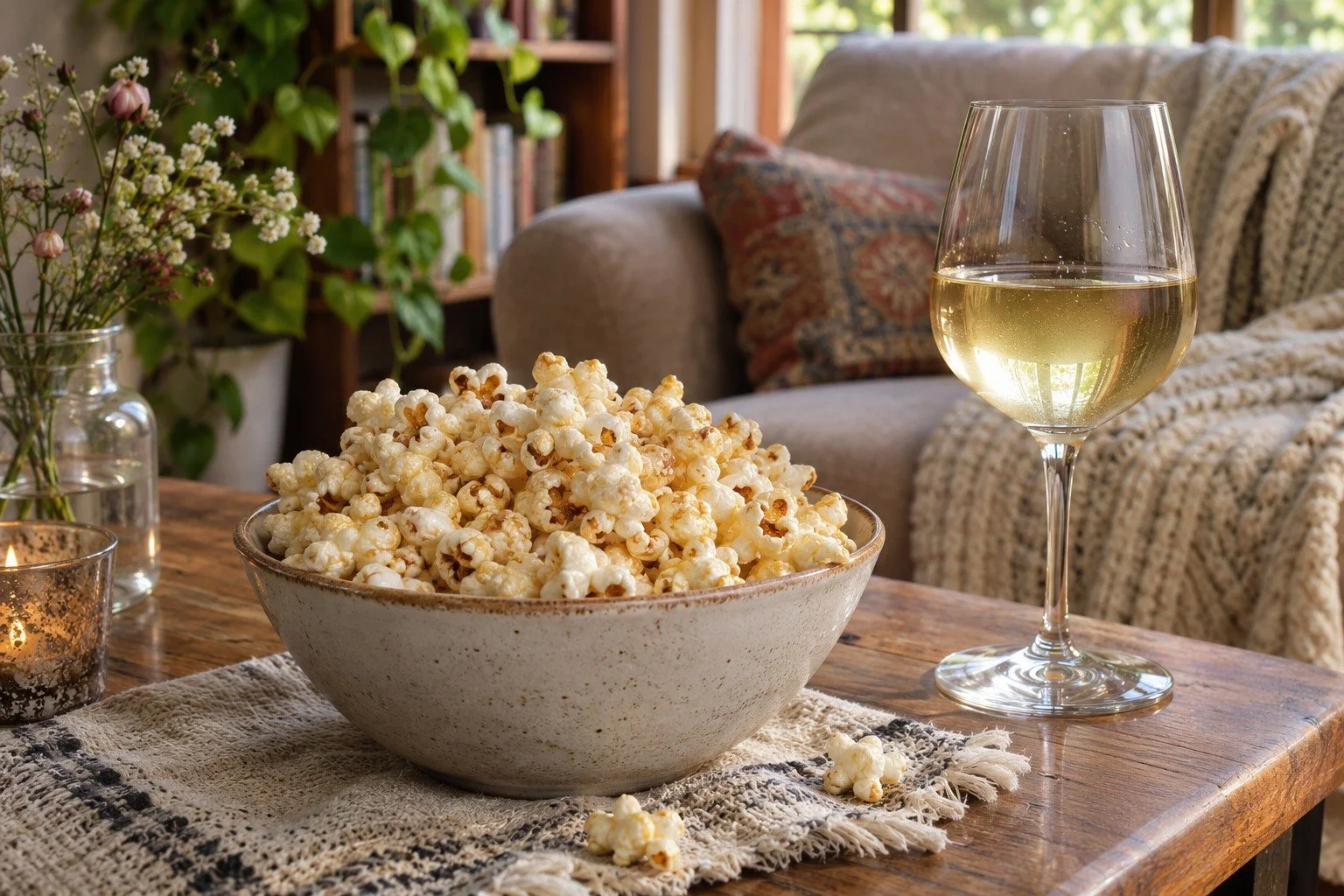
The Kettle Corn Round Is My Favorite Complication
Kettle corn brings sweetness as well as salt, so I’d save it for the end of the comparison with whatever wine you’ve chosen to try. A sweet bite can make a dry wine seem more tart or less fruity by comparison, of course. That change is especially easy to notice if you return to the wine immediately after tasting the sweet coating.
I’d try the dry bubbles first, then bring in a lightly sweet Riesling as a second option. Look for a bottle described as off-dry or medium-dry, and taste it with the kettle corn rather than making a decision from the grape name alone. Riesling comes in a wonderfully broad range of sweetness levels.
Yes, this is a predictable suggestion from the person who named her dog Riesling. The little bit of sweetness in the wine can make a sweet-and-salty snack feel more settled, while the acidity keeps the combination lively. If the popcorn is very sweet, I’d be open to a sweeter bottle too.
For the kettle corn round, I’d suggest Peter Lauer “Barrel X” Riesling Feinherb, Max Ferd. Richter Mülheimer Sonnenlay “Zeppelin” Riesling, or Spreitzer Oestricher Lenchen Riesling Kabinett. I’d lean toward the sweeter Spreitzer when the popcorn has a particularly generous coating. For a sparkling option, I’d try Loosen Bros. Dr. L Sparkling Riesling. This German Sekt brings peach, lemon, and a little sweetness, which makes it especially appealing to me for the kettle corn round. Bubbles and Riesling in the same glass feels like a very reasonable way to finish our research.
A Better Experiment Still Looks Like a Nice Evening
I’d give each version a separate spoon or serving hand, keep the pours modest, and try the bowls in a different order on a second pass. Water between rounds helps give you a fresh starting point or gnaw on some celery sticks or carrots to reset your palate. A quick note such as “fruitier after salt” is more useful than trying to remember the entire comparison once the bowls are empty.
Don’t forget that a wine’s taste belongs to a moment. Temperature, food, and what you tasted just before it all become part of the experience. A single bottle can teach us quite a lot when we change what’s on the plate, or in this case, what’s in the bowl.
And if the evening ends with everybody choosing their favorite popcorn and abandoning the note-taking, I’d still count that as useful information. You’ve found something you like eating and drinking together, which, for a snack that began as a handful of kernels, is a win.