Volcanoes Helped Unleash the Black Death
I’ve had a cold or some sort of flu for like 2 weeks now. It’s not bad enough to call out of work, but not mild enough to ignore, so it’s the perfect balance of annoying. This morning while I was coughing up what remains of my lungs I compared it in my head to the Black Death. Then of course, because it’s me, I started looking more and more into the history of the Black Death while I made my breakfast sausages.
I like to imagine history by battles won and by kings signing decrees, and dates carved into stone. Turns out though, a lot of what truly reshapes our story arrives quietly and slips in sideways. It hides in weather or travels in trade. Sometimes history is shaped by what lives in the breath of animals smaller than a fingernail.
The world changing can literally start with a dimming of the sun.
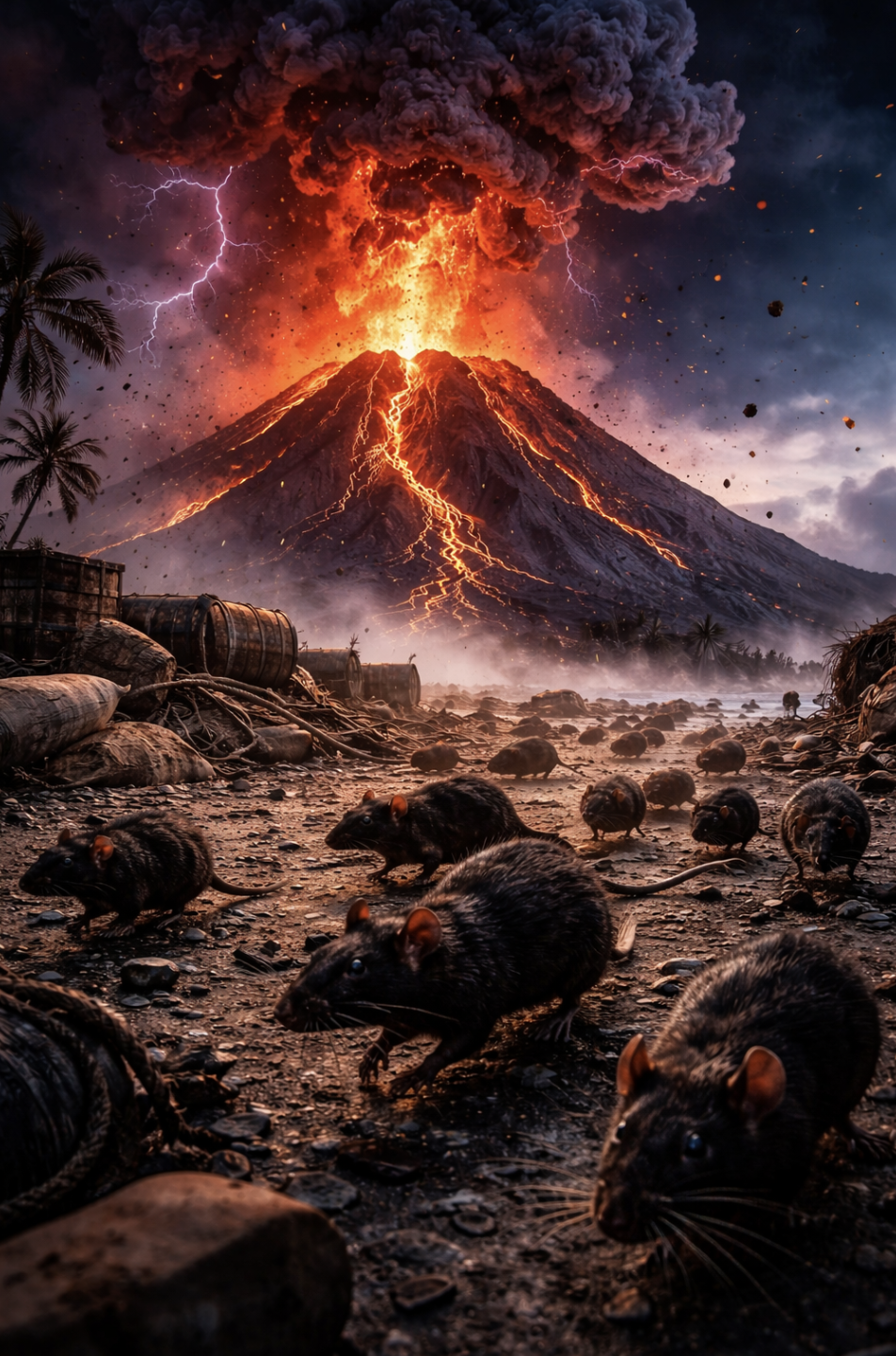
In the early 14th century, something happened high above the Earth, they think it was somewhere in the tropics, when a volcano erupted with massive force, hurling sulfur and ash into the upper atmosphere, as volcanos tend to do. No medieval chronicler recorded its name and no city watched it explode, but yet, centuries later, its guilty fingerprints remain etched into ice, and carved into trees, preserved by the planet itself.
Those little dusty fingerprints tell a story that changed how I understand one of humanity’s darkest chapters: the Black Death.
When we forget or aren’t there to even notice, the Earth remembers for us in magical ways.
Deep in glaciers, snow falls year after year, compressing into ice, each layer sealing away tiny fragments of the atmosphere at the moment it formed. Dust or sulfur, volcanic ash, you name it, basically all chemical signatures that no one meant to preserve, end up trapped, literally frozen in time.
Also, at the same time, trees around the world grow outward in rings, each ring a year, each thickness a response to the conditions of that season. Abundant warmth leaves wide rings while cold summers, drought, or sudden climate shocks leave thin ones. Trees don’t editorialize or exaggerate, they simply record, exactly how HR tells you to record incidents at work: pure fact.
When scientists like Professor Ulf Büntgen (a climate scientist at the University of Cambridge, known for his work on tree-ring reconstructions and historical climate patterns) and Dr. Martin Bauch (an environmental historian at the Leibniz Institute for the History and Culture of Eastern Europe (GWZO) in Leipzig, specializing in medieval climate and societal change) lined up ice cores from Greenland and Antarctica with tree rings from Europe and Asia, they can reconstruct ancient climates with astonishing precision. It’s not guesses or myths, just cold hard data.
Turns out, around the mid-1300s, the data begins to change.
Ice cores show a sharp spike in sulfate aerosols around 1345 CE, which they tell me on the interwebs is a telltale sign of a massive volcanic eruption. Tree rings across the Northern Hemisphere show reduced growth in the years that followed at the same time that historical accounts from Europe speak of cold summers with relentless rain and tons of failed harvests.
This wasn’t just bad weather either, it was a climatic disturbance large enough to ripple across continents.
Volcanic aerosols reflect sunlight back into space, and when enough of them reach the stratosphere, global temperatures dip. Crops struggle as seasons shift in the most unpredictable of ways. The delicate balance between people and food frays.
Medieval Europe already lived close to the edge of subsistence where a few poor harvests could mean hunger. Several in a row meant famine, and famine does something profound to societies: it forces movement. As European granaries emptied, city-states looked outward. Italy, in particular, turned toward long-established trade routes stretching across the Black Sea and into Central Asia. Grain was imported in bulk sacks, hauled across ships to warehouses.
Trade was not luxury at this point in time, it was lifeline when no grocery stores existed.
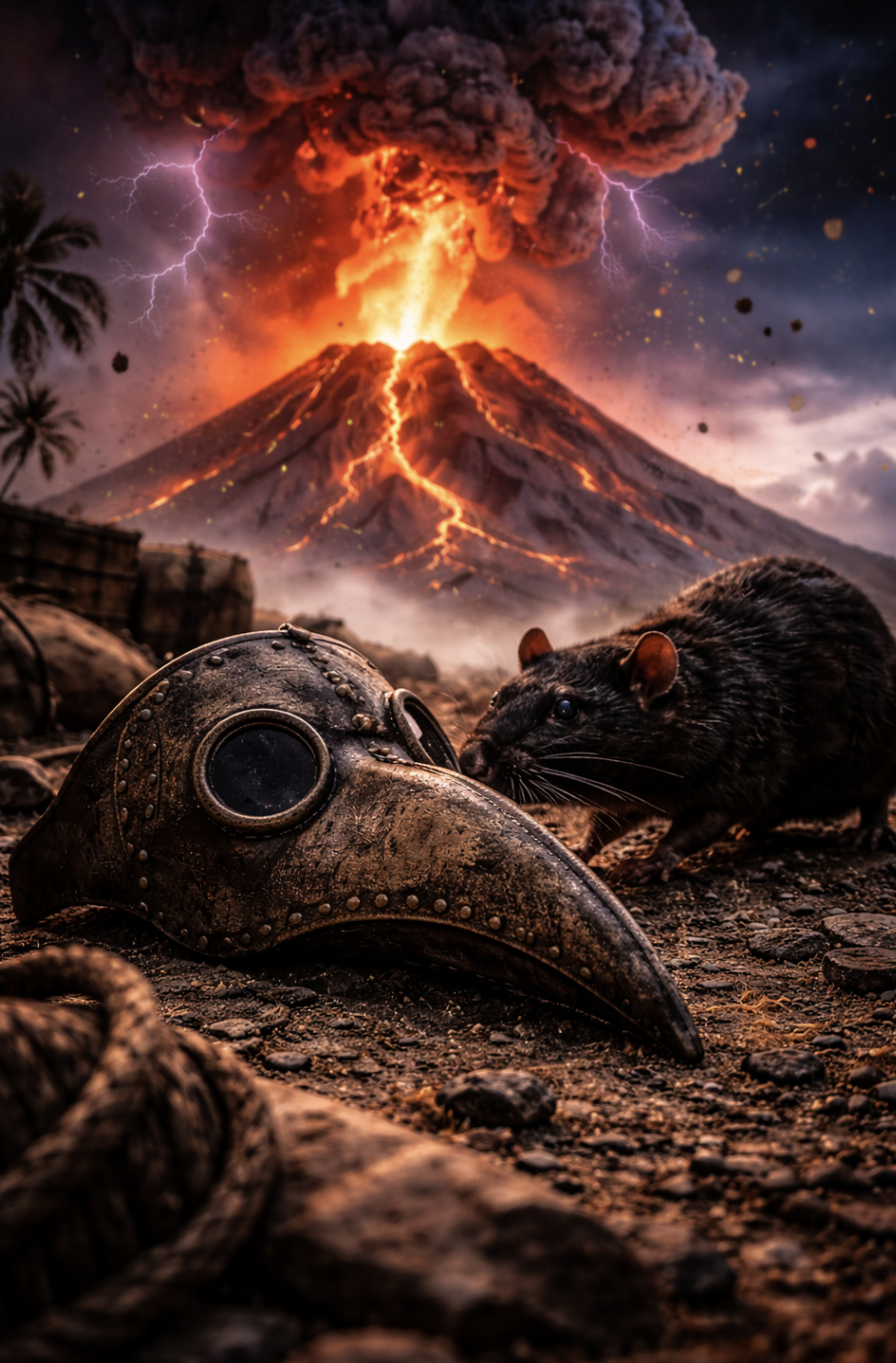
Trade is never sterile though. Along with grain came stowaways in the form of fleas and rodents, also the deadly microorganisms invisible to medieval eyes…among them: Yersinia pestis.
The Bacterium That Changed Everything
For centuries, scholars debated the origin of the Black Death. Was it Europe’s fault? Bad sanitation? Divine punishment? Miasma drifting through the air? I’ve heard about everything from aliens coming to Earth (I mean, their foreign immune systems would bring something funky with them I’m sure, so not totally insane) to the lack of bathing.
Modern genetics has rewritten the answer. Maria A. Spyrou, Johannes Krause, and a bunch of other multidisciplinary teams finally found the true answer. By extracting ancient DNA from human remains (teeth specifically), scientists have traced the genetic lineage of Yersinia pestis. The strain responsible for the Black Death seemed to have emerged from wild rodent populations in Central Asia, near what is now Kyrgyzstan, before branching outward.
This bacterium didn’t appear suddenly in Europe…it traveled.
It traveled slowly at first, circulating in animal reservoirs, flaring up and dying back, waiting for the right conditions, as these little buggers always do. The bacterium was waiting for pathways and for people to connect to distant places in times of need. Climate disruption provided exactly that opportunity.
The Parallel of Systems Interlocking
This is where the story becomes unsettling to me, and it’s not because it’s dramatic, but because it’s totally plausible.
A volcanic eruption alters the climate, then the climate stresses out agriculture so much food becomes a serious issue. Agricultural failure reshapes trade as people flee for better, more abundant lands. Trade moves pathogens, then pathogens reshape civilization. There’s no villain in this story and no conspiracy (hello COVID-19). There was no intention to spread germs around the world, it was simply systems interacting. Cause and effect in real time.
The eruption didn’t “cause” the Black Death in a simple sense, but it feels like it nudged history indirectly by changing the conditions of life and how we lived then traded, and survived. This is how I’ve always believed the Earth influences us most often: not through catastrophe alone, but through subtle pressure applied over time.
We seriously love to imagine ourselves as separate from nature, distinctly above it, protected by our culture and fancy technology. This story about the Black Death reminds us how thin that boundary really is. A bacterium that lived comfortably among rodents for centuries suddenly found itself ferried across continents because a bunch of people needed grain.
Fleas didn’t know or care they were participating in history, they were just doing what they always had. The tragedy was not malevolent, it was ecological, and boy, was it a tragedy. From 1347-1351 it’s estimated by History And Culture Media that the Black Death “killed an estimated 75–200 million people worldwide” across Europe, Asia, and North Africa.
Reading the Past Without Myth
What makes this research so remarkable to me isn’t just its conclusion (blows my mind we can figure stuff like this out at all), but its method. No single document explains this chain of events and there isn’t a diary out there somewhere that says, “a volcano erupted, and therefore the plague came.”
Instead, scientists all across the world and different fields of study came together to stitch multiple forms of evidence from ice chemistry to tree growth patterns, climate reconstructions, genetic sequencing, to historical trade records. Each field alone couldn’t have brought us to this answer, but together, they form a picture that’s hard to ignore. This is science as humility. Science that doesn’t ever like to claim certainty, but probability. Science understands history as an ecosystem of causes and consequences, not as just a straight line.
It’s tempting to treat this story as safely distant, I mean it’s medieval, and probably irrelevant for today. The truth is though, the lesson isn’t about the 14th century at all, it’s about interconnectedness.
We still live in a world where climate affects food and trade moves organisms, and microscopic life can exploit human networks. If anyone out there remembers how quickly COVID-19 spread from China to the US to the entire globe (shout-out to New Zealand who locked down so quickly they escaped the worst of it), then you know what I’m talking about. The difference is just time.
Our systems are faster now and more dense. A disruption in one region echoes everywhere else almost instantly and the Earth still remembers everything we do, we’re just better at forgetting. I’d like to blame our trauma-responses for that gem.
Ice cores and tree rings offer us is something rare: a narrative unfiltered by human bias. They simply show us that something changed, and that the change mattered. History does not only belong to people, it belongs to the planet as a whole. We aren’t separate from nature no matter how much we’d like to think that we are.
Occasionally, the most important moments leave no monuments at all, only a faint chemical trace frozen in ice, waiting for someone curious enough to listen.
The Black Death reshaped Europe economically, socially, and spiritually. Labor systems collapsed as beliefs shifted, and entire worldviews cracked like thin ice on a lake. Its possible trigger was not something we had any control over, but a volcanic eruption whose name we may never know. The forces shaping humanity are often indifferent to us as much as we might feel indifferent towards them.
The world is more vast and complex than we realize, and it’s beautiful and horrific because of that.
Other Reads You Might Enjoy:
The Tomb That Lied: When History’s Bones Whisper a New Truth
Why Scientists Are Trying to Dim the Sun and What It Could Mean for Us All
The Quiet Giants: Why Trees Are More Valuable Than Diamonds (and Always Have Been)
The Cursed Mummy Who Sank a Ship (Or So the Newspapers Said)
The Wild, Winding History of Pinot Noir: How One Grape Became a Global Obsession
The Forgotten Inventions of the 1800s: Machines That Glowed, Whirred, and Vanished
The River Doesn’t Forget: How Cocaine Ended Up in Every Shrimp Tested
The Prisoners, the Brides, and the Bayou: How Louisiana Was Populated by a Strange French Deal