The Bones We Wear Outside Our Bodies
You don’t really think about your teeth until someone else’s hands are inside your mouth.
That was me today anyway, as I was tilted back under the harsh glow of a dental lamp while a hygienist gently scraped at enamel in my mouth. It struck me as my jaw ached and begged for me to shut it on her hand: she’s cleaning my skeleton. Like my actual skeleton, the only part of my bones I wear on the outside like jewelry. Why did I leave a piece of my skeleton out in the open like that?
Teeth are strange things, they’re harder than bone did you know that? Technically, they’re also older than bone, evolutionarily speaking. They’re tiny little fossils we grow ourselves as memory stones or timekeepers, markers of childhood and survival and the slow, grinding passage of years.
Today, someone polished mine. No cavities, by the way, and nothing else to be worried about thankfully.
Teeth Are Not Bones
Okay, so for the record, bones are living, dynamic, and flexible. They respond to weight, grow stronger with strain, and even remodel themselves every seven to ten years like a quiet renovation happening so slowly you miss it entirely.
Teeth are not like that. Teeth are the hardcore rebels of the skeletal system: calcified structures made of enamel, a crystalline fortress that is 96% mineral, the hardest substance in your entire body, and so durable it can survive millions of years when the rest of you can’t.
Enamel doesn’t regenerate unfortunately, it doesn’t “heal” or remodel itself over time. It’s both ancient in design and ruthless in its permanence, a beautiful symmetry I absolutely adore. Teeth are also time capsules, and you know how much I’m obsessed with time. Whatever happens to them from stains to cracks to chemical exposures becomes a kind of geological story etched in mineral.
Bones tell the story of your life, but teeth tell the story of your childhood. Once enamel forms, it stays forever. Scientists can read your teeth like climatologists read ice cores with layers of stress, nutrition, trauma, environment, and growth all trapped inside. If bone is the ever-changing present, I’d like to think that teeth are the permanent past.
Teeth evolved before bones…which seems a little too strange to be true, but before skeletons hardened or even before vertebrates strutted out onto land, or jaws became the home to these little guys, teeth were there. The earliest teeth we’ve found to date belonged to ancient armored fish, tiny plates of enamel and dentin embedded in skin. Proto-teeth I suppose, basically little shards of mineral evolution was experimenting with. Calling them teeth might seem like a stretch at this point in time, but they grow out of their ugly teenage phase soon enough. Eventually, these mineral plates crept inward, lining the mouth, anchoring into jaws when jaws finally evolved. Teeth were nature’s OG tools.
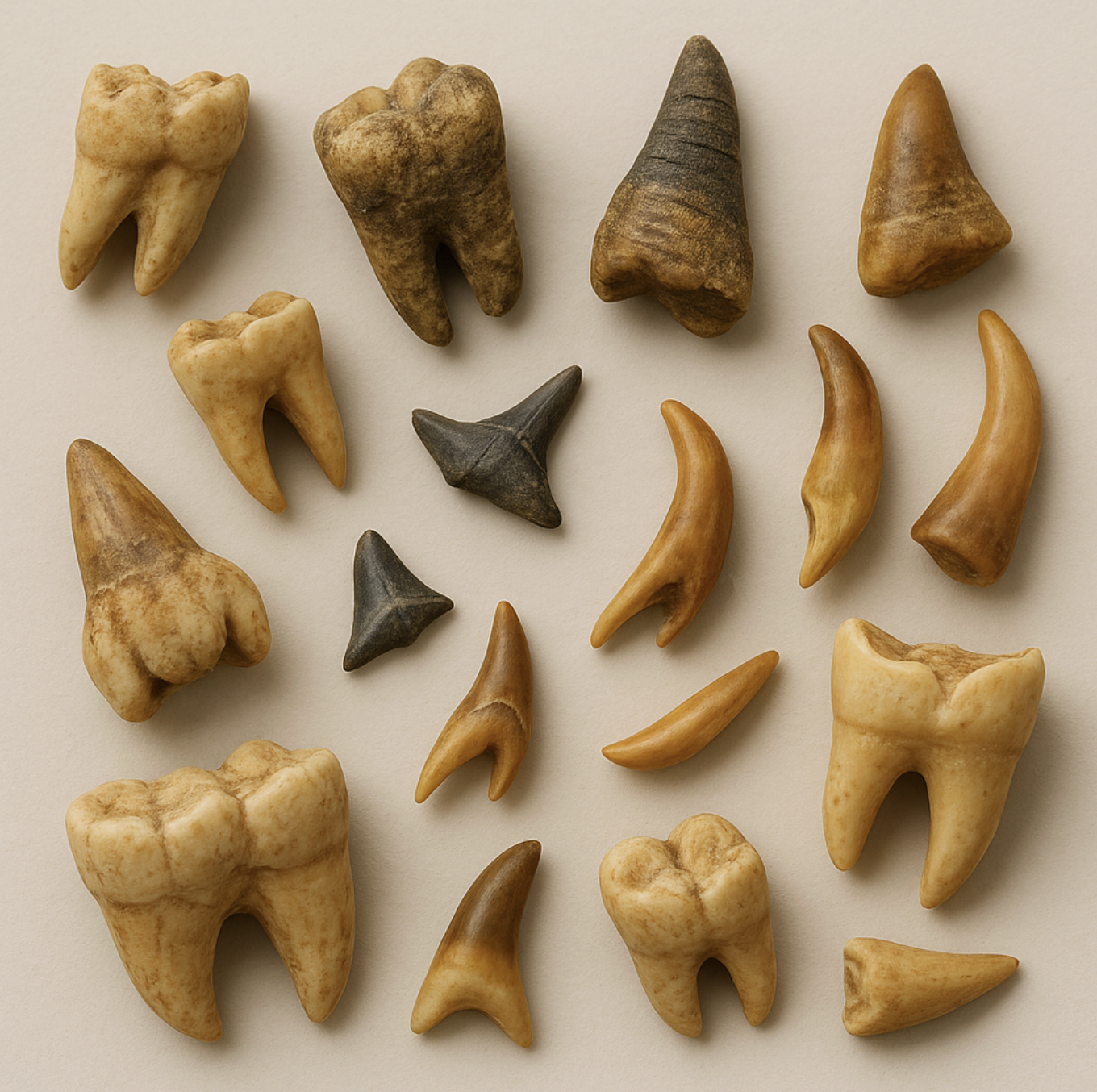
Every Tooth in Your Mouth Has a Job
As someone who love order and organization more than I should, this little fact absolutely delighted me more than it should’ve. Our teeth all evolved for individual jobs. Incisors were the precision cutters while canines took the role of the puncture-and-hold specialists. Premolars are the grinders-in-training (awe, how cute), and the molars are like the hydraulic presses of the mouth.
Not to brag or anything, but us being the omnivores that we are, have one of the most balanced sets in the animal kingdom. In my totally unbiased opinion.
We’re not specialized like lions, who evolved scissor-like carnassials capable of slicing through hide and tendon, and definitely not like horses, whose continuously growing molars grind grass like millstones. We aren’t like baleen whales, who abandoned teeth entirely for massive keratin combs. If you’ve never seen these things, Google it, you’ll be amazed by them. Maybe that’s a blog post for another day.
Our teeth show us one evolutionary truth: we eat everything and have for a looong time.
The Dentist Is Cleaning Fossils
There’s something beautifully weird about modern dentistry that I couldn’t stop thinking about after I left the dentist this morning. As my hygienist leaned over me with stainless steel tools and gently scraped away minerals my saliva has been depositing for months I kept wondering if my mouth was pissed about it.
Dentists polish enamel that predates your conscious memory if you think about it. They clean surfaces your ancestors spent millions of years evolving and maintain the bones you never grew the ability to repair.
It’s oddly intimate. I suppose the balance is that their little fingers end up in a position of danger for the moment, hoping against hope our jaws are strong enough to stay open long enough for them to finish.
Archaeologists have discovered a 7,500-year-old dental drilling in Neolithic Pakistan, Egyptian mummies with gold wire splints, and Roman dentures made from human or animal teeth, which shows we’ve actually always been trying to save our teeth.
Teeth are the last part of you that dies if you think about it. Cremation destroys nearly everything, but teeth often remain behind in the pile of ash. Skeletons in archaeological sites crumble to dust long before molars give way and paleontologists identify species from nothing but a single tooth fragment all the time.
Your enamel is one of the only parts of you built to outlive you.
It’s why forensic scientists look to teeth for identity and archaeologists use teeth to study ancient diets. Your teeth are a biography written in calcium and crystal.
Fun fact: even identical twins do not share the same tooth shape. Bite marks, wear patterns, subtle ridges, your dental topography is your own as much as snowflakes are their own. Which means that when you smile, you’re showing the world a part of your identity no one else has ever had, which is strangely intimate.
Teeth That Defy Belief
Before you start thinking too highly of yourself (too late), and want to feel humbled by evolution, step into the animal kingdom.
Elephants grow six sets of molars in their lifetime, which is way more than us in case you weren’t counting when your teeth fell out. When the last one wears down, they can’t eat and eventually die. Their mortality is literally tied to their teeth.
Sharks lose and regrow teeth constantly, some species replace 35,000 teeth in a lifetime. I can’t even image how much the tooth fairy is spending on all those teeth.
Rats have teeth that never stop growing if you wanted a creepy fact. They must gnaw continuously, and not out of hunger, but pure survival.
Narwhals have a single spiraling tooth that forms a unicorn-like tusk, which is actually a sensory organ filled with 10 million nerve endings. I’m willing to bet money on that fact you didn’t know that was a tooth.
Want to guess what animal has the most teeth?
If you guessed snails, then you’re way smarter than me. These guys have the most teeth of any creature, up to 14,000, arranged in rows on a ribbonlike tongue.
Gorillas develop massive sagittal crests (that strange bony ridge on top of the skull) as anchor points for jaw muscles because their molars crush incredibly tough plant material.
Vampire bats have razor-thin incisors that slice with surgical precision and their saliva contains anticoagulants to keep the blood flowing. Of course, vampires have that as well. I’m quite sure of it, just haven’t found any peer-reviewed studies to reference for this post.
Beavers have orange teeth because of iron, this strengthens their enamel and makes it resistant to acid, which is something I can only dream of because I drink so much wine. Yes, yes, I know it’s horrible for my teeth, but I can’t help what I fall in love with.
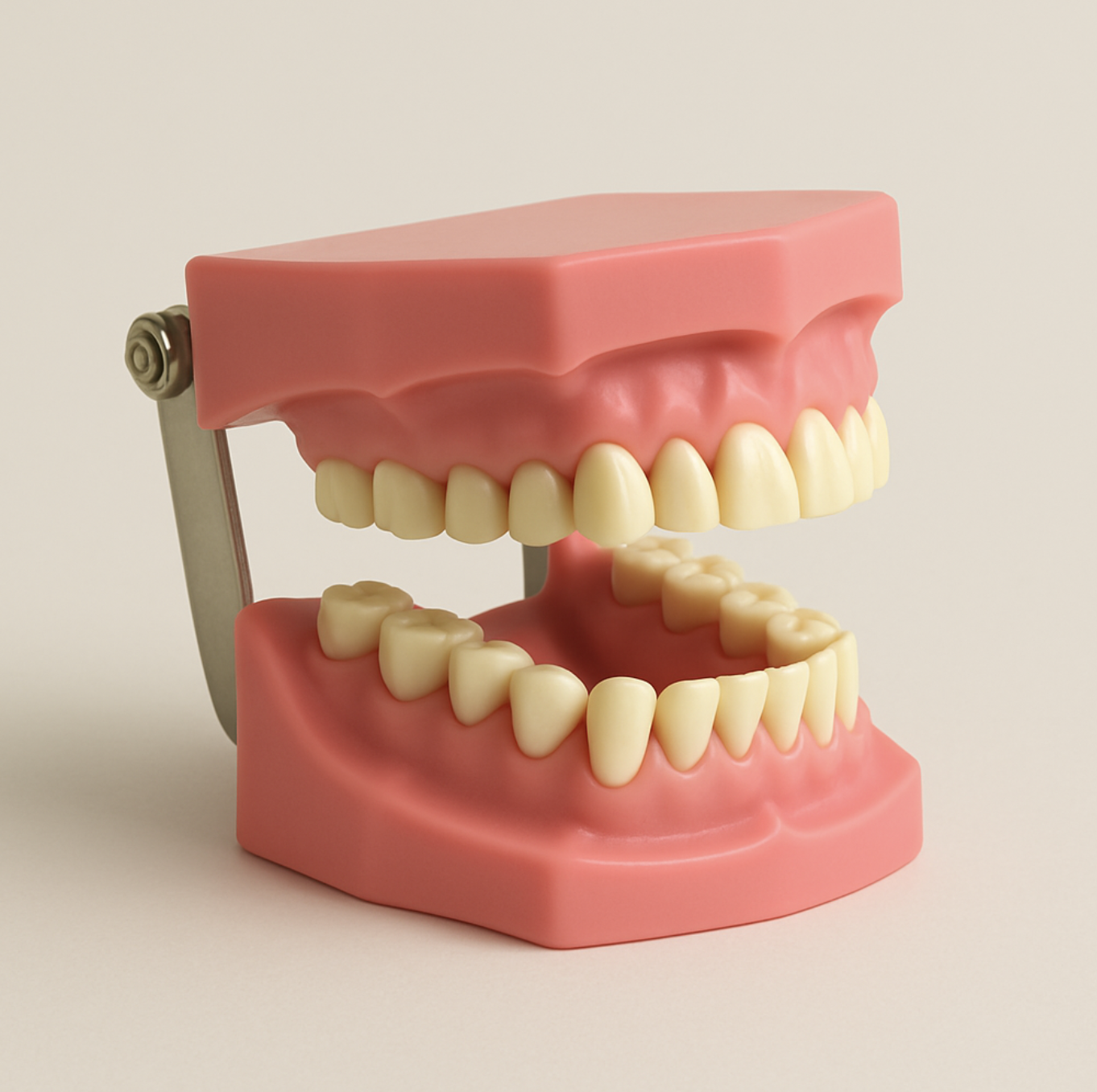
Teeth record stress like tree rings. Every major stressor in your early life from malnutrition to trauma or a major illness, leaves marks in your teeth. These marks appear as grooves or pits or some sort of disrupted enamel formation.
Your teeth remember even when you don’t.
We Love Teeth
We decorate teeth, whiten them, straighten them, literally sometimes carve diamonds into them.
Teeth are used from everything from social currency to survival tools. Did you know back in the day rotten or blackened teeth were considered fashionable? Only the elite could purchase sugar, so the privilege of rotting teeth fell to the upper class. No thank you.
It’s odd when you think about how obsessed we are with the condition of our skeletons. Enough to drag our butts to the dentist every six months and try not to bite anyone’s fingers.
When the dentist handed me a mirror today, I looked at my teeth and saw more than enamel.
Teeth mark the passage of time in a way nothing else does because bone regenerates. Skin heals and blood replaces itself, but enamel is forever. The romantic in me just melts at this.
We wear the story of our lives in our mouths, and twice a year, someone cleans that story for us. Your smile is a fossil that learned how to live, and somehow, that’s endearing.