Quantum Timelines, Parallel Worlds, and the Power of What You Expect
If you’ve been here before you know I have a weird obsession with time. A few years back time broke for me in a real way when I experienced a life-altering trauma. Quantum Physics I also have a strange pull towards. Of course, the two of them together is like catnip for me, so here we are.
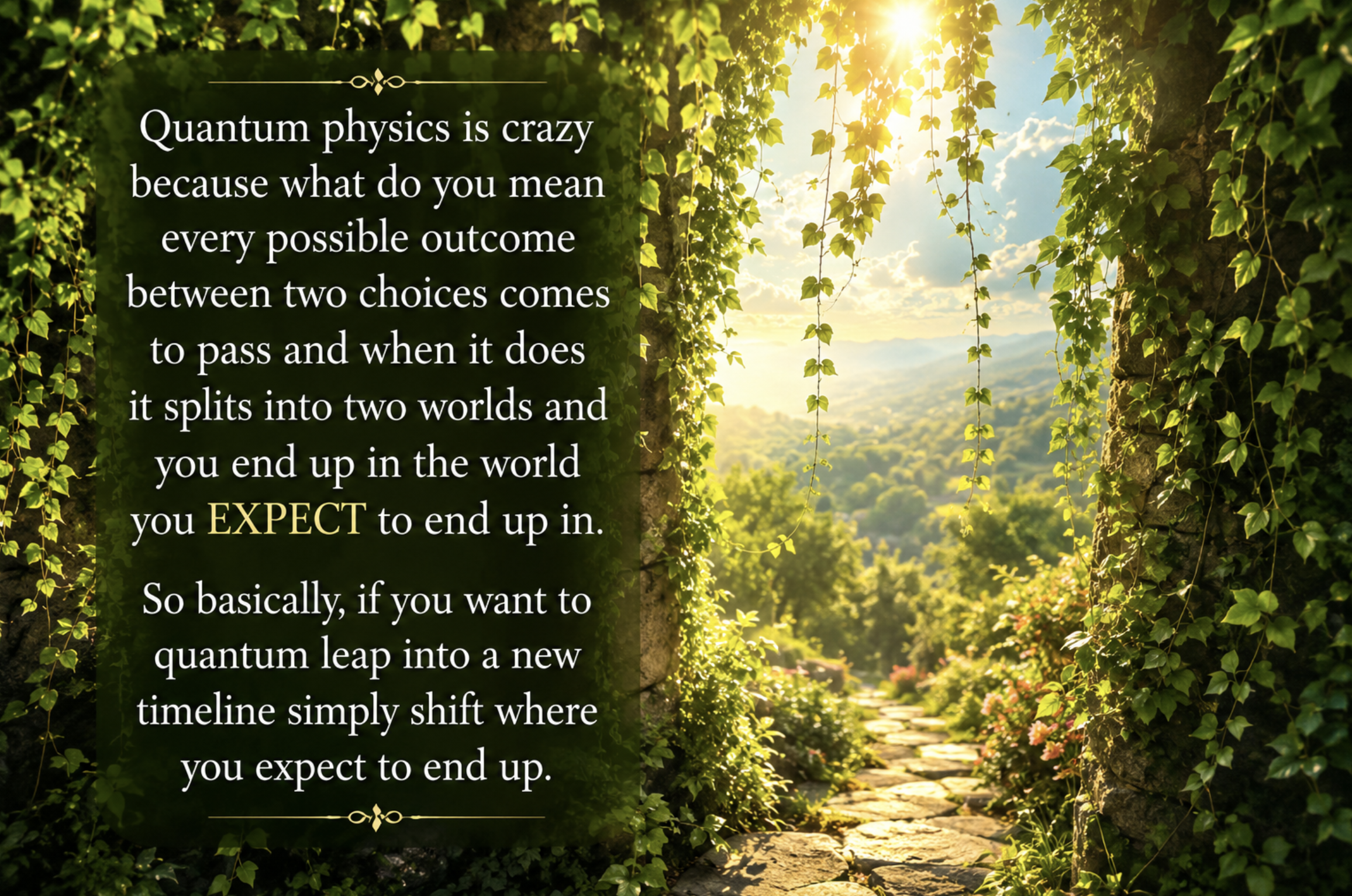
While doom-scrolling last night I saw a post that I appreciated so much, I wanted to dive into it more. The overlay text was pure mind-bender: “Quantum physics is crazy because what do you mean every possible outcome between two choices comes to pass and when it does it splits into two worlds and you end up in the world you EXPECT to end up in. So basically, if you want to quantum leap into a new timeline simply shift where you expect to end up.”
I read it a few times to be honest with you. I tend to do that with bigger, more abstract ideas until my brain can get a good grab of them. You should’ve seen how long it took me to read The Elegant Universe. Anyway, this post felt like someone had taken the quantum rabbit holes I’ve been tumbling down for years from parking-spot luck to delayed-choice erasers rewriting the past, and distilled them into one viral, slightly woo-woo Instagram story.
I mean, I’ve written before about how quantum weirdness leaks into everyday life. In “Quantum Physics, Parking Spots, and the Strange Science of Luck,” I confessed my lifelong parking-lot curse and wondered if expectation actually tilts probability. In “When the Future Rewrites the Past: The Quantum Eraser Paradox,” I obsessed over the fact that photons seem to know the future before it happens, reshaping what we thought was already fixed. Both posts came from the same place, a deep fascination (and healthy skepticism) about how the subatomic rules of reality might whisper clues about how we shape ours.
At some point my brain unfortunately decided to smash the Many-Worlds Interpretation directly into manifestation culture and see what happened. Parallel timelines meets mindset shift. Which, to be clear, sounded either deeply insightful or like the beginning of a spiritual crisis, but I kept reading anyway. I’ve had enough spiritual crises in my life that I’m adept at navigating them.
Expectation as Timeline Teleport
The post’s core promise is seductive because it’s simple. In the quantum realm, every possible outcome of a choice or measurement actually happens. The universe doesn’t pick one; it branches. You, your consciousness, your story and all that you are, land in the branch that matches what you expect. Therefore, to “quantum leap” into a better version of your life, you don’t need to change circumstances first. You change the expectation, and reality reorganizes around the new you.
It feels to me like somebody took a self-help seminar and wrapped it in quantum mechanics until nobody could argue with it anymore. No more grinding against the current and wondering why life hates you, it’s as simple as recalibrating the inner GPS and poof, suddenly you’re on the timeline where the dream job, the soulmate, the healed body, the parking spot right in front already exists.
Part of me immediately rolled my eyes while another part went, ‘okay…but wait a second.’ I’ve lived enough versions of myself to know that expectation does change things. The question is…does quantum mechanics actually back it up, or is this another beautiful metaphor we’re borrowing from the lab to help us sleep at night?
What Quantum Physics Actually Says
Most of us grew up with the Copenhagen interpretation of the quantum realms. Basically the idea is that a quantum system exists in superposition (multiple possibilities at once) until measured or observed, at which point the wavefunction “collapses” into one definite outcome. Schrödinger’s cat is both alive and dead until you open the box. The act of looking forces a choice.
Hugh Everett III had a different idea in 1957. What if the wavefunction never collapses? What if the entire universe, including the observer, is described by one giant, universal wavefunction that evolves deterministically according to the Schrödinger equation? Every time a quantum event with multiple possible outcomes occurs, the universe branches into parallel worlds, each realizing one possibility. All branches are equally real, they just stop interacting (decoherence). That’s the simplified version of it, anyway. I’ll tell you reading the complex version gave me a dull migraine behind my eyes.
That’s like me saying Schrödinger’s cat, well, there’s a world where the cat lives and a world where it dies. You, the observer, also split: one version sees a living cat, another sees a dead one. Both versions of “you” exist and experience their respective realities with full conviction that theirs is the only one.
The double-slit experiment I’ve raved about before? In Many-Worlds, the electron really does go through both slits…in different branches. When we detect which slit it took, we’re not collapsing anything; we’re simply entangling ourselves with the system and splitting into branches where different detections occur.
In this theory there’s no special role for consciousness and no mystical observer effect beyond ordinary measurement. Physicists like it partly because the equations stop needing weird patchwork explanations. No need for wavefunction collapse, which was always the ugly kludge in Copenhagen anyway. As physicist David Wallace and others point out, Many-Worlds is essentially just taking the equations of quantum mechanics seriously and at face value. That means the branching isn’t some rare cosmic event, it happens constantly, everywhere, at every quantum interaction. The number of worlds grows exponentially.
We live in an ever-expanding tree of realities, each fork representing a different history. Some branches diverge only slightly (did the photon go left or right?), others wildly (different evolutionary paths, different personal decisions scaled up across trillions of microscopic choices).
It’s one of those theories that somehow sounds both mathematically beautiful and absolutely unhinged at the same time.
Where the Physics Stops
Here’s the rub the meme glides over in the effort to make everything seems easy peasy lemon squeazy: in pure Many-Worlds, all versions of you exist across the branches. So no cosmic sorting hat that sends “the real you” to the timeline matching your expectations. You don’t consciously choose your branch. Decoherence and entanglement do the splitting for you. Your expectations are part of the quantum state too, and they evolve along with everything else.
The idea that “you end up in the world you expect” is a beautiful poetic reinterpretation, unfortunately, not a direct prediction of the theory. Physicists like Sean Carroll emphasize that the Born rule (why we experience probabilities the way we do) still needs careful derivation in Many-Worlds, and there’s ongoing debate about the preferred basis problem (why we see classical, macroscopic branches instead of total chaos). No experiment has shown that human intention can steer which branch “you” experience…yet. Your beliefs don’t reach across the multiverse and yank the steering wheel. Electrons and photons don’t care about your vision board.
But…here’s where it gets interesting, and where my previous posts come in. While physics doesn’t hand us a remote control for timelines, it does show us a universe of radical possibility. And psychology shows us that expectation is one of the most powerful forces inside our single, subjective experience.
How Expectation Rewires Your Personal Universe
At a certain point your brain starts helping the story along without you even noticing.
Your brain has a filtering system called the Reticular Activating System (RAS). I’ve mentioned this in a lot of posts, but it sort of decides what gets through to conscious awareness. You actually “see” a lot of crazy things throughout the day that your brain sort of removes. When you hold a strong expectation (positive or negative) your RAS starts spotlighting evidence that confirms it. The “lucky” people in the Zurich luck study I wrote about were noticing opportunities everyone else filtered out, not bending probability at the quantum level. Their expectations changed their behavior, their persistence, their willingness to take the next right-hand turn.
That’s the power of the self-fulfilling prophecy in action (more psychology). It’s confirmation bias on steroids. It’s why the friend who expects good parking spots circles the lot with relaxed confidence while I’m already muttering about how the universe hates me. One mindset scans for possibility; the other scans for confirmation of scarcity.
Neuroscience backs this up. Expectation influences everything from pain perception (placebo effect) to performance (growth mindset research by Carol Dweck). When you expect a better outcome, your brain releases different neurochemicals, lowers stress, sharpens focus, and literally changes how you act in the world. Those actions create new data points that reinforce the expectation. It’s a feedback loop that’s self-sustaining.
In Many-Worlds language, you don’t hop branches like a video-game character selecting a save file (sadly). It’s more like your internal state (your beliefs, emotions, habits) becomes part of the wavefunction that determines which version of the story feels continuous to you.
You’re choosing which world’s story you keep telling yourself…and therefore living. I’ve seen it in my own life more times than I can count. The future I expected started coloring the past I remembered. Slowly, deliberately shifting my expectation from “I’m broken and stuck in this timeline forever” to “there are versions of me who healed and thrived”, changed what I noticed, what I tried, and who I became. Unfortunately, there wasn’t a magic wand to use, so this was the best option for me, One microscopic choice at a time, my personal branch started looking a little different.
Practical Timeline Shifting: Tools That Actually Work
Okay, so now that I’ve got you excited to take control of your own timeline (sort of), here is my best advice for moving forward. I’m not a physicist, but I think to shift where you expect to end up without falling into toxic positivity or quantum pseudoscience is pretty straightforward.
Start off by getting specific. Don’t just say something generic like, “I want to be happy.” What does the you in the desired timeline do on a Tuesday morning? How does she speak to herself (or himself)? What does their body feel like? Write it like a scene from a movie, because the more vivid, the more your RAS starts hunting for matching data.
Embody what it is you want before you can truly see it. This is the quantum leap part the meme gets right in spirit. Act as if the branch is already real…not fake-it-till-you-make-it performance, but genuine embodiment. Dress like the person you want to be, schedule like them. Make decisions from that successful person’s perspective. In wine terms (because sommelier brain): stop tasting the current vintage like it’s flawed because it’s to young, and start noticing the layers that will develop with time.
Big leaps come from tiny, consistent actions that prove to your brain the new expectation is safe. Each small win updates your internal model. Over time, the old timeline feels increasingly foreign to you.
Gratitude as retrocausality, because you knew this one was coming. Everyone and their mom will tell you that gratitude is the language of the universe. Borrowing from the quantum eraser: thank the future version of you now. It collapses (or branches) your story backward. I keep a “future gratitude” journal. It sounds cheesy until you realize it’s literally rewiring memory and expectation the way the delayed-choice experiment rewires photon behavior.
Curate your inputs on a daily basis as much as you can. Follow people living the timeline you want. Read stories of transformation so you don’t think it’s rare and hard to achieve. Limit exposure to doom-scrolling that reinforces the old branch. Your environment is part of the measuring apparatus. For the love of God, set a timer on your social media apps on your phone. 15 minutes a day is plenty of time to rot your brain.
Rest and allow decoherence without giving up on everything. Sometimes the kindest thing you can do for yourself is to stop forcing things. Let the branches settle and the cards land where they may. Trust that the universe is doing its quantum thing and your job is to stay aligned with the version you want to experience. Things will end up being okay, you’ll see.
Honestly, a lot of this is probably just psychology wearing a beautiful hand-knitted physics blanket (I’m still trying to learn how to knit, keep an eye on Dopamine Hobbies to see if I get there eventually). It works because reality at the scale our brains can comprehend, is participatory whether or not the multiverse is real.
Parallel Selves and the Art of Choosing
If Many-Worlds is true, there are infinite versions of me writing this right now. Some are thriving sommeliers who never left the industry, some never started blogging, and some are still stuck in the parking lot of old trauma.
That concept could be crushing…or liberating. It means regret is just attachment to a different branch. It means every “what if” is actually happening somewhere. And it means the only branch that matters is the one you’re conscious of right now.
This post invites us to stop arguing with the universe and start dancing with it. Learn to treat expectation as an active participation in the unfolding wavefunction of our lives instead of as passive wishing. I don’t know if we ever truly jump timelines, but I know we can change the story so profoundly that it feels like we did. In the end, isn’t that the point?
Every ripple a tiny quantum event is out there creating new branches we’ll never see. We don’t control the entire river, but we can choose how we navigate the fork in front of us. We can decide how we expect something around the next bend, with joy or with apprehension.
So next time you catch yourself in the same old loop with the same complaints, the same fears, the same “this is just how it is”…pause and a take a deep breath for me. Look at the water of your life and ask: what would the me in the better timeline expect right now?…then shift. Quantum physics doesn’t owe you a parking spot or a perfect life, but the universe is already doing every possible version of you. The only question is which one you’re willing to show up for, and if that isn’t crazy beautiful, I don’t know what is.
Related Reads You Might Enjoy:
When the Future Rewrites the Past: The Quantum Eraser Paradox
Quantum Physics, Parking Spots, and the Strange Science of Luck
Feeling Worthless? Here’s Why the Odds of You Existing Are the Most Beautiful Miracle
Run Toward Time: How 75 Minutes a Week Can Reverse 12 Years of Biological Aging
Choose Your Energy Wisely: The Science of Why What You Focus On Really Does Grow
The Clock That Never Lies: 100 Million Years of Perfect Time
Rewiring Time: The Billionaire-Funded Race to Hack Aging, Freeze Brains, and Digitize the Soul
Quantum Time Control: How Scientists Are Learning to Rewind Reality
The Day the Earth Stood Still: When Planetary Motion Breaks Its Rhythm