How Yamanaka Factors, Epigenetic Reprogramming, and Longevity Escape Velocity Just Blew My Mind
Last night I put on the Modern Wisdom episode with David Friedberg that Elon Musk had quietly posted with the single-word caption “The Moon.” Now, I expected the conversation to stay in the realm of lunar mining, mass drivers, and self-replicating factories in space. I happen to be very interested in that nerdy stuff, so of course, I was pumped.
What I got instead was the kind of idea that makes your stomach drop a little in the best possible way. It’s literally the possibility that aging itself miiiiight not be the fixed law of nature we always assumed it was. Yeah, you can go back and read that again if you’d like, I said it.
Friedberg has this weirdly calm way of talking about things that honestly should sound completely insane and that I was literally was so excited to tell my husband as soon as he got off work (he’s a bodybuilder obsessed with longevity). When he started walking through the science of epigenetic reprogramming and the Yamanaka factors, something in my very soul started cheering. Now, this isn’t one of my fantasy books where people suddenly become immortal next Tuesday, and I’m not interested in selling false hope either. I just genuinely think something kind of insane may quietly be happening beneath the surface of modern biology. The truth is, everything we’ve told ourselves about aging might be starting to crack open in real time.
I feel it’s worth mentioning again that I’m not a biologist or a venture capitalist in biotech. I’m just the gal who spent years rebuilding after a difficult 2021 experiencing a trauma that less than 0.001% of the population ever do, who found healing through writing and wonder, and who now spends most days thinking about what it means to live a life of meaning in an accelerating world. So when someone like Friedberg lays out a path where healthy decades could be added and lived with vitality, not just tacked on at the end, I pay attention. Early human trials using partial reprogramming are already underway as you read this.
So let me try to explain this whole thing the best I can.

The Quiet Lie We’ve Believed About Aging
For almost of history we’ve treated aging like an inevitable mechanical failure. Sun damage, free radicals, accumulated mutations in our DNA, all those little errors that pile up until the system breaks down and there’s nothing we can do about it. That story made sense because it matched what we’ve always observed. Skin wrinkles, joints stiffen, energy fades, and organs slow down. It felt like rust on a car that parks near the ocean…it’s just going to happen.
The deeper scientists keep digging into biology, the weirder this whole thing starts to get. Aging no longer seems to be the body simply breaking down like an old machine left in the rain. Instead, more and more, it looks like the body just forgetting how to read itself correctly.
You see, your genome (the complete set of DNA instructions you were born with) doesn’t change very much over a lifetime. A 70-year-old skin cell and a 20-year-old skin cell still contain almost identical DNA sequences. Yet one looks and behaves like it’s been through decades of wear, while the other is still functioning at peak performance. The difference lies in the epigenome, which is the layer of chemical tags and markers that sit on top of your DNA and control which genes get read and which stay silent. I like to think of our genome as an enormous library containing every book you’ll ever need to build and maintain a healthy human body. The epigenome is the librarian deciding which books get pulled off the shelf and which stay in storage.
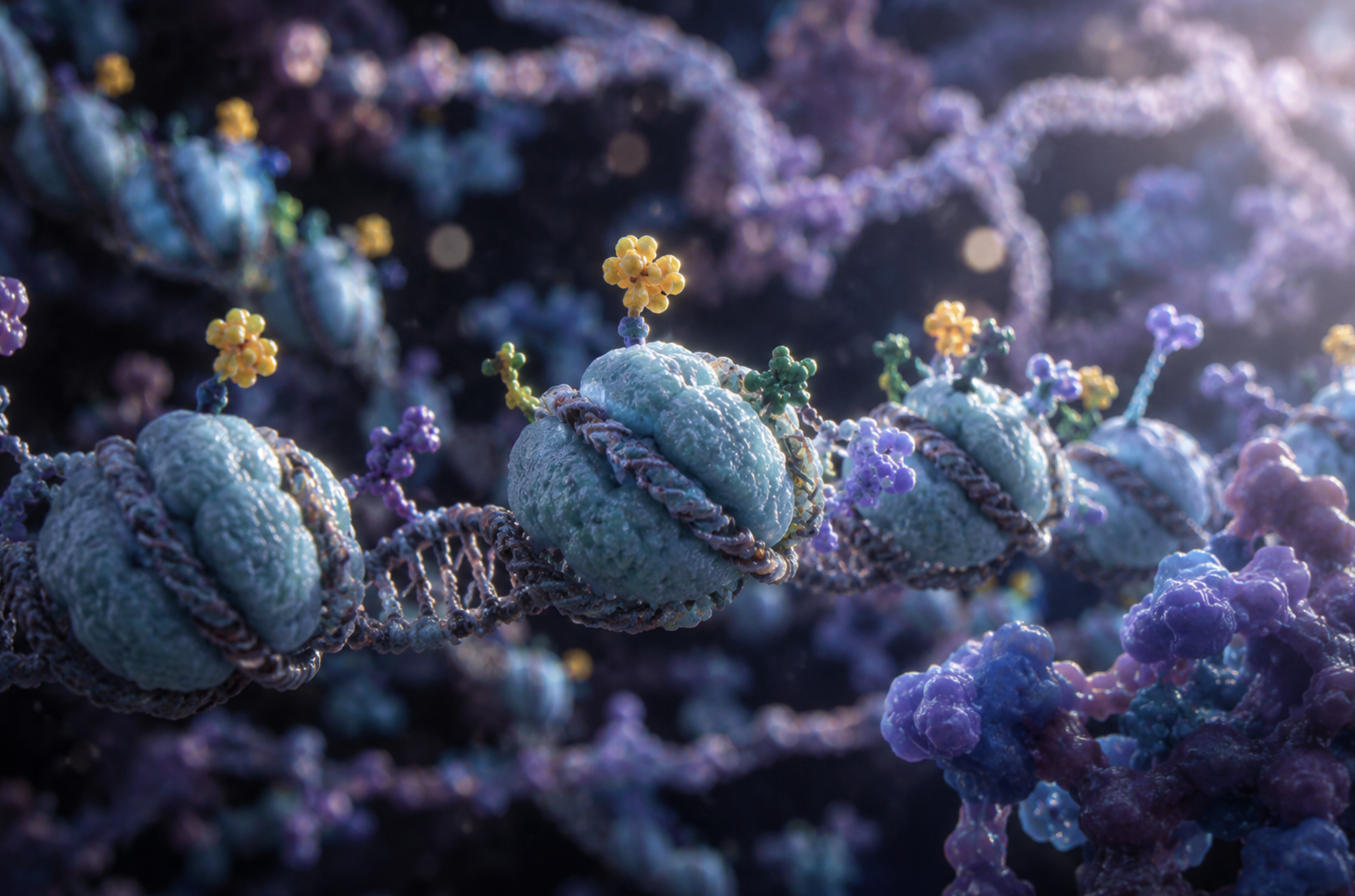
Over time, life just tend to get at you with a dollop of stress, a dash of inflammation, poor sleep, unknown environmental exposures, and even just the passage of years. All of these things start to scramble the librarian’s filing system. Genes that should be turned off in mature cells get turned on or repair genes that should stay active get dialed down. The cell still has the right instructions in them, it’s just reading the wrong ones at the wrong times.
That misreading is what drives a vast amount of the characteristics of aging: chronic inflammation, loss of tissue function, slower healing, metabolic changes. That’s the background of it all though, but here’s what changed everything: in 2006, Shinya Yamanaka discovered four specific proteins, now called the Yamanaka factors, or OSKM (Oct4, Sox2, Klf4, and c-Myc), that could reset that epigenetic playlist almost completely.
Yamanaka Factors: The Four Proteins That Hit Rewind
Yamanaka took adult cells and introduced these four proteins to them. The cells responded by reverting to a pluripotent stem-cell state (ha! Remember how I told you I wasn’t a biologist? Yeah, I had to do some serious research to figure all of this stuff out), that just means it’s in the same highly flexible state that all of the embryonic cells have early in development. In essence, it was like watching a specialized adult cell forget its job and go back to being a blank canvas baby again! The epigenetic markers were basically wiped clean and rewritten for starting over.
The discovery was so profound that Yamanaka shared the Nobel Prize in 2012. It opened the door to induced pluripotent stem cells (iPSCs), which have since been used in everything from disease modeling to regenerative medicine. I’m sure by now you’ve heard of stem cells being used to treat disease and that sort of thing.
The catch of all of this though is that full reprogramming turns the dial all the way to “stem cell.” The cell loses its specialized identity in the way that a skin cell stops acting like skin. In a living organism, that can lead to uncontrolled growth…aka tumors. Not exactly the longevity hack we were all out here hoping for.
So researchers began exploring something they call partial reprogramming, which is brief, carefully controlled pulses of the Yamanaka factors. Just enough to nudge the epigenetic markers back toward a younger configuration without erasing the cell’s identity or causing it to dedifferentiate completely. The results from animal studies have been striking.
In mice, partial reprogramming has shown the ability to improve tissue function across multiple organs. Some experiments have demonstrated measurable lifespan extension. Skin that had lost elasticity regained youthful texture, and wounds healed faster. Metabolic function in some older animals began to resemble that of much younger ones. In one study, researchers saw restoration of vision in aged mice by reprogramming retinal cells. In others, heart tissue and liver function showed clear signs of rejuvenation.
Primate studies followed mice, the usual progression of things. In aged monkeys, partial reprogramming of skin cells led to visible smoothing of wrinkles and improved cellular markers of youth. This isn’t a surface botox situation either, tissues didn’t just look better, they started behaving biologically younger.
My husband loves to do research on new drugs and he always says that it’s hard because most studies choose which anecdotes to highlight and sort of downplay the others. These tests however are the result of rigorous, peer-reviewed work coming out of labs that are now scaling toward human applicationm, so the majority of the studies are showing these results. The key insight Friedberg emphasized is that it’s not like people will live forever in some frozen, unnatural state. We’re trying to restore the body’s own instructions so it can maintain itself the way it did when it was younger.
Human Trials in 2026
David Sinclair’s company, Life Biosciences, launched the first Phase 1 human clinical trial using a partial reprogramming approach for an age-related eye condition (specifically targeting glaucoma and other optic nerve issues). The trial began enrolling in early 2026. The goal is safety and preliminary efficacy, so seeing whether the therapy can restore function in damaged retinal ganglion cells without side effects.
Other players out there are moving fast too. Altos Labs, backed by some of the biggest names in tech and biotech, has poured hundreds of millions into reprogramming research. Multiple academic labs and smaller companies are working on targeted delivery systems to get the Yamanaka factors (or safer analogs) into specific tissues without systemic effects. Delivery systems include things like viral vectors, small molecules, and even non-viral methods.
We’re still in the early days. Phase 1 is about safety, not miracle cures, but the biological foundation is there, and the pace of progress is accelerating.
Longevity Escape Velocity
This is where the conversation gets truly mind-bending.
Peter Diamandis and Aubrey de Grey have talked for years about “longevity escape velocity” (LEV), which is basically the point at which scientific progress adds more than one year of healthy life expectancy for every calendar year that passes. Once you reach LEV, your biological age effectively stops advancing, or even starts moving backward relative to the calendar.
Friedberg laid out the current numbers and said that right now, medical progress is adding roughly three to four months of life expectancy per calendar year for people in developed countries. We’re still losing ground overall…but the curve is bending.
With tools like epigenetic reprogramming, combined with AI-driven drug discovery, robotics-enabled high-throughput research, and cheap abundant energy, that rate could jump absolutely dramatically in the coming decades. Some optimistic models that I particularly like suggest we could cross the threshold of one year gained per year as early as the mid-2030s or 2040s.
So, if you’re 45 reading this today in 2026 and the curve keeps accelerating, you might reach a point in your 60s or 70s where every year that passes adds more than a year of healthy life. At some point the body may stop aging faster than science can help repair it, which honestly still feels surreal for me to even type.
It feels important for me to mention that none of these technologies are developing separately anymore. The same exponential forces Friedberg discussed throughout the episode from AI designing better molecules in days instead of years, to robotic labs running experiments 24/7, fusion energy potentially making power effectively free, to self-replicating manufacturing on the Moon, are exactly what will turbocharge longevity research.
We’re moving from a world where biology was done by hand to one where it’s done at digital speed, and of course, that changes the timeline super dramatically.
What We Can Do While the Science Matures
Alas, although it’s super tempting, none of this means we should sit back and wait for the future to arrive. The fundamentals still matter enormously.
Sleep, nutrition, movement, stress management, meaningful relationships, these things directly influence your epigenome today. They’re not replacements for the coming breakthroughs, but they’re the foundation that makes the most of whatever years we have right now.
Some people are already tracking biological age through blood tests and epigenetic clocks out of curiosity. Others are following the research closely, supporting credible organizations, or even participating in trials when appropriate. The key is staying informed without falling into either blind optimism or reflexive cynicism.
I choose informed hope. After my own reset in 2021, I’ve learned that the stories we tell ourselves about what’s possible shape how we show up in the present. And right now, the emerging story in longevity science is one of the most hopeful I’ve encountered.
The sun is literally setting as I finish writing this. I’m looking out at the same tiny little garden I’ve tended to for years, thinking about how much has already changed in my own life through small, consistent choices and a willingness to stay open to everyday wonder.
We might actually get to watch our great-grandchildren grow up while we’re still able to chase them through the grass (if we’re lucky). We might get to keep on learning, creating, loving, and contributing long after the old timelines said we should be done.
That possibility doesn’t diminish the beauty of the life we have today. If anything, it makes it more precious, because now we have reason to believe the best chapters might still be ahead.
Other Reads You Might Enjoy:
Here's Why Having a Good Partner Literally Makes You Healthier
The Healing Science of Hugging: Why Touch Might Be the Most Powerful Medicine of All
The Science of Anger: How Your Brain Hijacks You (and How to Take Back Control)
Why Do I Cry When I’m Tired? The Science of Overwhelm, Sleep Deprivation, and Softness
The Weird Link Between Happiness and Sleep: Why Sadness Makes You Want to Stay in Bed
Run Toward Time: How 75 Minutes a Week Can Reverse 12 Years of Biological Aging
Just 20 Minutes of Sunlight a Day Stimulates Over 200 Antimicrobial Peptides
The Protein Comeback: Why Dairy’s Becoming a ‘Gut-Healthy’ Superfood (Again)