The phrase negative time gets my attention immediately. Between writing, wine and whatever has distracted me in the garden, I can think of plenty of uses for an extra afternoon. Naturally, a physics experiment with a name like that makes me wonder whether somebody has found a loophole. I'd settle for enough borrowed time to finish a book without deciding to start three other things halfway through it.
What interests me here is a question that sounds almost embarrassingly simple: how much time does light spend interacting with matter? You'd think somebody would have sorted that out by now. Then you get to a measurement with a negative answer, and suddenly even the question needs a little more care. The result is fascinating, although the explanation takes us into an atom cloud rather than back to last Tuesday.
The Experiment Has Had an Important Update
Daniela Angulo, Aephraim Steinberg and their coauthors posted its experimental results in September 2024. The study later appeared in Physical Review Letters on April 13, 2026, with a title specifically describing negative weak values for atomic excitation time. That wording gives us a useful clue about what the experiment measured.
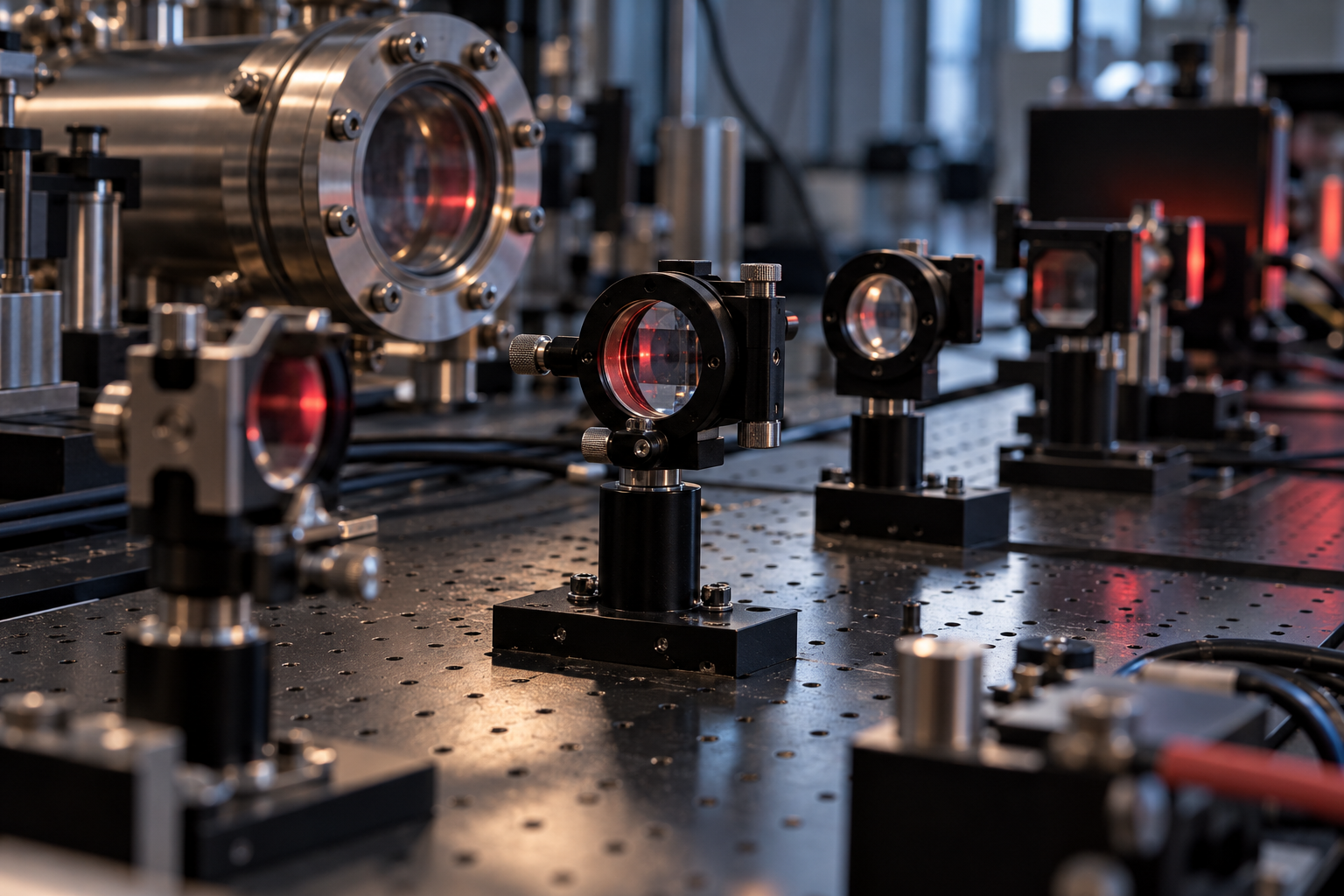
The researchers used a cold cloud of rubidium atoms and pulses of laser light. They studied the effect associated with photons that were transmitted through the cloud, rather than scattered away. The unusual result concerns the inferred time spent as an atomic excitation, meaning energy temporarily associated with excited atoms. Nobody filmed an atom reacting before the light reached it, and no laboratory clock began counting backward.
I find that last distinction helpful because my brain would much rather make a little movie. Light arrives, an atom does something, light leaves, and somebody checks a stopwatch. That would be wonderfully convenient. Unfortunately, by the time we've turned the situation into a tiny version of waiting in traffic, we've already carried a lot of everyday assumptions into a problem where they can lead us astray.
The Measurement Was Made With Another Beam of Light
There were two beams with different jobs. The signal light interacted with the atoms, while a separate probe helped measure the excitation through a small change in its phase. Phase describes a wave's position within its cycle. An earlier experiment, published in PRX Quantum in 2022, had already used this approach to show that transmitted photons could be associated with atomic excitation. Getting through the cloud didn't mean having no interaction along the way.
The later detection also matters. Researchers compared probe readings associated with a photon detection to readings without one, across many repetitions. Selecting records according to a later outcome is called post-selection. Here, the question was about the photons that made it through. It was a careful comparison of accumulated measurements, rather than a stopwatch attached to one photon as it completed a little obstacle course.
This is the point where I want to stop and appreciate the question itself. Being able to detect light on the other side of something doesn't give you a complete story of what happened on the journey. It's tempting to fill in that story with whatever feels reasonable, especially when the beginning and end look straightforward. I do that with much less complicated things than photons, and I suspect that's why this experiment appeals to me.
A Weak Value Can Give a Very Unfamiliar Answer
The theoretical description uses weak measurement, which gathers a small amount of information per trial while limiting disturbance, together with post-selection. In that framework, the averaged probe response is described by a weak value. Such values can fall outside the range you'd expect from an ordinary direct measurement. In the atomic-excitation problem, quantum interference allows a negative value even though an ordinary excitation probability stays nonnegative.
That last part is where the familiar idea of an average stops being a particularly good guide. Average a collection of ordinary waiting times, all positive, and you can't obtain a negative waiting time. A weak value involves a different measurement arrangement and quantum interference, so treating it as an everyday average of little stopwatch readings gives you the wrong picture. The minus sign belongs to the result of that specified measurement.
My wine brain keeps circling back to how much a question depends on what you're actually measuring. Alcohol percentage and the amount of alcohol in a poured glass are related, but you still need to know which question somebody has asked. That isn't a model of a quantum experiment, obviously. It's just my reminder to slow down when a familiar word appears beside a number that seems impossible.

Why the Shape of a Light Pulse Matters
The theory behind the experiment predicts that the excitation-time weak value equals the group delay, a pulse's timing shift relative to free propagation. Absorption can reshape a pulse and shift its center earlier. Even with a negative group delay, the theory keeps information transmission within the speed-of-light limit. That's an important distinction when interpreting the result.
Think about a broad hill drawn on paper. If you remove more of its right-hand side than its left, the center of what's left shifts toward the left. You haven't moved the original hill bodily across the page. That's a rough visual aid for why a changing pulse shape complicates the idea of following one recognizable lump of light. It isn't the full explanation of the atom-cloud measurement, which also involves the quantum selection and probe.
The researchers found negative excitation-time weak values under particular conditions, with results broadly consistent with the prediction. The significance goes beyond noticing where the transmitted pulse's center appears: the sign also shows up in its measured effect on the probe. That is why dismissing the result as a funny-looking graph misses what the experiment was testing. There is an interaction to understand, even if the language we use to describe it feels awkward.
Can We Send Anything Into the Past?
That timing shift offers no way to send a message into yesterday. A pulse's center appearing earlier is different from new information arriving before it was sent, and the causal limit still applies. Calling the result negative time doesn't change that distinction.
I'd certainly be curious about a machine that could rescue an unfortunate decision before I made it, but this setup gives me no reason to start planning one. The words negative time make such a spectacular promise that it's easy to overlook the actual achievement. Scientists asked a difficult question about light and atoms, devised a way to probe it, and obtained a result that everyday intuition handles rather badly. I'm happy to spend a while with that before demanding a time machine.

The Interesting Part Is What We Can Actually Ask
There is a particular sort of science question I love, where the first sentence seems manageable and every answer makes you reconsider something you thought was obvious. How long did it take? Where was the energy? What counts as an interaction? Those sound like questions you could ask about a kitchen appliance. Then light and atoms become involved and an apparently simple duration turns into an argument about how the measurement is defined.
It would be easy to take a detour through every other strange thing we associate with time. Déjà vu, an afternoon that seems to disappear, a smell that brings back a memory, the feeling of waiting forever for something you're excited about. I understand the temptation because those experiences are much easier to connect with than a probe beam. This experiment studied light interacting with rubidium, though, and it offers no evidence that those experiences come from events reaching backward through time.
I can also enjoy a time-travel story without recruiting a physics paper to make it true. Fiction gets to ask what would happen if we could revisit a moment, while an experiment has to tell us how a particular measurement was made. I like having both. One gives me a wonderfully unreasonable premise to wander around in, and the other occasionally supplies a real result that's stranger than the premise I would've come up with.
In the meantime, I'd still love a few extra hours for the garden or my wine studies. I'm probaby going to keep trying to fit too many interests into an ordinary day, with the hourglass carrying on in its usual direction. But I do like knowing that a question as basic as how long light spends interacting with matter can still produce an answer worth puzzling over. That's plenty to keep me occupied while the rest of the afternoon disappears.
Related Reads You Might Enjoy
A Couple of Everyday Tangents
For readers looking for the products I've mentioned in my writing, here are the NeoRhythm PEMF device and magnetic hourglass listings. They're separate from the physics discussed here and have no connection to the rubidium experiment.
Works Cited
Angulo, Daniela, et al. Negative weak values for atomic excitation time. Physical Review Letters 136, 153601, April 13, 2026. Authors' 2024 preprint with the experimental description.
Thompson, Kyle, et al. Photon excitation time and transmission. APL Quantum 2, 036108, 2025. Authors' theoretical paper.
Sinclair, Josiah, et al. Measuring atomic excitation associated with transmitted photons. PRX Quantum 3, 010314, 2022. Authors' preprint and abstract.