Choose Your Energy Wisely: The Science of Why What You Focus On Really Does Grow
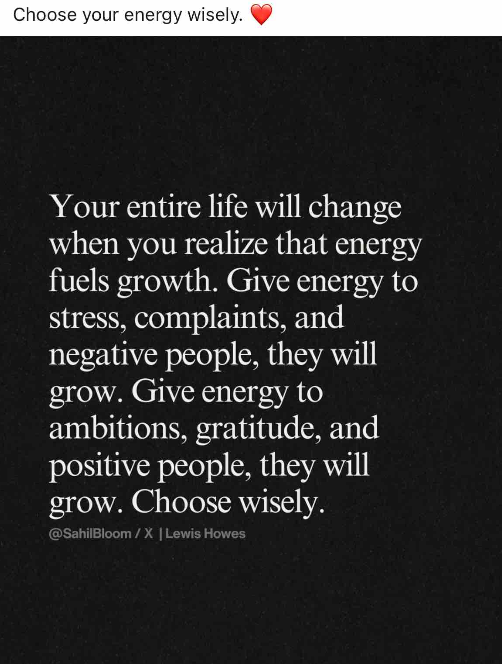
I was doom-scrolling LinkedIn late last night (my timers for Instagram and Facebook were up), after another marathon blogging session balanced against my sommelier shifts and the endless grant applications for Blockchain Botany, when this post stopped me cold. Black background, white text, the kind of clean graphic that feels both profound and a little too polished. It read:
“Your entire life will change when you realize that energy fuels growth. Give energy to stress, complaints, and negative people, they will grow. Give energy to ambitions, gratitude, and positive people, they will grow. Choose wisely.”
—
@SahilBloom | X | Lewis Howes
Above it was written nice and ominously: “choose your energy wisely. ”
I saved the screenshot. I know this is nothing new, and I’ve definitely written about variations of this before, I mean, we’ve all heard that “what you focus on expands” in every self-help corner of the internet. I beg you to read this article next: Quantum Physics, Parking Spots, and the Strange Science of Luck, it might change your life. However, this landed right after I’d spent weeks writing about how negative self-talk flips the same stress switch as a real emergency, and how complaining might literally reshape your brain. I’d been living the other side of the coin.
Something in me whispered: this isn’t just motivational wallpaper, there’s got to be some science here.
So, of course, I went looking, per my usual way of being. I have plenty of feel-good quotes on Pinterest, so instead I went hunting for the actual research. What happens in your brain when you pour your limited daily energy like your attention, your emotional bandwidth, your literal neural firing, into one thing versus another? Turns out, the old adage has roots deeper than pop psychology.
It’s wired into neuroplasticity, selective attention, positive emotions, and even the way we catch feelings from the people around us. This isn’t woo-woo magical nonsense either, it’s repeatable, measurable, and absolutely changeable. If you’re like me, tired but still trying, building a life that blends wine notes with wonder and the occasional 4 a.m. venting session to my supportive husband Zak, then understanding the mechanics might just be the permission slip you need to prune the weeds and water what actually matters.
Neuroplasticity and the Energy of Attention
I’d like to begin with the hardware to fully prove my point. Your brain isn’t a fixed machine, it’s more like a living garden. The soil, the paths, even the plants themselves shift based on what you tend to over time. This principle is experience-dependent neuroplasticity, which is basically the idea that repeated experiences, thoughts, and focuses literally strengthen or weaken the connections between neurons.
The foundational principle is Hebb’s rule: “Neurons that fire together wire together.” Every time you direct energy toward stress from replaying that awkward client interaction from your last tasting, to scrolling through complaints on social media, those neural pathways get a little thicker, and a little more efficient. The brain becomes better at spotting (and generating) more of the same.
I felt this viscerally after my last deep dive into negative self-talk. One harsh thought about my writing not being “serious enough” or my journey in Blockchain Botany being “too late” would trigger the hypothalamic-pituitary-adrenal (HPA) axis, the same stress response I wrote about before. I’ll give you the little highlights, but essentially, cortisol floods in and suddenly the garden is overgrown with thistles and those tiny little plants that keep popping up in my backyard.
The flip side is just as real though, direct energy toward ambitions or gratitude, and those pathways grow stronger too. Small, consistent focus literally changes brain structure.
Research on this is plentiful and not at all abstract. Studies show that focused attention practices (like mindfulness or deliberate gratitude) increase gray matter volume in areas tied to learning, memory, and emotional regulation. One review even links regular positive focus to better cognitive fitness as we age, countering natural decline. Your brain adapts. It grows what you water.
As a sommelier in my day-to-day, I see the parallel in fermentation every day. Yeast doesn’t just magically turn grape juice into wine, it needs the right energy: temperature, nutrients, and time. Give it too much stress like wrong conditions, and you get vinegar. Give it the right focused inputs and you get something layered, complex, alive.
Your mind works the same way.
The Reticular Activating System and Selective Attention
Your brain is bombarded with millions of bits of information every single second of your life. It can’t process everything, so it has a built-in bouncer the science people on the interwebs call the Reticular Activating System (RAS) in your brainstem. This system decides what gets through to your conscious awareness based on what you’ve already told it matters.
Ever decide you want a specific wine (say, a particular Brunello) and suddenly see it everywhere? Or set a goal and notice opportunities you missed before? That’s the RAS at work. It doesn’t create reality out of thin air, but it amplifies what aligns with your dominant focus. Psychologists online call this selective attention, and it’s closely tied to confirmation bias, which is the tendency to seek, interpret, and remember information that confirms what you already believe or notice.
That means, in the context of the post, if your energy goes to stress and complaints, your RAS starts highlighting more of them. If someone is starting to annoy you, then you’ll suddenly notice their drama first. However, if you’re thinking about ambitions and gratitude, suddenly you spot the small wins, the helpful connections, and all the millions of reasons to keep going.
I’ve lived both. It’s easy to look at your life and see the missing pieces. It’s normal to compare yourself to others and let envy get in the way. The garden grew weeds fast in these situations. Shifting focus (even imperfectly) to what was working opened doors I hadn’t seen though: better pairings, deeper stories for the blog, even the courage to start seeking out grants for Blockchain Botany.
Science backs the lived experience too. Studies on decision-making show that once you’re fully commited to a perspective (positive or negative), all the following information gets weighted differently, confirmatory evidence gets amplified, contradictory stuff gets downplayed in your mind.
Your energy doesn’t just feel like it grows things, it literally programs the filter through which you experience your entire life.

Positive Energy Builds More Than Just Good Feelings: The Broaden-and-Build Theory
If you want to dive a little more into this then Dr. Barbara Fredrickson’s broaden-and-build theory is one of the most robust frameworks in positive psychology for exactly this. Positive emotions like joy, gratitude, interest, contentment, feel nice, yes, but they also broaden your momentary thought-action repertoire.
Where negative emotions narrow you down to fight-or-flight (which is very useful for real danger), positive ones expand your options, you become more creative, more open to new ideas, and much better at seeing the big picture.
Over time, these broadened moments build lasting resources like better relationships, stronger resilience, more skills, even physical health improvements. Fredrickson’s lab experiments showed that people induced into positive states (via films or reflection) recovered faster from cardiovascular stress and listed more possible actions than those in neutral or negative states.
Other works out there confirms that positive emotions predict flourishing, like real, measurable growth in well-being. I like to think of this as energy fueling growth in action. Give attention to gratitude and ambitions, and your mind literally has more tools to create the life you want.
The best wines in life aren’t just one note screaming; they have layers because the right conditions allowed complexity to build. Your life can be the same.
Gratitude is The Quiet Multiplier That Rewires Everything
If there’s one practice that consistently shows up in the research as a high-ROI way to direct energy positively, it’s gratitude.
I’m not talking about the Instagram “blessed” version where it’s secretly a flex about how much you have, I mean the deliberate, repeated noticing of what’s already good.
Robert Emmons and Michael McCullough’s classic studies (and many many replications since) found that people who kept weekly gratitude journals reported higher optimism, fewer physical symptoms, more exercise, and a greater overall life satisfaction than control groups. Other work shows gratitude interventions reduce anxiety and depression symptoms and can have effects lasting months.
On the brain level, fMRI studies reveal that gratitude activates reward pathways (dopamine and serotonin) and can increase gray matter volume in key areas. It dampens the amygdala’s reactivity, meaning less hair-trigger stress responses. One study even linked higher gratitude to better heart health markers.
I started a simple practice after my trauma years ago that I need to name three things at the end of the day that went right, no matter how small. A perfect pour, a kind note from a reader, or Zak making me laugh until I forgot the to-do list. The thing about gratitude is that it will never ever erase the hard days, but it changes the soil.
The weeds grow slower over time and the good stuff will start to thrive.
Emotional Contagion and Choosing Your Circle
Energy isn’t only internal.
We’re all out here hardwired for emotional contagion, which is the unconscious mirroring of others’ emotions through mirror neurons, facial expressions, tone, even online posts. Research out there shows happiness and positive emotions spread through social networks up to three degrees of separation. Negative emotions spread too (my cautionary tale for those out there spreading hate or unhappiness), but studies suggest positive contagion can be especially strong in close relationships.
Give energy to chronically negative people and you’ll catch more of it. Surround yourself with those who fuel ambitions and gratitude, and the opposite happens.
It’s not about cutting everyone off who has a bad day and wants to vent to you about it, it’s about being intentional with where you invest your limited emotional bandwidth.
As a sommelier who’s worked every kind of service, I’ve seen it in real time: tables full of laughter and curiosity taste better wines and leave happier. Your life is literally what you make it and what you want it to be. Try not to waste energy on the bad, and when you’re stuck in a negative spiral, thinking about all the things you’re grateful for in this life tends to stop that spiral in its tracks.
We’ve all been guilty at one point or another of rumination spirals, or endless complaining sessions that leave you drained.
Turns out though, that’s not just “venting.” It strengthens the negative pathways, elevates cortisol chronically, and, per the research I cited in my complaining post, can actually impair memory, immunity, and problem-solving. Bad really is stronger than good in the short term (Baumeister’s work), which is why intentional positive focus is such a powerful counterweight.
The beautiful part in all of this is that neuroplasticity works both ways. It’s never too late to change your brain and remember that small, repeated choices compound. Like pruning a vine, you cut back what’s draining resources so the fruit can ripen better.
Practical Ways to Choose Wisely (That Actually Stick)
You don’t need a total life overhaul, but this part is here for you if you want some tips. Start small because the brain absolutely loves consistency more than intensity.
Morning RAS priming: Spend 2-3 minutes writing or speaking your top 1-2 ambitions and one thing you’re grateful for. Tell your filter what to look for. I like to start my day like this. It helps a lot.
Gratitude ritual: Not a massive journal, just scribble something daily about three specific things, and why they matter to you. Make it personal.
Energy audit: Once a week, notice where your mental/emotional energy went. Prune one low-value drain (endless scrolling, certain conversations, even people who drain your energy).
Positive people investment: Schedule time with those who lift you up and make you feel good and like you can do anything. It’s contagious in the best way.
Wine (or life) tasting mindfulness: Next time you open a bottle or face a challenge, practice focused attention on the positives first. Build the muscle.
It’s made the hard days more bearable and the good ones deeper for me, and I hope it impacts you as well.
The Fermentation of Your Future
Energy fuels growth in every aspect of life. In the vineyard, in the barrel, in the brain.
The yeast doesn’t complain about the sugar (or lack there of), it just transforms it. Your attention is that transformative force.
The post that started this whole reflection was right: your entire life can change when you realize this. The universe isn’t magically going to rearrange itself overnight, but your brain, your relationships, and your opportunities will start aligning with where you consistently direct your energy.
I’m still a work in progress. There are still nights I complain to Zak even though I try to hold my tongue. There are still weeds out there, but I’m choosing more wisely now, watering the ambitions, the gratitude, the positive connections. The garden is responding slowly, but I’ve never had a tomato plant seed to fruit overnight.
What are you giving energy to today? The stress that grows bigger every time you feed it? Or the ambitions and gratitude that quietly build the life you actually want?
Choose wisely. Your brain…and your future…is listening closely.
Related reads on the blog:
Quantum Physics, Parking Spots, and the Strange Science of Luck
Feeling Worthless? Here’s Why the Odds of You Existing Are the Most Beautiful Miracle
Quantum Time Control: How Scientists Are Learning to Rewind Reality
The Invisible Symphony: How the Universe Flickers Through Our Lives Without Us Knowing