The Forgotten Warning of Icarus: Why Flying Too Low is Just as Dangerous as Too High
I’ve always been drawn to old stories that tell tales that somehow sneak into modern conversations, shape how we parent, how we chase careers, even how we order a second glass of wine when the first one feels a little too bold. The myth of Icarus is one of those stories I’d love to talk about today. We’ve carried it around for thousands of years like a well-worn caution sign: don’t fly too close to the sun.
But here’s the part that keeps me up at night lately after I spend hours working on Blockchain Botany and other projects that I probably have no business building.
We only ever tell half of the story. Daedalus didn’t just warn his son about the sun, he gave him two warnings that morning over the Cretan sea, two equally deadly directions. Somewhere along the retellings through Roman poets, Renaissance painters, motivational speakers, and every parent who ever said “don’t get your hopes up”, the second warning quietly disappeared.
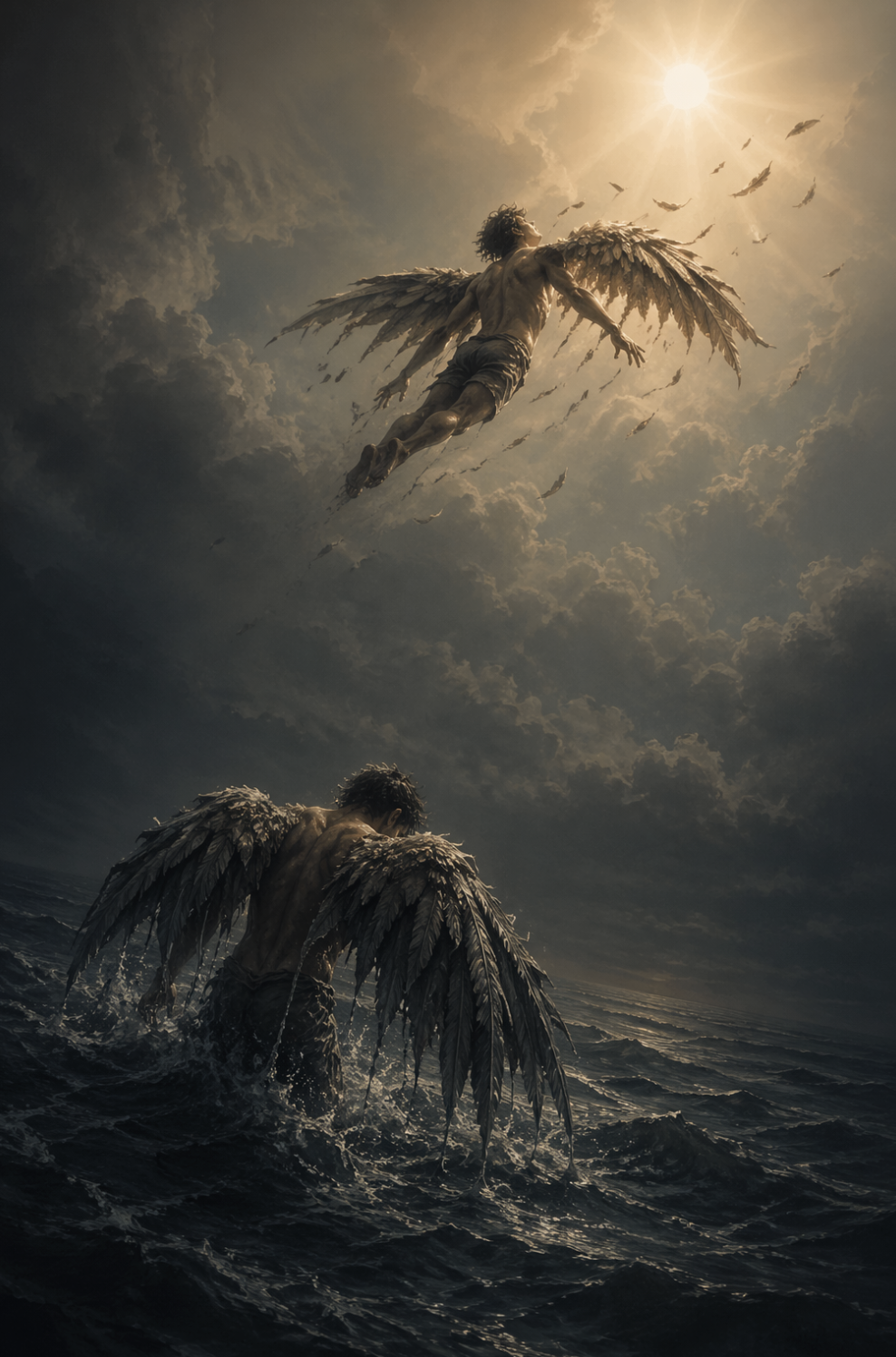
I keep thinking about that lost half, because in a world obsessed with burnout culture on one end and quiet quitting on the other, we’re still only hearing the loudest part of the myth. The dramatic fall, the melted wax, then the final splash. We forgot the damp wings. We forgot that mediocrity can drown you just as surely as ambition can burn you.
This is the story I want to tell today, and not the one you already know, but the fuller, stranger, more beautiful version. The one that doesn’t let us off the hook so easily. The one that asks: what if the real tragedy isn’t falling from the sky… but never quite leaving the shore?
The Story We Think We Know
To keep it classic, I’m going to start with the boy and his wings. King Minos of Crete had locked Daedalus and his son Icarus in the labyrinth they themselves had designed to imprison the Minotaur. Clever, no? The inventor trapped by his own invention, I know there’s a deeper meaning in there. But Daedalus, being Daedalus, wasn’t one to accept a cage. He gathered feathers from seabirds that nested along the cliffs and melted beeswax from the island’s hives.
He shaped two pairs of wings, strong enough to carry a man across the sea to freedom, delicate enough to feel like magic. Before they launched, Daedalus gave his son the instructions every schoolchild learns: “Follow me closely. Do not fly too high, or the sun will melt the wax. Do not fly too low, or the sea spray will soak the feathers and drag you down.” They took off, and the boy, exhilarated by the rush of wind and the impossible view of the world below, ignored the first warning.
Higher and higher he climbed, laughing, until the heat of Helios softened the wax. Feathers loosened, the boy fell, the sea claimed him…end of story. Or so we think.
We turned Icarus into shorthand for hubris. He’s a cautionary tale for the entrepreneur who raised too much venture capital and crashed. He’s a message for the artist who chased fame until it consumed them. For the kid who pushed too hard in school and burned out before twenty-five.
“Don’t be an Icarus,” we say, and what we really mean is: stay in your lane, keep your ambitions reasonable, the fall hurts more than you know. It’s a tidy moral, comforting, even. It lets us feel wise without ever having to risk anything ourselves.
But Ovid, who wrote the version most of us inherited in his Metamorphoses, didn’t stop at one warning. Neither should we.
What Daedalus Really Said
I went back to the original Latin (well, as close as a sommelier with a dusty copy of Ovid and the interwebs can get). The instructions are crystal clear. Daedalus doesn’t just say “don’t go too high.”
He says, in essence: there’s a middle path, and it’s the only one that will get us home. “Inter utrumque vola,” he tells his son.
Fly between the two. Too high, the sun’s heat will loosen every careful joint he spent days crafting. Too low and the ocean’s mist will weigh the feathers like soaked sponges. The wings will grow heavy and the rhythm of flight will falter. And eventually, even the strongest arms will fail. Both extremes lead to the same blue grave.
Daedalus understood something profound about the physics of wings, and about the physics of life in general. Elevation matters, and altitude is not optional if you actually want to cross the sea. But altitude without awareness of the elements around you is suicide. The myth isn’t a warning against trying too hard. It’s a warning against imbalance. Against forgetting that the environment you fly through has rules, and those rules don’t care about your intentions.
We lost the second half because the first half makes for better drama. A boy plummeting from the sky is cinematic. A boy slowly sinking because his wings got soggy from playing it too safe? That’s just…another damn Tuesday (just like today). That’s the guy who stayed in the job he hated for thirty years because “it was stable.” That’s the woman who never submitted the manuscript because “what if it’s not good enough?” That’s the friend who keeps saying “maybe next year” about the trip, the business, the relationship, the dream.
No splash…just quiet exhaustion.
Why We Only Remember Half the Warning
Cultures absolutely love cautionary tales that punish the ambitious.
They make the rest of us feel better about our ordinary paths. “See?” we say. “I told you reaching for the stars was dangerous.” But mediocrity doesn’t photograph as well. It doesn’t go viral or get turned into paintings by Bruegel or poems by Auden.
It just… accumulates. Like sea salt on feathers.
Think about how we talk about burnout today. Entire industries have sprung up around it, there are books, podcasts, wellness retreats, all focused on the dangers of flying too high. And yes, those dangers are real. I’ve watched brilliant people in the wine world chase Michelin stars, those sommelier pins they wear proudly on their jackets, and wine fame until their bodies and relationships cracked under the pressure. I’ve done it myself, more than once.
When was the last time you heard a TED Talk titled “The Quiet Tragedy of Never Trying at All”? We romanticize the fallen Icarus. We rarely sit with the boy who made it across the sea by flying so low his wings were permanently waterlogged, arriving on the other shore too tired to celebrate.
Flying Too Low in a High-Flying World
I see it every day in the people I love and admire.
The talented sommelier who keeps turning down opportunities to open her own wine bar because “the market is too competitive right now.” Her wings are getting damp. The spray of “what if I fail?” is already soaking through.
The writer friend who has three finished novels in a drawer because every time he thinks about querying agents he remembers that one harsh critique from college. Safer to keep the dream small. Safer to say “I’m not really a writer, I just dabble.”
The couple who stay together because breaking up would be “too messy,” even though both of them have been quietly dying inside for years.
The friend of mine who wants to be an actor but is waiting for the right time to try.
Low flight…predictable…heavy.
This is the slow tragedy of the dampened wing. You don’t die dramatically, you just stop rising. You hover a few feet above the waves, telling yourself you’re being responsible, until one day you realize you haven’t actually moved forward in years. The shore you left is a distant memory. The shore you’re heading toward feels impossibly far.
The worst part is that no one out there claps for the person who plays it safe. No one writes poems about the cautious flight. Icarus is immortalized for flying too high, but if he flew too low, I’m willing to bet you wouldn’t know his name today.
Daedalus tried to teach his son that playing small doesn’t protect you from pain. It just changes the flavor of the pain from the sharp burn of failure to the dull ache of wondering “what if.”
Mediocrity isn’t safe, it’s just slower drowning.
Wine, Balance, and Altitude
As a sommelier, I think about this every time I taste a wine lately.
The greatest bottles, I mean, the ones that make you close your eyes and actually feel something, are never the ones that play it safe. They don’t hide behind too much oak to mask flaws or stay on the vines longer to develop more sugars and fruit to hide the imbalance of it all. They don’t stay so light and neutral that they disappear into the food. No, they find that terrifying middle path.
Enough ripeness to carry depth and alcohol, but not so much that the fruit becomes jammy and one-dimensional. Enough acidity to keep things alive, but not so much that it tastes like sucking on a lemon. Enough tannin to give structure, but not so much that your mouth feels like it’s been sandblasted.
Balance isn’t the absence of extremes, it’s the intelligent navigation between them. My Libra mind loves this.
I once tasted a 2016 Brunello di Montalcino that had absolutely everything you’d want in it. Power, elegance, earth, fruit, age-worthiness. The winemaker told me later that in that vintage they had to make an impossible choice: harvest early to preserve freshness or wait for full phenolic ripeness and risk the weather.
That’s what Daedalus was trying to give his son: not a rulebook, but the courage to read the conditions and adjust in real time.
Doing this means starting with honest self-assessment. Check your wings regularly. Are they heavy with sea spray like the fear of judgment, perfectionism, the need to be liked? Or are they getting brittle in the sun chasing metrics that don’t actually matter, comparing yourself to people on different journeys, burning the candle at both ends until there’s nothing left?
The middle path requires constant tiny corrections. Daedalus didn’t expect his son to set a course and never deviate. He expected him to pay attention. To feel the temperature rising and to notice when the mist started collecting on the feathers. In practical terms, that might look like setting ambitious goals but building in recovery time before you need it.
Maybe try to share your dreams with people who will challenge you lovingly instead of people who will either cheer blindly or discourage safely.
Learn to say both “yes” to the scary opportunity and “no” to the thing that looks good but will dilute your focus.
It’s not about playing moderate, it’s about playing alive.
The True Tragedy of the Myth
Here’s the part that still breaks my heart when I read Ovid.
Daedalus made it across in the end. He landed safely on the other shore, and then he looked back and saw his son’s body floating in the waves. The inventor who built the wings, who understood the dangers perfectly, still lost the person he loved most. Not because he flew too high, but because his son flew too high and because the world celebrates that version of the story while ignoring the other danger.
We tell kids “don’t be Icarus” and we think we’re protecting them, but what if we’re actually teaching them to fear their own potential? What if we’re teaching them that the only safe flight is the one that barely qualifies as flying?
I don’t want that for you, and I don’t want that for myself.
I definitely don’t want that for the next generation of dreamers, creators, and wonder-seekers.
Be brutally honest with yourself moving forward, are you hovering low because it feels safer? Or are you climbing too fast because the view is addictive? Build better wings. Daedalus didn’t improvise, he studied birds, and tested materials. Preparation is what allows you to fly higher safely.
Look for the natural updrafts in your life, mentors, communities, routines that lift you without requiring you to flap harder. Learn to read the conditions surrounding you. The sun moves, the sea changes. What felt like the perfect altitude yesterday might be too high or too low today. Check in often.
Also, I beg you to celebrate the middle path publicly. When someone you know nails that balance, say it out loud. Make the quiet courage as visible as the dramatic falls.
A New Way to Read the Icarus Story
I want us to retire the old version, I’m tired of it. I want us to start telling the fuller myth.
The one where Daedalus’ love for his son included both warnings. The one where ambition and caution are not enemies but dance partners. The one where the boy who fell wasn’t a cautionary tale against dreaming, he was a cautionary tale against forgetting to listen to both parts of the instructions.
The real gift Daedalus gave wasn’t those wings, it was the wisdom to use them well.
We all have wings, some of us were born with them, and some of us built them ourselves through years of quiet craftsmanship. Some of us are still gathering feathers. Wherever you are in the process, remember this: the sea is always waiting to claim those who fly too low, just as surely as the sun waits for those who fly too high. The only way across is the middle path.
The only way to honor the story is to fly, I mean really fly, while staying awake to both dangers. The next time you feel that familiar tug toward playing smaller, toward dimming your light “just in case,” ask yourself if you’re protecting the wax from the sun, or letting the waves soak your feathers.
Daedalus built those wings so his son could reach the other shore, not so he could hover forever just above the water. He didn’t want his son to burn up chasing the sun, but to fly free.
May we all have the courage to do the same, and may we remember to look back every once in a while, not to mourn what was lost, but to make sure no one we love is flying too low either. The only thing more heartbreaking than watching someone fall from the sky…is watching them never leave the shore at all.
Related Reads from the Blog:
The Sound of Extinction: How Disappearing Animals Take Silence With Them
Feeling Worthless? Here’s Why the Odds of You Existing Are the Most Beautiful Miracle
The Emotional Life of Fish: What Science Is Finally Starting to Admit
The Rise of Independent Media: When People Stop Waiting to Be Told What’s Real
The Sound of Trees Crying: What Plants Really Do When They’re Stressed