The Weeds We Can’t See: Solar-Powered AI Robots Might Save Our Food
I’ve spent my career chasing the perfect balance in a glass, chasing the way a vineyard can tell its story through soil, sun, and subtle decisions made row by row. A great wine never really came from brute force, but from paying attention to the details most people never notice: the exact moment a cluster reaches ripeness, the microbial life beneath the surface, and the quiet interplay between vine and environment.
Lately, though, my mind has been drifting from the cellar to the fields themselves. Maybe it’s because the spring has sprung and all my plants are starting to finally bloom. Also, to be honest, I absolutely hate that we spray things on our food and wine. What if the future of farming didn’t have to rely on spraying chemicals across entire acres but instead saw and removed weeds one by one, plant by plant, with a kind of precision that could make a real difference in the vineyard?
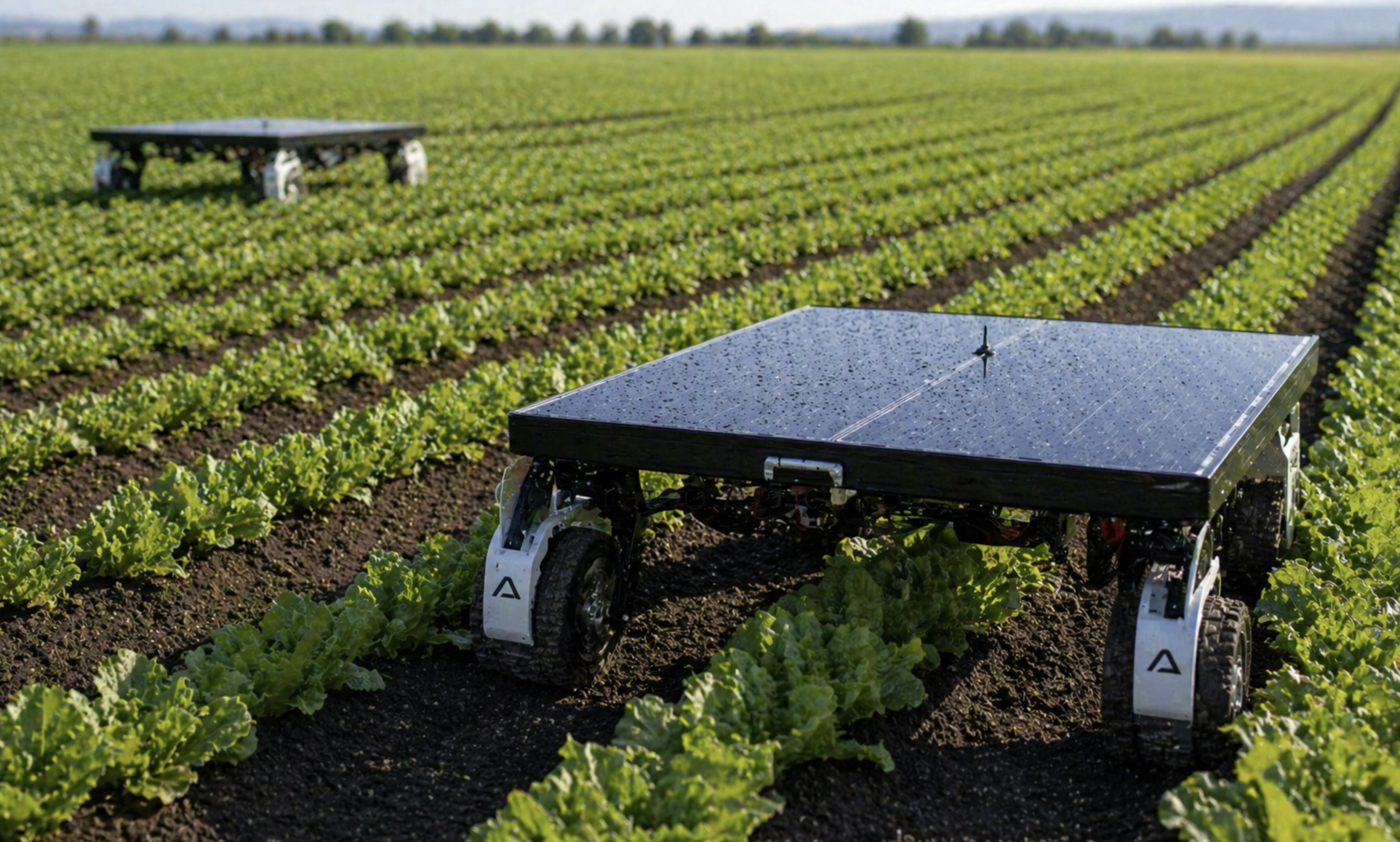
I came across an image on LinkedIn of a farmer standing in a sunlit field beside a low, rugged robot that looked part drafting table, part all-terrain vehicle. The caption read, “NVIDIA-Backed Farm Robots Are Learning to Kill Weeds Without Chemicals.” Below it, the post from Aigen explained: AI-powered farming is already working in real fields. Their solar-powered robots use vision AI to identify weeds at the plant level and remove them directly where they grow. This means no blanket spraying or excess chemicals floating around.
These machines are already patrolling cotton rows in California’s Central Valley, soy fields in the Red River Valley, and sugar beet patches farther north. As someone who slightly obsesses over how our food and drink are grown (if you’ve been here before you know this), I felt that spark of possibility. Sort of the same one I get when a vineyard manager shows me a new regenerative practice that honors the land without sacrificing quality.
This is physical (and cute little robot) AI stepping into the dirt, and it’s changing the story of modern agriculture in ways we’ve all been waiting for. Even if you didn’t know you were waiting for it yet.
The Story We Think We Know About Farming
We’ve told ourselves a straightforward narrative about feeding the world: bigger equipment, stronger chemicals, higher yields. After World War II, synthetic herbicides became the go-to solution.
Glyphosate and its relatives let us wage total war on weeds so crops could thrive without competition. It worked…spectacularly well…for decades. Fields stayed clean, labor demands dropped, and production scaled to meet a growing global population.
Yeah, but the story has cracks that have become impossible to ignore. Over 500 weed species worldwide have now developed resistance to common herbicides. Farmers find themselves locked in an expensive arms race, reaching for newer formulations, tank mixes, and higher application rates that can cost thousands of dollars per acre.
Not to mention, the environmental cost is equally steep. There’s chemical runoff into waterways, impacts on pollinators and beneficial insects, soil degradation, and growing concerns about residues in our food and drink. It feels like almost every year now (is it every year?) there are recalls on wine or food that have dangerous levels of arsenic or other lovely chemicals in them.
On top of that, labor shortages make hand-weeding absolutely impractical at commercial scale. I mean, weeding my tiny tiny garden for too long hurts my back. Many of us, especially those who seek out “clean” wine, regenerative produce, and transparent supply chains, want to believe there’s a better way out there than this. We talk about biodiversity, soil health, and minimal intervention in the vineyard, but conventional weed management has too often been the blunt instrument that undermines the very terroir we celebrate.
The system we built for efficiency is starting to show its limits, and it makes me wonder: can we do better without going backward?
What These Robots Are Actually Doing
Aigen’s Element robots offer a different answer. Instead of a tractor roaring across the field and coating everything in spray, fleets of these solar-powered machines move quietly through the rows every single day. Their onboard cameras and edge AI scan at the individual plant level, distinguishing crop from weed with remarkable accuracy. Their words on their website, anyway.
Once a weed is identified, and ideally at the tiny 1- to 2-inch stage, the robot deploys a precise mechanical strike, essentially a targeted hoe or blade that kills the weed at its base without disturbing the surrounding crop or soil. The real beauty of it is that no chemicals touch the field. I mean, no blanket applications drift into neighboring areas and ruin their ability to apply for Organic labeling. If you didn’t know, if your neighbors are spraying, then your farm can’t technically be organic because of the wind and runoff.
These robots are farm-tough by design: all-wheel drive, rugged suspension, foam-filled tires, and an IP65 rating that lets them handle mud, slopes, rain, and the punishing heat of a real growing season. They run 100% on solar power with onboard battery storage, so no extra charging is needed. A custom solar panel (now enhanced in the second-generation model) keeps them operating up to 14 hours a day, often even generating a surplus of energy.
The AI models themselves are astonishingly efficient drawing roughly 1.5 watts, which is less than many cell phones, while delivering real-time, double-digit frames-per-second performance on the robot’s neural processing unit. Aigen deploys them as a service and complete crews of five, ten, or more robots stay in the field for the entire growing season. They communicate through an intelligent mesh network, adapting as a team to target problem areas automatically. No daily farmer intervention is required.
They work while the sun shines, rest at night, and wake up ready to go again. Early commercial deployments at farms like Bowles Farming Company in California’s Central Valley have shown the robots keeping cotton fields clean without herbicides, freeing up workers for higher-skill tasks and giving farmers back precious time.
The newest Element gen2 model takes this further by featuring 50% more solar power capacity, four times the AI compute power, improved stereo depth vision for better weed detection across growth stages, and expanded compatibility with cotton, soy, and sugar beets. Wider and taller than its predecessor, it handles real-world field conditions even more effectively while maintaining that ultra-low energy footprint, operating under 200 watts total, about six times less than a household vacuum cleaner.
I can’t tell you how much I love this company. Truly.
The People Behind the Machines
None of this happened by accident. Aigen was founded in 2020 by Rich Wurden and Kenny Lee, two people whose backgrounds perfectly positioned them to bridge the gap between cutting-edge technology and the realities of the farm.
Rich, the co-founder and CTO, is a former Tesla engineer with deep farming roots, his family grew sugar beets in good ole Minnesota. He brought hardware and robotics expertise honed in the electric vehicle world. Kenny, co-founder and CEO, came from data, cybersecurity, and impact investing with an executive MBA from MIT/Sloan. They connected over a shared passion for regenerative agriculture and a desire to decarbonize the industry.
Together they set out to build something practical, a scalable, chemical-free solution that actually fits into existing farm operations. They sell the service by the acre under management rather than selling any individual robots. Farmers talk to a local Aigen agent, the company delivers and maintains the fleet for the season, and the robots simply do the work. It’s a partnership model that keeps farmers focused on what they do best, growing great crops, while the technology handles the most repetitive and chemically intensive part of the job.
Why This Matters for Wine, Terroir, and the Things We Taste
As a sommelier, this technology resonates deeply with how I think about wine and our food in general.
In the vineyard we obsess over terroir, the unique voice of a place expressed through soil, climate, and careful stewardship. We celebrate minimal intervention, cover crops, biodiversity, and healthy soil microbiology. Yet traditional weed control has often worked against those goals, compacting soil, harming beneficial organisms, and leaving residues that can subtly alter the chemistry of the grape.
Precision mechanical weeding changes the equation in a big way. By removing competition early and only where it exists, these robots preserve soil structure, support cover crops, and let the vines (or row crops) express their site more purely. Imagine tasting a wine from a vineyard whose understory was managed by solar-powered AI instead of chemical sprays.
Cleaner soil biology, healthier vines, potentially more complex aromatics and minerality, that’s the goal for everything. The same principle scales to the grains, vegetables, and commodities that feed the world and, ultimately, find their way into our glasses and plates.
I’ve walked vineyards experimenting with sheep grazing, cover cropping, and now I can’t wait to see robotics at work. Each step feels like a return to balance, with technology finally catching up to the ancient understanding that the best farming works with nature rather than waging war on it.
Physical AI and a More Regenerative Future
This is about more than weeds, it’s a glimpse of physical AI, systems that don’t just process data in the cloud but perceive, decide, and act in the messy, real-world environment of a living field.
Aigen’s robots rely on advanced computer vision, including foundation models for detection and segmentation, simulation for training, and real-time edge inference powered by NVIDIA technology. Their machine learning pipeline has scaled dramatically using tools like Amazon SageMaker, which accelerated data labeling by 20x while slashing costs. That’s the part that blew my mind, because saving money and the environment in one go is ideal, duh.
The wins here are multifaceted. Environmentally, we can dramatically reduce chemical runoff, lower carbon emissions (no diesel tractors idling), preserved biodiversity, and create healthier soil for future generations. Economically, farmers save on herbicide and labor costs while maintaining or improving yields by eliminating competition at the earliest possible stage. I also believe it addresses chronic labor shortages and reduces farmworkers’ exposure to harsh chemicals.
Real-time field data from the robots also gives farmers better insights for decision-making across the season. Because the entire system runs on renewable solar power, it aligns perfectly with the push toward regenerative and climate-resilient agriculture. Of course, plenty of challenges remain. Scaling to millions of acres, integrating smoothly with existing equipment, making the technology accessible and affordable for smaller operations, and continuing to refine AI performance across diverse crops, geographies, and conditions, and I’m sure a ton of other things I’m not thinking about. This feels like the right kind of progress to me.
What began as prototypes is now commercial fleets operating successfully today. NVIDIA’s public spotlight on the technology suggests the broader tech world recognizes the potential for physical AI to transform not just farming but entire industries.
Don’t forget either that the farmer isn’t being replaced here. He’s standing there with his clipboard, observing, strategizing, freed from the most back-breaking, repetitive, and chemically intensive work. The robots handle the grunt labor so the people can focus on the art and science: soil health, variety selection, market relationships, long-term stewardship.
This feels like the right kind of progress to me.
And This Is Only the Beginning
The LinkedIn post ended with a simple line that has stayed with me: “And this is only the beginning.”
I believe it. We stand at the early days of an agricultural shift where precision technology and sustainability finally align. Solar-powered robots patrolling rows, identifying weeds at the plant level, delivering targeted strikes with quiet efficiency and fields kept clean without the environmental baggage of the past.
I can’t wait to see farmers empowered to focus on quality and regeneration instead of spraying. As someone who has spent years tasting the results of how we grow our food and wine, I can’t help but feel optimistic. Cleaner fields mean potentially cleaner grapes, grains, and produce. Healthier soil means more resilient systems.
Thoughtful technology means we no longer have to choose between feeding the world and protecting it. The next time you raise a glass or sit down to a meal, consider the unseen work happening right now in fields across the country. We don’t need to spray everything to grow what matters, we just need to pay better attention, and these solar-powered AI crews are showing us how.
In case you’re like me and your back hurts when you weed, and you don’t have a farm (I wish) to rent robots, try this weed puller!
Other Reads You May Enjoy:
The River Doesn’t Forget: How Cocaine Ended Up in Every Shrimp Tested
When Plastic Speaks: Coca-Cola, Corporate Power, and the Global Tide of Waste
Plastic Rocks: The Rise of Plastistone and What It Says About Us
Airborne Seeds and Invisible Roots: The Poetry of Floating Agriculture
The Ghosts in Your Grocery Bag: How Overfishing Hides in Our Diet
Japan’s New Plastic Dissolves in Seawater (and Boosts Soil Health)
The Sound of Extinction: How Disappearing Animals Take Silence With Them
The Day the Ocean Whispered Less: When Blue Whales Began to Go Silent
The Whale That Would Not Let Death Pass: Why Humpbacks Keep Crashing Orca Hunts
The Plastic-Eating Robot Fish That Feeds on Pollution to Stay Alive
Blood Plastic: The Audacious Claim to Filter Microplastics from Our Veins