Where the Quantum World Touches Ours
Yes, I’ll admit it, I’m incredibly sleep-deprived today. It’s a holiday weekend and I pulled a ton of hours at work, then drove my husband to work at 7am after getting home around 1am a few too many days in a row. Also, yes, my mind goes to strange places when I’m tired, but also, maybe that’s why you’re here.
Even in our sleep-deprived states, there are moments in an ordinary day when reality feels thinner than we admit. To me, it feels almost transparent. You’re pouring yourself a decaf cappuccino or lavender tea, or watching sunlight slip across the floor as your little dog lays in it, or trying to remember where you left your keys, and something in the air feels textured in a way you can’t really explain in words.
It feels almost like the universe is breathing close to your skin.
Beneath the familiar world we wrap up in logic and physics, the sidewalks and grocery store aisles and lists taped to refrigerators, there’s another world sitting quietly underneath. A world so strange and so fluid that calling it “physics” feels like calling starlight “a lamp.” It’s the quantum layer of reality, the smallest and most unruly place existence has ever made. Without realizing it, you brush against it every single day.
The quantum world is not elsewhere in space, it's here. It’s always been here. We like to picture the quantum realm as tiny glittering particles floating in some void out in space, but the truth is more astonishing than that. It’s inside your breath, your thoughts, it’s inside of the molecules brushing against your skin when someone hugs you.
Everything you touch is threaded with strangeness.
In Your Neurons
Every thought you’ve ever had, and I mean every idea, every heartbreak, every spark of hope, all depends on electrons doing something they technically shouldn’t be able to do.
They tunnel.
Quantum tunneling is the act of moving through barriers instead of over them, slipping through walls that should be completely impenetrable. In everyday life, this isn’t possible, but in the quantum world, it’s just Tuesday.
Your neurons rely on this. When a signal needs to jump from one side of a synapse to the other, electrons sometimes tunnel through gaps they shouldn't be able to physically cross. That’s part of why thoughts feel so fast, it’s quantum rebellion.
Your mind, your very consciousness, rides on particles that break the rules of space and flirt with the laws of time.
Sometimes you turn around because you feel someone looking at you, with that tiny tug of awareness or sudden spark of certainty. Our intuition isn’t a quantum detector, but quantum mechanics does teach us that particles behave differently when they’re observed.
Physically a photon passing through two slits becomes either a wave or a particle depending entirely on whether something is watching. Reality shifts when attention enters the room. Maybe that’s why we underestimate the power of witness, and why encouragement feels like fuel, and neglect feels like fading.
The universe itself behaves differently when it’s watched…so do we.
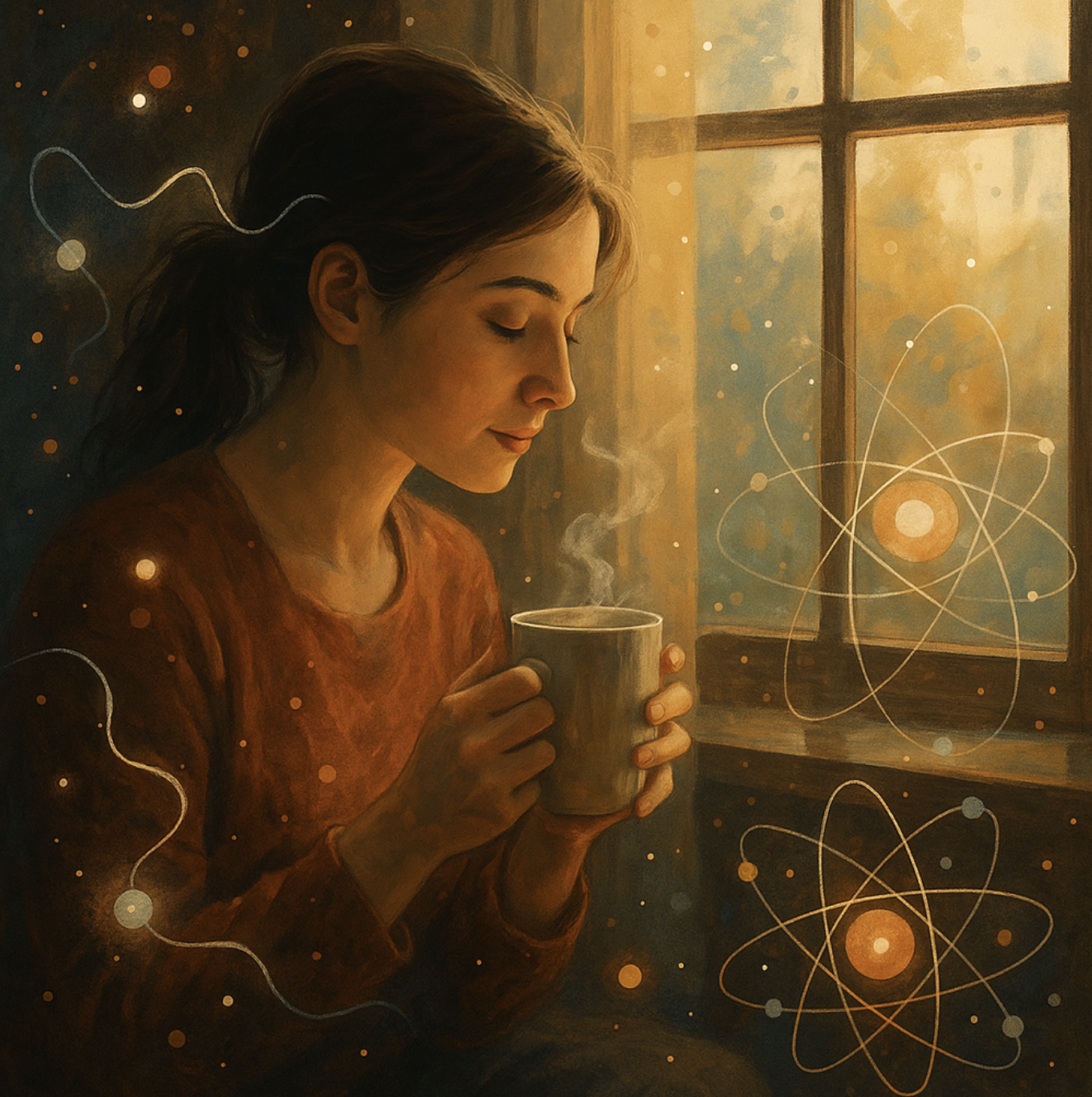
Quantum Entanglement
There’s a strange ache that comes from missing someone. Not the dramatic kind of yearning that movies always show, just that small, persistent tug when you think of them randomly, or they text right as you’re reaching for your phone.
Two particles born together or once touching can remain connected even across galaxies. What happens to one shapes the other instantly, faster than the speed of light, which isn’t supposed to be possible.
Einstein called it spooky action at a distance, scientists call it entanglement.
I like to think we all know what it feels like that moment when someone far away thinks of you the same second your stomach drops, or when you know someone is going through something heavy without needing to be told. Ever know when a car is about to merge into your lane and hit you before they do it?
Is that quantum entanglement…eh probably not in the literal sense, but the universe is clearly comfortable with invisible connections. We’re creatures made from its rules, don’t forget. It makes sense that we feel the pull in some way, shape, or form.
When someone touches your arm, what’s really happening?
Nothing touches anything, I mean, not really. Electrons repel electrons, so your skin never actually meets another surface. What you feel as “touch” is the electromagnetic force shouting into your nerves. It’s more like quantum fields speaking in sensation.
A hug, then, is when two sets of electrons refusing to overlap, are held in place by invisible forces that translate into warmth. Touch is an illusion that becomes a feeling, that becomes comfort that reminds us of safety.
Sunlight Is Quantum Light
When sunlight hits your face on a cold morning, that warmth is carried by photons that were created through quantum fusion inside the Sun. Those photons, those little packets of light, travel as both waves and particles, they literally don’t choose what they are until they reach you. Until you enter the equation. If you’ve ever felt like you’ve never made a difference in this life you can shed at belief right now, your being here literally changes the world.
The warmth you feel on your face is a cosmic identity crisis being resolved on your skin. Also, the sunlight warming you today could’ve begun its journey inside the Sun thousands of years ago before finally escaping into the vacuum, crossing 93 million miles, and landing on your cheek.
Some scientists argue that microtubules (tiny structures inside neurons) use quantum coherence to store or process moments. Like tiny instruments holding vibrations. It’s still debated, but it feels right in a poetic-sleep-deprived- way. Your memories could be built from the same strangeness that once governed the first atoms in the early universe. Déjà vu, that eerie flicker of “I’ve lived this before”, quantum noise in the brain could be to blame. A misfired signal, a fraction-of-a-second glitch, a flash where your brain processes the same input twice, so fast it feels simultaneous.
The universe is stranger than we could even imagine, yet it chose to bloom into someone like you.