Russia’s Brain-Implanted Pigeons and the Uneasy Future of Living Machines
As if Thanksgiving isn’t weird enough (I normally work, so a 10+ hour day is normal for me), I stumbled on a post on my break saying that people are putting chips in pigeon brains now. Of course, I’m a sucker for click-bait, so I clicked, then I went down the research spiral.
Turns out, recently, Russian neurotechnology firm Neiry conducted flight tests in Moscow using pigeons implanted with electrodes in targeted regions of their brains, paired with backpack-mounted GPS controllers powered partly by solar energy. That sentence was convoluted to write for some reason. According to reporting from Forbes Russia and statements from the company, these birds successfully completed pre-programmed flight paths, through electrically guided navigation.
I’m not talking about drones designed to resemble birds or biomimetic robots, but birds themselves, wired into a system that blurs the boundary between organism and device.
The company even has a term for them: biodrones.
Umm…How?
Okay, so super odd, but the interwebs was able to help me out a bit with this aspect of it, apparently electrodes stimulate neural regions associated with movement and orientation. A GPS-linked controller sends electrical signals to steer the bird, then the pigeon, experiencing the impulses as directional urges, follows the programmed route.
There’s no behavioral conditioning, and no training period, the general impulse does the steering.
Neiry says surgeons use precision methods to keep the survival rate near 100%. The company claims it has now moved beyond early experimentation and is preparing for “industrial deployment,” citing similar brain-stimulation animal research conducted in China, South Korea, the United States, and India over the past decade.
Although most published studies involve rats, not birds, Russia seems confident this is going to work.
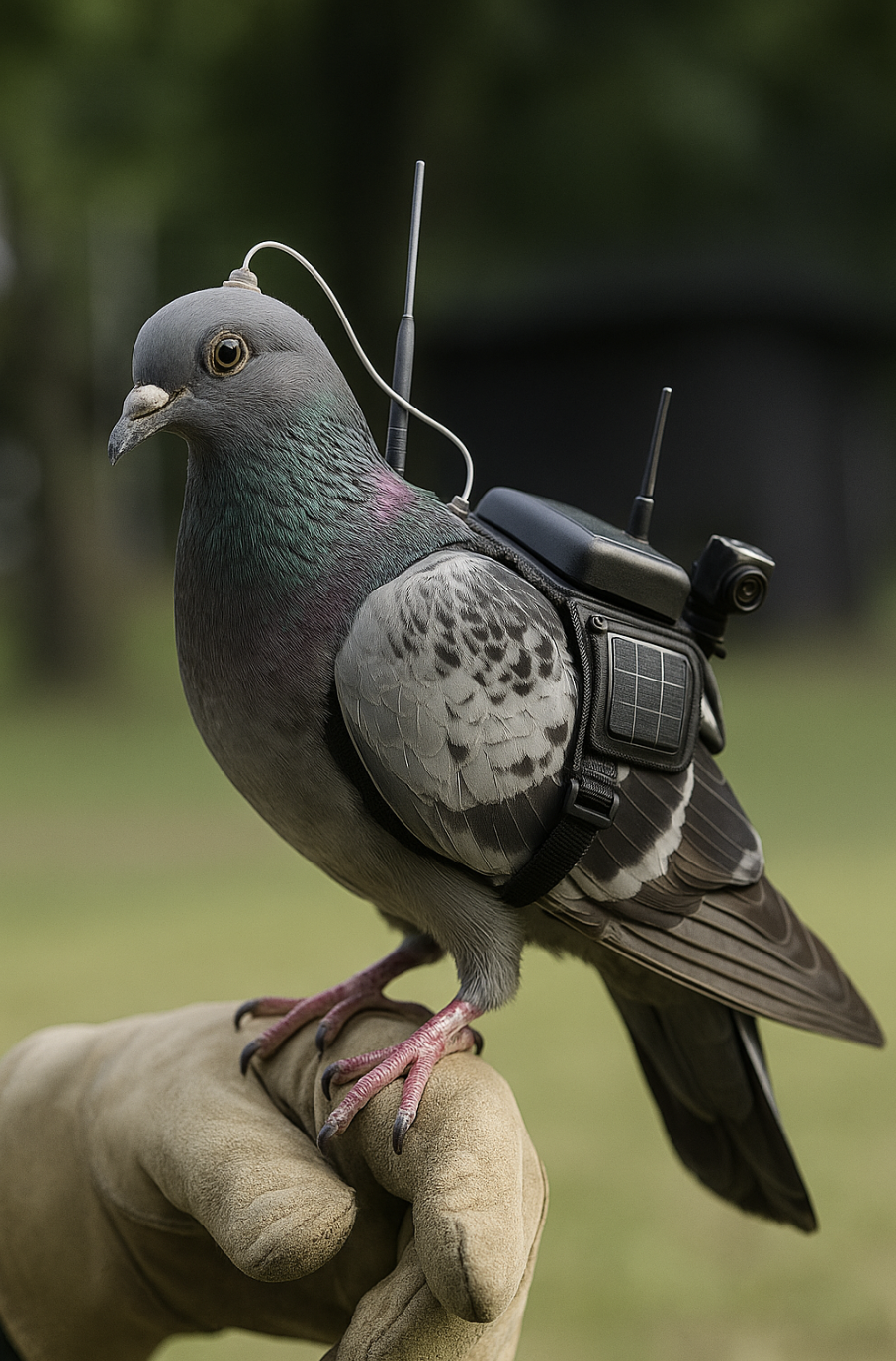
Some pigeons reportedly carried cameras with AI-based privacy filters that blur faces and remove personal details during transmission. The company says these living drones could monitor infrastructure, power lines, remote regions, and industrial sites at far lower costs than traditional UAVs. Range and endurance are much higher because the bird does the flying, not a battery.
But the technological details aren’t what catch in the throat like a bite of tomato that hits wrong.
It’s really the moral gravity of the idea for me. Do I truly believe those who buy these biodrones are going to use filters to protect peoples’ identities? Not in a million years, no. In a world where someone just created a perfect little spy, then comes out to say “oh no, we’d never use this for spying,” I’m skeptical to say the least.
Also, can we pause for a moment to wonder what does it mean to turn a creature, one that has navigated the world on instinct and the magnetic whispers of Earth itself, into a remote extension of human intention? Birds that once navigated by starlight being guided instead by electrical pulses delivered through metal threads right to their brains.
Long before steel skylines and satellite maps, pigeons ferried our secrets across deserts and oceans, following invisible lines only they could see. They were the first reliable messengers of civilization before USPS came around (I don’t know who’s better, USPS just lost my package with 100 stamps that cost me an arm and a leg) they were our feathered couriers who carried love letters, battle orders, and our fragile hopes tucked into tiny scrolls. For thousands of years, humans shaped their destiny, and they actually shaped ours in return.
When wires and radios arrived, these loyal and fully domesticated birds were set aside like old tools. Entire messenger lofts were emptied, their occupants released into cities that resembled the cliffs they once clung to. They never became truly wild, and really, how could they? They were creatures sculpted by human hands, bred for trust, for closeness, and for coming home. And so they stayed, lingering on ledges and power lines, surviving on crumbs and kindness of strangers, still looking to us the way an abandoned dog waits by a locked door. Nothing made me more sad than reading about the history of pigeons on Facebook once. I literally never looked at them the same after I realized they were all abandoned pets.
Today, when people call them pests, we rarely think about what they once actually were: veterans of wars, companions of emperors, and the original navigators of the sky. City pigeons are the living relics of a time when our worlds were intertwined. They’re not invaders of our cities, they’re exiles.
There’s a quiet eeriness to this plan to turn them back into domesticated friends, but this time with electrical signals, they’re life reconfigured as infrastructure.
Neiry says it plans to adapt the system for other species like ravens, seagulls, and albatrosses, birds with higher payload capacity or better long-distance endurance. If successful, this would push the technology from city-level applications to coastlines, oceans, borders, and beyond.
It also arrives at a time when the region’s use of autonomous systems is accelerating.

The Oldest Messenger Meets the Newest Machine
For thousands of years, pigeons carried news between kingdoms, brought messages of war and peace, and found home from hundreds of miles away. They remember faces and hold grudges. They’ve always served us…but they’ve also always been birds.
This is something different.
A drone is a device, while a pigeon is a beating heart, a soft breastbone, and a living pulse, and electrodes don’t change that.
No major peer-reviewed publications on Neiry’s pigeon system exist yet, only media reports and company statements. That means the technology could be either a genuine (if ethically complex) neuro-engineering breakthrough, or an early-stage prototype being publicized ahead of real validation.
Either way, it shows the direction of research that’s real, ongoing, and echoed in other nations’ neural-control experiments. Really though, we’ve as a people, been working on neural-control for way longer than I could even guestimate.
Whether this tech scales or dissolves into the fog of incomplete projects, it leaves behind questions we’ll eventually need to answer: how far are we willing to go to merge biology with machinery?
Until then, the future moves with the beating of quiet wings, and we’re left wondering whether we’re guiding it, or simply following impulses of our own.
Other Reads You Might Enjoy:
Mice With a Human Language Gene? Scientists Just Made Rodents Talk (Sort Of)
Scientists Just Grew a ‘Mini Brain’ With a Light-Sensitive Eyeball
Living Batteries: How Bio-Energy is Powering the Next Generation
Real-Life Zombies: The Parasites Turning Insects Into Mindless Puppets
Doctors Just Treated a Genetic Disease in the Womb—Here’s What That Means for the Future of Medicine
Your Brain Is Lying to You: Everyday Ways Your Mind Betrays You (And How to Outsmart It)