The Secret Life of Snowflakes
This morning I was dropping my husband, Zakary Edington, off at work and it started snowing. Now, he’s from Minnesota so snow is nothing to him, but as a girl who grew up in Jersey, I love snow. It’s soft and sweet and makes everything seem more calm and quiet, which is nice for my hyperactive nervous system and PTSD. So, today I decided to write about the snow that lit up my morning.
Even the loudest cities like Philadelphia seem to hold their breath under those first peacefully drifting crystals. Snowflakes are magic, just not the kind we were told in childhood books.
They’re not delicate paper doilies drifting from the sky or even perfect mirror-image hexagons, and they’re definitely not as innocent as they look. The truth is far more beautiful.
This is the quiet, crystalline world inside a snowflake, how it forms, what myths we’ve gotten wrong, and why each one is a tiny biography of winter itself.
A Snowflake Begins With Something Dirty
In school I remember vividly being taught that snow is the purest of all waters, tiny little frozen angels falling from the clouds.
But the truth is that every snowflake starts with a speck of imperfection, the total opposite of that.
It could be a grain of dust, a piece of ash from a wildfire, maybe a bit of pollen, salt from the sea, or even a microscopic fragment of cosmic debris that drifted here from space. You get the idea.
That’s what gives a snowflake a place to starts and a nucleus for water vapor to cling to. Perfection hangs on imperfection, and beauty needs something flawed to shape itself around. As the tiny particle drifts through a cloud, water vapor notices it, gathers around it, and cools against it. Molecular cues turn into architecture as the droplet freezes, expands, and branches outward like my tiny little dog finally stretching her limbs after a long nap.
What we see later as a tiny crystal on a mitten or eyelash actually began as a speck of dust just trying its best.
“No Two Snowflakes Are Alike”
This lie is literally everywhere. It’s printed on mugs, cards, sweaters, and half the winter decorations in America.
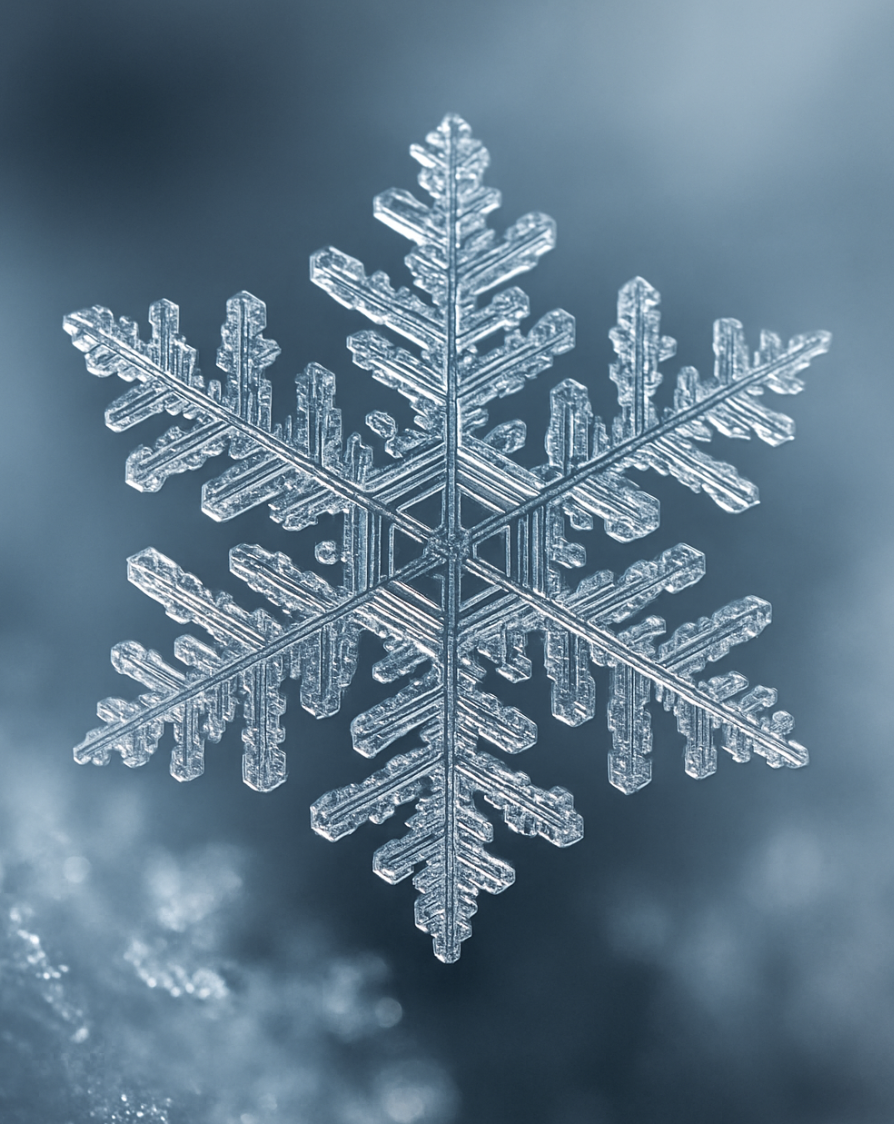
The complex, branching snowflakes we imagine, like the ones with six needle-thin arms and fractal cloning patterns, really are functionally unique. That’s because they experience wildly different micro-climates on the way down. A fraction of a second in warmer air means they grow a branch, or a brush against slightly drier air and suddenly a needle forms.
It’s like each snowflake is on its own heroic journey, and the atmosphere embodies all the challenges and character-building bullshit the universe likes to throw at us all. I know that sounds like I’m agreeing with that long-told-saying, but simple snowflakes absolutely can be identical. They’re made up of columns, slabs, tiny prisms, needles, and they form quickly, with little branching, and are well-known to be repeatable.
So yes and no, I guess. Those beautiful fractal flakes are unique just like every hero is, but those forgettable “rice grain” flakes are total duplicates. The myth stays alive because the real point was never about physics, it was about our desperate yearning to believe uniqueness is built into the universe.
Snowflakes also always have six sides. This is the rule that actually is absolute, and every snowflake has six sides. It has to do with the way water molecules bond. A water molecule looks like a tiny Mickey Mouse head, two little hydrogen ears angled away from their big oxygen head. They connect to each other through hydrogen bonds, forming hexagons when frozen. It’s just geometry written into the chemistry of life. Both subjects I hated in high school but found a fun passion for later in life. Go figure.
When the flake grows, those hexagons copy themselves outward, repeating themselves more than me when I find a good story to tell at work. The shape of the snowflake is just the shape water has always wanted to become, if we let it freeze slowly enough to think and plan ahead.
Even how fragile it is is a clue, the atoms are arranged in a pattern that is strong in one direction and delicate in another.
Did you ever think about the fact that snow is white and wonder why? I did as those big fat fluffy flakes hit my windshield this morning. (Yes, I ask a lot of questions in my head). Snow is made of perfectly clear ice, but what makes it look white is light scattering. Every tiny surface of a snowflake reflects and refracts the incoming sunlight. With billions of crystals stacked together, light bounces so many times that all wavelengths mix into a brilliant, blinding white. The Google machine estimates that around 90% of the light is actually reflected back at you, which is why it hurts your eyes to stare at snow for too long.
Snow isn’t really white, snow is every color at once, snow is just a prism.
If you scooped up one snowflake alone, you’d see right through it, a tiny window into winter.
Snow sometimes looks a little blue in deep piles too because snow absorbs red light more easily than blue. When light has to pass through a thick enough layer, the red wavelengths disappear, leaving blue behind, the same physics that makes glaciers sapphire.
How a Snowflake Actually Forms
The atmosphere is messy, chaotic, and unforgiving, so the formation looks something like this:
Water vapor freezes onto the dust particle, a hexagon appears, the seed of a snowflake. Then, the flake begins to grow outward as arms appear like reaching fingers. A brief dip in humidity often makes one side slow down, while a burst of colder air makes another side race ahead.
Because molecules attach faster to sharp points, the slower arms catch up, nature is always trying to pull it back toward symmetry. A stunning beauty and truth that also makes me love symmetry. The flake drifts, spins, melts slightly, refreezes, grows plates or needles or hollow columns depending on the temperature.
The moment it touches your glove or tongue, it dies as the warmth collapses the architecture instantly. A snowflake dies the moment you meet it, which makes each glimpse feel like a borrowed moment of perfection.
There's also something almost eerie about the silence that follows a snowfall. Snow is full of air pockets, it’s actually about 90% air, 10% ice, and those pockets absorb sound, especially higher frequencies. It’s nature’s noise-cancelling headphones.
But emotionally that silence sometimes feels like a reset button, like the world is giving itself permission to pause and just breathe for a moment. It’s why snowy days make us want to curl up by the fireplace with some tea and a fuzzy blanket and a good book. Literally as I write this now I’m fighting the urge to read instead of write.
Snowflakes come in over 35 shapes in case you were wondering. I like to think about snowflakes like delicate lace, but most snowflakes aren't pretty at all. I take that back, beauty is in the eye of the beholder afterall. Winter is an artist, yes, but also a bit of a chaos gremlin.
Pollution
This part is less magical and more unsettling, sorry about that in advance.
Because snowflakes begin on particles, they capture the microscopic history of the air they fell through.
Everything in the sky becomes part of the snow, like soot from factories, particles from wildfires, microplastics, salt, pesticides, vehicle exhaust, and even bacteria and spores.
When scientists melt down snow samples, they find the fingerprints of our entire modern world trapped inside. That’s the dark truth behind “pure” white snow, it’s reflecting back our atmosphere if we look closely enough.
Kids figured this out long before scientists did, but some snow is perfect for snowballs: sticky, heavy, and cohesive. Other snow is powdery and useless, more like flour than ice.
The difference is all about temperature.
Snow around 32°F (0°C) is perfect because a thin film of liquid water forms on the crystals, helping them stick together. Snow around 20°F (-6°C) becomes dry and powdery. Around 0°F (-18°C) it becomes sharp and squeaky, the kind of snow that crunches like brittle bones under boots.
Snowflakes fall slowly, only about 1 to 6 feet per second, dancing around more than dropping. Each one takes a different path down, negotiating gusts of air like a tiny pilot.
If two snowflakes could somehow be placed in the same exact air, at the same temperature, pressure, and humidity for the same journey, they would be identical twins, but that never happens. The atmosphere is too chaotic, timing is too uneven, and life is too unpredictable. When you look at one closely, you’re really looking at time itself, frozen mid-sentence.
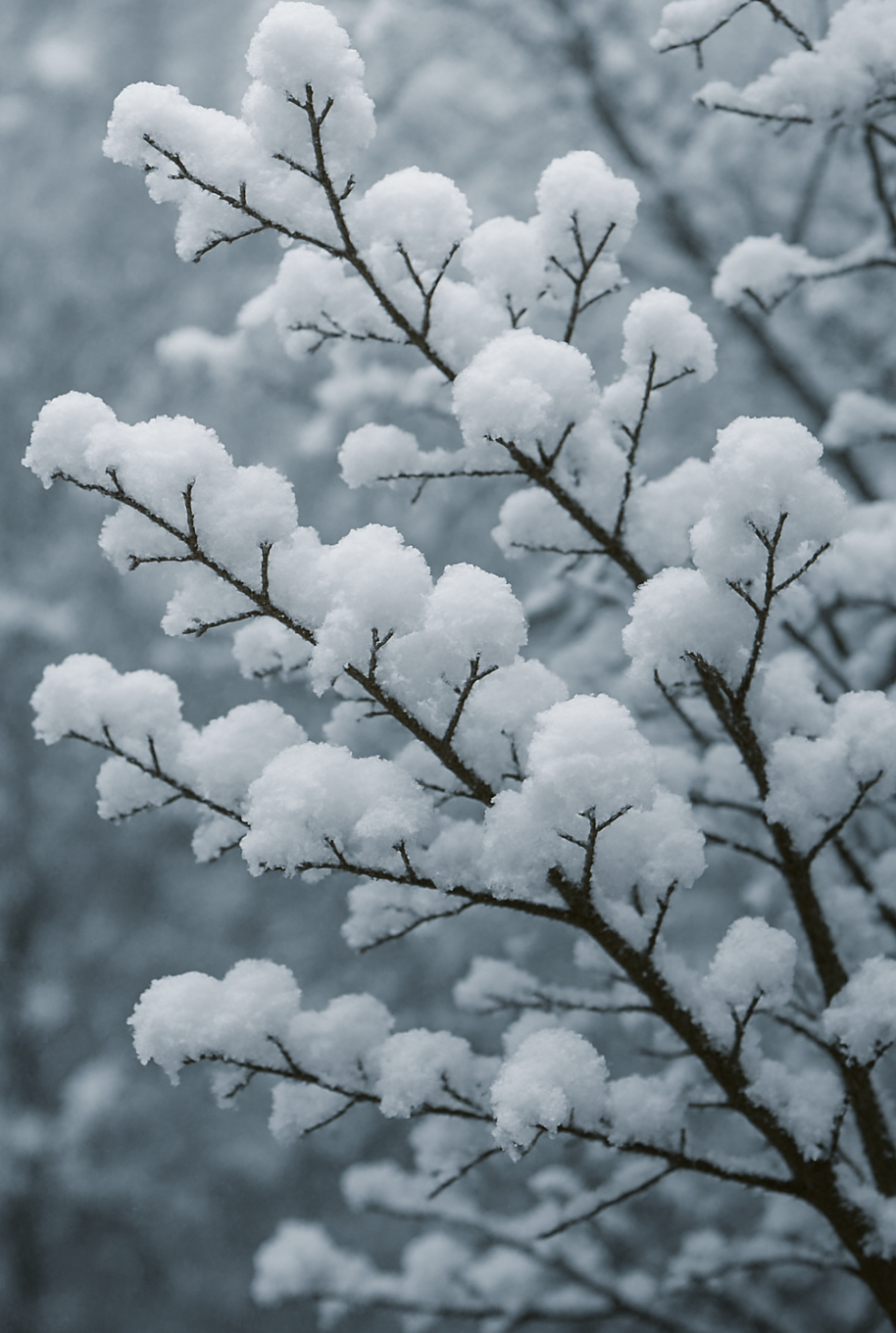
A snowflake is only a snowflake until it lands, then it melts, instantly, losing everything it built on its journey through the sky.
All that architecture, all those fractals, all that silent work simply dissolves. The fleeting beauty of something so perfect might actually make it more precious. A snowflake exists to fall and to change shape constantly, to be temporary and ephemeral for a second and then gone.
I’m still obsessed with snowflakes even as I get older because in a world that feels rushed and messy and unpredictable, a snowflake is a moment of order, a tiny geometry of peace. Winter strips everything down until we’re left with what really matters.
I do’t think I will ever stop being the kid who pressed my nose to windows and whispered, “it’s snowing.”
Snowflakes are the closest thing we have to falling stars we can touch.
Other Reads You Might Enjoy:
The Sun Isn’t Yellow: A Mind-Bending Dive into Light, Space, and the Lies Our Atmosphere Tells
How Do Auroras Form? A Dance of Solar Fire and Magnetic Veils
We Are Vessels of Light: How Sunlight Moves Through Us and Mends Our Vision
How the Brain Reacts to Light Pollution: What Happens When We Forget the Night
The Science of Awe: What Happens When Wonder Floods the Brain