There is something wonderfully unreasonable about the idea that sunlight can push things. It arrives through a window, stretches across the floor, and makes the dust suddenly look like it has somewhere important to be. Most of us think about what light lets us see, or how good a sunny patch feels after a string of gray days. A shove seems like a lot to ask of something that cannot even hold a door open.
Yet light carries momentum. When it is absorbed or reflected, it can transfer that momentum to matter, producing a force. Spread that force over an area and you have radiation pressure. The effect is small enough to disappear beneath the ordinary commotion of life, but precise instruments can measure it, and spacecraft engineers can put it to work.
That is the real surprise behind the gentle weight of light. The title is a little poetic; weight and radiation pressure are different ideas. A photon has no rest mass, and a sunbeam does not weigh down your hand the way a stone does. Still, the light reaching your hand is participating in a physical exchange. I think that is definately strange enough to deserve a closer look.
How something massless carries momentum
We usually learn momentum through moving objects: a rolling ball, a bicycle, a shopping cart with one wheel committed to its own personal journey. In those familiar examples, mass and motion go together. It becomes tempting to assume that having no rest mass means having no momentum either.
Photons follow a different relationship. In a vacuum, a photon's momentum equals its energy divided by the speed of light. More energy per photon means more momentum per photon. The absence of rest mass does not erase either quantity, and we do not need to imagine a tiny hidden weight tucked inside the light to make the physics work.
When a surface absorbs incoming light, it receives momentum in the beam's direction. Reflection changes the situation because the light leaves traveling another way. For an ideal mirror sending the beam straight back, the change in the light's momentum is twice as large as it would be for absorption. The mirror receives a correspondingly larger push.
Real surfaces complicate that tidy picture. Some light may pass through, some may be absorbed, and some may scatter in different directions. The angle of arrival matters too. Those details determine the net force, which is why a shiny object in a photograph tells us very little about how well it would perform as a carefully designed light sail.
A push with very small numbers
Here is an idealized calculation to give the idea some scale. Imagine a beam delivering 1,000 watts straight onto a perfectly absorbing target in a vacuum. Dividing that power by the speed of light gives a force of about 3.3 millionths of a newton. A perfect mirror reflecting the same beam directly backward would experience about 6.7 millionths of a newton.
For an Earthbound comparison, the first force is roughly equal to the weight of 0.34 milligrams; the second is about 0.68 milligrams. These are calculated weight equivalents using ordinary surface gravity, not claims that the beam contains that much rest mass. They also assume ideal materials and geometry. The point is the scale: considerable incoming power can produce a remarkably delicate mechanical effect.
The warmth of sunshine is much easier to notice. When light is absorbed, its energy can contribute to heating; momentum transfer supplies the tiny push. Feeling warm on your cheek does not mean you are sensing radiation pressure. The two effects can accompany the same incoming light while producing very different experiences.

A spacecraft can be patient
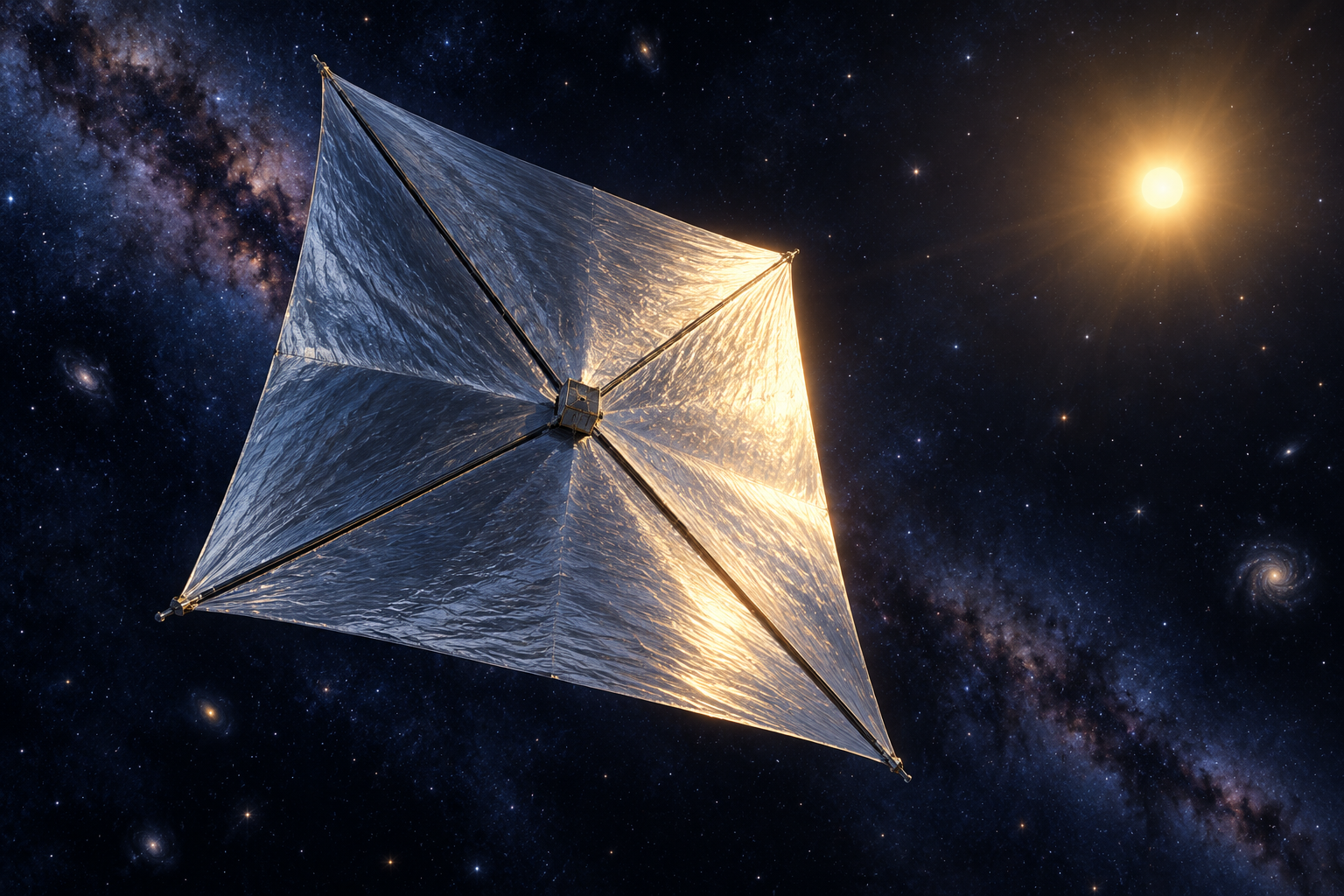
On Earth, a force this small is easily overwhelmed by air currents, friction, vibration, or the simple inconvenience of having a planet beneath your feet. A very light spacecraft presents a different opportunity. Give it a large reflective sail, expose that sail to sunlight, and a small continuing force can gradually change its motion.
That does not mean the craft takes off like a speedboat when somebody opens the sail. Acceleration depends on force and total mass, and the useful effect accumulates over time. Engineers also have to control the sail's orientation, manage its structure, and work within the available sunlight. The elegance of the idea comes with an impressive amount of practical homework.
JAXA supplied an important demonstration with IKAROS. In July 2010, the agency reported that its analysis of the spacecraft's motion confirmed acceleration from solar radiation pressure after sail deployment. JAXA gave an estimated force of about 1.12 millinewtons. That value describes force, not speed, and the achievement was showing that sunlight could provide the expected propulsion in space.
There is also the less glamorous question of how to unfold an enormous, thin structure without turning it into an expensive tangled napkin. NASA's Advanced Composite Solar Sail System reached a deployment milestone in August 2024, unfurling a sail of approximately 80 square meters. The mission's composite booms were part of the engineering being tested. Deployment and propulsion performance are separate milestones, so that announcement alone should not be read as proof of every later mission goal.
Measuring light by its push
Radiation pressure also offers a different way to measure light itself. At the National Institute of Standards and Technology, researchers have developed instruments that infer laser power from the force exerted on a mirror. Instead of relying on absorbing the beam and measuring the resulting heat, the instrument uses the mechanical effect of reflection.
The underlying logic is beautifully direct: if you know how a beam is reflected and can measure the resulting force accurately, you can work backward to its optical power. Making that measurement reliable requires careful calibration and control of other forces. This is precision metrology, which is a much more demanding activity than pointing a flashlight at the bathroom scale and becoming disappointed.
NIST's work is useful because the reflected light can continue onward rather than being consumed by the power measurement. It turns an effect that seems almost negligible in everyday life into a practical measuring tool. Sometimes the obstacle is not that a physical effect is too small to matter. It is that we have not yet arranged the experiment to hear it clearly.
The tiny things a laser can hold
Optical tweezers bring the same broad subject into another scale entirely. In suitable conditions, a tightly focused laser can trap and manipulate microscopic particles. Arthur Ashkin's pioneering work in this area was recognized with part of the 2018 Nobel Prize in Physics, and the technique opened ways to study small objects, including biological material.
A trap requires more than a beam pushing everything straight ahead. The way the light's intensity changes across the focus, together with the particle's optical properties, can produce a restoring force toward the trapping region. Other forces compete with it, and the experimental conditions determine whether a stable trap forms. A random laser pointer does not become tweezers because we have given it an ambitious job title.
I like this example because it changes the scale of the conversation. The same field of physics that helps explain a reflective spacecraft sail also helps explain tools that hold objects far too small for ordinary tweezers. The devices and force arrangements are different, but both make light's mechanical interaction with matter useful.
Comets have more than one kind of tail
A comet offers a particularly lovely place to see why the details matter. Its dust tail and ion tail respond to different influences, and combining them into one story about sunlight blowing everything backward loses some of the best physics.
Radiation pressure helps drive small dust grains away from the Sun after they leave the comet. Those grains also have their own orbital motion, so the dust tail can curve. Its appearance reflects the particles' sizes and trajectories as well as the sunlight acting on them. The result is far more interesting than a ribbon simply trailing behind the comet wherever it goes.
The ion tail involves electrically charged gas and its interaction with the solar wind and the magnetic field carried by that wind. The solar wind is a flow of particles; it is different from the photons responsible for radiation pressure. Both come from the Sun, but treating them as interchangeable would make it much harder to understand why the two tails behave differently.
Astronomer David Jewitt's explanation of comet tails is a helpful guide to that distinction. It also gives me another reason to appreciate an image slowly. A beautiful streak across the sky may contain several mechanisms at once, each leaving a different shape behind.
Blue light is more energetic, not faster
Color introduces another easy misunderstanding. In a vacuum, blue light and red light travel at the same speed. A blue photon has a higher frequency and carries more energy than a red photon. Because photon momentum depends on energy, it also carries more momentum. None of that requires it to win a race through empty space.
There is a useful wrinkle here. If two beams deliver the same total power onto the same ideal absorbing target, one blue and one red, their total momentum transfer per second is the same. The blue beam delivers fewer, more energetic photons; the red beam delivers more, less energetic ones. This follows from the power-divided-by-light-speed relationship used earlier. Comparing individual photons and comparing whole beams are different questions.
Rainbows depend on another set of optical details. Light entering and leaving water droplets bends, and some reflects inside. The bending varies with wavelength, separating colors into the familiar arc. Radiation pressure exists whenever the light transfers momentum, but it is not the explanation for the rainbow's color pattern. Refraction, internal reflection, and dispersion do that work.
Sunsets have their own explanation too. When the Sun is low, its direct light travels through a longer stretch of atmosphere. Shorter visible wavelengths are scattered out of that direct path more strongly, helping the remaining light look redder or more orange. The photons have not become tired from the trip. I appreciate that distinction, partly because tired is already doing enough work in my own vocabulary.

A leaf uses light in another way
The green world around us adds a different kind of exchange. In photosynthesis, light supplies energy that plants use in processes involving water and carbon dioxide, building energy-rich chemicals. The atoms in the resulting plant material come from matter taken up by the plant. Sunlight does not simply turn into a branch by arriving with enough determination.
That difference makes the process more compelling to me. The leaf is a place where energy capture, chemistry, and living structure meet. The light can transfer momentum as well, but that small mechanical effect does not explain the plant's growth. Understanding which part of the interaction does which job helps preserve the wonder without asking one explanation to cover everything.
It also changes how I think about an ordinary patch of greenery. The light reflected toward my eyes and the light absorbed by the leaf have different immediate outcomes. Some energy is available to the plant's chemistry, some becomes heat, and some light continues elsewhere. A scene that looks still can contain a steady traffic of exchanges.
The journey is remarkable enough
Sunlight takes roughly eight minutes and twenty seconds to cross the distance from the Sun to Earth. That familiar travel time refers to the trip through space. It should not be confused with the much more complicated transport of energy inside the Sun, or turned into a biography in which one original photon remembers every stage of the journey.
Once the light arrives, its effects depend on what it meets. A mirror redirects it, a leaf absorbs some of its wavelengths, a droplet bends and reflects it, and a solar sail receives a tiny continuing force. These are connected through electromagnetic physics, but they are distinct interactions. Warmth, color, chemistry, and pressure each deserve their own explanation.
I think that is where this subject becomes unexpectedly satisfying. We can begin with a phrase that sounds impossible, then discover something specific enough to calculate, measure, and build around. The feeling of surprise survives the explanation. In some ways it gets better, because the mystery has acquired edges we can actually explore.
The next time I notice sunlight crossing a room, I will probably still think first about the warmth and the way it changes the space. Then I will remember the momentum arriving with it: a push too small for me to feel directly, yet substantial enough for an instrument to measure or a spacecraft to use. I love that the universe can be so gentle about doing something so strange.
Related Reads You Might Enjoy
Just 20 Minutes of Sunlight a Day Stimulates Over 200 Antimicrobial Peptides
The Invisible Symphony: How the Universe Flickers Through Our Lives Without Us Knowing
The Sun Isn’t Yellow: A Mind-Bending Dive into Light, Space, and the Lies Our Atmosphere Tells
The Sunscreen You Never Knew You Had: How Your Skin’s Bacteria Might Be Saving You from the Sun
The Star That Speaks Every 44 Minutes: A Mysterious Signal from the Milky Way
Soundwaves: The Invisible Force That Can Heal, Hurt, and Reshape the World
The Light That Shouldn’t Exist: Discovering Stars in the Darkest Corners
What Happens When a Star Dies? The Science and Poetry of Stellar Death
The Science of Yawns: Why They’re Contagious, Mysterious, and More Than You Think
Sources and further reading
JAXA: confirmation of photon acceleration by IKAROS, July 2010
NASA: composite booms and solar sail deployment, August 2024
The accompanying images are AI-generated editorial illustrations. The solar sail is an artistic concept, not a mission photograph or an exact spacecraft design.