The Rise of Synthetic Eggs
I’m just going to start this article off by saying I’m anti-fake food. I really don’t have much interest in eating lab-grown chicken or beef. There’s a reason the phrase synthetic eggs makes people pause.
Eggs are one of the most ancient foods we rely on. I have a friend who has bragged when she’s in financial stress she can get away with eating eggs and veggies for weeks until she can afford more. They’re simple, familiar, and biologically complete. An egg doesn’t need an ingredient list or a nutrition fact spec or a process of making explanation. It comes wrapped in calcium and intention, laid by an animal that evolved to produce it. That’s all we need to know.
So when I hear that eggs are being “reinvented,” “engineered,” or “made without chickens,” my reaction isn’t just political or ideological. It’s instinctive.
“Synthetic Eggs”
The term synthetic egg is messy. It gets used to describe several very different things much to my horror, which is part of why confusion spreads so easily online.
In reality, there are three categories of “fake eggs”, one is plant-based egg substitutes, the second is precision-fermented egg proteins, and the third is counterfeit or adulterated “fake eggs” (these are rare, illegal, and highly dangerous).
Most of what I’m going to talk about revolves around the first two. The third one, like I said is illegal and rare, so not worth fixating on.
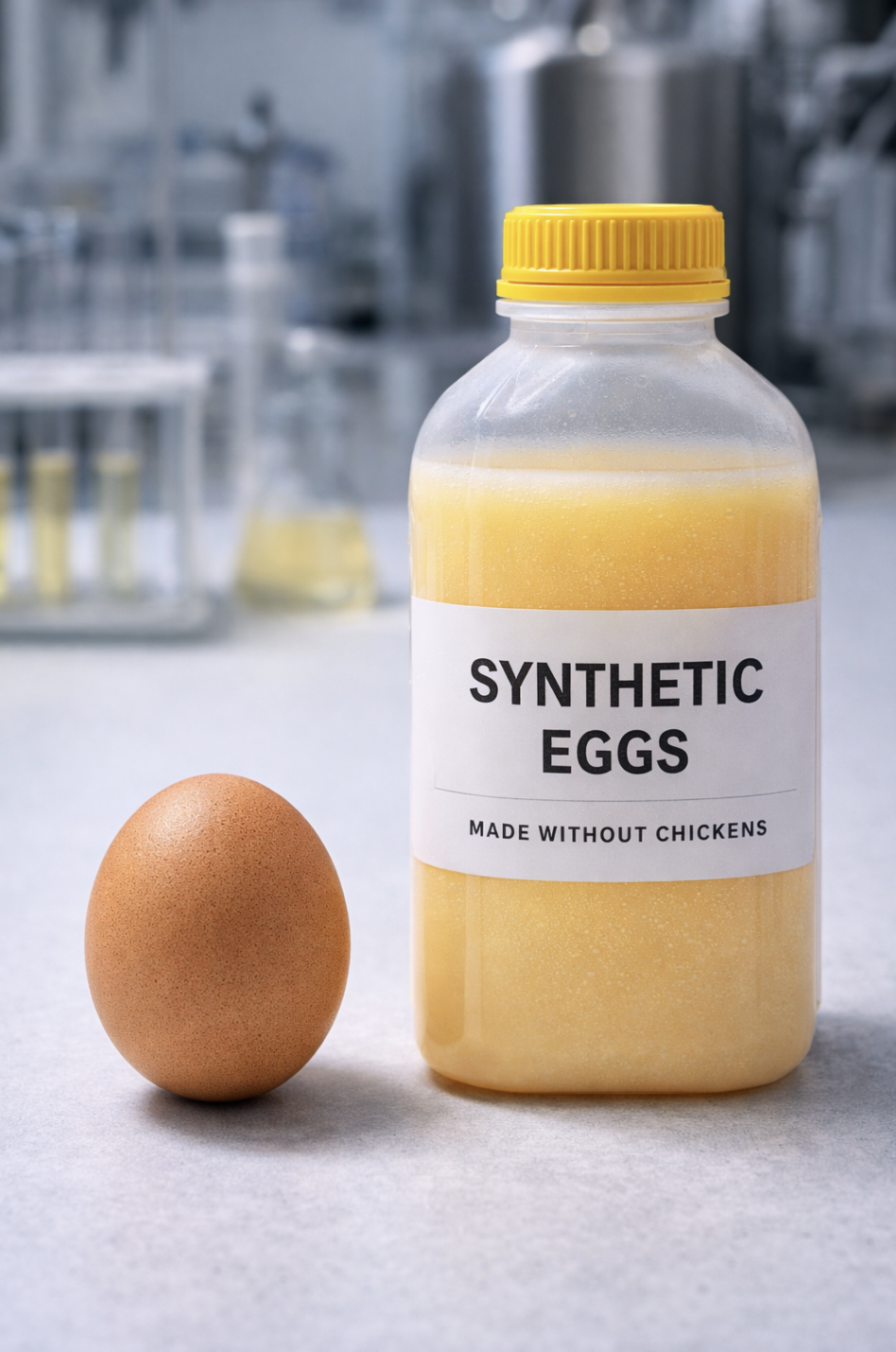
Plant-Based Egg Substitutes
These products don’t contain eggs at all, which is why they’re vegan-friendly.
Instead, they rely on plant proteins combined with oils, emulsifiers, stabilizers, and flavor compounds designed to mimic the taste, texture, and behavior of eggs when cooked. They’re often made with mung bean, soy, or pea as their protein source, some of which is actually terrible for the environment. (Read more on that here)
They’re formulated foods, assembled, not grown.
From a regulatory standpoint, these products are considered processed food, not biotechnology. From a personal standpoint, they sit somewhere between “innovative” and “ultra-processed,” depending on how closely you read the ingredient list. Doesn’t sit well with me, but whether someone chooses to eat them often comes down to personal values: animal welfare, allergies, cholesterol concerns, or environmental motivations. I’ve seen a lot online about how these eggs are better for the environment, but the truth really couldn’t be farther from that idea. The amount of land plowed for the fields to grow the plant protein alone often claims more lives than the chicken that could’ve laid the egg, but I digress.
These are not what I’m even reacting to when I hear the word synthetic, though.
Precision-Fermented Eggs
This is where the unease in my gut deepens.
Precision fermentation doesn’t replace eggs with plants, it attempts to recreate the egg proteins themselves…without the chicken. Basically, scientists identified proteins found in chicken eggs, with the most common being something called ovalbumin, which is the protein responsible for egg whites’ structure and cooking behavior.
The genetic instructions for producing that protein are inserted into microorganisms, usually yeast or fungi. Those microbes are then grown in large fermentation tanks, similar to how insulin or some enzymes we use are produced. Fed a healthy and well-balanced diet of sugar and nutrients (you can’t read the sarcasm, but it’s there), the microbes produce egg proteins.
Those proteins are harvested, purified, and blended with other ingredients to create an egg-like product. Egg-like. No chickens are involved, and no eggs are laid. What’s produced is not an imitation in the traditional sense, it’s technically the same protein, made through a completely different biological pathway.
This isn’t farming, it’s industrial biotechnology.
Supporters often frame resistance to synthetic eggs as ignorance or fear of science. Let me tell you something, I’m the least afraid of science person there is out there. I studied genetic engineering before I went to culinary school and have no problem with a ton of things that other people wince at. This framing is lazy and just not true.
Everything we are today evolved to detect risk not just through data, but through pattern recognition. That’s why so many people tell you to trust your gut even when you don’t know why you’re feeling a certain way. The pattern people are responding to here isn’t “new food,” but increasing this ridiculous distance between nourishment and nature that is growing more and more every year.
Eggs represent self-contained life potential. They’re reproductive, seasonal, and biologically contextual. Precision-fermented eggs are context-free, scalable, replicable, and utterly detached from ecosystems. That efficiency is exactly the selling point, and exactly what sets off a bunch of alarms of discomfort in my head.
Don’t get me wrong, I’m not afraid because I don’t understand fermentation. I’m a sommelier for goodness sake! I made my entire career about fermentation, and I eat soy sauce by the liter in my house. No, I’m uneasy because something ancient is being abstracted yet again, and our food is still getting worse and worse and less “foody” and more chemically.
The Regulatory Gray Zone
Precision-fermented egg proteins are often classified under GRAS standards: “Generally Recognized As Safe.” This designation allows companies to self-affirm safety based on existing scientific consensus, instead of undergoing any long-term independent feeding trials.
Now, while that doesn’t mean these products are automatically dangerous, it does mean they’re entering the food system faster than our cultural or biological understanding of them does. Eggs have been eaten for thousands of years by us and a ton of other animals, while precision-fermented egg proteins have been eaten for less than a decade.
That asymmetry matters.
Texas has already moved to restrict lab-grown meat, and several states are grappling with how to define, label, and regulate food produced through biotechnology rather than agriculture.
People sense a shift happening faster than public conversation can keep up.
The Bigger Question Isn’t About Just Eggs
It’s more about the precedent.
If eggs can be separated from chickens, milk from cows, meat from animals, and protein from soil, then food becomes something entirely different than it has ever been in our entire long history.
Food that’s not grown, raised, or harvested, but manufactured puts a bad taste in my mouth.
What do we lose when food no longer has a living origin story?
We’ve already seen this erosion happen slowly, through the neat removal of humanity from what we eat. Chicken is no longer chicken in the way it once was and truly is. It’s no longer a bird with feathers and instincts and a pulse, it’s a sanitized cut of meat under fluorescent lights, wrapped in plastic, drained of context. There’s no reminder of the animal it once was, and no trace of a life lived before it reached a refrigerated shelf.
That distance has consequences.
When food becomes an object rather than a life, responsibility fades. The conditions under which that animal lived crowded and confined, are easy to ignore because they’re never really shown. There’s no moment of reckoning, no pause that asks us to acknowledge the cost when we burn our chicken breast and throw it out without even bothering to eat it. The system is designed to make sure we don’t feel anything at all.
This detachment didn’t begin with lab-grown food. It began the moment we stopped recognizing food as something that once breathed, moved, and existed within an ecosystem. When efficiency replaced reverence and when volume mattered more than care, the process became so abstract that morality no longer had a seat at the table.
Now, as food becomes further separated from living systems altogether and is engineered, synthesized, and optimized yet again, the question becomes harder to ignore. If we’re already this disconnected from animals we know are alive, what happens when food no longer comes from a living being at all?
At some point, nourishment stops being a relationship and becomes a transaction. Something you consume without reflection, without awareness, without a smidge of gratitude. We’ve already crossed that threshold in many ways, and synthetic food doesn’t create the problem, but it amplifies it.
We’re not just losing a food source, we’re losing the story that once reminded us where we fit in the chain of life.