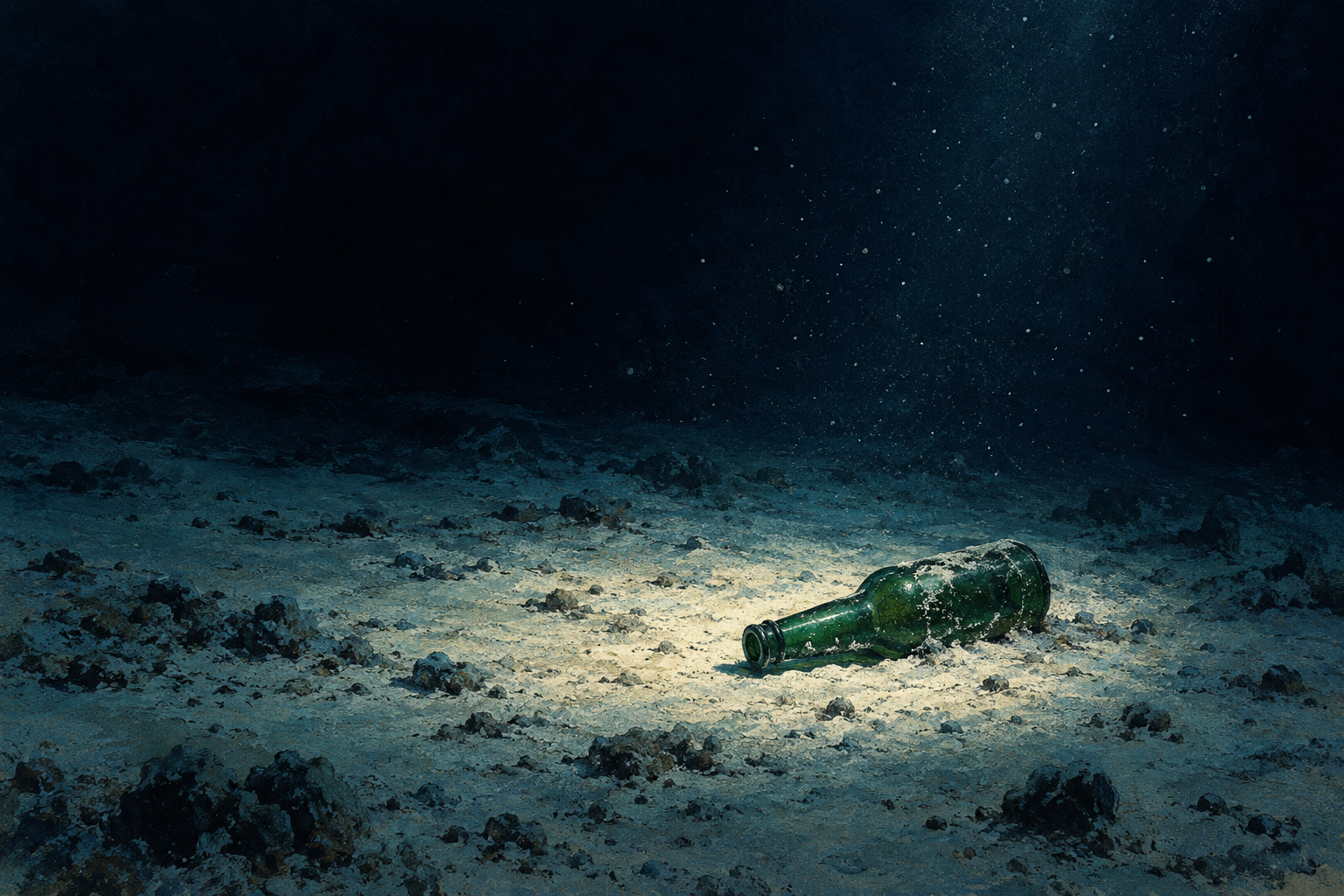
There was a beer bottle at the bottom of Challenger Deep. A perfectly recognizable green bottle in a place nearly seven miles below the ocean's surface, and I can't decide which part bothers me more: that it got there at all, or that it looks so ordinary. We send people down in a vehicle that takes an enormous amount of engineering to keep them alive, and our rubbish has somehow arrived ahead of them.
Oceanographer Dawn Wright and explorer Victor Vescovo saw it during their July 2022 dive to Challenger Deep, in the Mariana Trench. They were nearly seven miles below the surface, in a part of the world that takes an extraordinary amount of work to reach. I would've much preferred a story about some strange little animal we'd never seen before, but that familiar green bottle is difficult to stop thinking about.
I keep thinking about how quickly a bottle can stop being interesting once we're finished with it. We know what it is, we've used it, and now it needs to go somewhere else. Then one turns up in a place that's almost impossible for us to visit and suddenly I have all these questions about it. Who had it, how did it get into the water, how long has it been down there? The photograph doesn't answer those, which somehow makes the familiar shape even harder to stop looking at.
The Beer Bottle Was Actually There
Wright's expedition account includes an image of the bottle and describes seeing it immediately after reaching the bottom. She and Vescovo were in the Western Pool of Challenger Deep, in the western Pacific. Their initial touchdown was at 10,904 meters, or roughly 35,774 feet below the surface.
They'd gone down to map the seafloor with sonar, and they saw animals and rock formations too. That's the part I wish could've been the whole story. There are things living in this place, and details we still want to understand, and then there's a drink container. I don't need it to become an enormous symbol before I find it upsetting. It's already something somebody has to notice and record while trying to learn about the ocean.
The deepest known part of Challenger Deep is a little farther down, at about 10,935 meters according to NOAA. The dive's initial touchdown and the deepest measured location aren't exactly the same spot, but either figure puts us close to eleven kilometers underwater. These are distances that are very easy to read and considerably harder to get my brain around.
Mount Everest is about 8.8 kilometers tall. Put that into Challenger Deep and the summit would still be underwater, which is a rather upsetting way to realize how much ocean there is. We can spend an awful lot of time thinking about the highest mountain on Earth without thinking nearly as much about the space below the surface.
I definately find the bottle easier to understand than the depth. I know how big a bottle is. I can think about picking it up, or putting it beside something, without having to stop and work out the scale. Then you put all that water above it, enough to cover Everest, and I lose the ability to make the surroundings feel like a real place. That's part of why the object gets to me. It's familiar enough to make the distance less abstract for a second.
How Did the Glass Stay Intact?
My next question was about the pressure. At that depth, NOAA's rough rule of one additional atmosphere for every ten meters gives us pressure around a thousand times greater than at the surface. An ordinary glass bottle doesn't sound like something that ought to do particularly well down there.
The useful detail is what happens inside it. An open bottle can fill with water, allowing the pressure inside to approach the pressure outside. That's very different from a crewed submersible, which has to maintain an air-filled space where people can breathe while an enormous amount of water presses against it.
So an intact bottle doesn't mean the pressure is mild or that we've overlooked a wonderfully cheap material for passenger submarines. It means we need to think about the pressure difference across the container, rather than only the depth. The ocean is still doing exactly what we'd expect it to do.
We Know Where It Ended Up, but Not How It Got There
The bottle doesn't come with the story of how it got there. We don't know who bought it, where it entered the water, how long it traveled, or how long it had been sitting on the bottom. I want to know all of those things, but a photograph of the end of the trip only gives us so much. We do know that rubbish has plenty of routes into the ocean, and some start much closer to home than a boat above the Mariana Trench.
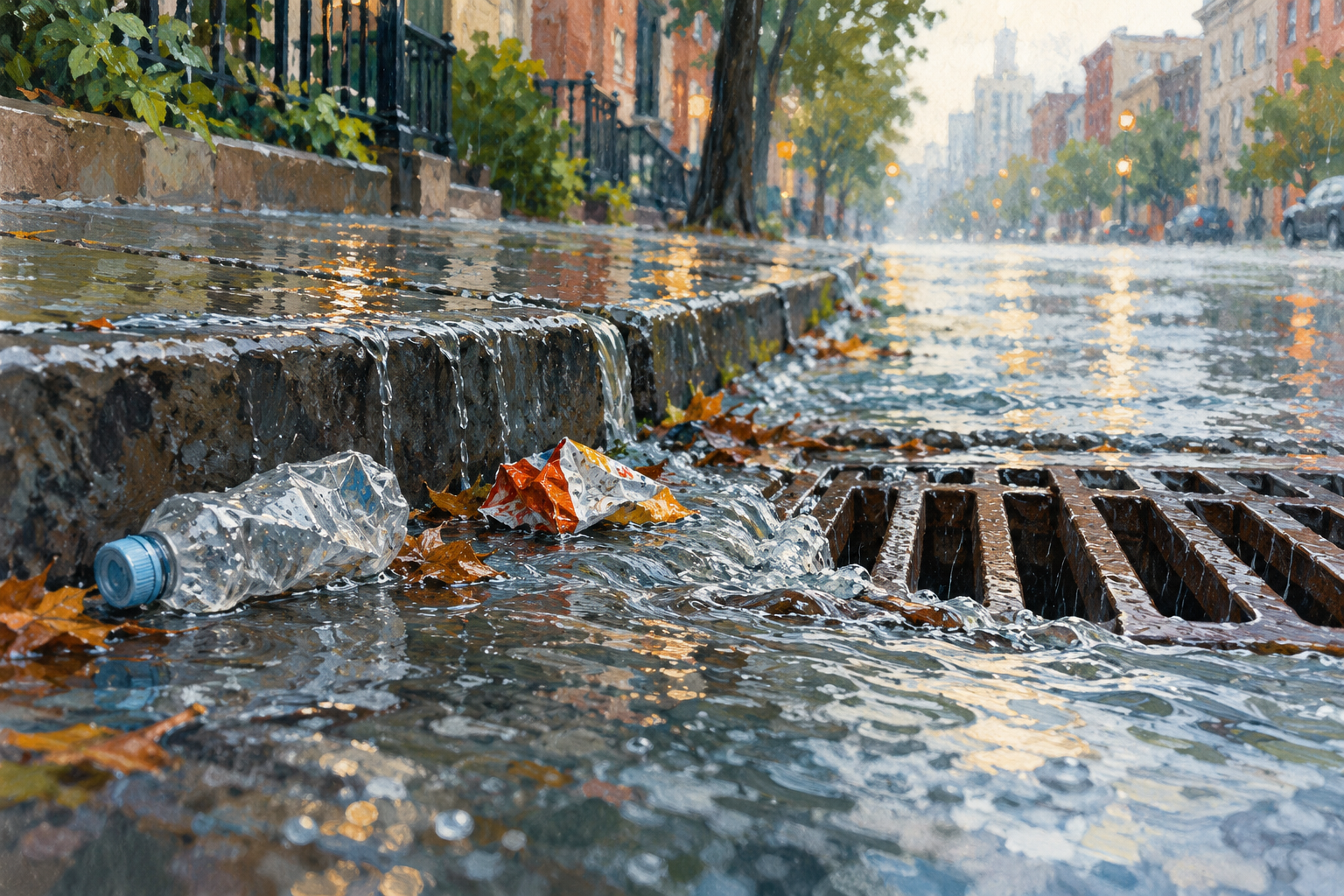
What we do know is that rubbish has several ways of reaching the ocean. NOAA describes debris being moved by wind and rain, carried through rivers and storm drains, or lost during activities at sea. Poor waste management and major storms can add to the problem, so deliberate littering isn't the only route.
That makes a wrapper beside a city curb feel less separate from the ocean than it might look at first. Water can carry things away from the place where we last noticed them. That particular wrapper might never go anywhere near the Mariana Trench, of course, but we don't have to live beside the sea to contribute to what eventually enters it.
The Bottle Has Some Very Unfortunate Neighbors
A plastic bag has also been recorded at 10,898 meters in the Mariana Trench. JAMSTEC, Japan's marine science agency, maintains a public database of debris seen in deep-sea survey imagery. Something made for an ordinary errand can end up in a place most of us couldn't reach even if we desperately wanted to.
And the problem shows up in other deep-water surveys too. A study highlighted by NOAA reviewed 188 dives in the central and western Pacific and found debris during 17.5 percent of them. The objects included glass, metal, plastic, cloth and fishing gear, with some fishing line entangled around deep-sea corals.
Then I get stuck on the corals. We call somewhere remote because it's a long way from us, but things live there. This is their entire place, and a piece of fishing line doesn't become less of a problem for them because most of us will never go down and see it. I know that's obvious when you say it out loud. It's still a detail I think we lose when a deep-ocean photograph makes the place look so distant from ordinary life.
The glass bottle and a plastic bag behave differently, so they shouldn't be treated as if they have identical effects. But they do both challenge the comforting idea that things disappear after we throw them away. Sometimes they remain recognizable, and sometimes they become much harder for us to see.
NOAA explains that marine debris doesn't come with one dependable expiry date. The material matters, along with conditions such as sunlight, temperature and the organisms around it. Some plastics keep breaking into smaller fragments without fully going away, eventually becoming microplastics, which are particles smaller than five millimeters.
That's a frustrating distinction, because a beach can look cleaner after the big recognizable pieces have disappeared while smaller pieces remain. Breaking a container into bits doesn't automatically resolve what happened to the material. It's simply harder to point to the original object and say where it went.
We Don't Need a Time-Travel Disaster to Make This Matter
I can see why the butterfly effect turns up in conversations about small actions. We've all seen the time-travel version where somebody changes one little thing and everything goes wrong later. I find that idea entertaining in a film and much less useful when I'm already overthinking a perfectly ordinary decision. The science behind the phrase has a particular meaning, and it doesn't ask us to predict an entire future every time we do something.
The scientific idea, associated with Edward Lorenz's work on weather, concerns how small differences in starting conditions can lead to very different outcomes in chaotic systems. It helps explain why some things become difficult to predict. It doesn't prove that every small decision we make will have a huge consequence we could somehow trace back to one moment.
The bottle already gives us a consequence we can see. It entered the ocean and ended up on the seafloor, where a research expedition encountered it. We don't need to invent a whole future catastrophe to recognize that keeping it out of the water would've been a better result.
This Was Also Why I Thought About Zak
When I first wrote about the bottle, my husband, Zak, was training to become a professional wrestler. Watching him continue through exhaustion and doubt gave me a much more familiar example of effort that can be easy to overlook. One day of training couldn't contain the whole thing he was trying to achieve, but that day still required him to do the work.
I was proud of him while he was doing it. There wasn't some future result I needed to wait for before the effort became worth noticing, and most of it wasn't happening in front of an audience. Sometimes the part you see is somebody getting tired and trying again, which doesn't necessarily make an exciting photograph but can mean a great deal to the people around them.
I know that feels like a detour from a bottle on the seafloor, but it's where my mind went. Watching somebody do something difficult reminds me how much effort can happen before there's a result to point at. I was proud of Zak while he was trying. I didn't need to wait for the story to have an impressive ending before that became worth saying, and I'd like to remember that with the other people I care about too.
For the rubbish, there are practical things we can do right here. Secure loose waste, follow the local recycling rules, reuse the containers already in the cupboard and join a neighborhood or shoreline cleanup when you can. NOAA emphasizes prevention as well as removal, because collecting debris afterward can't keep pace with everything entering the water.
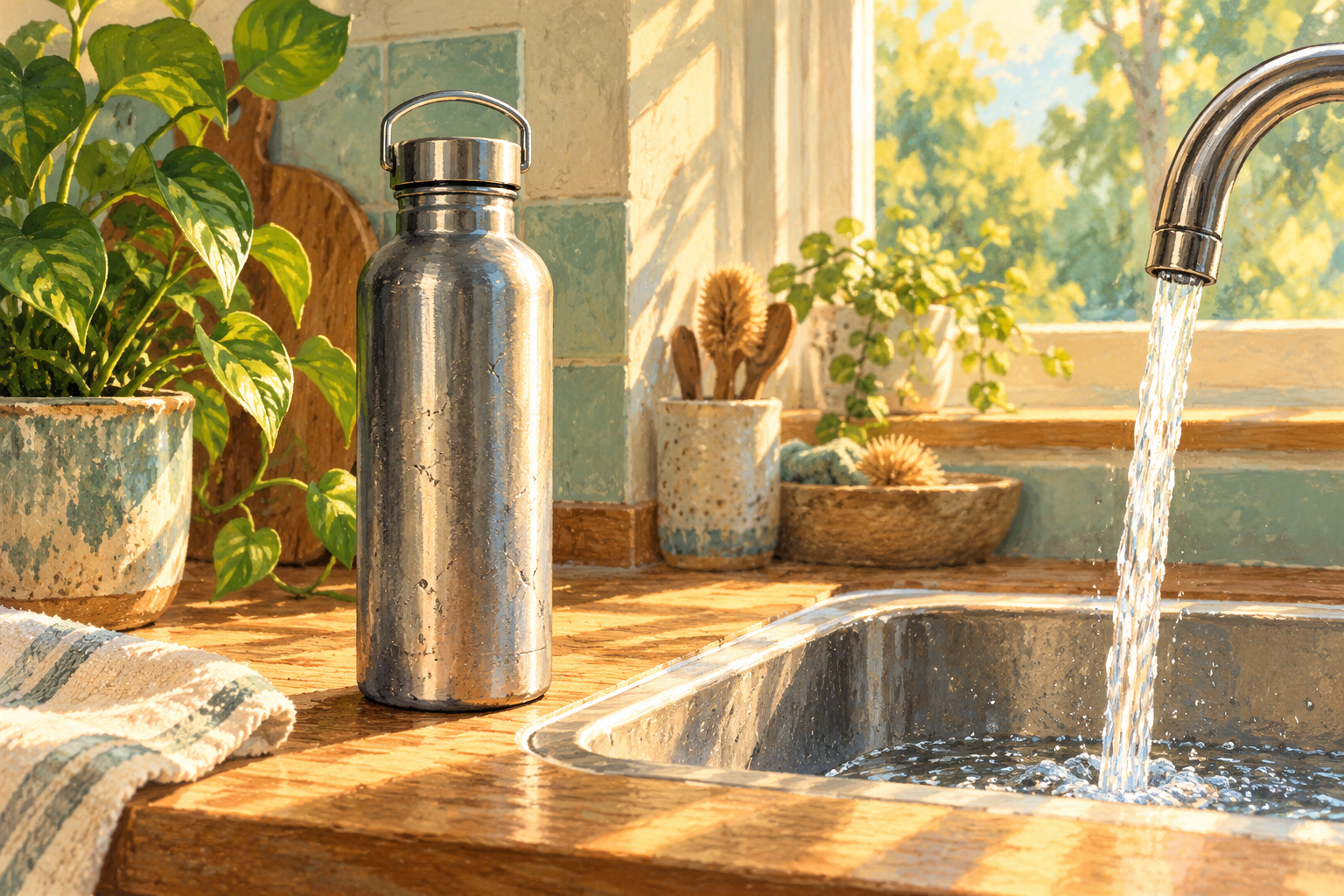
A reusable stainless steel water bottle is one option if you need a bottle. If you already have one you like, keep using it; the point is to replace repeated disposable purchases. We don't need to celebrate using less stuff by immediately acquiring an entire new cupboard of stuff.
Businesses and governments have work to do too, from packaging choices to waste collection and keeping rubbish out of waterways. Carrying a refillable bottle won't build a city's infrastructure. Our everyday choices can be useful while we also expect the larger systems to work properly, because both affect what reaches the water.
I suppose this is how I ended up thinking about encouragement in the middle of an ocean-rubbish story. Both make me stop at something small that I might otherwise pass over. A message can make someone's afternoon better without having to change their whole life. Keeping one container out of the water is useful without pretending it has fixed everything happening in the ocean. I can care about the larger problem and still do the thing that's in front of me.
I still want to know how that bottle got there. I probably never will, but the photograph has made it much harder to forget what can happen after something leaves our view. I'd rather the next expedition have more room in its report for the animals and the rocks and all the things we went down to learn about. There's already enough interesting stuff at the bottom of the ocean without us adding more of our own.
Sources and Further Reading
Dawn Wright and Victoria Phillips: Photos from the Challenger Deep Expedition
NOAA Ocean Exploration: Deep-sea Debris in the Western and Central Pacific