The Glow in the Mud and the Light that Refused to Die
I’ve always been drawn to the places where science and wonder refuse to stay in their lanes. I’d like to think it’s because the universe has this stubborn habit of slipping miracles into the last places you’d expect them, like cracks in the sidewalk, the bottom of the ocean, or, in this case, the open wounds of men who had every reason to believe God had already looked away.
Angel’s Glow is one of those stories that drew me in like a juicy fat mosquito on a hot summer day. Granted, if you’ve been here before you know I have an obsession with things that glow in the dark as well. My glow-in-the-dark living petunias from LightBio is proof enough of that. Anyway, this story is something of a myth, with a dash of a miracle, but it has glowing lights, so I’m all in. It’s the story of a faint blue-green light that appeared on the battlefield when everything else had gone to rot.
This tale lingered in the oral stories of Shiloh long after the cannons fell silent, and was whispered around campfires and told in letters that never quite made it into the official records. A little rebellion of light in the middle of humanity’s darkest chapter if you will, and I’m here to share it with you.
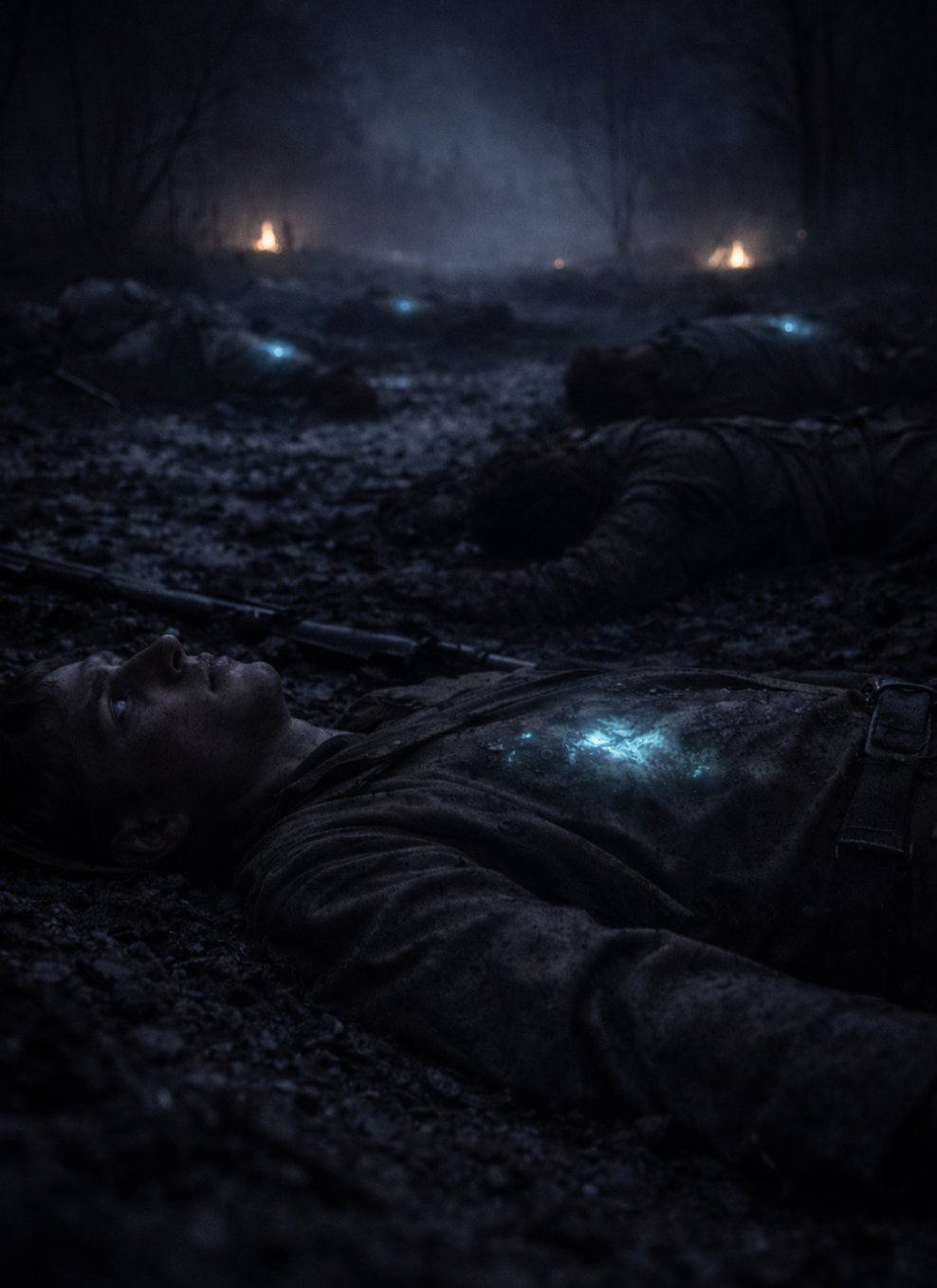
The Legend: “Angel’s Glow”
It was April 1862, two days after the Battle of Shiloh.
The fields in western Tennessee were still littered with more than 23,000 Union and Confederate casualties: dead, dying, or simply forgotten in the chaos. A brutal spring rain had turned the ground into a slick, blood-soaked mire. This is where I’m glad my imagination is all I can smell at this point. Medics and stretcher-bearers moved through the darkness like ghosts, lanterns swinging low, when some of them noticed that certain wounds were glowing.
A soft, eerie blue-green luminescence, faint as starlight caught in torn flesh was emanating around them. It’s not like the light was bright enough to read by, but in the black Tennessee night it stood out like a firefly. The soldiers who saw it gave it a name that feels fitting for the middle of a battle field: Angel’s Glow. Word spread through the field hospitals and tent cities quickly about the phenomenon when they realized those who glowed survived more often.
You read that right, the ones whose wounds lit up at night had a better chance of beating the infections that were slaughtering everyone else. It felt divine, supernatural, almost chosen, or sent from the heavens.
In a place where nothing holy remained, in a hellhole where brothers had shot brothers and the air reeked of gunpowder and death, something luminous appeared anyway. That gentle blue-green light felt like a promise that the universe hadn’t turned its back completely. I suppose the minds of a solider after battle would try to cling onto anything hopeful after witnessing the sort of thing our minds aren’t built to see.
To be unflinchingly clear about what war wounds looked like in 1862 I just want to remind you that here were no antibiotics. Penicillin wouldn’t be discovered for another seventy years at least. A Minié ball or bayonet did a great job tearing through muscle and bone, and it also dragged with it every speck of Tennessee mud, horse manure, rotting leaves, and human waste that had been churned into the battlefield. AKA the ground at Shiloh was a bacterial soup with Clostridium perfringens ready to bloom into gas gangrene, Streptococcus racing toward sepsis, and every kind of opportunistic killer waiting for a warm, oxygen-starved home inside living tissue.
Most soldiers didn’t die from the bullet itself, they died later, slowly, in absolute agony that no morphine could fully dull. Flesh turned black and foul was common enough to see out here, and limbs swelled until the skin split. Surgeons worked by lantern light with saws and scalpels, amputating by the hundreds, sometimes without even the courtesy of a swig of whiskey.
Infection was the real enemy, and it almost always won. Of the roughly 23,000 casualties at Shiloh, thousands more would succumb in the weeks that followed, those who survived the Confederate steel couldn’t keep up with the invisible war happening inside their own bodies.
So when in the middle of all that rot, some wounds started to glow…well, the contrast was almost cruelly poetic: glow versus gangrene. The light in the midst of hell was a quiet refusal by the body, or by something living inside the body, to surrender without a fight.
The Science
Decades would pass before anyone could explain what the soldiers had seen. Instead, the story was passed down in letters and stories, and shrugged off by the general population as a hallucination told by the mind in a high-stress scenario.
The thing is though, the glow came from a bacterium called Photorhabdus luminescens, which is a tiny, soil-dwelling marvel sometimes grouped with its close cousins in the Photobacterium family. These are the same little lights that live in the deepest trenches of the ocean, you know, the ones that turn midnight water into living constellations. Bioluminescence isn’t some rare party trick in nature; it’s literally everywhere the sun can’t reach: jellyfish pulsing like slow heartbeats in the sea, squid flashing warnings in the black cold abyssal plain where no photosynthesis has ever touched.
Seeing as I’m a sucker for beauty in this life, I like to think of this bacterium as the universe’s way of saying even here, even in the abyss where pressure would crush steel, I will make my own light.
Oddly enough, that same ancient light found its way into open wounds on a muddy battlefield in Tennessee.
Here’s where the story turns from legend to quiet genius though, so bear with me. Photorhabdus luminescens glows, but it’s not for show. It wages a sophisticated chemical war on its surroundings. It lives in symbiotic partnership with tiny nematode worms (Heterorhabditis in case you were interested) that hunt insect larvae in the soil. When the nematodes find a host, they burrow in and vomit up their bacterial passengers. Lovely, no? The bacteria go on to release a cocktail of toxins and antibiotics that kill the insect and, suppress or destroy any competing microbes already trying to claim the real estate.
In the soldiers’ wounds, the same thing happened by accident. Nematodes from the Shiloh mud, drawn to the blood and exposed tissue, delivered their glowing cargo in a creepy but cool way. The bacteria lit up and began producing powerful antimicrobial compounds that beat back the far more dangerous gangrene-causing bugs. It was, in effect, an accidental pharmacist wearing a bioluminescent coat.
There was one more exquisite condition that this bacterium needed though in order to work its miracle and save all of those lives. Photorhabdus luminescens is finicky about temperature (big same, so very relatable). It can’t survive at normal human body heat, but the soldiers whose wounds glowed were usually the ones left lying on the cold, wet ground overnight hypothermic and shivering, half-forgotten while the overstretched medical teams triaged those who could still walk. Their lowered body temperature gave the luminous bacteria exactly the edge they needed to outcompete the killers.
Ironically enough, the soldiers rushed to crowded, feverish field hospitals often fared worse; warmth favored the enemy.
The glow was never divine intervention in the way the soldiers imagined. I think it was better though. Nature doing what nature does when we least expect it and slipping us a lifeline into the exact conditions we thought would finish us off sounds like magic to me.
The Long Road to Discovery
The legend lingered for 139 years before science finally caught up to it. In 2001, a seventeen-year-old Civil War buff named Bill Martin visited the Shiloh battlefield with his family. He heard the old stories of glowing wounds and survival. His mother, Phyllis, happened to be a microbiologist who had spent years studying Photorhabdus luminescens as a potential biocontrol agent for insects. Bill and his friend Jonathan Curtis turned the tale into a science-fair project.
As anyone would’ve in their situation, they connected the dots: the bacterium’s bioluminescence, its antibiotic properties, the nematodes common to Tennessee soil, and the cold, damp conditions of wounded men left overnight on the battlefield.
Their work revealed a deeper truth about how the universe hides medicine in the strangest of places. What looked like an angel’s mercy was really a symbiotic partnership millions of years in the making, pressed into service by the random cruelty of war.
The Light That Refused to Die
Historians still debate whether any soldier ever wrote the words “Angel’s Glow” in a letter home, because most of the historical records are silent on the phenomenon. The tale survived anyway though, passed mouth to ear through generations because it felt true to the strange, stubborn beauty of life itself.
We keep looking for angels in the sky, but sometimes they’re smaller than we imagined, glowing faintly blue-green in the places we were sure God had abandoned. The most beautiful truths are the ones that don’t need our belief to work, they just need the right temperature, the right wound, and the stubborn refusal of the universe to let even the smallest light go out.
The same light that lives in the deepest parts of the ocean found its way into open wounds on a battlefield. For a moment, in the middle of humanity’s worst impulses surrounded by war, mud, and rot, something decided to shine anyway. Both the Union and the Confederacy saw miracles after that battle.
The conditions were right, and light, it turns out, is what certain living things do when the dark gets too loud. The universe is still hiding medicines in the mud, writing prescriptions in bioluminescence, and still reminding us that even when everything holy seems to have vanished, something luminous might appear anyway.
Other Reads You Might Enjoy
The Uncensored Library: Where Journalism Went When the Internet Closed Its Doors
The Man Who Dreamed in Lightning: The Life and Mind of Nikola Tesla
Real-Life Zombies: The Parasites Turning Insects Into Mindless Puppets
Bacteria That Eat Electricity: The Quiet Revolution Beneath Our Feet
The Bacteria That Could Turn Any Blood Into a Universal Donor