What Echoes Know That Eyes Cannot
When the light bows out and stars whisper into the darkness that comes whether or not we’re ready for it, there’s a song most of us can’t hear that comes out to play. Technically, there are a lot of them, but this one is a delicate architecture of sound that reveals unseen objects, dimensions unfelt, and worlds otherwise hidden to the void of the night. Echolocation is the true and unfiltered beauty of navigation, it’s the sound of perception, and a sensory noise that turns echoes into truth, and silence into landscape.
I’ve been intrigued by echolocation since I was a little girl and would watch the bats come out at night in New Jersey. Some nights in the summer my parents would sit in the backyard on the deck and I’d stare upwards, trying not to blink so I wouldn’t miss the tiny lightning-fast echolocating creatures that played a vital role in vampire stories. It probably didn’t hurt that bats have tiny adorable faces that look like dogs, and I always wanted to see in the dark.
Echolocation is a testament to the inventive way of life itself. It’s both a biological curiosity and a scientific phenomenon that answer the age-old challenge of knowing what’s out there when our eyes fail us. It’s the universe reaching back at us through sound, and in listening, we learn that perception is more wondrous, expansive, and more fluid than sight could ever realistically claim.

What is echolocation really?
Let me say that the person who named the road you drive on a parkway and the place you park on a driveway must’ve been fired before we got to this particular discovery. Echolocation gives away its own function just by the name itself: “echo,” meaning sound that bounces back at you, and “location,” hinting toward a presence in space.
It’s more than just fancy words or not-so-hidden meanings though, it’s a lived experience for certain beings out there. Echolocation is a biological sonar system, a method in which animals emit sound waves and then interpret the returning echoes to understand their surroundings. It’s, in essence, a form of sensory cartography, painting the world around you with sound.
Where sight uses photons to detect what’s where, echolocation uses pressure waves. Sight captures reflected light and echolocation captures reflected sound. When you say it like that it might lose a little bit of the magic for you, so I’m sorry about that, but don’t forget in that shift from light to sound we did discover a different way of knowing.
In the ocean’s deepest darkest corners, where light falters and darkness is king, dolphins and whales sing their way through labyrinths of coral and currents. In the cool night air, where vision wanes, bats and swiftlets weave their high-frequency vocal noises, catching insects in midflight and gliding between branches as if the night truly held no mystery to them.
Even us, creatures so often bound to the tyranny of sight (just ask your optometrist), have learned to echo-see, using resonance to perceive space with astonishing precision. Okay, so maybe “see” is a stretch, but tell that to someone walking with a cane or the Navy.
One of the truly captivating things about echolocation is that it was never bound to a single habitat. It’s a sensory solution that has arisen independently, again and again, in the grand experiment of evolution. This example of convergent evolution where unrelated creatures develop strikingly similar traits is deeply captivating as different lives find the same tool useful.
Bats
There is no creature thst symbolizes echolocation more evocatively than the bat. In the twilight between day and night, bats awaken. Their wings beat against the seductive pull of gravity, and their cries that are too high for our ears, ripple outward in rapid bursts.
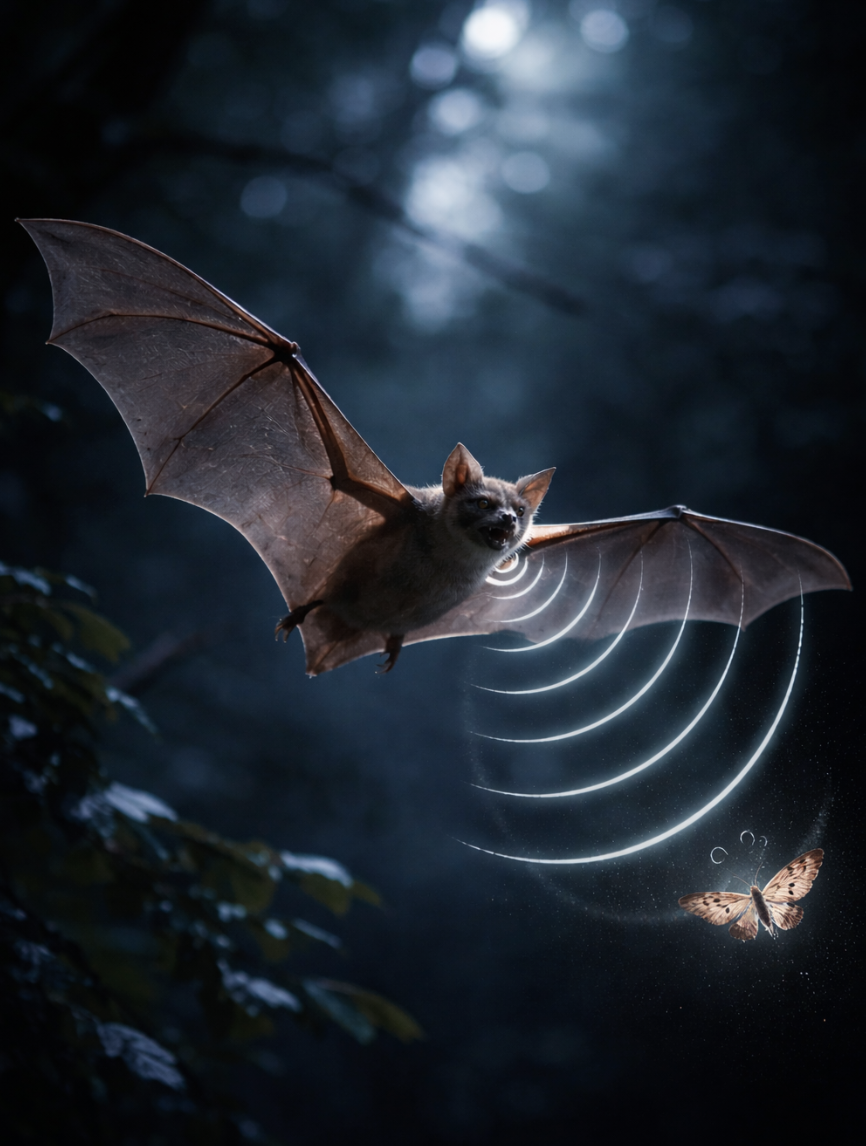
These aren’t just calls shouting out into the void (like blogging is), but finely tuned and shockingly accurate maps. Bats emit ultrasonic pulses sometimes hundreds per second, and when those pulses encounter an object, they bounce on back, carrying information about size, distance, texture, and motion. In an instant, a bat calculates not only where an insect hovers but how it moves, how fast it turns, and how best to intercept it.
This isn’t instinct alone, rather it’s real-time math performed with remarkable elegance. The bat’s brain is the crucible where sound becomes space and flight becomes maps in motion.
Dolphins & Whales
In the ocean’s blue depths, where light surrenders to shadow, dolphins and whales sing a suite of clicks, whistles, and buzzes. Their echolocation pulses are focused into beams like flashlights made of sound, and sent into the watery unknown. Similar, yet different to our nighttime flier. When these pulses strike objects like fish schools, rocky outcrops, or the sea floor, they return with subtle changes that reveal distance, size, and form.
The speed of sound in water is nearly five times that in air, and allows these marine mammals to build precise sonic images of their world quickly. The interwebs tell me that dolphins can identify fish separated by only centimeters, and whales can detect oceanic features across mind-blowing distances (Nature tells me up to 15km or 9.3 miles). In the waters around the globe, echolocation is a compass, a map, and a language all in one.
Shrews to Swiftlets
Echolocation is not the exclusive inheritance of bats and cetaceans either. Certain shrews, tiny mammals with a voracious appetite that might even surpass my husband’s, use rudimentary echoes to navigate the underbrush. Swiftlets are small birds that dwell deep in limestone caves and they also emit clicking calls to avoid cliffs and caverns too dark for vision.
Some blind people out there are sensory adventurers in their own right and deserve to be mentioned here as well. They have even developed a form of our own echolocation. By making clicking sounds with their tongues or walking sticks and listening to the returning echoes, they perceive doorways, trees, and objects, carving a world of sound that guides their footsteps. Studies have shown visual regions of the brain (including the visual cortex) in these people activate when listening to echoes…meaning the brain is literally seeing with sound.
In every case across the animal kingdom, the essence remains the same: produce sound, receive its return, interpret the difference.
Echolocation is as much physics as it is biology though, a subtle interplay of waves and matter that reveals the unseen.
Think about throwing a stone into a still pond for a moment. Ripples spread outward until they meet the bank, where they return with a clue about the barrier that stopped them. Echolocation is sort of similar in that way: sound waves radiate outward, encounter objects, then reflect back. The time it takes for the echo to return, and the way the sound changes in pitch or intensity, tells the listener what sort of rock was thrown and where.
The fundamental metric in echolocation is time. Sound travels at a known speed in air, roughly 343 meters per second, and in water, nearly 1,500 meters per second. When an echolocator emits a pulse and receives its echo, the interval between departure and return becomes a measure of distance. AKA a short delay means a closer proximity while long delaies means distance.
Of course, distance is only one dimension. The frequency of the returning echo (its pitch) tells even more: texture, shape, and motion. Higher frequencies bounce off small objects with greater fidelity, revealing fine details. Lower frequencies travel farther and penetrate through materials, revealing broader structures. Many echolocating animals use a range of frequencies, sort of like eyes shifting from peripheral vision to focused gaze
Movement itself becomes part of the echo’s story as well. When an object is moving relative to the listener, the frequency of the returning echo shifts, which they tell me is a phenomenon known as the Doppler effect. Bats, for instance, can detect the tiny shifts caused by an insect in flight, allowing them to intercept prey with uncanny precision.
This isn’t merely hearing but listening deeply to the sound of motion, to the subtle bending of sound waves by life in action.
Such an Enchanting Phenomenon
Echolocation resonates with me because it challenges our assumptions about perception, reality, and the limits of sensation.
We think we know space through sight alone, through the small amount of light that makes its way into our eyes. Yet echolocation reminds us that sound as well can paint dimensions, distances, and forms. There’s a world unbounded by visible light, one where darkness is opportunity, not absence.
Echolocation is a reminder that reality is multimodal, and that our senses are just little windows to deeper truths.
It also reveals the astonishing flexibility of life. The brains of bats, dolphins, swiftlets, and even people have evolved to perform feats that would seem supernatural to creatures reliant on sight alone. Neural circuits have learned to extract geometry from echoes, to compute distance in milliseconds, and to orient motion with nothing but reflected sound. That actually sounds like magic to me, as I sit here writing this, relying 100% on my eyes to do so. The brain is an active interpreter, not a passive receptor in this world.
We often elevate sight as the supreme sense of all senses, as if the world only truly exists when seen (ie if a tree falls in the woods and no one is there to see it old philosophical question). Echolocation challenges this as animals make their way through the world without light. Some blind humans, when trained in click-based echolocation, describe spatial experiences as vivid and real as vision itself.
After all, what is perception, if not the interaction between stimulus and interpretation, and what is reality, if not that which we perceive?
Tech Inspired by Echolocation
Echolocation’s rhythmic wisdom did not remain confined to the biosphere, no, in the mid-20th century, we translated this natural sonar into engineering marvels that reshaped warfare, navigation, and science.
SONAR is an acronym for SOund NAvigation and Ranging in case you didn’t know, and is humanity’s mechanical echo. Like bats and dolphins, ships and submarines emit pulses of sound into water and listen for the returning echoes. These echoes reveal the depth of the sea, the presence of other vessels, and even the contours of the ocean floor. When you’re six years old on a boat, looking at a fish-finder your dad has, trust me, this is as close to magic as it gets.
In military applications, sonar can detect submarines, track torpedoes, and map undersea terrain. In oceanography, it has unveiled seamounts, trenches, and the echoes of ancient geological forces.
Echolocation’s legacy extends into medicine too. Ultrasound imaging allows doctors to see inside living bodies without incision. A pulse of high-frequency sound enters tissue, reflects off structures, and returns as an image. In these echoes we witness life’s inner architecture: organs, blood flow, even unborn life.
As our tech ventures deeper into space, the use of echolocation persists. Radar, a cousin of sonar, uses radio waves to map planets, track asteroids, and to navigate spacecraft. In some future, echoes might help us listen to the structure of spacetime itself.
The World in Echoes
Perception is dynamic, and echolocation is a duet between the sender and listener, between silence and sound.
It reminds us that what we can’t see can still sing, and that the world, in all its vastness, is still out there waiting for us to listen. In the echoes of a bat’s call we hear insects and branches and the affirmation of life in the night. The clicks of a dolphin reveal fish and currents, as well as the harmony of movement in a world without light. In sonar’s pulses we hear data and the beauty of curiosity reaching into the deep.
To perceive is not merely to see with our eyes, but to be willing to be shaped by both sound and shadow, and the unseen.
Echolocation is more than a survival tool, it’s the ability to listen beyond the veil of light, to understand through resonance, and to know through return. Life in all its forms will find ways to see, throughout the cosmos and into comprehension.
Other Reads You Might Enjoy:
Audible Enclaves: The Future of Private Sound Without Headphones
The Science of Awe: What Happens When Wonder Floods the Brain
The Invisible Symphony: How the Universe Flickers Through Our Lives Without Us Knowing
The Sound of Trees Crying: What Plants Really Do When They’re Stressed
When Robots Run with Humans: Inside the Beijing Half-Marathon for Androids
The Wild Side of AI: From Resurrecting Direwolves to Talking with Plants
ChatGPT Just Surpassed Wikipedia in Monthly Visitors: What That Says About the Future of Knowledge
The Science of Awe: What Happens When Wonder Floods the Brain
Why Do We See Faces in Everything? The Science of Pareidolia
The Science of Nostalgia: Why We Long for Summers That Never Really Existed
Your Brain Is Lying to You: Everyday Ways Your Mind Betrays You (And How to Outsmart It)