A milkshake with a charging cable on the side
Somewhere between a roadside diner and a product launch, Tesla decided that plugging in a car should come with the possibility of fries. I understand the appeal immediately. Give me a reason to sit down, something cold in a glass, and a little architectural drama, and my errand suddenly develops a personality. Apparently the future has room for whipped cream. This is excellent news for those of us who were worried it would consist entirely of passwords.
Tesla Diner opened on July 21, 2025, in Hollywood, Los Angeles. The address is 7001 Santa Monica Boulevard. Its combination of a restaurant, electric-vehicle charging and outdoor movies makes a compelling photograph, but I’m interested in what happens after the photograph. Can a place built around waiting become somewhere people actively want to spend time? Can the burger hold its own once the novelty has finished introducing itself?
I haven’t visited, so this is a researched look at the concept and its evolution, rather than a firsthand tasting review. My original enthusiasm came from nearly two decades in restaurants, where I learned to appreciate an idea that brings people through the door. That same experience makes me curious about everything behind it: the menu, the service, the logistics and the reason someone might come back on an ordinary Tuesday.
The future has been borrowing this look for a while
There’s a wonderfully circular quality to selling tomorrow through yesterday’s diner. Southern California’s Googie coffee shops were already putting futuristic roofs, expansive windows and dramatic signs beside the road decades ago. The Los Angeles Conservancy describes how architects Armet and Davis combined car culture with exuberant forms while keeping practical restaurant operations at the center. Their buildings promised adventure and still needed to get breakfast onto a table.
That history makes this pairing feel less random to me. A diner offers a recognizable invitation: come in, sit down, order something familiar. Electric charging supplies the newer reason to pull over. Put the two together and you have an old roadside proposition wearing a different power source. I like that continuity. Progress can arrive with a comfortable seat; it doesn’t always need to arrive with an instruction manual.
The emotional ingredient is nostalgia. We can be drawn to a version of the past we never personally experienced, especially when it comes with chrome and an appealing dessert. That doesn’t make the pleasure fake. It does make the design persuasive. Before anyone tastes a fry, the room has already suggested what sort of afternoon they’re supposed to be having. I’d like my afternoon to include an actual good fry.
What a visit currently involves
Tesla currently lists 80 V4 charging stalls, more than 250 seats, a rooftop Skypad and two 66-foot screens. Everyone can visit, including people who aren’t charging or driving a Tesla. Public dining runs from 6 a.m. to midnight; Tesla vehicle ordering operates around the clock. Those are different kinds of access, so a midnight arrival deserves a little planning rather than an assumption based on opening-week coverage.
On-site parking is for charging. Other visitors need nearby parking; walking and rideshare are also options. Tesla’s touchscreen Diner app supports car-side ordering, while other guests can order inside. Movie viewing requires dining or active charging. Check the official visitor information before going, particularly for hours, payment and vehicle compatibility. I’d rather spend five minutes sorting that out beforehand than begin a promising evening negotiating with a parking sign.
For me, this is where the experience becomes interesting. A restaurant has to welcome people with different purposes into the same place: someone hungry, someone curious, someone needing electricity, someone accompanying all three. Clear directions matter. A guest should be able to understand how to arrive and eat without needing to join a fan club or obtain a minor qualification in touchscreen navigation. Good hospitality makes the first few decisions feel easy.
The menu has moved on, and yes, there is coffee
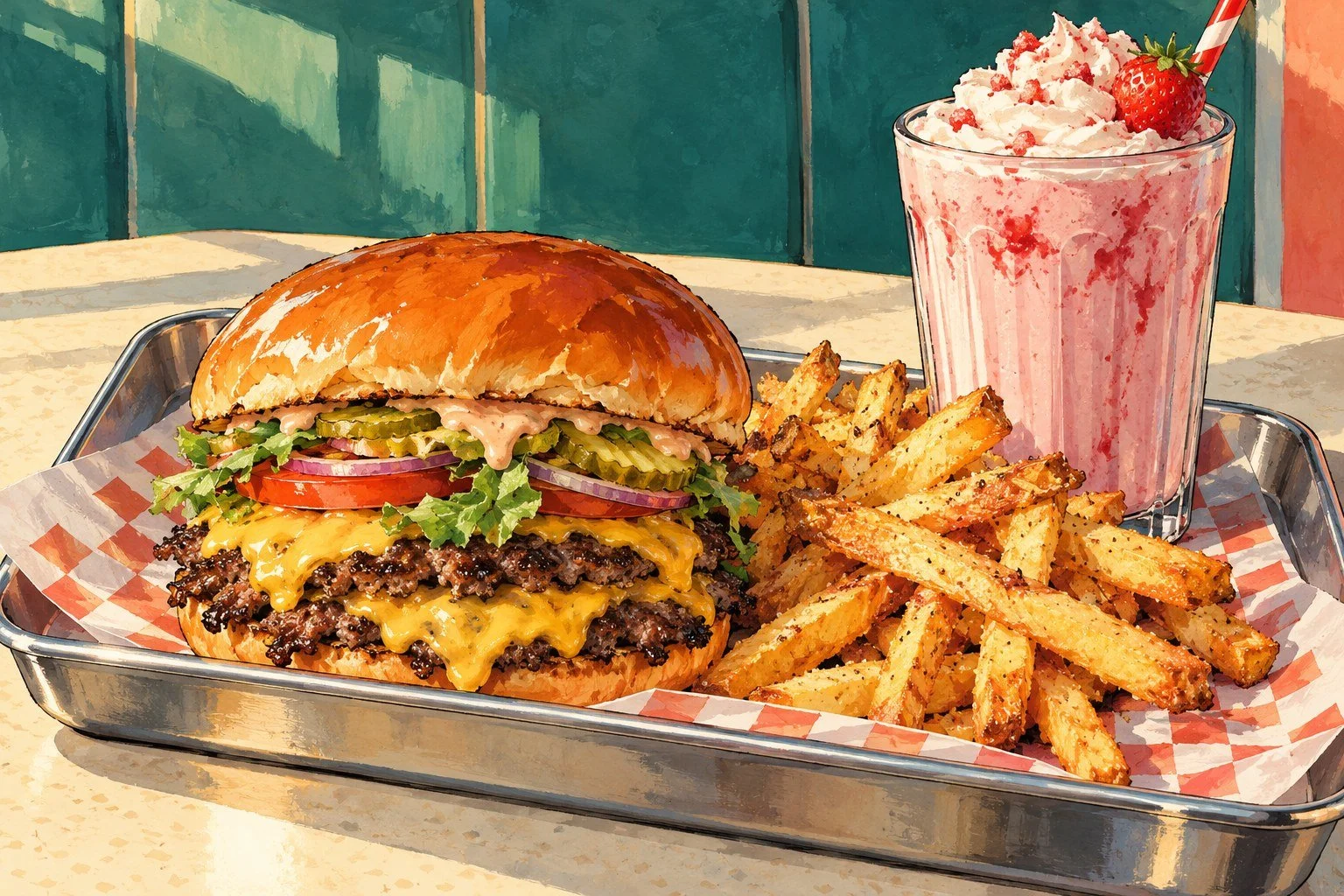
The official menu checked for this October 20, 2026 update includes the Tesla Giga Burger, Pacific Tuna Melt, Chill Mode Grilled Cheese and Falcon Wing Fried Chicken Sandwich. Breakfast includes pancakes, egg bites and avocado toast. Fries, a market salad, milkshakes and other drinks round out the choices. These are current menu observations, rather than a promise that every item will be available whenever you arrive. The menu deserves a fresh look before a trip.
One particularly useful correction: coffee is very much on the menu. Drip coffee, cold brew, espresso, cappuccino and latte are listed, alongside tea-based drinks. My earlier description of a caffeine-free beverage strategy needs to retire. Preferably after an espresso. Tesla currently says the diner doesn’t serve alcohol, but that doesn’t turn the rest of the drinks list into an argument against caffeine or evidence of anyone’s personal philosophy about wellness.
From a restaurant perspective, familiar food gives an ambitious setting a useful anchor. People know roughly what they want a burger, grilled cheese or milkshake to deliver. That also makes the food accountable. An elaborate building can entertain me while I wait, but a sandwich still needs good texture, sensible proportions and a temperature that suggests it recently met a kitchen. The garnish cannot file an appeal on behalf of a soggy bun.
Chef Eric Greenspan helped launch the restaurant and departed in November 2025. His opening involvement belongs in the history, rather than a claim about who runs today’s kitchen. I’d also leave opening-week prices out of a current recommendation. A live menu and the total at checkout are better guides than a screenshot from last summer, especially if you’re ordering for a group whose definition of a small snack includes several additional courses.
A sommelier can appreciate a good milkshake
My beverage curiosity doesn’t switch off because a restaurant skips wine. A milkshake has its own balancing act: sweetness, temperature, texture, flavor and how it sits beside the food. A very rich drink can be delightful and still feel like dessert arriving early. If I were choosing a meal here, I’d think about the whole order before committing to the largest possible version of everything. This is a planning aspiration, of course. Fries have previously weakened stronger positions.
With salty food, a sweet drink creates contrast, but how much contrast feels good is personal. Someone may want a shake beside a burger; someone else may prefer water with the meal and a shared shake afterward. Both approaches make sense to me. The most useful pairing advice starts with what you enjoy and how hungry you are, rather than turning lunch into a performance review. Your straw should never feel like it reports to a sommelier.
I’d be curious about an ordinary coffee, too. In a place built to attract attention, the everyday order can tell an interesting story. Is it convenient to get? Is the service clear? Would I choose it again without needing a photograph? Those are questions I’d take into a visit, rather than answers I can supply from a menu. Hospitality earns trust in small transactions, long after the impressive roof has finished making its first impression.
Charging changes the timing of lunch
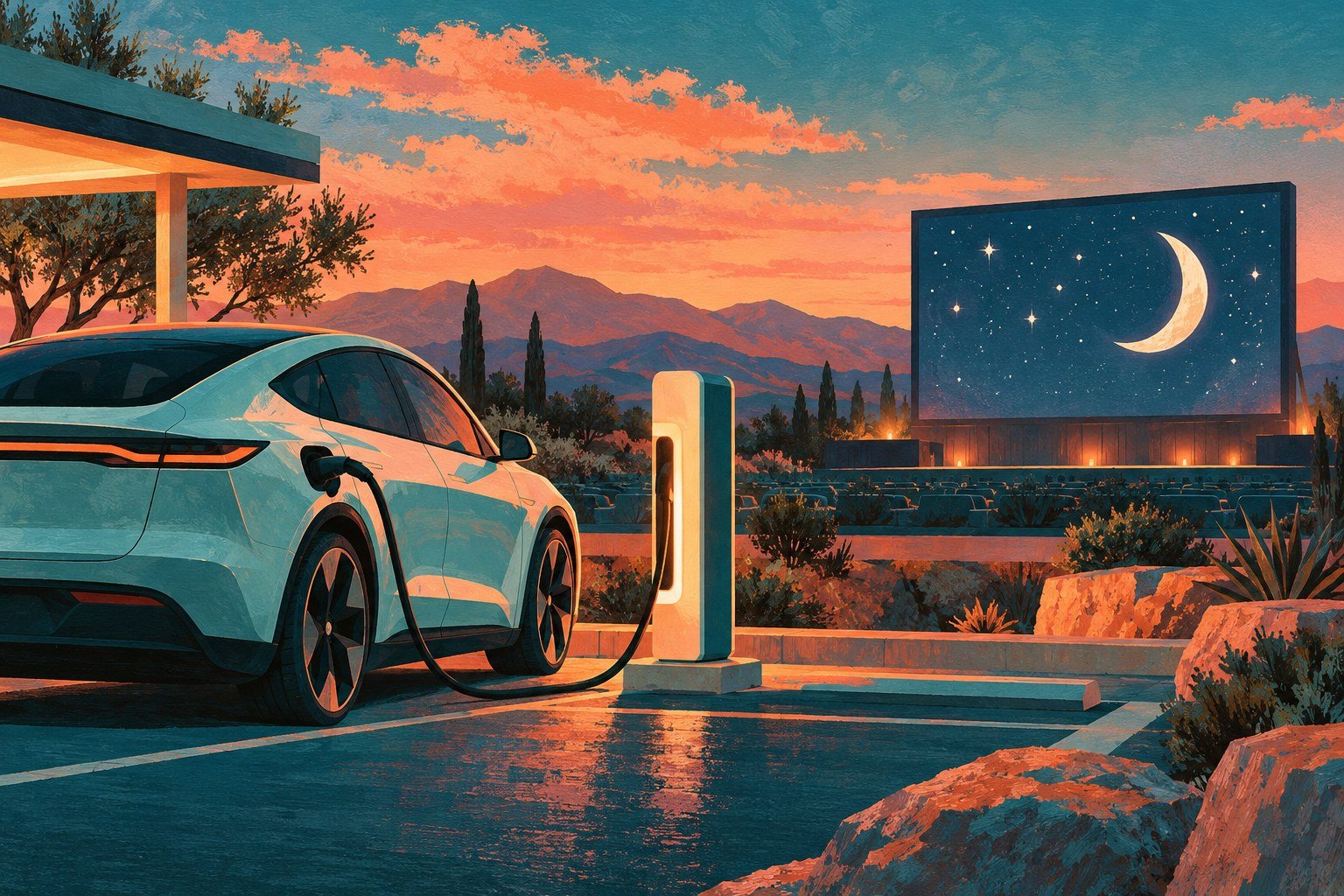
The practical idea underneath the spectacle is straightforward: eating can give a necessary stop another purpose. The Department of Energy explains that charging time varies with the vehicle, battery condition, state of charge and equipment. That means a charging stop and a meal won’t automatically end together. An advertised charger rating can’t guarantee how long your individual car will take, and a kitchen has its own timing. Neither operation becomes perfectly synchronized because the signage looks coordinated.
I can imagine that overlap working beautifully when expectations are clear. Place an order, settle into the space, keep an eye on the car and enjoy a break that was already on the schedule. I can also imagine the less glamorous version: food arrives just as the car is ready to leave. Designing for both versions seems essential. Packaging, order updates and clear communication become part of the experience, as surely as the shape of the building.
For a driver, it makes sense to monitor charging and move the vehicle when finished, following the site’s rules and checking applicable charging fees. A charger serves a different purpose from a long-stay restaurant parking space. The dream of a leisurely meal has to coexist with someone else needing the plug. I’m in favor of enjoying the stop while remembering that the next driver also has a destination and possibly a hungry passenger.
The broader lesson could travel well beyond this address. An enjoyable charging stop might involve a neighborhood café, a bookstore, a clean restroom or a comfortable outdoor table. Different places can solve the same problem in different ways. I’d welcome a future in which the reliable amenities receive as much attention as the futuristic renderings. Somewhere to wash my hands will always rank remarkably high on my personal innovation index.
The robot should stay in its proper paragraph
Tesla describes Optimus appearances as occasional, with dates announced separately. That’s the sensible expectation for visitors. A robot sighting is a possible attraction; it isn’t a guaranteed part of lunch or evidence that an autonomous machine routinely runs the dining room. My earlier robot-server framing overstated what a visitor should expect. The people doing the everyday work deserve to remain visible in the story, especially when the photogenic technology attracts so much attention.
Restaurant work involves a steady stream of judgment calls. A guest has a question, an order needs clarification, a tray needs carrying, a spill needs handling and somebody needs an answer delivered kindly. An impressive demonstration can be fascinating without telling us how those demands are managed across an entire service. I’d want evidence of dependable operations before declaring that any particular machine has solved hospitality. A popcorn moment and a reliable shift are different accomplishments.
The same care applies to environmental language. Electric charging and a menu described as responsibly sourced don’t establish a carbon-neutral meal. Food production, energy, transport, packaging and waste all belong in a serious footprint assessment. I’m comfortable appreciating the charging infrastructure while leaving sweeping claims out of the story. A greener-looking setting can start a useful conversation, but the calculation still needs information that a promotional photograph cannot provide.
A launch can attract a crowd; a restaurant has to earn another visit
The business proposition interests me: guests may arrive for charging, food, the setting or simple curiosity. Those motivations could reinforce one another. That’s my interpretation of the concept, rather than proof of its financial performance. Without diner-level financial statements, we can’t responsibly announce that it prints money, has negligible food costs or guarantees success. Electricity doesn’t eliminate the invoices. Neither does putting a futuristic name on a burger.
There’s also a difference between drawing attention and earning affection. In his February 2026 follow-up, Eater’s Matthew Kang described improved food and little waiting on his visit, while exploring the venue’s political baggage. That’s a dated critic’s account, rather than a current occupancy report or a balance sheet. I find that distinction useful: a reviewer can describe an afternoon honestly without that afternoon becoming a permanent verdict on the whole business.
A powerful brand brings expectations with it. Some visitors may be enthusiastic about the company; others may feel uncomfortable supporting it. A recommendation should leave room for those choices rather than pretending a restaurant exists outside its ownership. My interest is in evaluating the idea clearly: what guests can expect, what has changed, which claims hold up and where I’m offering an opinion. I don’t need everyone to reach the same conclusion about dinner.
As for expansion, I’d wait for confirmed locations and openings before describing a network of these diners as an established reality. A compelling prototype still has to work in another neighborhood, with another team and another set of costs. Replication adds its own complications. Anyone who has ever tried to repeat a good dinner for twelve people instead of two already understands the principle, even without a slide deck explaining economies of scale.
What would make me return
When I think about visiting with my husband, the appeal is easy to picture: have a meal, look at the design, see how the pieces fit together and enjoy being somewhere slightly improbable. I’d definately be curious. I’d also arrive with ordinary restaurant expectations. Tell me how the place works, get the order right, serve food worth eating and make the time feel pleasant. The future earns considerable goodwill by remembering the napkins.
A first visit can run on curiosity. A second needs a reason of its own. Maybe the coffee is convenient, the food becomes a favorite or the setting makes a break feel restorative. Those are possibilities I’d like to test for myself, not experiences I can claim in advance. A restaurant’s most persuasive achievement may be becoming useful enough that people stop explaining its concept every time they recommend it.
That’s what keeps me interested in Tesla Diner after the opening headlines. It brings an extravagant visual idea to a practical roadside question: what should we do while we stop? There’s room for entertainment, comfort and a decent meal in that answer. For now, I’ll keep the enthusiasm and the fact-checking on the same tray. If the future wants to park itself beside a milkshake, I’m willing to look at the menu.
Related Reads
McDonald’s Sales Just Dropped Big, Here’s Why Fewer People Are Eating Fast Food Right Now
How Damola Adamolekun Saved Red Lobster and Reimagined Its Future
The Psychology of Tiny Things: Why We Love Miniatures, Dolls, and Dioramas
Rewiring Time: The Billionaire-Funded Race to Hack Aging, Freeze Brains, and Digitize the Soul
Inside Elon Musk’s Mind: Neuralink, Brain Chips, and the Billion-Dollar Question
The Internetless Revolution: Jack Dorsey’s New Chat App and the Rise of Offline Resistance
Sources
Tesla Diner visitor information and current operating details
Los Angeles Conservancy — Armet & Davis and Googie coffee shops
U.S. Department of Energy — electric-vehicle charging equipment and timing
Los Angeles Times — Eric Greenspan’s departure and next restaurant, August 10, 2026
Eater — Matthew Kang’s dated follow-up review, February 6, 2026
Updated October 20, 2026. Images are AI-generated editorial illustrations of imagined diner food and charging concepts, not photographs of Tesla Diner, its menu items or equipment.