A pill that might give dogs more healthy time is the sort of headline that gets my attention immediately. I love dogs, and I understand the urge to skip straight to the part where somebody tells us how to get it. Preferably yesterday, with clear instructions and several additional years included. That is a perfectly understandable wish, and a considerably larger promise than a developing drug can make.
The company behind this particular research is Loyal, which is developing veterinary drugs intended to extend healthy lifespan. Its lead program for senior dogs is called LOY-002, and the question is whether treating aspects of aging could help dogs stay healthier and live longer. I think that's a fascinating research question. I also want to know exactly which part has been demonstrated before attaching an imaginary extra birthday to anybody's dog.
The useful story has several pieces: what the company is trying to change, what the clinical trial measures, and what the FDA has actually reviewed. Those pieces can move forward at different speeds, which makes the headlines rather difficult to follow. I wanted to put them together without losing sight of why anyone cares about them. The dog at the center of this discussion still needs to have a good day.

Where LOY-002 Stands Right Now
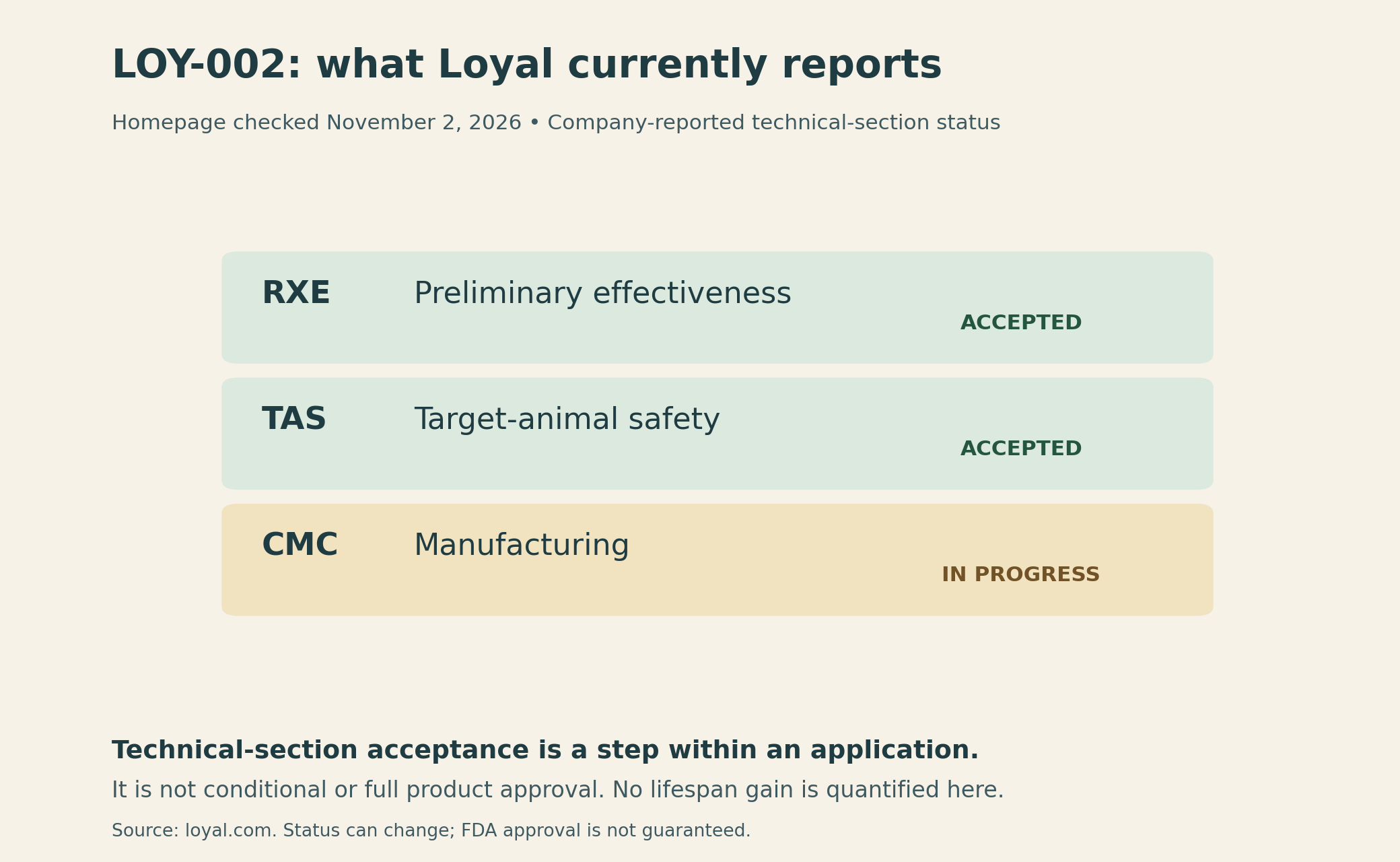
As checked on November 2, 2026, Loyal's website reports that LOY-002 has completed two of three major requirements for conditional approval: the preliminary effectiveness and target-animal safety sections. It lists the manufacturing section as still in progress and says FDA approval is not guaranteed. That's a dated account of the company's reported progress. It gives us a much clearer picture than treating an earlier projected launch year as an appointment already on the calendar.
Those distinctions matter because several very different announcements can sound like a drug has arrived. Acceptance of one technical section, conditional approval of the product, and full approval each mean something different. I want the announcement to tell me which one happened and which drug it concerns. A family reading about this deserves enough detail to understand the news without having to become a veterinary regulatory specialist over breakfast.
The Three Programs Are Aiming at Different Dogs
According to Loyal's information for veterinarians, LOY-002 is a daily-pill program intended for dogs at least ten years old and weighing at least fourteen pounds. Its stated goal involves improving insulin sensitivity and lowering insulin levels to support metabolic health. Those are the company's proposed route and target population, rather than a prescription for every older dog. A dog's size, existing conditions, and current care still matter to any eventual treatment decision.
Loyal's product overview also describes LOY-001, a long-acting injectable program, and LOY-003, a daily-pill program, for large and giant dogs. They have their own intended populations and formulations. I would keep those names attached to the details when reading an update, because a milestone for one program doesn't automatically describe the others. Three numbered products are quite capable of creating more confusion than one very optimistic headline can comfortably hold.
There has been another recent development. In a September 16, 2026 announcement, Loyal reported FDA acceptance of the reasonable-expectation-of-effectiveness section for LOY-003. The company describes that program as targeting growth hormone and IGF-1, with the aim of addressing pathways associated with large dogs' shorter lifespans. That is a reported preliminary effectiveness milestone for that candidate. It still belongs on the development side of the story, with its remaining requirements attached.
Conditional Approval Is a Specific Kind of Approval
The FDA's explanation for veterinarians separates conditional approval from full approval primarily through the effectiveness requirement. Conditional approval requires a reasonable expectation of effectiveness, while full approval requires substantial evidence of effectiveness. Safety and manufacturing requirements still have to be met. A promising technical-section decision therefore sits within a larger application; the product must actually receive conditional approval before that pathway permits it to be marketed for its labeled use.
Conditional approval is initially valid for one year, with possible annual renewals for a total of up to five years while the company works toward full approval. That gives a qualifying product a route to patients while the remaining effectiveness evidence is collected. It also explains why the words conditional approval deserve their full name. The ongoing evidence requirement is part of what the approval means, and readers should be able to see it clearly.
I think that is a more interesting story than simply waiting for a yes-or-no headline. There are real questions about how to evaluate a treatment whose intended benefit takes time to measure, especially when its potential patients are already older. The answer needs both a workable study and a meaningful standard for interpreting the result. I can appreciate the urgency while still wanting to know what a particular decision establishes.
STAY Is the Study Designed to Test the Big Question
Loyal's current STAY study page describes a double-blinded, placebo-controlled trial with more than 1,300 dogs across seventy veterinary practices, and it now says the study is fully enrolled. Owners and investigators are blinded to whether a dog receives the study drug or a placebo. That comparison is how the study is intended to distinguish a treatment effect from differences that might otherwise be attributed to the pill.
The placebo group is especially useful here because older dogs can change for many reasons. If an owner thinks a dog seems brighter after starting a tablet, that observation might matter, but it needs context and a fair comparison. I want researchers to have a way to ask whether a pattern holds across groups. An encouraging individual story is something to investigate, and the trial is what can make the larger claim testable.
The company's February 1, 2024 announcement of the first dog dosed introduced Boo, an eleven-year-old Whippet enrolled in Harrisburg, Pennsylvania. It described collecting lifespan, quality-of-life, and frailty data over a four-year study. That gives the project a Pennsylvania connection and a useful reminder of the timescale involved. A study intended to answer a lifespan question needs actual follow-up, rather than a few unusually energetic afternoons presented as the final answer.
What I'd want from the eventual results is the size of any benefit, how uncertain that estimate is, and what happened to the dogs receiving the drug compared with the dogs receiving placebo. I'd also want to know how quality of life was measured and how many dogs remained in follow-up. Those details help turn a hopeful sentence into something you can assess. Adding a number to a headline is the beginning of that explanation, rather than the end.
Safety Has to Stay Attached to the Intended Use
In its January 13, 2026 safety-milestone announcement, Loyal reported that the FDA had accepted LOY-002's target-animal safety section. The company describes evidence from several studies and hundreds of treated dogs. That's a meaningful reported development, while the complete product application and the eventual prescribing information remain separate pieces. I would read the milestone for what it says about the intended use, rather than turn it into a promise that every individual dog would have the same experience.
A treatment aimed at preserving health raises a very practical question about the balance between benefits and unwanted effects. The dog might be doing reasonably well already, so the result has to justify adding something to that dog's care. I want to know what was observed, how often it happened, and which dogs were included. A reassuring adjective gives me much less to work with than that information.
Loyal's veterinary materials also say the drugs' active ingredients and exact mechanisms remain confidential during development. That limits how specifically the public can assess pharmacology or interactions from the current descriptions alone. For an eventual prescribing discussion, I'd want a veterinarian to work from the actual product information and the individual dog's medical history. That is more useful than filling the gaps with assumptions about a different longevity drug or a supplement with a similar-sounding goal.
Healthy Time Is the Part I Care About
Lifespan is a count of time, while healthspan concerns the portion of that life spent in good health. For a dog, the questions I'd care about include comfort, mobility, interest in ordinary activities, and whether the daily routine still seems enjoyable. I would want an eventual benefit described in terms that make sense for the animal living through it. An extra date on a calendar tells only part of the story.
That also affects what a good result would mean to different families. One dog might love a gentle sniffing walk, while another is most interested in a familiar game or being near somebody during the afternoon. Those preferences are worth noticing in their own right. The point of following a longevity study, for me, is the possibility of preserving enjoyable life, with the dog's wellbeing supplying the definition of success.
The AAHA senior-care guidelines describe care that includes medical assessment, behavior, existing conditions, and changes to the environment. They also emphasize helping families understand the needs of senior pets. That is useful context while drug research continues, because a future treatment would sit within a whole plan of care. The ordinary work of understanding an older dog's current needs still deserves time and attention.
For an everyday activity, an adjustable dog puzzle toy might be worth considering if it suits your dog's abilities and preferences. I'd choose an appropriate size and easy starting challenge, supervise, and stop or adapt it if the dog seems uncomfortable or frustrated. That's an optional way to offer a little engagement. It belongs with ordinary daily enjoyment, separate from any claim about changing lifespan or treating an age-related condition.
What I Would Ask Before Turning a Headline Into a Plan
First, I'd check whether the particular product has received approval, what its label says, and which dogs it is intended for. Then I'd want to discuss the evidence, possible adverse effects, monitoring, existing medications, and practical costs with a veterinarian. The answers need to refer to the actual product and the actual dog. A development-stage eligibility description is helpful for understanding a study, while a future clinical decision needs the approved information available at that time.
I'd also keep a company's projected timeline and an available prescription in different places in my notes. A target year can change as a program develops, and the same applies to an early price estimate. The sources reviewed here don't justify promising a launch date, a particular monthly bill, or a fixed number of extra years. I'd rather have those details when they are established than build somebody's expectations around a number that sounded reassuring.
STAY's fully enrolled status matters for the same reason. A reader can follow future study announcements, but the old instruction to enroll immediately would now send them looking for an opening the current page doesn't offer. I want a useful update to tell people what is possible today. Following the evidence should be a little easier than chasing an application button through several years of old news.
The Hope Is Understandable, and the Evidence Still Matters
This topic connects naturally with my interest in the bond between people and pets and dogs' evolution and emotional lives. It's easy to understand why a dog-longevity story reaches people before they've read the second paragraph. That attachment is a reason to make the explanation clear and careful. People who want more time with an animal deserve information that helps them think, as well as something hopeful to read.
I ask a related question when reading about optimism and longevity or gene editing: what did the study measure, and how far does that particular finding reach? The same habit matters with the Brazilian cattle-breeding story, where a striking animal or an ambitious breeding goal can attract attention before the details arrive. Different scientific approaches need their own evidence. An appealing shared word like longevity doesn't make the findings interchangeable.
Even an article about evaluating device and energy-treatment claims raises that basic evidence question, although it is a separate subject from a veterinary drug trial. I want to see a defined intervention, an appropriate comparison, and an outcome that actually supports the claim. The method matters because the subject is interesting enough to take seriously. I can be excited by a possibility while still wanting the next result to do its share of the work.
I'm definately interested in what Loyal's studies eventually show. A well-supported way to give dogs more comfortable, enjoyable time would matter enormously, and following the development is worthwhile on its own. For now, there is a drug program, a large ongoing trial, and a set of regulatory requirements still being worked through. I want the next chapter to bring clear results, with the dogs' quality of life staying at the center of the story.