Cruising With Wine: My Latest Project
It has officially been a month since I blogged regularly, which in internet time feels like I disappeared into the woods and came back holding a lantern, feral with my hair a mess and full of sticks, and with a suspicious amount of river cruise research.
I didn’t mean to vanish from my writing life, I meant to write exceptional posts that moved people to tears. Instead, I went out of my norm to build a website that will eventually be an app. Or, more accurately, I started building the wine travel tool I wanted my dad to have before his cruise. That sounds much more organized than it actually felt.
It started because my dad is going on a European river cruise, and naturally, because I’m me, I couldn’t just say, “Have fun! Drink something local!” and leave it alone like a normal daughter and a regular person. My brain immediately started doing the thing it always does. Where are you stopping? What grows there? What should you drink? What bottle should you bring home? Is the local wine something you can actually find in the United States, or is this one of those magical little bottles that disappears the second you leave town? How far is the wine shop from the ship? What if you only have two hours? What if the tour takes you to one place but the better glass is hiding three streets away behind a bakery?
This is why I can’t have casual hobbies…I just take things and run with them.
At first, I thought I would make him a little list, a cute little travel note…maybe one page per stop.
Famous last words. One page became several stops, then several stops became maps. Maps are fun to make because they’re like drawing but more precise and people will always tell you they aren’t accurate enough. Eventually I was thinking about wineries, food pairings, shops, beer alternatives, distilleries, bottles to look for, producers worth recognizing, and tiny notes like, “If you see this on a shelf, just buy it, don’t hesitate.”
Then suddenly I was building Cruising With Wine with the help of my dad.
Of course I’m biased, but honestly, it makes so much sense I’m annoyed it didn’t already exist out there.
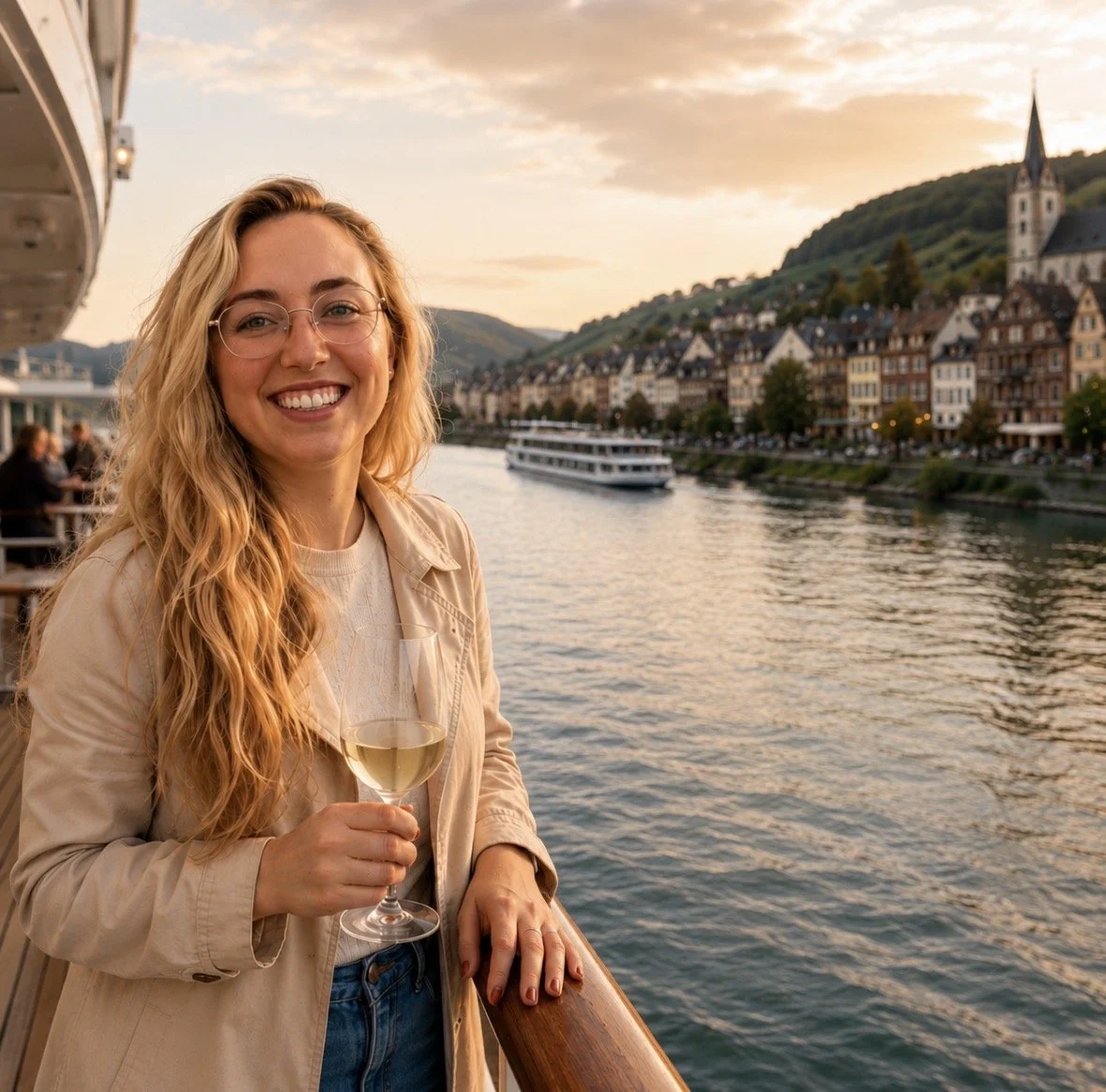
Michele Edington on a river cruise in Germany
River Cruises Are Secretly Wine Trips
The thing about European river cruises is that they are already moving through wine country. They just don’t always tell you it that way. While you’re floating past castles and church towers and cute little towns that look like someone sprinkled powdered sugar over the rooftops, you’re often traveling through some of the most historic wine regions in the world.
Like, the Rhine is a pretty river, sure. It’s also Riesling country.
The Danube moves through old imperial cities, Grüner Veltliner vineyards, Blaufränkisch country, apricot orchards, and monastery vines. Its white wines can taste like someone sharpened a green apple with a pocketknife then tossed it into some lighting (because why not?).
Alsace feels like one long daydream of Riesling, Gewürztraminer, Pinot Gris, tarte flambée, storks on rooftops, and half-timbered houses that look like they were designed by a pastry chef. Of course, my gingerbread loving husband absolutely adores this.
Every stop brings its own local drink into the picture. There’s beer and cider, Jenever then herbal liqueurs. A family-run shop with a small shelf of bottles made for that exact corner of the world. People spend thousands of dollars on these cruises. They carefully choose the itinerary, the ship, the cabin, the excursions, the dates, and the flights. Then they arrive in one of the most interesting drinking regions in the world with a few precious hours to experience it.
A little guidance can turn those hours into something incredible.
Travel days move fast and menus arrive in unfamiliar languages while your jet lag rears its ugly head and you nod off at the table. The town names are new and you have no concept of how to pronounce them and the grapes are new too. Standing in the middle of a wine shop and searching every label on one bar of service gets especially interesting when your husband has already wandered toward a sausage cart.
A recognizable bottle feels easy and the included excursion keeps the day moving.
A few useful details before the ship docks can lead you to the glass that tastes like the river, the stones, and the entire point of being there. That’s where Cruising With Wine comes in. It gives you the wine part in easy to understand ways (why do sommeliers make everything so hard to comprehend these days?), so you can find the good stuff and enjoy your time in port.
I Built This for Real People Who Love Wine
The more I worked on Cruising With Wine, the more clearly I understood who I was building it for.
Sommeliers can land in a town, sniff the air, read a list in three languages, recognize half the producers, and decide what to drink before everyone else has found the bathroom. That’s why whenever I go out to eat with anyone at all, the wine list is shoved in my direction and I’m immediately in charge of beverages for the night.
Cruising With Wine is made for the person who loves wine and wants their vacation to feel like a vacation. The cruiser who wants to drink something local and learn just enough to make a great choice will absolutely adore this website/app. My dad who wants to enjoy his trip, will now find a bottle he loves, and bring it home to open months later.
Somewhere out there, there’s a person who knows they like crisp white wine and should discover that a dry Riesling from the Rhine can become their entire personality for the afternoon. This was built for the traveler with four hours in port who wants to know whether a winery visit fits into the day or whether a wine bar close to the ship is the better way to go.
Mostly, it’s for curious people though. I love curious drinkers, they’re my favorite kind of people. I mean…they’re me, so I understand I’m biased, but they bring enthusiasm, questions, and an appetite for one great discovery. They just need a good doorway in, and Cruising With Wine is meant to be that doorway.
The Stops Started Taking Over My Brain
Once I started building out the stops, the whole thing became weirdly addictive (yeah, I know, my doctors say I have obsessive issues, I’m working on it). Every city had its own little personality though, and what could be cuter than that?
Rüdesheim feels like it should come with Riesling in one hand and a ridiculous grin on your face. It has that Rhine energy where the vineyards climb so steeply you wonder who first looked at that hill and said, “Yes, obviously, let’s farm that.” I’m assuming it was someone without a ton of money or options, but I can appreciate and admire their tenacity. I mean…please look at these slopes.
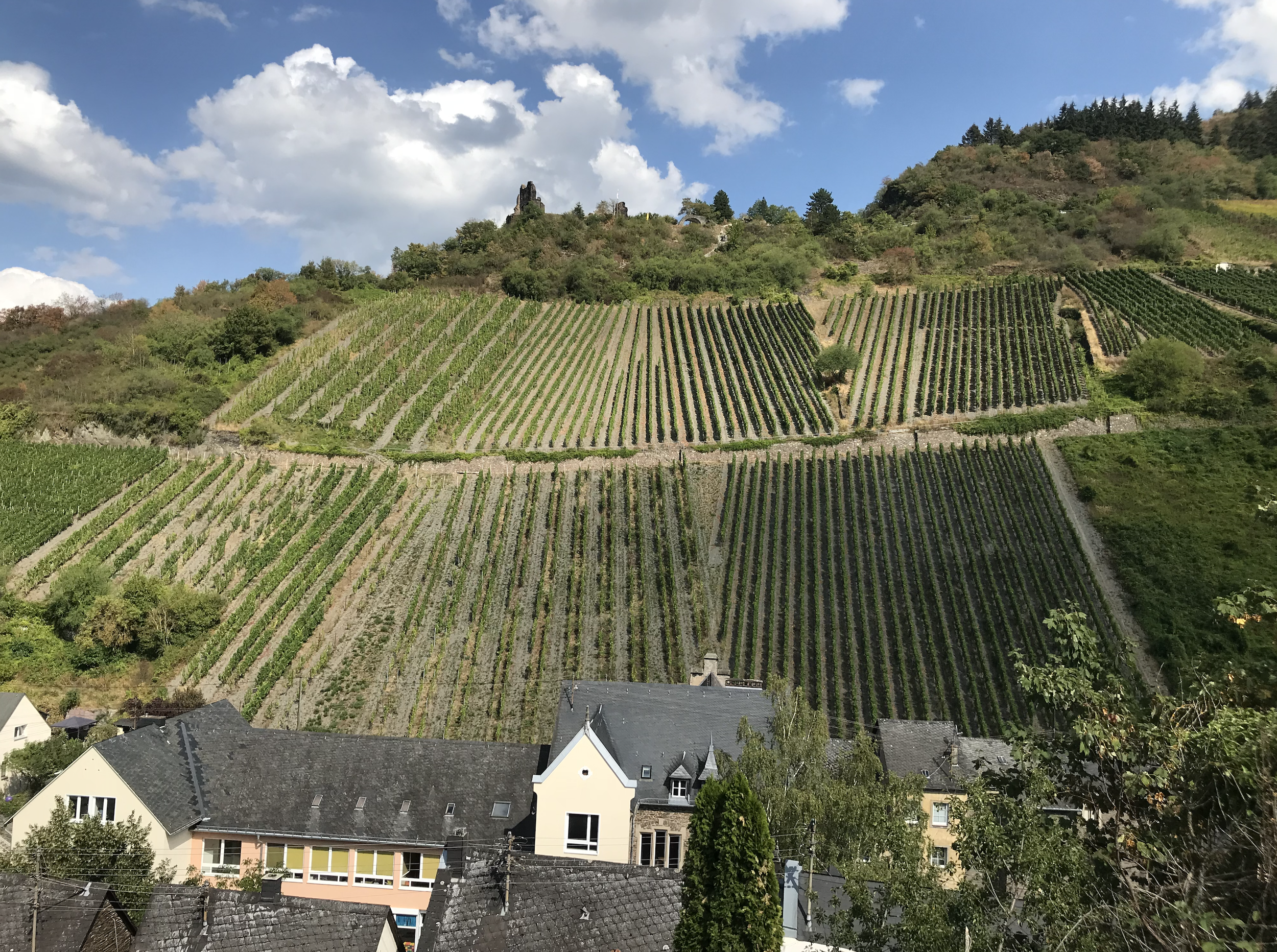
Vineyards at Trarbach, Germany
I took that photo off the Moselle river, and absolutely regretting climbing to the top. Why I thought that was a good idea, I’ll never know. Especially because I knew that the soil was slate and would shift under my feet as I climbed. These slopes are sometimes so steep the grow the grapes tall instead of on trellises like you’re used to seeing. Here’s a pic of that so you see what I mean.
Also, peep the slate pieces.
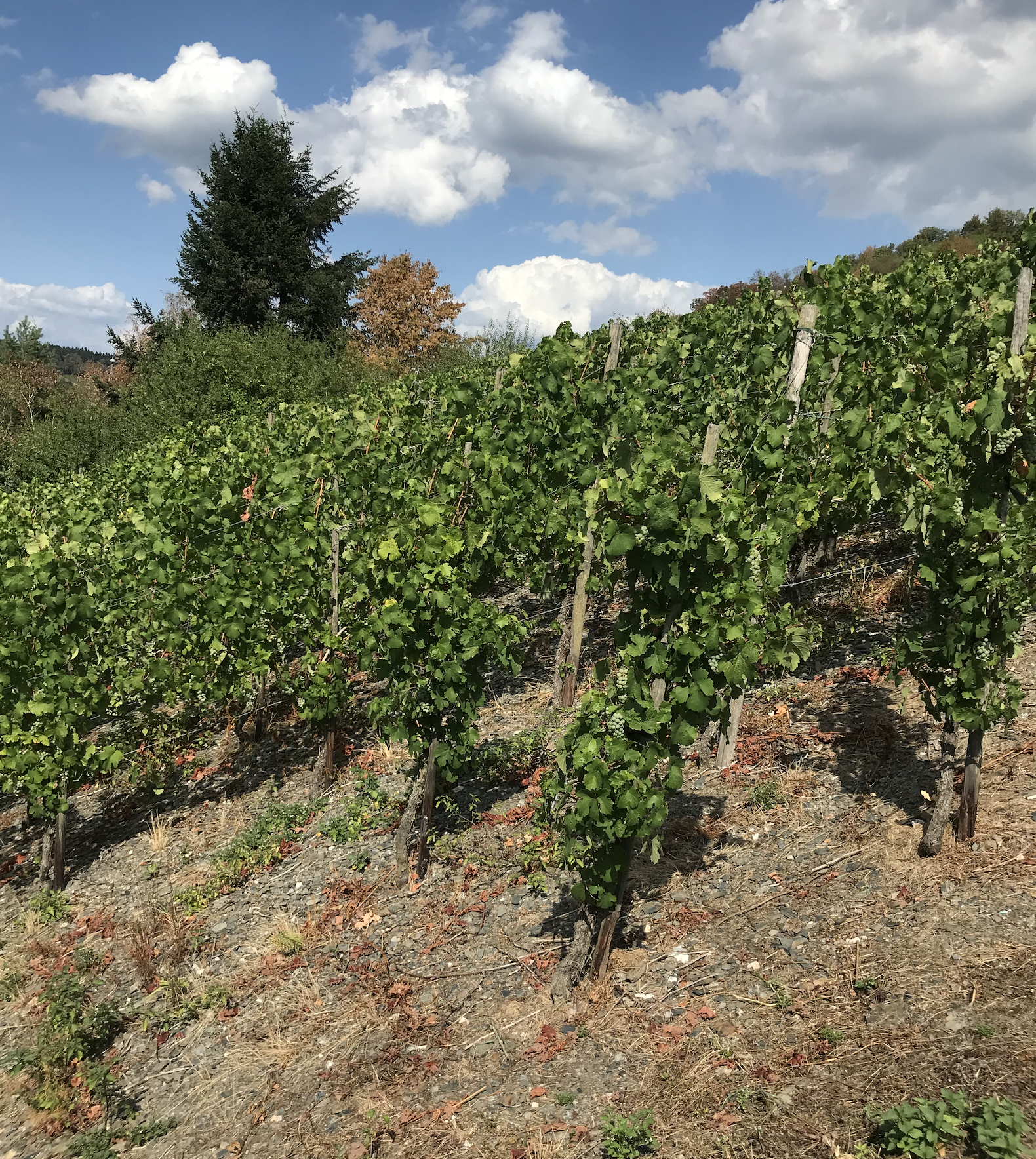
Vineyards at Trarbach, Germany
See how they climb up one stake instead of grow holding hands (branches) horizontally? Sheesh.
Anyway, the dry Rieslings here can taste like lime, peach skin, wet stone, and nervous energy - which I know all about. The sweeter styles make spicy food feel like it has been gently tucked into bed and the wine taverns here carry the kind of warmth that makes one more glass feel like an essential part of the afternoon.
Koblenz sits where the Rhine and Mosel meet, which feels almost too poetic to be real. Two rivers, two moods, and one place where you can start thinking about slate, Riesling, Spätburgunder, and delicate bottles that somehow feel ancient and fresh at the same time. German wine contains entire worlds. It can be feather-light, serious, joyful, savory, floral, sharp, soft, and completely transportive. A stop in Koblenz gives you a chance to see how much character can fit inside one tall bottle.
Strasbourg and the Alsace stops practically wrote themselves because Alsace is already such a sensory place. The wines smell like orchards, flowers, spice cabinets, and rain on old stone. Riesling there carries a different posture from Riesling across the German border. Pinot Gris can feel richer and more golden. Gewürztraminer is dramatic in the way a very fragrant aunt is dramatic at a wedding. You notice it immediately, as it arrives wearing perfume and opinions. If you’ve never smelled a Gewürztraminer, I’m telling you to go out and do that soon.
Don’t even get me started with the food.
Tarte flambée with Alsace Riesling, or Munster cheese with Gewürztraminer, try Choucroute with something bright and dry enough to lift all that sausage, cabbage, and happy salt. The pairings feel natural because the dishes and wines grew up together. “What grows together goes together.” The region has been testing these combinations for generations, and all you have to do is sit down and enjoy the results.
The Danube has been its own rabbit hole. Vienna is elegant in a relaxed, lived-in way where cake crumbs sit on porcelain plates and opera posters hang around the city. White wine appears beside lunch and Grüner Veltliner makes so much sense there. It has that peppery snap, citrusy edge, and clean green freshness. It brings brightness to fried food and makes a plate of schnitzel feel ready for another bite. Who doesn’t love fried foods and white wine though?
Budapest brought me a different kind of pleasure to write, because my husband and I went there for our honeymoon and it might be one of my favorite places to visit in the world. Hungarian wine has so much to offer people if they’re willing to try grapes they’ve never heard of before. Tokaji carries centuries of history and the kind of golden glow that belongs beside candlelight and royalty. Dry Furmint brings texture, acidity, and a savory edge while Hungarian reds can carry spice, earth, and dark fruit.
Budapest also has wine bars where you can taste your way across the country in one evening. They even have bars built into ruins that you can pub crawl from one to the other. The city already feels golden, layered, and cinematic at night, add a glass of something local, and the whole place clicks into focus.
The Douro might be the most visually dramatic of all the routes I have been working on.
Porto has a weathered, blue-tiled, river-lit beauty that makes everything feel like it knows the secret to happiness and a long life. Then the Douro Valley opens around you, with vineyards rising in terraces along the river and a landscape carved by generations of patience. Port deserves its drama. Tawny Port brings roasted nuts, dried fruit, and caramelized edges. Ruby and vintage styles carry dark fruit and structure, and white Port with tonic tastes like vacation started early, especially when the day is warm and the river is shining.
The Douro also produces incredible dry reds and whites. These wines can carry grip, freshness, herbs, dark fruit, flowers, citrus, and mountain air. Some bottles feel like they still have a little dust from the vineyard road clinging to them. That’s exactly the kind of thing I would want someone to bring home, because opening it later brings the whole day back.
Yes, I got distracted from my mission of telling you all about my latest obsession, but you knew I would if you’ve been here before. The heart of Cruising With Wine is that it helps you find the bottle that belongs to the place.
Then, months or years later, that bottle helps you remember exactly where you were when you found it.
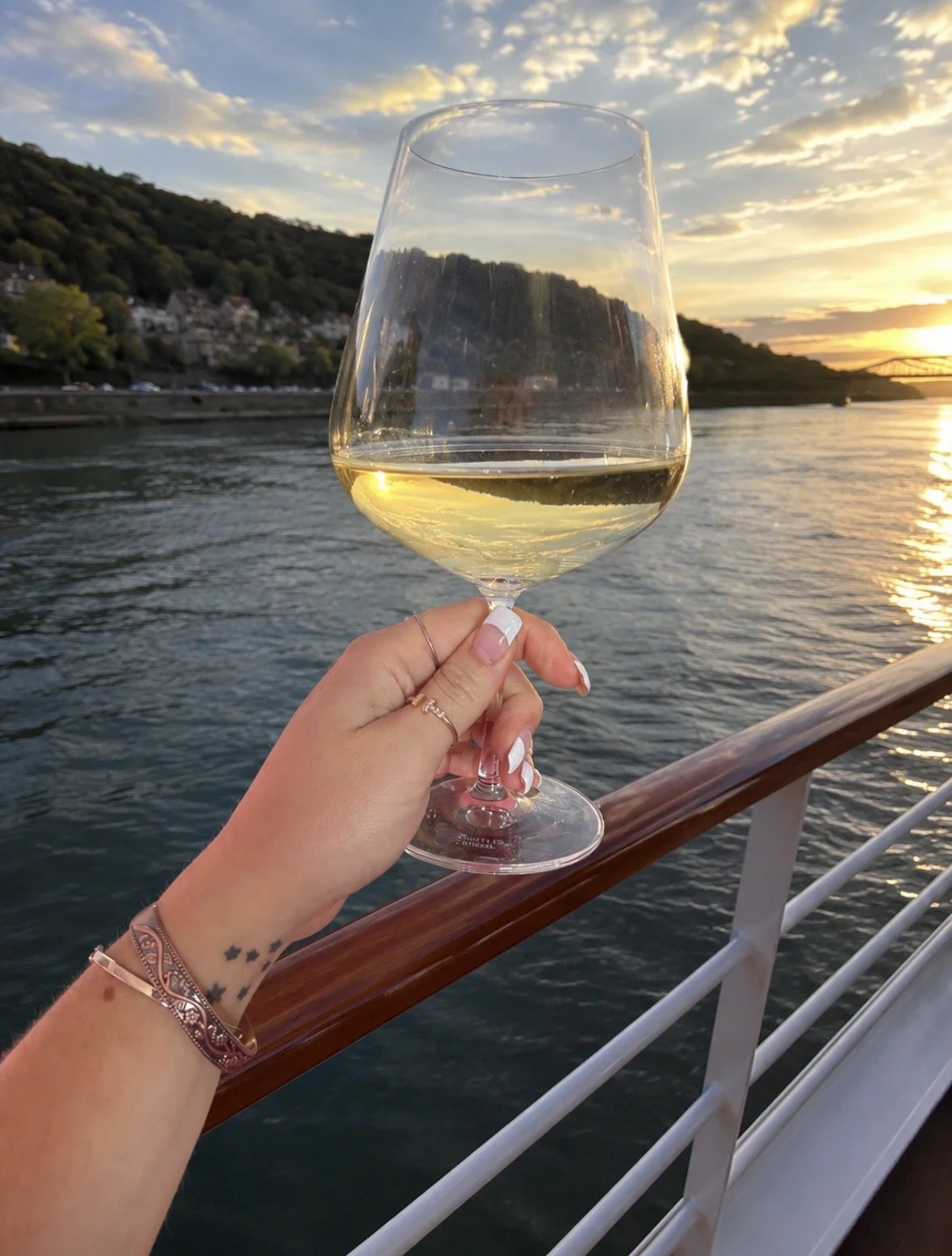
Michele Edington enjoying a Riesling on a cruise through Germany
What I Wish Every Cruiser Had In Their Pocket
When I imagine someone using Cruising With Wine, I picture them finding what they need in a few easy taps. That’s the goal anyway.
I want someone to be standing near the port with a free afternoon and a tiny bit of decision fatigue, then they open the stop they are visiting and quickly learn what the area is known for. They find a few wines to try, bottles to look for, nearby places that fit their schedule, food pairings, and practical notes about what they can comfortably enjoy before the ship leaves. And yes, you can download all the information on your phone before you leave the ship, so wifi shouldn’t be an issue, especially if you didn’t get the international phone plan.
Timing matters when you’re pressed for it and might get left behind if you don’t respect the clock.
A beautiful winery ninety minutes away may be perfect for a full-day excursion, or a tasting room with afternoon hours might fit easily into a shorter stop. A wine bar within walking distance can turn two free hours into one of the best parts of the trip. Cruise travel has its own set of rules. You’re traveling on a ship with arrival times, departure times, excursions, and a very specific moment when the gangway comes up.
That means every recommendation needs to work for the place and the schedule. Cruising With Wine thinks like a wine person and a cruise person at the same time, which was the fun part for me, and also the useful part for you.
I want each stop to answer the questions people actually have, while keeping in mind my own timing anxiety and the need to be 15 minutes early for everything…just in case. What should I drink here? What is the local specialty? What food should I try with it? Can I visit a winery from this port? Is there a wine shop close enough to walk to? What bottle is worth carrying home and trying to squeeze into the suitcase I brought that suddenly feels inadequate and definitely too small? What should I order if I usually like Sauvignon Blanc, Chardonnay, Pinot Noir, or Cabernet? What local beer, cider, spirit, or alcohol-free drink should I try so I don’t miss them? What would my travel partner enjoy? What’s the one thing I should experience while I am here?
That last question is my favorite because it forces some sort of mission.
Wine people can happily disappear into the details. I say that with love because I’m absolutely one of them. Give me one grape variety and suddenly I am talking about limestone, harvest dates, old clones, trade routes, and why a monk in the 1400s probably had a better palate than most of us and how that donkey in France did us all a favor by teaching people about pruning.
Travelers need useful beauty and the right amount of detail to make the moment richer while keeping the day easy.
The Bigger Idea
The more I build it, the more I see Cruising With Wine as something bigger than a travel guide.
It’s a way of paying attention to what’s going on around you and soaking up what you can, while you can. Cruises move quickly, and that’s part of their charm. You wake up and the view has changed completely. Yesterday’s church bells have given way to a new river bend, a new bridge, a new town square, and a new pastry you swear you are only going to taste before immediately eating the whole thing.
Wine gives each stop its own flavor. The cute town in Germany becomes the place where you tasted a Riesling that smelled like lime and peaches and the castle day becomes the afternoon when you ate something salty and drank something cold. Budapest suddenly becomes the city where you discovered dry Furmint (you’re welcome).
I want to turn stops into real memories that you’ll think about for the rest of your life. The kind where your shoes hurt a little, your hair has been rearranged by the wind, the menu translation makes everyone laugh, and the glass in front of you tastes exactly right, because that’s the beauty of travel to me.
Right now, I’m deep in the building stage, which means my browser tabs are a public health concern. I’ve been working through the stops, organizing wine styles, researching wineries, choosing bottles that make sense for travelers, and shaping all of that information into something simple and useful while trying to make it look pretty enough that my brain doesn’t get bored and itch for Instagram instead.
Behind the scenes, it currently looks like a raccoon got into a wine atlas though. On the screen, I want every stop to feel alive and manageable. That’s the little click I’m currently working toward. I’ve been reaching out to travel bloggers, cruise YouTubers, and as many people as I can find (like travel agents) to collect feedback and adjust as needed.
I want people to feel like they have a sommelier friend in their pocket (I’m totally pocket sized, so it works). I’m overly excited, yet practical, and happy to say, “Try this. It’s perfect here,” before letting you get back to your lunch. Wine can make travel feel even better. Drinking a wine where it was made can make an unfamiliar label feel exciting.
Cruising With Wine
So that’s why I created Cruising With Wine.
My dad is going on a cruise, and he found the perfect hole in the market. He’s the best website creator I’ve ever met (yes, I’m insanely biased, and I still believe that), and working with him on projects as an adult has been the most fun of my life.
I’m incapable of leaving a wine question alone, so here we are.
River cruises pass through extraordinary drinking regions, and I want more people to experience what’s waiting just beyond the ship. Local wine is one of the easiest and most enjoyable ways to understand a place. A bottle brought home from a trip becomes a little glass time capsule. It holds the river, the weather (hopefully not too hot), the lunch, the walk back to the ship where the sole fell off your shoe, the town square that was a little too crowded, the person you were with, and the version of yourself who had enough time to sit down and taste something.
Travel can leave you with flavors that return months later. Bring yourself home a little apricot from the Wachau, some slate from the Mosel, a little spice from Alsace, some walnut and caramel from Porto, and a bottle of something you discovered because someone gently pointed you toward it.
That’s the magic I am chasing with Cruising With Wine…better moments in beautiful places, preferably with a very good glass of wine nearby.
Also, if you’re going on a cruise I highly recommend these wine sleeves for traveling back your new bottles safely!
Other Reads You Might Enjoy:
A Sommelier’s Perfect Finger Lakes Trip: Wineries, Waterfalls, and Unforgettable Bites
The Wild, Winding History of Pinot Noir: How One Grape Became a Global Obsession
Rosorange: The Sunset in a Glass That’s Rewriting the Rules of Summer Wine
The Sherry Cask Illusion: How a Rare Barrel Became Every Whiskey’s Best Friend
The Secret Bordeaux Wine That’s Changing Everything: L'Épiphanie de Pauillac
The Wine Climate Crisis: Is Terroir Shifting Beneath Our Feet?
The Artisan of Bubbles: Remembering Frédéric Panaïotis and the Soul of Champagne
Why Do We Clink Glasses: The History and Meaning Behind Toasting