The Healing Current: How Grounding Helps Calm Inflammation and Restore the Body
I’ll admit it, I’ve got severe PTSD, so my brain is always, always, always on high-alert. My calm days look like other people’s anxious days. Lucky me, I know. When my doctors first told me about grounding techniques, they meant mental grounding ones. Things like naming three objects in the room with me to calm my spiraling mind down. After a little while though, I noticed other people were talking about grounding in a slightly different, but related way. It turns out, there’s a quiet power humming beneath your feet.
Not in the metaphorical way (you know I love my metaphors, and I’ll get there, but I mean it literally this time)…the earth doesn’t whisper promises or hand out affirmations sadly for all of us, but if you’re still for long enough, and if your bare skin touches soil or sand or moss or stone, something subtle begins to stir.
Your heart actually slows down from its crazy rhythm, your breath deepens, and your nervous system seems to soften. Slowly, inflammation retreats like a tide pulling back from the shore.
This is grounding.
Also, not the kind your parents gave you for sneaking out after curfew or punching your sister in the face after she shoved you during laser tag, I mean the kind that returns you to the electric conversation between your body and the earth.
What Is Grounding?
Grounding, also known as earthing in some things I read on Pinterest, is the simple act of physically connecting to the earth’s surface.
Think walking barefoot on the beach, sitting in the grass, or swimming in a lake.
It also includes using grounding devices (like conductive mats and bed sheets) that allow you to stay connected even when nature is far away or not really possible to get to. Yeah, the bed sheets make sense if you can’t sleep in a yard of grass, so those devices might be worth it sometimes.
The practice stems from a wild but beautifully intuitive idea that our bodies, full of electrical impulses and charged molecules, benefit from direct contact with the planet's negative charge.
Yes, the earth has a charge, yes so do you, and yes, it affects you.
We live in a world so insulated everywhere we turn that we’ve become ungrounded…literally and figuratively. Rubber soles, high-rises, synthetic carpets, devices that fill the air with positive ions, while we slowly fray at the edges, you name it, we found a way to disconnect even further from the planet than you realize.
What if our chronic inflammation, insomnia, anxiety, and fatigue weren’t just a matter of stress or diet…but also of disconnection?
The Science of Touching the Earth
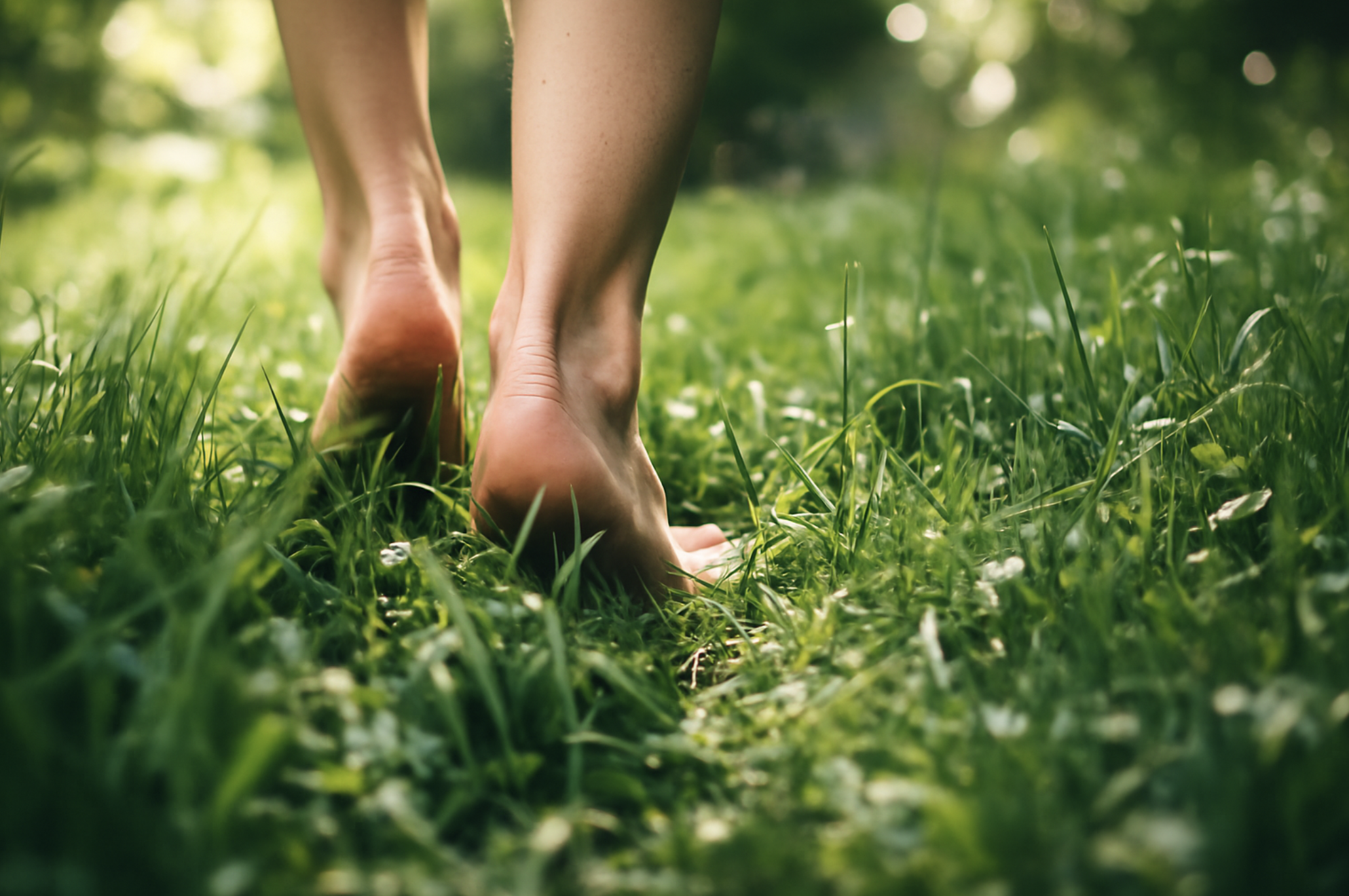
The Earth’s surface carries a negative electric charge. Our bodies (especially when inflamed!!) often carry a higher load of positively charged free radicals. When we ground ourselves, we allow an exchange to happen as free electrons from the earth flow into the body and neutralize these radicals.
It’s like an anti-inflammatory handshake, and this isn’t pseudoscience dressed in hemp robes. I know some of you think I might be a little too out there, but I do have some studies to back me up.
Peer-reviewed studies from journals like The Journal of Inflammation Research and The Journal of Environmental and Public Health have explored grounding’s effect. Although most of the research is small and preliminary, several studies report reductions in inflammatory markers, improvements in cortisol patterns, better heart rate variability, deeper sleep, and even faster healing responses.
In one study, grounded participants had significantly reduced blood viscosity…a major risk factor for cardiovascular disease.
Another showed accelerated recovery in muscle soreness after exercise.
A double-blind sleep study revealed normalized cortisol rhythms and improved energy in grounded subjects.
The earth is medicine, but it’s medicine you touch, not take.
Inflammation isn’t always the enemy, it’s your body’s way of responding to injury and infection. A little is natural, vital, even, but chronic inflammation, now that bad boy is a different story altogether.
It simmers below the surface, quietly linked to almost every major health issue of our time: heart disease, arthritis, asthma, type 2 diabetes, cancer, autoimmune disorders, cognitive decline, you name it.
Yes, yes, while diet, stress, and genetics all play a role, grounding offers a simple, low-cost, side-effect-free tool to help cool the fire. It doesn’t replace medical care obviously, but it adds to your arsenal in the gentlest, most primal way: bare feet on earth.
Related read: Magnesium and the Aging Brain: How One Mineral Boosts Cognition and Longevity
The Beginner’s Guide
You don’t need to live in a cabin in the woods or spend your weekends forest bathing, grounding is beautifully accessible.
Walk barefoot in grass, sand, dirt, stone…any natural surface will do. Asphalt, concrete, and wood are less conductive. Aim for 20–30 minutes a day if possible. Can a Room Full of Energy Heal You? We Tried the EESystem (And Compared It to NeoRhythm).
Sit or lie on the ground. Picnic, sunbathe, or nap outdoors, there is no wrong answer here. Skin-to-earth contact is the goal, so as long as you figure that part out, you’re golden.
Swim in natural waters if you can, lakes, oceans, and rivers are excellent grounding mediums. Bonus: cold water immersion adds anti-inflammatory benefits too if you’re feeling brave and able to take that cold plunge.
Optionally, you can also use grounding equipment. When nature isn’t accessible, grounding mats, sheets, and patches offer an alternative. These connect via a grounded outlet or grounding rod inserted into the soil outside.
This grounding mat for under your desk is a great place to start for those with desk jobs or limited outdoor time.
Related read: The Stress-Relieving Science of Cardamom: Nature’s Little Hug
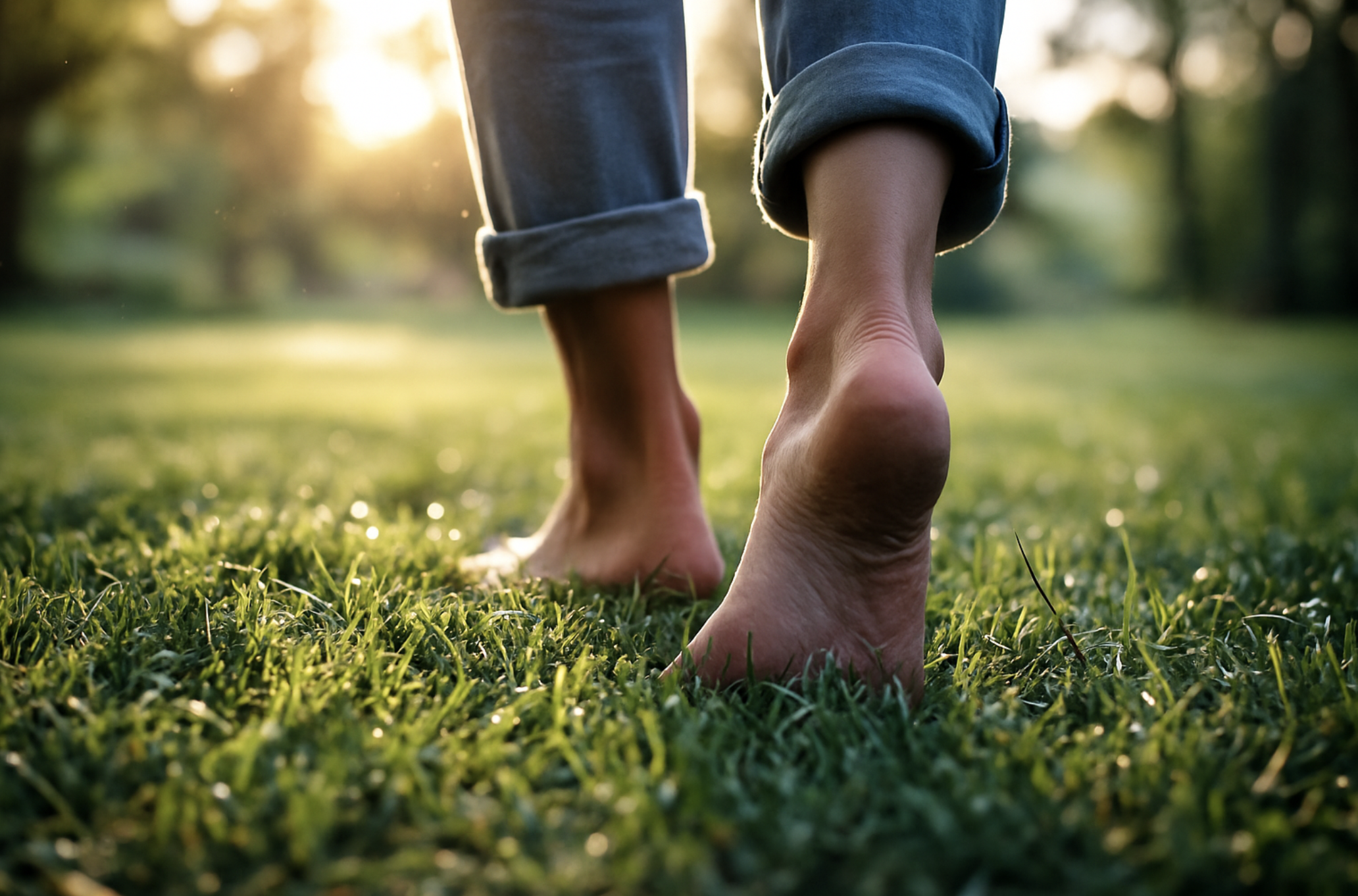
Long before the term “grounding” appeared in wellness blogs or scientific studies, it was just life. Indigenous peoples across the world lived in harmony with the earth walking barefoot, sleeping on animal skins, bathing in rivers, and tending soil with bare hands.
Their connection to land was not a practice, it was an existence, a reciprocal relationship. We’re the first generations to live our entire lives insulated from the pulse of the planet.
No wonder we’re inflamed and slowly feel like we’re losing our minds.
Grounding vs Forest Bathing: Different Roots, Same Soil
You may’ve heard of shinrin-yoku, the Japanese practice of forest bathing. It’s the act of immersing oneself in a natural setting (not to hike or accomplish anything) but to simply be among the trees.
While grounding focuses on electrical connection, forest bathing leans into sensory absorption. But both offer a profound anti-inflammatory effect. In fact, studies on forest bathing have shown reduced cortisol levels, enhanced immune function, and improved blood pressure and mood regulation.
Now imagine blending the two.
Barefoot in a forest with your back pressed against bark, listening to leaves whisper and birds compose symphonies. You’re not just touching the earth…you’re letting it touch you back.
Related read: The Emotional Lives of Fish: What Science Knows and What We Ignore
EMFs, Devices, and the Invisible Storm
We live surrounded by electromagnetic fields (EMFs) that we all love to pretend isn’t a thing, but it is. Wi-Fi routers, cell towers, smartwatches, bluetooth everything, you name it, we’re living in it.
While the long-term effects are still debated, early research suggests prolonged exposure may increase oxidative stress and inflammation.
Grounding may help by discharging built-up static and restoring natural bioelectrical rhythms, it allows your body to reset…even amidst a technological storm. Grounding works best not as a one-time event, but as a practice. Try morning grounding by stepping outside barefoot, let the grass cool your soles. Stand for five minutes and breathe into your belly.
After work, try to reconnect again if possible (if you’re like me and work until past midnight, might not be possible). Sit on your porch or garden without gloves. Let dusk anchor you.
Use grounding mats or sheets indoors if it’s too rainy/cold/snowy outside. Place one at your workstation or sleep on a grounded pad.
Try pairing it with breathwork or mindfulness for a full parasympathetic reset.
Sometimes, life doesn’t make grounding easy: winter (I’ve literally done this in the snow before just to see, but don’t recommend it), apartments, travel (good for you, you earned this vacation!), and that’s really okay.
Try grounding mats under desks or beds, grounded sandals or sneakers, hand-to-stone contact (hold a smooth rock daily), indoor plants with exposed soil, or bathtub grounding (touching the faucet or pipes).
Other Reads You Might Enjoy:
The Fiber-Optic Forest: How Trees Might Power the Next Energy Grid
The Secret Life of Soil: Why Healthy Dirt Might Be Smarter Than You Think
The New Garden Revolution: Growing with Companion Microbes Instead of Chemicals
Living Batteries: How Bio-Energy is Powering the Next Generation
The Plants That Predict Earthquakes: Is Nature Trying to Warn Us?
The Forest That Never Dies: How a Single Tree Became 80,000 Clones
You Are an Electrical Symphony
You are voltage, your heart runs on electrical signals. Your brain is a thunderstorm of sparks, grounding isn’t about belief, it’s biology. It’s remembering you belong to something larger and older than stress.
Wellness trends come and go…celery juice (this one can stay away for all I care), charcoal, ice plunges (hard pass on these), but grounding is older than shoes. It’s what children do instinctively and what animals do when they’re hurt. Monks and mystics have done this for centuries to find peace.
It’s free and it’s so simple to try there’s literally nothing to lose from it. Inflammation is the silent language of disconnection and grounding is the return.
Take off your shoes, let the dew kiss your feet.
You’ve been simply ungrounded for so long, but that can change…today.