How Gene Editing Turned a Tiny Fish Into a Neon Glowstick
Once upon a time, fish shimmered under moonlight, but now they shimmer under blacklight. As a person who studied genetic engineering at one point in life, honestly, this story excites me more than it probably should. There’s also a child-like wonder I’ve always had for something that glows in the dark. It’s why I’ve written about glow-in-the-dark plants (The Secret Light of Plants: Exploring Bioluminescence) more times than I’d like to admit.
There is a tiny fish, just a few centimeters long, that glows with the intensity of a nightclub sign (and the enthusiasm with one with a typo). And, no, before you think about Chernobyl, it’s not because it swallowed something radioactive. It also didn’t evolved in bioluminescent tides.
This little guy came about because we edited its DNA.
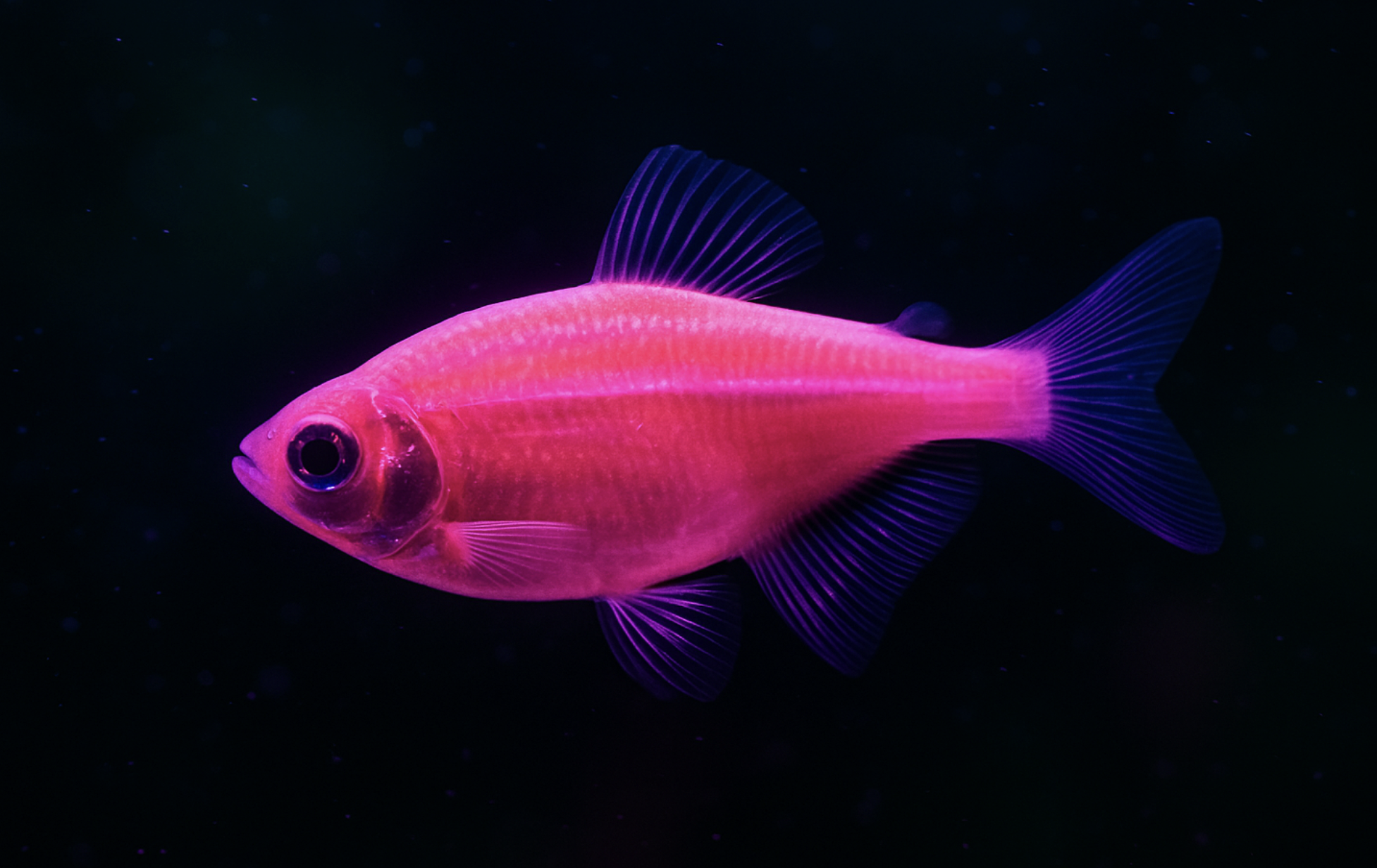
We gave it genes from jellyfish and turned it into a glowstick. This fish (called the GloFish) is a true biotech marvel. A fluorescent light of nature merged with science to create a pet store oddity that quietly signals the arrival of designer life.
What Is a GloFish?
The GloFish is a genetically modified version of the zebrafish (Danio rerio)…a species that’s long been loved by researchers because of its transparent embryo and fast growth rates.
In 1999, scientists in Singapore inserted a green fluorescent protein (GFP) from jellyfish into zebrafish DNA. Originally, this was meant to help detect pollution in water, the fish would glow in the presence of toxins.
But then someone saw the glow and thought, wow, this is beautiful. So the science turned commercial to bring beauty to the masses.
Today, you can walk into almost any chain pet store and choose from red, green, blue, orange, or purple fish…each one aglow, not with dye or paint, but from the inside out, their glow is written into their genome.
They are living art.

How Do They Glow?
It’s not magic even though it sort of feels like it when you’re showing your nephews. It’s bioluminescent proteins.
And the glow comes from genes borrowed from jellyfish (GFP – green glow), but also some sea anemones (RFP – red glow), or even coral (CFP, YFP – cyan and yellow glows).
These genes are stitched into the zebrafish’s DNA, so the glow shows up in every cell, and even their babies glow.
You can’t wash it off (thank goodness because they live in the water), and it’s not a cool TikTok filter, it’s a fundamental rewrite of what it means to be a fish.
It’s not a costume and they aren’t pretending to be anything they aren’t, it’s their true identity.
The GloFish isn’t alone anymore.
Scientists are now engineering plants that glow like fireflies, designing yeast that smells like roses, creating mushrooms that pulse with light, editing cats to lack allergens (personally, I feel good about this only because I’m super allergic to cats), and making pigs that fluoresce neon green (yeah, they lost me on that one too).
The age of CRISPR and gene splicing has ushered in a new era where life is no longer discovered (yeah, because we’ve killed off a lot of it), it’s designed. Evolution doesn’t just happen over millions of years anymore, it’s directed by us in labs based off which pet we decide we want tomorrow.
The GloFish was just a prototype, and now we’re building ecosystems from scratch.
We’ve always been captivated by glow, and me specifically. I used to have those glow-in-the-dark stars on the ceiling of my room as a kid and I would beg my dad for glowsticks whenever we went to the beach at night. Our ancestors probably felt the same draw when they first saw cave paintings glowing in firelight. Churches glow ethereally from the outside with their stained glass, all while cities glow now with artificial suns that never set.
We love to light things up and now we’ve lit up the inside of a fish not because we had to, but because we could.
It’s an eerie little metaphor for this moment in history because there might be a moment soon where the boundary between natural and artificial is blurred, glowing faintly in a fishbowl near you.
Do They Belong in Nature?
No.
GloFish are patented and trademarked, which is a slightly odd thing to wrap my head around at this moment in time. In many countries, they’re illegal to sell and they’re not meant to be released into the wild.
And yet…I can’t help but think about a river full of them with neon streaks beneath the surface.
Would it be dystopian or dazzling? Would the other fish notice? Birds certainly would and might find quick little snacks at night. Would the ecosystem adapt? Have I read too many romantic fantasy books with magic and spells waiting to be used? Eh, probably, but like I mentioned before, I’ve always been fascinated with glowing things, especially those that feel magical.
We’ve already filled oceans with plastic, noise, and metal, so is a glowing fish more unnatural than a six-pack ring?
It’s not a question of if life will change at this point, it’s more a question of how much control we want to take.
Beyond their aesthetic appeal (10/10), GloFish have helped in cancer research, toxicology testing, as well as developmental biology. By inserting fluorescent markers, scientists can literally watch cells divide, organs form, and diseases spread…in real time, under a microscope.
The fish becomes a map of sorts for those willing to chart their way through life, they’re little glowing storyboards of life unfolding! So while they’re sold as novelties, they do actually carry deep scientific value. They’re tools as well as teachers and symbols.
Don’t forget I’m still waiting for trees that light up cities without power, or clothing made from glowing spider silk. I’m not really holding my breath for pets that change color with mood (although that might be funny to see Riesling glowing different colors when she’s mad).
We’re not just modifying life anymore, we’re curating it as if we were some curator at an art gallery that happens to create her own art.
I really like to think that despite everything, we can all still marvel at beauty and crave wonder.
Here we all are, still wanting to make the world glow, if only a little.
If you enjoyed this article, check out the gene edited green monkey!
Other Reads You Might Enjoy:
When the Light Becomes Too Bright: How a Quasar Silenced the Sky
The Sound of Trees Crying: What Plants Really Do When They’re Stressed
Why Your Houseplants Might Be Gossiping (and Other Strange Plant Behaviors)
The Secret Life of Soil: Why Healthy Dirt Might Be Smarter Than You Think
The New Garden Revolution: Growing with Companion Microbes Instead of Chemicals
The Sound of Extinction: How Disappearing Animals Take Silence With Them
Airborne Seeds and Invisible Roots: The Poetry of Floating Agriculture